
Short answer
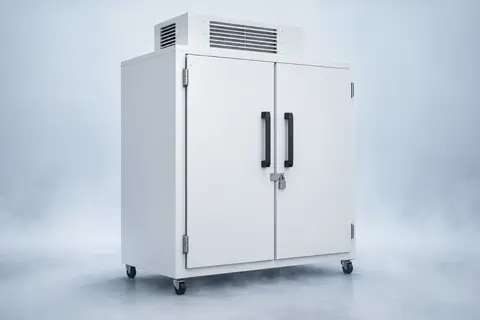
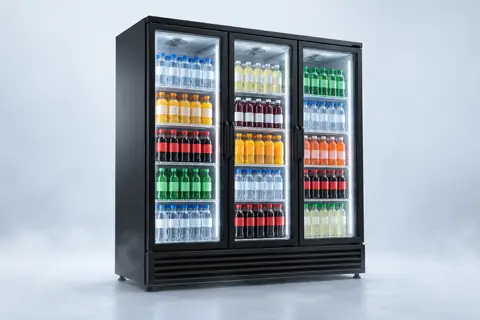
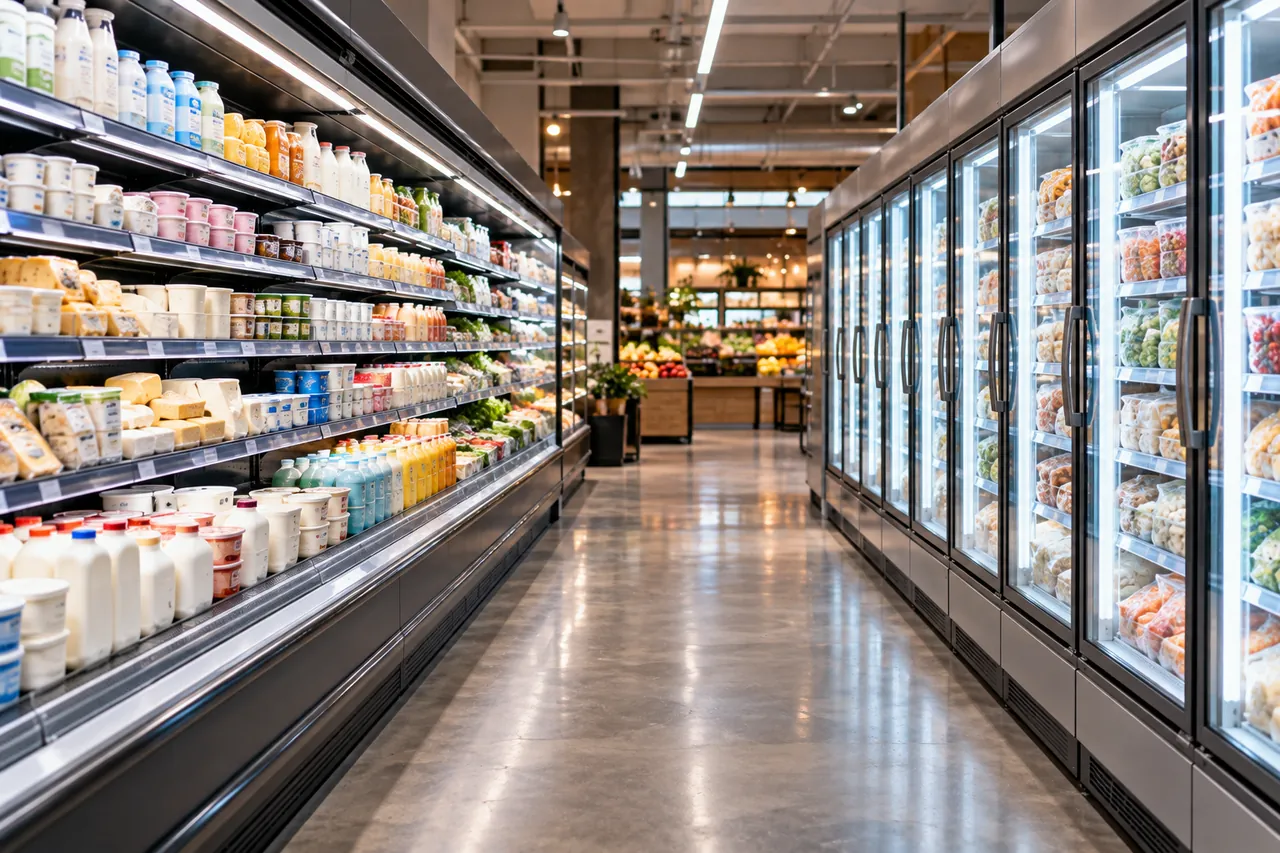
Supermarket refrigeration equipment covers chilled display cases (glass door fridges and open multidecks at +1 °C to +5 °C), frozen display cases (upright glass door and chest freezers at −18 °C to −24 °C), back-of-house walk-in coolers and freezers, and the plug-in or remote rack plant that cools them. Convenience stores mainly need 4–20 doors of drinks coolers plus freezers and an ice merchandiser.
Key takeaways
- Drinks are held at +1 °C to +4 °C (34–40 °F), dairy at +2 °C to +5 °C, packaged meat at −1 °C to +2 °C and frozen food at −18 °C (0 °F) or colder.
- Glass door coolers use much less energy than open multidecks; open cases are best kept for produce and grab-and-go lines.
- Above about eight doors of drinks, a walk-in cooler with glass merchandising doors is usually cheaper to run and restock than separate fridges.
- Size back-of-house cold rooms for 2–4 days of chilled stock and 5–10 days of frozen stock.
- Choose display cases by ISO 23953 climate class: class 3 is 25 °C / 60% RH; class 7 is 35 °C / 75% RH for tropical shops.
- Plug-in cabinets suit small and medium stores; large supermarkets use remote rack systems, increasingly on CO2 (R744).
What refrigeration equipment does a supermarket need?
A supermarket needs four groups of supermarket refrigeration equipment: chilled display cases for dairy, meat, produce and drinks; frozen display cases for frozen food and ice cream; back-of-house walk-in cold rooms for stock; and the refrigeration plant that cools them, either built into each cabinet (plug-in) or in a central machine room (remote rack). A convenience store needs the same groups at a smaller scale.
The right mix is decided by what you sell and how fast it turns over, not by the floor area alone. A store selling mostly packaged drinks and snacks is dominated by glass door coolers; a full-line grocer with fresh meat and deli adds serve-over counters, open multidecks and several walk-ins. Refrigeration is typically the largest single share of a food store's electricity bill, so case type and door choice matter for running cost as much as for sales.
This guide is a whole-store planning view. For individual case types, see our guides to refrigerated display cases, open air multideck coolers and glass door freezers.
Supermarket refrigeration by department
Each department in a grocery store has its own temperature band and its own preferred cabinet. Use this table as a starting equipment list.
| Department | Typical equipment | Product temperature |
|---|---|---|
| Drinks, beer, water | Glass door display fridges (1–4 doors), walk-in cooler with merchandising doors | +1 °C to +4 °C (34–40 °F) |
| Dairy, yogurt, juice | Glass door fridges or open multidecks | +2 °C to +5 °C (36–41 °F) |
| Packaged meat, poultry | Multideck or glass door case set colder | −1 °C to +2 °C (30–36 °F) |
| Fresh produce | Open multideck with misting, produce walk-in | +2 °C to +10 °C (36–50 °F) depending on item; bananas and tomatoes about +13 °C (55 °F) |
| Deli, cheese, bakery | Serve-over counters, cake and pastry showcases | 0 °C to +5 °C (32–41 °F) |
| Frozen food | Upright glass door freezers, island chest freezers | −18 °C to −24 °C (0 °F to −11 °F) |
| Ice cream | Glass-top chest freezers, upright glass door freezers | −18 °C to −24 °C; storage −20 °C to −25 °C |
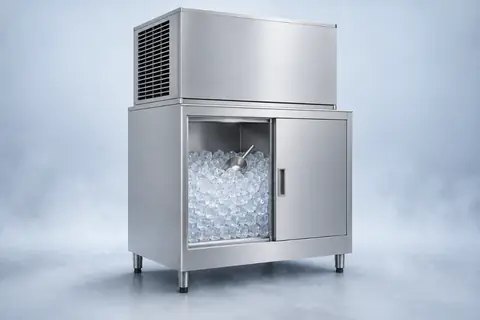
| Bagged ice | Ice merchandiser, indoor or outdoor | −12 °C to −6 °C (10–21 °F) |
| Back-of-house stock | Walk-in coolers and freezers | 0 °C to +5 °C chilled; −18 °C to −25 °C frozen |
For full product-by-product storage temperatures and humidity, use our cold storage temperature chart.
Should a grocery store use glass door or open coolers?
Glass door coolers use much less energy and hold temperature more evenly; open multidecks sell faster because customers can grab without opening a door. Most new stores now put drinks and dairy behind doors and keep open cases for produce and fast-moving grab-and-go food.
An open case relies on an air curtain blown from the top and drawn back at the base. Store air is constantly mixed into that curtain, so the case does more work, cools the aisle and is sensitive to draughts from entrances and air conditioning vents. A grocery store cooler with doors keeps the cold air inside; the main loads are the doors' glass and the openings themselves.
| Factor | Glass door cooler | Open multideck |
|---|---|---|
| Energy use per metre | Lower | Highest of all case types |
| Temperature stability | Good; recovers after openings | Sensitive to draughts and store temperature |
| Impulse sales | Good with LED lighting and clear glass | Best; no barrier |
| Aisle comfort | Neutral | "Cold aisle" effect |
| Typical use | Drinks, dairy, frozen food, convenience stores | Produce, grab-and-go, fresh meat in large stores |
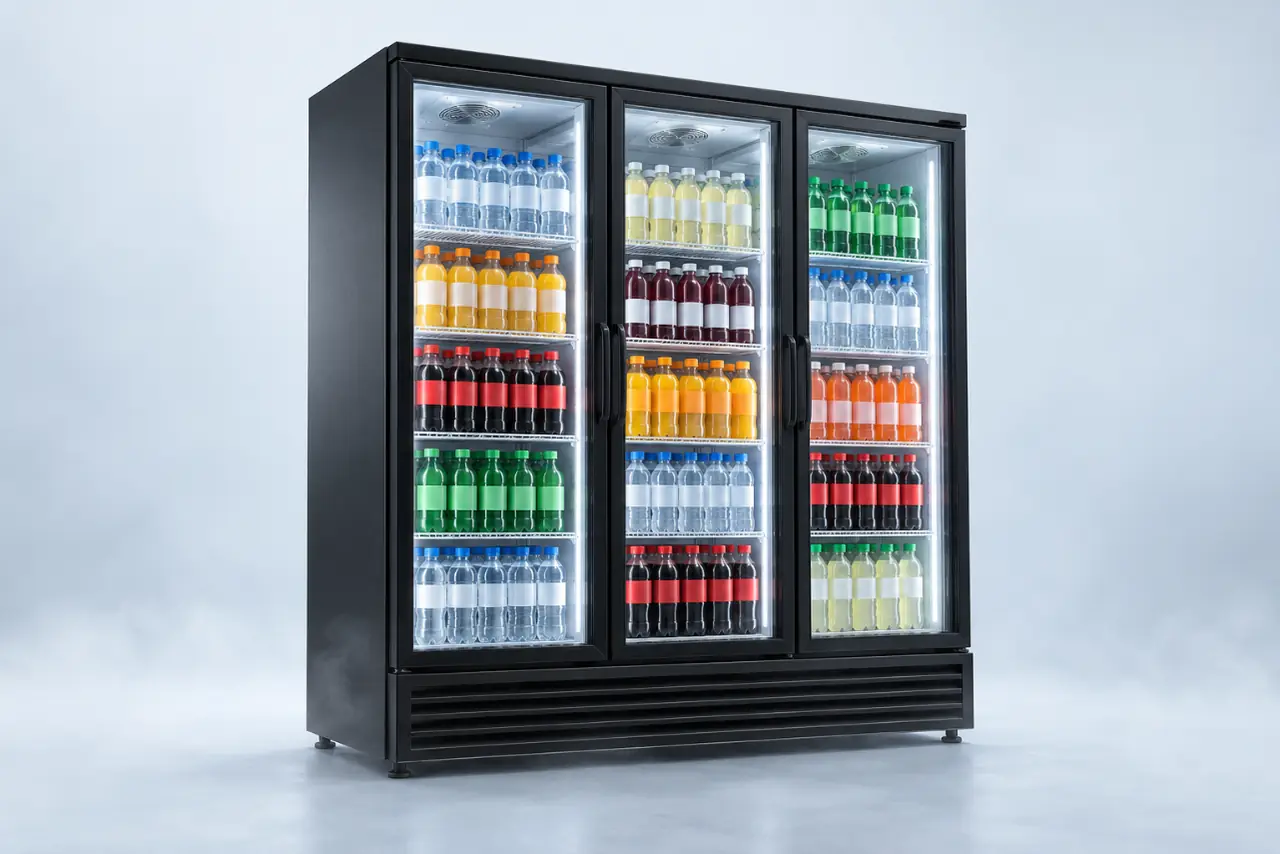
Be There glass door display fridges are upright, fan-cooled merchandisers with one to four doors, holding +2 °C to +8 °C (36–46 °F), with LED lighting, low-E glass and an R290 natural-refrigerant option. The glass door display fridge buying guide gives widths for each door count.
What freezers do grocery stores use?
Grocery stores use two main types of grocery store freezers: upright glass door freezers along walls and aisles for frozen meals, vegetables and pizza, and chest or island freezers with glass lids for ice cream, frozen meat and promotions. Both should hold −18 °C (0 °F) or colder at the product.
Upright glass door freezers
An upright supermarket freezer shows the most product per square metre of floor and is easy to shop at eye level. It needs heated, multi-pane glass to stop condensation and an automatic defrost. Be There upright display freezers come with one to four heated glass doors, about 400–1600 L (14–56 cu ft), holding −18 °C to −24 °C (0 °F to −11 °F).
Chest and island freezers
Chest freezers lose less cold air when opened because cold air sinks. Glass-top models from about 300 to 700 L suit ice cream, novelties and impulse frozen lines at the checkout. Large stores use long island retail freezers on remote refrigeration. See chest vs upright freezers for energy and access trade-offs.
A practical rule: plan one upright freezer door per 15–25 frozen SKUs facing one or two wide, and add chest freezers for ice cream rather than squeezing it into upright doors that are opened all day.
What refrigeration does a convenience store need?
Convenience store refrigeration equipment is mostly drinks coolers: a run of glass door display fridges or a walk-in cooler with glass merchandising doors along one wall, plus one or two display freezers, an ice cream chest and an ice merchandiser. Fresh food, sandwiches and dairy go in a smaller glass door or open grab-and-go cooler near the counter.
| Store size | Drinks and dairy | Frozen | Other |
|---|---|---|---|
| Kiosk / small shop, under 50 m² (540 ft²) | 2–4 doors of glass door fridges | 1 glass-top chest freezer | Countertop display fridge |
| Standard c-store, 100–200 m² (1,075–2,150 ft²) | 6–12 doors, plug-in or walk-in with glass doors | 2–4 upright freezer doors, 1 ice cream chest | Grab-and-go cooler, ice merchandiser |
| Large forecourt store, 200–400 m² | Walk-in cooler with 12–20 merchandising doors (beer cave optional) | 4–6 freezer doors, 1–2 chests | Outdoor ice merchandiser, small storage freezer |
Walk-in cooler for a convenience store
Once a store needs more than about eight doors of drinks, a walk in cooler for a convenience store with glass merchandising doors on the front is usually cheaper to run and restock than a row of separate fridges: staff fill shelves from the back, the stock behind the shelves is pre-chilled, and one condensing unit serves the whole wall. Convenience store cooler doors are heated, self-closing glass doors with LED lighting in the mullions; our walk-in cooler door guide explains the options, and the commercial beer cooler guide covers beer caves.
For convenience store walk in cooler shelving, use gravity-feed or sloped wire shelving behind the doors, set to the door module (typically 750 mm or 30 in), with 75–100 mm (3–4 in) clearance from the back panel so cold air can circulate. Keep the evaporator's air throw clear of stacked cases.
Plug-in or remote rack refrigeration?
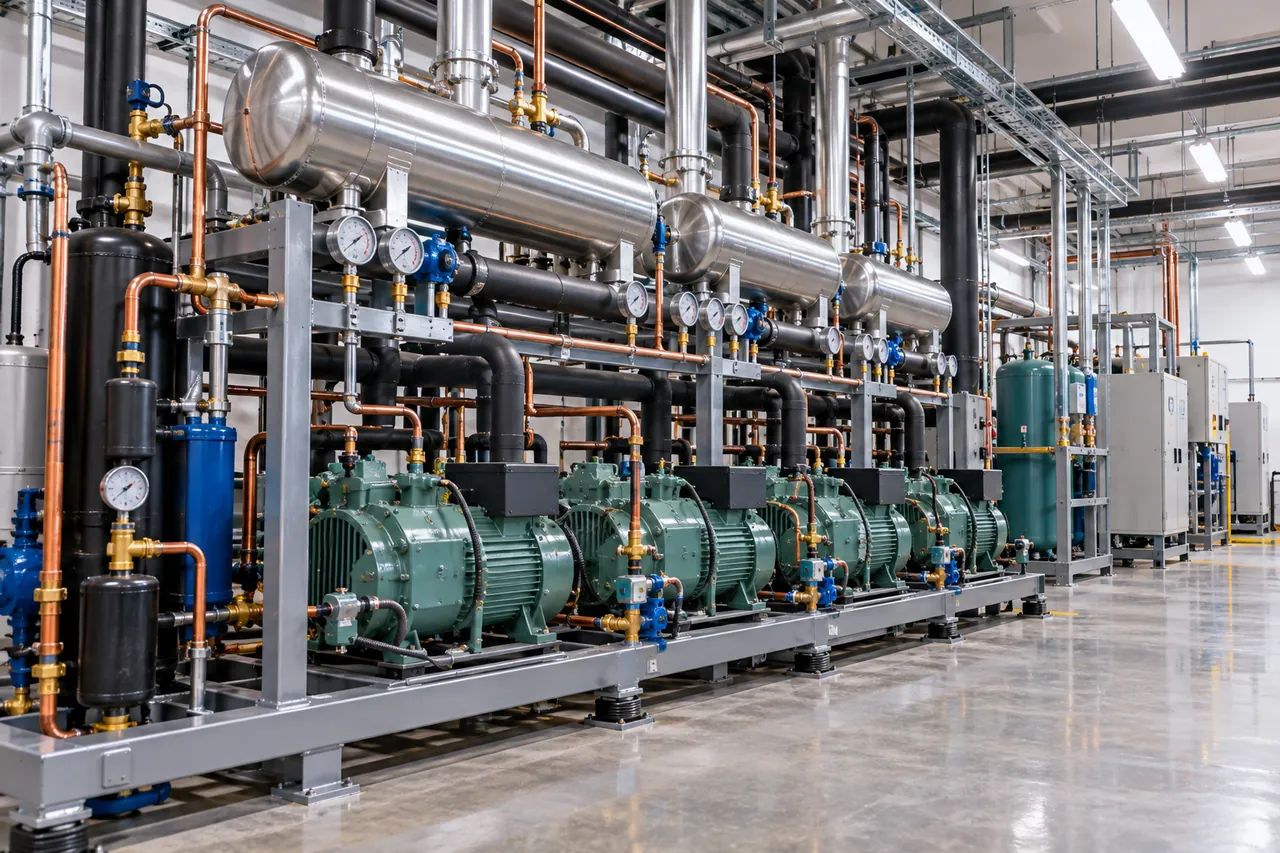
Plug-in cabinets have their own compressor and condenser built in and simply plug into a socket; remote cabinets are piped to a central rack of compressors in a machine room with condensers outside. Small and medium stores use plug-ins; large supermarkets use racks.
- Plug-in: low installation cost, easy to move, no refrigeration contractor needed for piping, but each cabinet rejects its heat into the store, which adds to the air conditioning load in hot climates.
- Remote rack: heat goes outdoors, cabinets are quieter, one plant serves dozens of cases and walk-ins, but piping, refrigerant charge and installation are far larger.
Refrigerant rules are pushing both towards natural refrigerants: R290 (propane) for plug-ins and CO2 (R744) for racks. Our guides to R290 vs R404A display refrigerators and rack and CO2 refrigeration systems explain the regulations and the energy differences.
How big should a supermarket's walk-in cold rooms be?
Size back-of-house cold rooms to hold the stock between deliveries plus a safety margin, typically 2–4 days of chilled stock and 5–10 days of frozen stock. For a small grocer that is often one 2 × 3 m chiller and one 2 × 2 m freezer; full-line supermarkets need separate rooms for meat, dairy, produce and frozen.
- Estimate the weekly sales volume of each department in kg or cases.
- Divide by the number of deliveries per week to get stock per delivery cycle; add 25–50% for promotions and holidays.
- Convert to volume at about 250–350 kg of packaged food per m³ of shelving, then add aisle space (gross room volume is usually about 2–2.5 times the stored volume).
- Run the result through the cold room load calculator to size the refrigeration.
Keep produce and meat apart: they need different temperatures and humidity. Our produce and meat cooler guide gives layouts. Be There supplies complete walk-in cold room kits with 75–200 mm PU or PIR panels, hinged or sliding doors, matched condensing unit, evaporator and controller.
Cake store fridges and coffee shop refrigeration
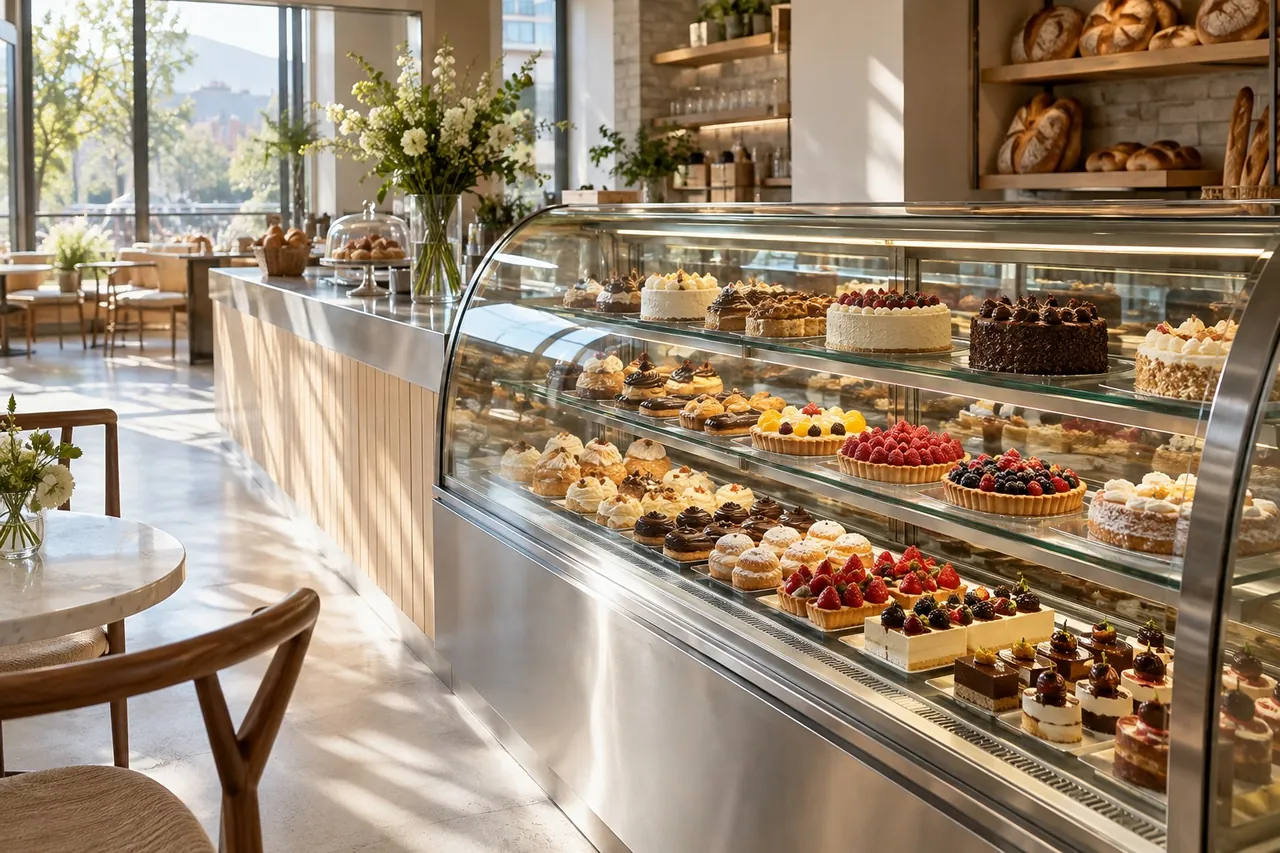
A cake store fridge is a glass-fronted pastry showcase holding about +2 °C to +5 °C (36–41 °F) with gentle, humidity-friendly airflow so cream and glazes do not dry out. Coffee shop refrigeration usually adds an undercounter fridge for milk at the espresso station, a glass door fridge for bottled drinks and a small ice machine.
Bakeries, cafés and supermarket in-store bakeries share the same equipment logic as a grocery deli: serve-over cases for unwrapped product, glass door fridges for packaged product. For case styles see the refrigerated display case guide; for drinks, the commercial beverage cooler guide.
What climate class and certification should a retail fridge have?
A retail fridge for a supermarket should be tested to the climate class of the sales floor it will stand in, and carry the electrical and food-equipment certification your market requires. Display cases are tested under ISO 23953, which defines both the room conditions and the product temperature class.
| ISO 23953 climate class | Room temperature | Relative humidity | Where it fits |
|---|---|---|---|
| Class 3 | 25 °C (77 °F) | 60% | Air-conditioned supermarkets in temperate climates |
| Class 4 | 30 °C (86 °F) | 55% | Warm stores, weak air conditioning |
| Class 5 | 27 °C (81 °F) | 70% | Humid stores |
| Class 7 | 35 °C (95 °F) | 75% | Tropical shops, petrol stations, open-front kiosks |
Product temperature classes in the same standard include M1 (−1 °C to +5 °C), M2 (−1 °C to +7 °C) and L1 (−18 °C to −15 °C for the warmest pack). A class 3 cabinet placed in a 35 °C kiosk will run constantly and still fail to hold temperature. For certification, US buyers usually require UL/ETL safety and NSF food-equipment listings; European buyers require CE marking; Gulf markets require SASO. Our import checklist covers voltage, refrigerant and paperwork.
How to choose supermarket refrigeration equipment: checklist
Choose store refrigeration by working from product groups to cabinets to plant, then confirm climate class and service support.
- List each product group, its temperature and the number of SKU facings.
- Choose case type per group: glass door, open multideck, serve-over, upright freezer, chest freezer.
- Count doors or metres per group and leave 10–20% space for growth and promotions.
- Decide plug-in or remote rack; check that the store's air conditioning can absorb plug-in heat.
- Size back-of-house walk-ins from delivery frequency and stock days.
- Specify climate class, voltage and frequency, refrigerant and certification.
- Plan floor drains, sockets on dedicated circuits and clearance at the condenser.
- Confirm spare parts, warranty and who services the equipment locally.
Be There supplies the core of a grocery or convenience store refrigeration package: glass door display fridges with one to four doors at +2 °C to +8 °C, upright and glass-top display freezers at −18 °C to −24 °C, lockable ice merchandisers for bagged ice, and walk-in cold room kits with glass merchandising or solid doors. Send your store layout, product groups, voltage and climate through the inquiry form and we will propose an equipment list and quote FOB, CIF or DDP.