Short answer
A glass door freezer is an upright, fan-cooled display freezer with heated, multi-pane glass doors that holds frozen food at −18 °C to −24 °C (0 °F to −11 °F) while customers see the stock. Commercial models come with 1 to 4 doors, roughly 400–1600 L (14–56 cu ft), about 0.7–2.6 m (28–102 in) wide and 2 m (79 in) high.
Key takeaways
- A commercial glass door freezer holds −18 °C to −24 °C (0 °F to −11 °F) and uses heated multi-pane glass so the doors do not fog or frost.
- Typical sizes: 1-door about 400–600 L, 2-door about 800–1100 L, 3-door about 1200–1500 L, 4-door up to about 1600 L.
- Automatic defrost runs several times a day; door and frame heaters keep glass clear and gaskets free of ice.
- Most door problems are fixed with a new gasket, hinge cam or heater wire rather than a whole new door.
- Walk-in freezer doors need a heated frame, a heated pressure-relief port and a tight gasket to stop ice locking the door shut.
What is a glass door freezer?
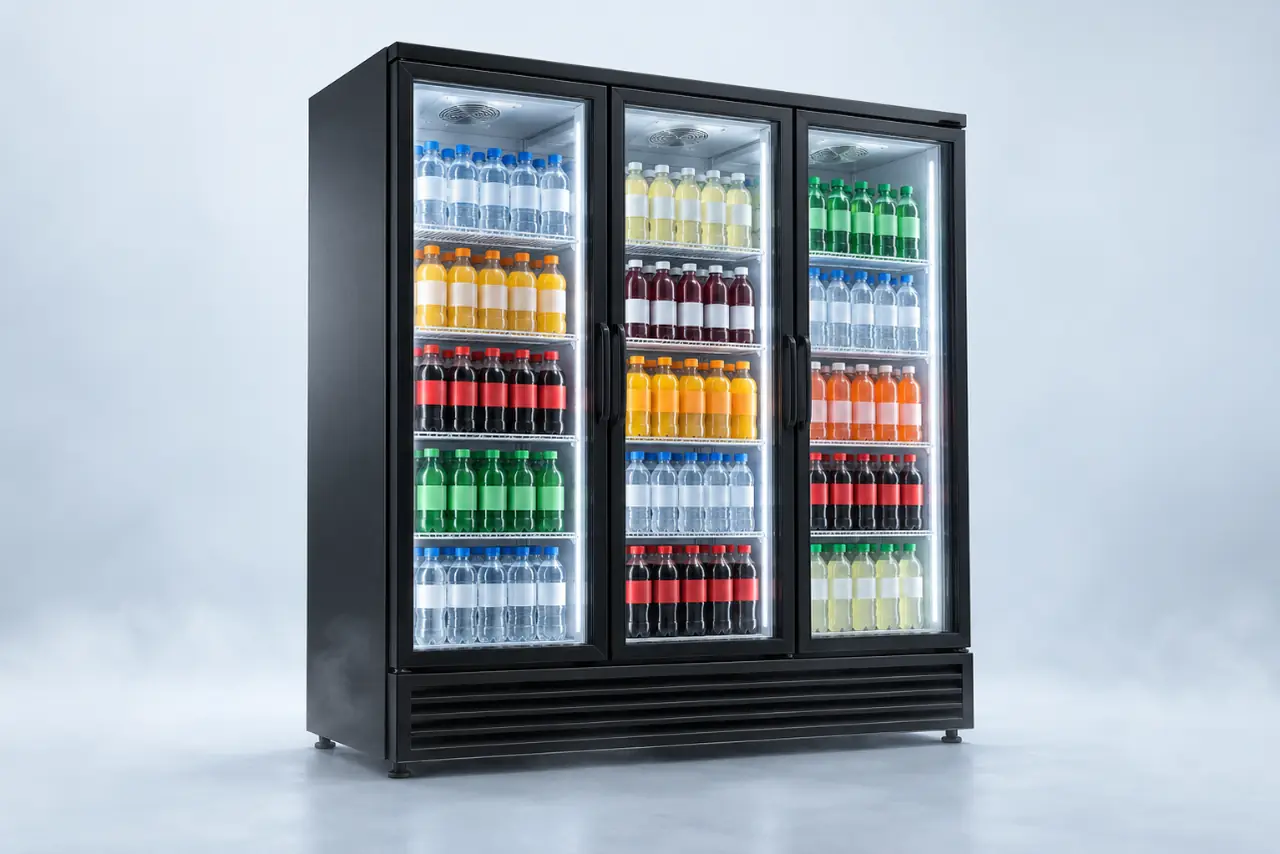
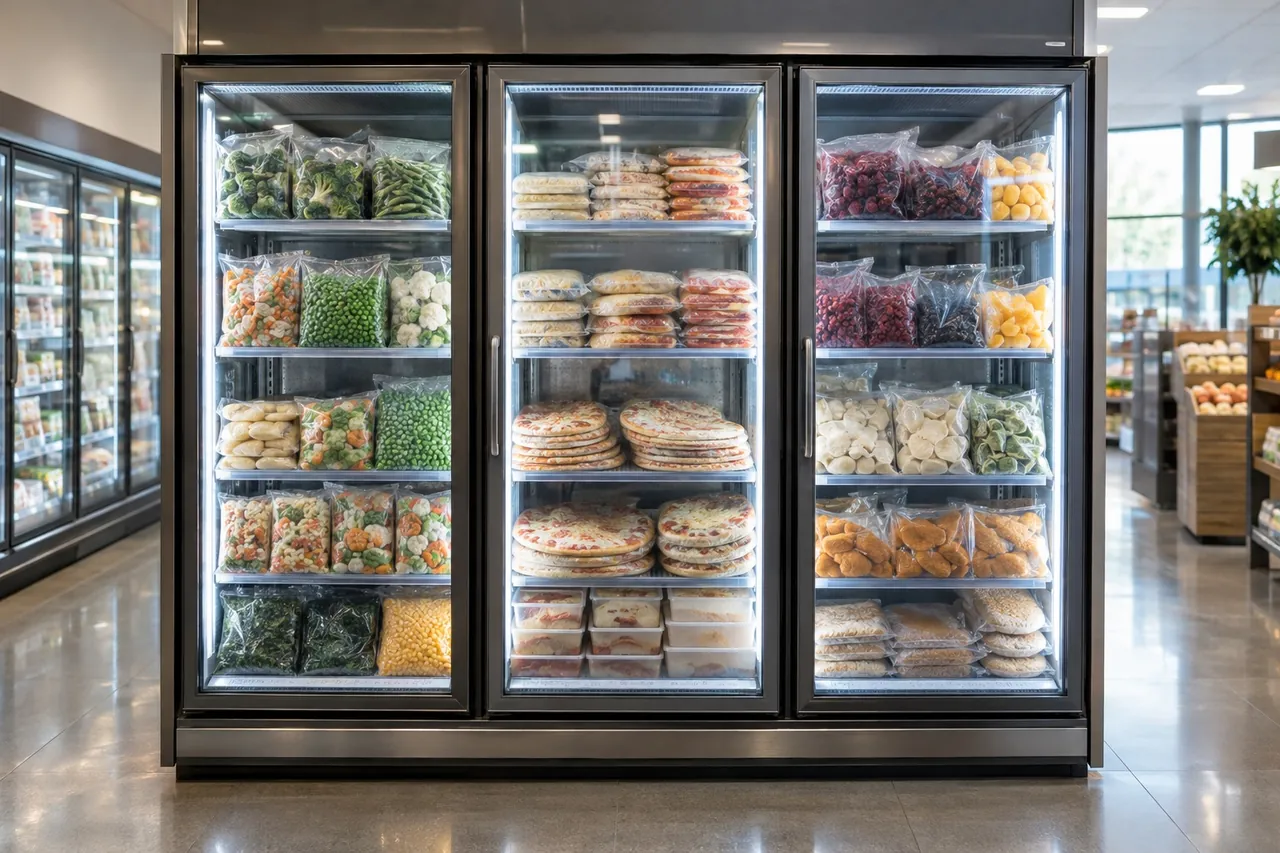
A glass door freezer is an upright freezer with transparent, insulated doors that lets customers see frozen products without opening the cabinet. In retail it is usually called an upright display freezer or merchandising freezer, and it is the standard way supermarkets and convenience stores sell frozen meals, vegetables, pizza, ice cream tubs and ice.
Compared with a solid-door reach-in, a commercial freezer glass door model adds three things:
- Heated, multi-pane glass so the door stays clear in a warm, humid shop.
- LED lighting along the door frame or shelves to show the product.
- Fan-forced cooling with automatic defrost, so the temperature recovers quickly after doors are opened.
Be There upright display freezers hold −18 °C to −24 °C (0 °F to −11 °F) and come with one to four heated glass doors, from about 400 to 1600 L. They are built for importers, distributors, supermarket chains and food brands that need branded or unbranded merchandisers.
A glass freezer is not right for every job. If staff open it constantly in a kitchen, a solid-door reach-in loses less cold. If you need to store bulk frozen stock out of sight, a chest freezer or walk-in freezer is more efficient. A glass door earns its place where seeing the product sells it.
What sizes do 1, 2 and 3 door glass freezers come in?
Door count is the main way glass door freezers are sized. Widths and volumes vary by model, but these ranges are typical for commercial uprights about 2.0 m (79 in) tall:
| Doors | Typical width | Gross volume | Shelves per door | Typical use |
|---|---|---|---|---|
| 1 door | 0.6–0.8 m (24–31 in) | 400–600 L (14–21 cu ft) | 4–5 | Small shops, cafés, single-brand display |
| 2 door | 1.1–1.4 m (43–55 in) | 800–1100 L (28–39 cu ft) | 4–5 | Convenience stores, gas stations |
| 3 door | 1.7–2.0 m (67–79 in) | 1200–1500 L (42–53 cu ft) | 4–5 | Mini-markets, supermarket end runs |
| 4 door | 2.2–2.6 m (87–102 in) | 1500–1600 L (53–56 cu ft) | 4–5 | Supermarkets, frozen food aisles |
A 2 door glass freezer (also sold as a double door glass freezer or two door glass freezer) is the most common size for convenience retail. A 3 door glass freezer gives roughly 50% more facing for the same depth, which suits stores that want one cabinet per category.
Check the depth, usually 0.7–0.8 m (28–31 in), and the door swing before you order. Glass doors on a 2-door unit need about 0.6 m (24 in) of clear aisle to open fully. Leave 50–100 mm (2–4 in) behind and above the cabinet unless the maker specifies otherwise, so the condenser can breathe.
A small display freezer or mini freezer glass door unit of 50–200 L (2–7 cu ft) is also made for countertops and back bars. Our standard uprights start at about 400 L; ask us if you need a smaller size.
How are glass freezer doors built?
A freezer door has to stop heat entering through clear glass at a temperature difference of 40 °C (72 °F) or more. That is why commercial freezer doors are very different from fridge doors.
- Glass pack – usually triple glazing or double glazing with low-emissivity (low-E) coatings and an inert gas fill, in a sealed spacer.
- Heated glass or frame heaters – a thin conductive coating or heater wire warms the outer glass and the frame just above the room's dew point, so it does not fog or drip.
- Magnetic gasket – a replaceable PVC gasket with a magnetic strip seals the door to the frame.
- Self-closing hinge – gravity cams or springs close the door, often with a hold-open position at about 90°.
- Lock option – a keyed lock at the bottom of the frame for after-hours security.
| Door style | Pros | Cons |
|---|---|---|
| Swing (hinged) doors | Best seal, easy to clean, full opening | Need aisle space to open |
| Sliding glass doors | No swing space, good for narrow aisles | Only half the front open at once; tracks need cleaning |
A sliding glass door freezer suits tight aisles and back-bar positions. Swing doors seal better and are the usual choice for full-height merchandisers.
Cooling, defrost and energy in display freezers
Every upright commercial display freezer uses a fan-forced evaporator. A fan blows air across a finned coil and down the back of the cabinet, so air reaches every shelf evenly. The trade-off is frost: moisture from door openings freezes on the coil.
To clear it, the controller runs an automatic defrost cycle, typically 2–4 times every 24 hours. An electric heater (or hot refrigerant gas) warms the coil for roughly 15–30 minutes, the meltwater drains to an evaporation tray, and cooling restarts once the coil sensor reaches its end point. Product temperature rises only slightly during a well-tuned defrost. Our frost-free vs manual defrost guide explains the cycle in detail.
Energy depends on:
- Glass and heaters – better glass needs less heater power to stay clear.
- Refrigerant and compressor – R290 (propane) cabinets with efficient or variable-speed compressors usually use less energy; see R290 vs R404A.
- LED lighting – far less heat than fluorescent tubes.
- Store conditions – ambient temperature, humidity and door openings. Check the cabinet's EN/ISO 23953 climate class against your store; class 3 is 25 °C (77 °F) at 60% humidity.
Night blinds are not used on glass-door freezers, but keeping doors closed, coils clean and gaskets sealed has the same effect.
Glass door upright or glass top display freezer?
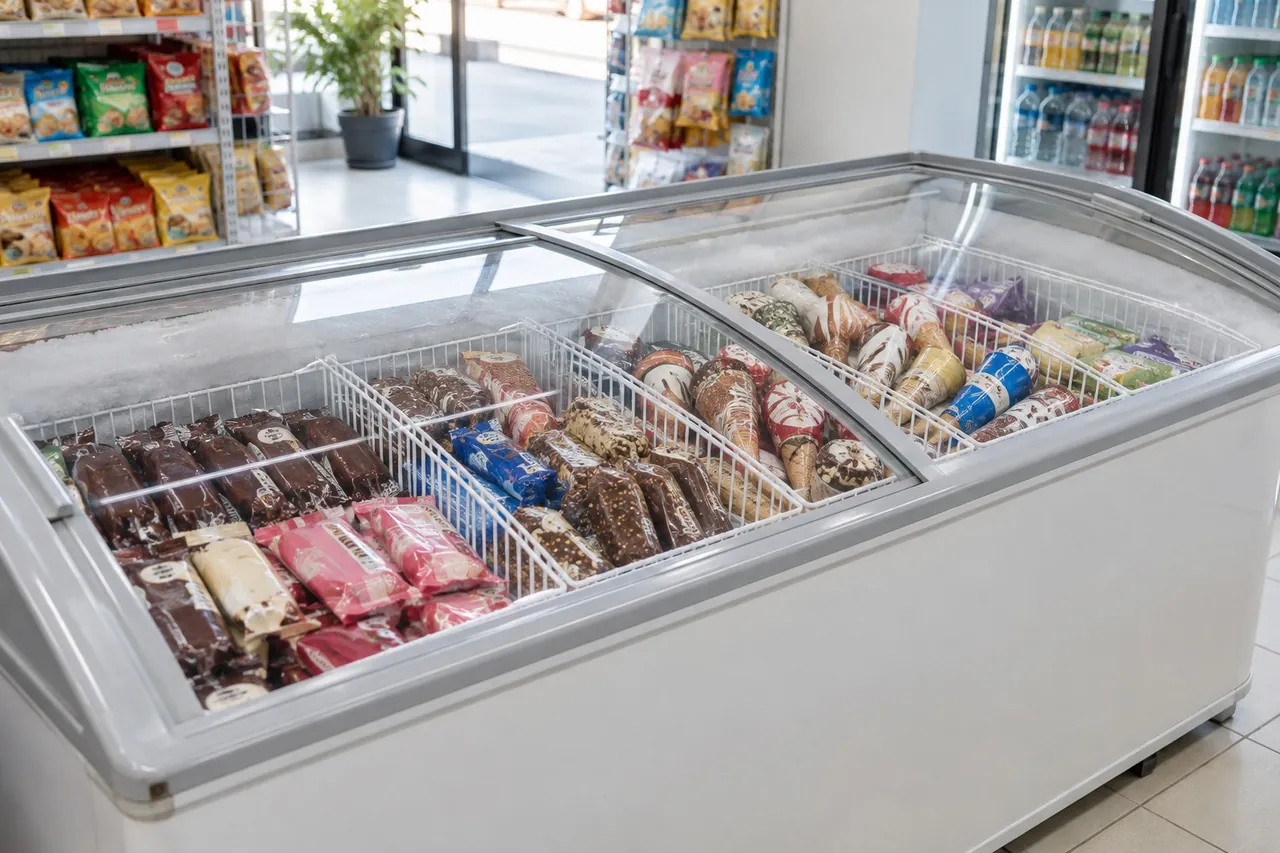
The other common display freezer format is the chest with a glass lid, sometimes called a glass top display freezer or top display freezer. Choose by floor space, product type and how customers shop.
| Factor | Upright glass door freezer | Glass-top chest freezer |
|---|---|---|
| Volume per m² of floor | High – uses height | Lower – uses floor |
| Product visibility | Eye level, brand blocks | Looking down, impulse items |
| Cold loss when opened | Higher – cold air falls out | Lower – cold air stays in |
| Best products | Frozen meals, vegetables, tubs, ice | Ice cream novelties, small packs |
| Be There range | 1–4 doors, about 400–1600 L | About 300–700 L |
Many stores use both: an upright glass door freezer line for core frozen ranges and a glass-top chest near the till for ice cream. For ice cream-specific temperatures and dipping cabinets, see our ice cream display freezer guide.
A glass door freezer for home use is mostly a style choice. Home units are smaller, often lack heated glass and use more energy than a solid-door freezer of the same size. If you only need storage, a solid door is the better buy.
Freezer door parts and commercial freezer door replacement
Most door faults on a commercial freezer are fixed by replacing a part, not the whole door. Common freezer door parts:
- Gasket – torn, flattened or ice-hardened gaskets are the most common cause of frost around the frame. Replace them every few years on busy units.
- Hinge cams, springs and closers – if a door no longer closes by itself, it is usually a worn cam or spring.
- Heater wires and frame heaters – a failed heater shows as condensation, ice on the gasket or a door that freezes to the frame.
- Handles and locks – loose handles crack the door frame over time.
- Glass pack – if the glass fogs between panes, the seal has failed and the glass pack (or door) must be replaced.
For a commercial freezer door replacement, record the cabinet model and serial number, door height and width, hinge side and heater voltage. Doors are generally made to fit a specific cabinet, so a freezer door for sale from a different maker rarely fits without changes.
When you buy new cabinets from Be There, ask for a spare-parts list with gaskets, hinge kits and heater parts, and ship critical spares with the order. Check gaskets and hinges monthly on busy units.
Walk-in freezer doors and industrial freezer doors
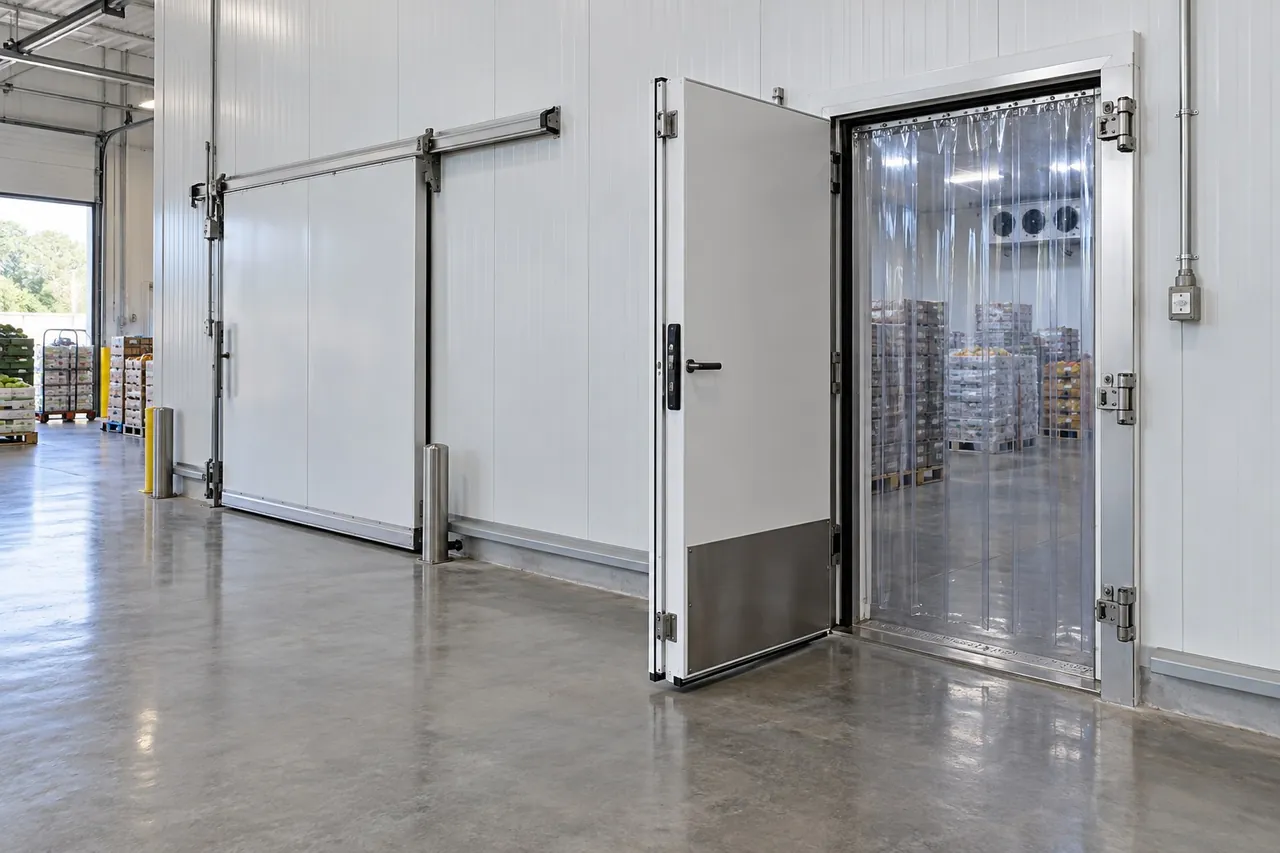
A walk in freezer door is a thick insulated panel door, not a glass merchandising door, although glass-door fronts are used on some walk-in cold rooms for retail display. For −18 °C to −25 °C (0 °F to −13 °F) rooms, the door must include:
- Insulated leaf – usually 100–150 mm (4–6 in) PU or PIR, matching the walls.
- Heated frame – heater cable around the frame stops the gasket freezing to the door.
- Heated pressure-relief port – balances the vacuum that forms after the door closes, so it can be opened again.
- Inside release – a safety handle so nobody can be locked in.
- Strip curtain or air curtain – cuts warm-air entry during loading.
Hinged doors suit most restaurant and shop walk-ins; sliding doors and high-speed doors are the usual industrial freezer doors for warehouses and forklift traffic.
Walk in freezer door replacement is usually needed when the frame heater fails repeatedly, the leaf is damaged by trolleys or the foam is waterlogged. Walk in freezer door parts such as gaskets, hinges, closers and heater cables can be replaced separately.
Every Be There walk-in cold room kit includes a hinged or sliding insulated door matched to the panels; our walk-in cooler doors guide compares them.
How to choose a commercial glass door freezer
Use this checklist when you compare quotes for a commercial glass door freezer:
- Products and facings – what you sell and how many shelf metres you need. That sets 1, 2, 3 or 4 doors.
- Space – width, depth, height and door swing, plus 50–100 mm (2–4 in) ventilation clearance.
- Temperature – −18 °C to −24 °C (0 °F to −11 °F) for frozen food and ice cream.
- Glass – heated triple or low-E double glazing; swing or sliding doors.
- Defrost and controls – automatic defrost, digital controller, alarm output.
- Refrigerant and power – R290 where your market requires it; correct voltage and frequency.
- Branding – header panel, door frame color and LED options for brand programs.
- Certification – UL/ETL and NSF for North America, CE for Europe, or your local mark.
- Spare parts – gaskets, hinge kits and heater parts shipped with the order.
Be There exports 1–4 door upright and glass-top commercial display freezers. Send your sizes, quantities, voltage and destination through the inquiry form for an FOB, CIF or DDP quotation.