
Short answer
A commercial beer cooler is a fan-cooled refrigerator that holds beer at about +1 °C to +4 °C (34–40 °F) through constant door openings. Shops use 1–4 door glass door merchandisers holding roughly 300–450 cans per door, bars use 860–940 mm (34–37 in) high back bar coolers, and stores with over about 150–200 cases use a walk-in beer cooler.
Key takeaways
- Hold mainstream beer and draught kegs at +2 °C to +3 °C (36–38 °F); never set a beer cooler at or below 0 °C (32 °F), as 5% beer starts to freeze around −2 °C (28 °F).
- An upright glass door beer cooler holds roughly 300–450 standard 355 ml (12 oz) cans per door; a 3-door unit is about 1.6–1.9 m (63–75 in) wide.
- A US half-barrel keg holds 58.7 L (15.5 gal), about 124 pints of 473 ml, and measures about 410 × 590 mm (16.1 × 23.3 in).
- Size beer coolers to hold one peak day's sales cold on the shelf, plus back stock in a reach-in or walk-in.
- Above about 150–200 cases or 8–10 kegs, a walk-in beer cooler with 75–100 mm panels usually costs less per case than more reach-ins.
- For hot bars and shops, ask for ISO 23953 climate class 4 (30 °C, 55% RH) or a 38–43 °C (100–110 °F) ambient rating.
What is a commercial beer cooler?
A commercial beer cooler is a refrigerator built to hold packaged or draught beer at serving or storage temperature, usually +1 °C to +4 °C (34–40 °F), through heavy door traffic in a bar, shop or restaurant. It comes in four main forms: glass door reach-in merchandisers, back bar and undercounter bar coolers, keg coolers for draught systems, and walk-in "beer caves" that customers step into.
The difference from a home beer fridge is duty, not looks. A commercial unit has a larger compressor and a fan-forced evaporator so it can pull a freshly loaded shelf of warm cans back down quickly, keep temperature even from top to bottom, and survive 12–16 hours of running a day in a warm room. It also carries food-equipment and electrical listings (NSF/ANSI 7 and UL/ETL in the US, CE in Europe) that inspectors and insurers expect.
This guide is about choosing and sizing beer-specific refrigeration. For general drink merchandisers see our commercial beverage cooler guide, and for under-bar dimensions see the back bar cooler guide.
What temperature should a beer cooler be?
A beer cooler should hold mainstream lagers at about +1 °C to +4 °C (34–40 °F) and draught kegs at +1 °C to +3 °C (34–38 °F). Craft ales and stronger beers taste better served warmer, but most businesses store everything cold and let the glass warm slightly, because cold storage slows staling far more than it harms flavour.
| Beer or use | Typical serving temperature | Practical cooler setting |
|---|---|---|
| Mass-market lager, light beer | +1 °C to +4 °C (34–40 °F) | +2 °C to +3 °C (36–38 °F) |
| Pilsner, wheat beer, pale ale, IPA | +4 °C to +7 °C (40–45 °F) | +3 °C to +5 °C (38–41 °F) |
| Amber ale, porter, stout | +7 °C to +10 °C (45–50 °F) | Separate warmer cooler or serve after a few minutes out |
| Barley wine, imperial stout, sour | +10 °C to +13 °C (50–55 °F) | Cellar cooler at +10 °C to +12 °C (50–54 °F) |
| Draught kegs (pasteurised or unpasteurised) | +1 °C to +3 °C (34–38 °F) at the tap | Keg cooler at +2 °C to +3 °C (36–38 °F), steady |
Two limits matter. Below about −2 °C (28 °F) a 5% beer can start to freeze, and frozen cans and bottles split or lose their seal, so never set a beer cooler at or below 0 °C (32 °F) unless it is a purpose-built sub-zero unit with tight control. For draught beer, temperature drift is the main cause of foaming: carbon dioxide comes out of solution as beer warms, so a keg cooler that swings 3–4 °C (5–7 °F) between cycles will pour inconsistently even if the average looks right.
What types of commercial beer coolers are there?
There are five common types, and the right one depends on whether customers pick beer themselves, staff serve it, or it goes through a tap. Most bars use two or three of them together.
| Type | Typical size | Capacity (355 ml / 12 oz cans) | Best for |
|---|---|---|---|
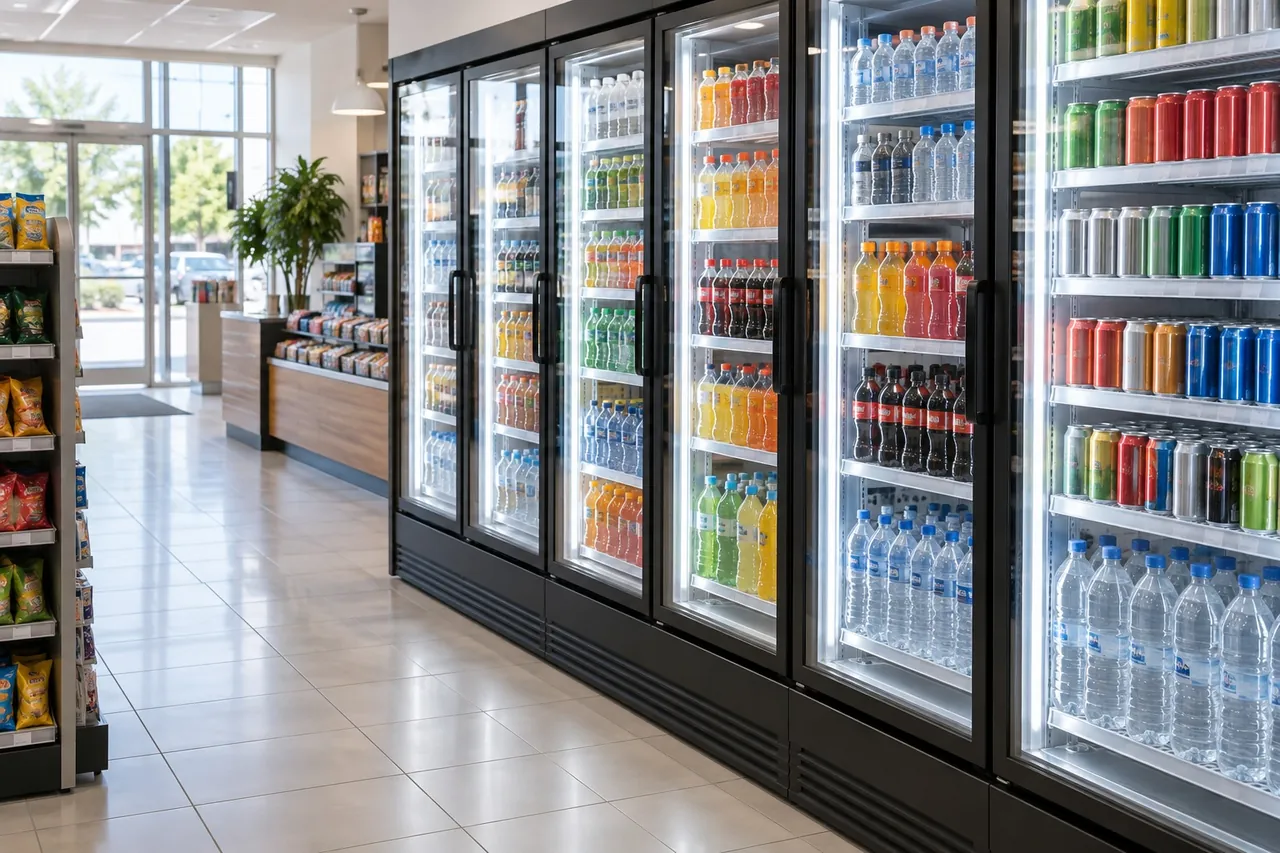
| Upright glass door reach-in (1–4 doors) | 0.6–2.5 m (24–98 in) wide, about 2 m (79 in) high | About 300–450 per door | Shops, petrol stations, self-serve sections of bars |
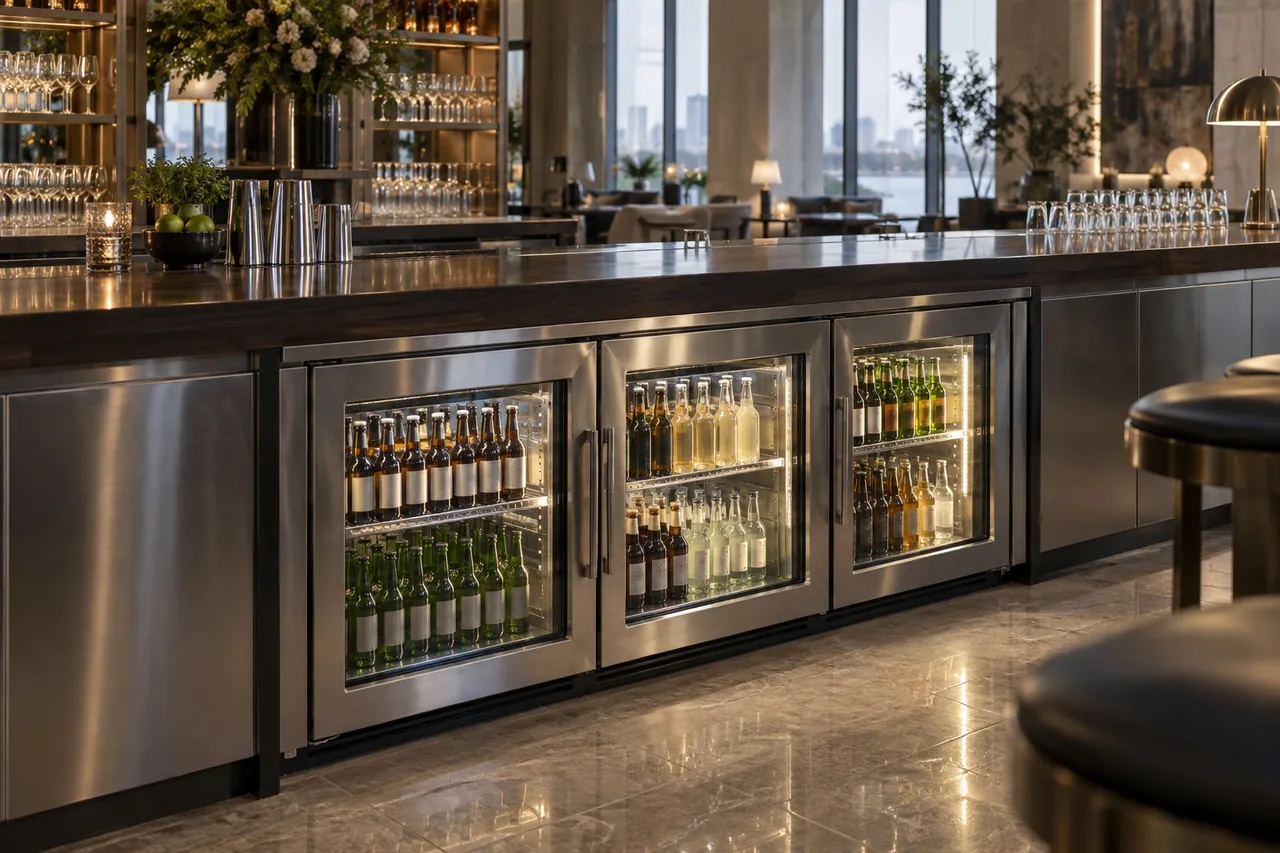
| Back bar cooler | 860–940 mm (34–37 in) high, 610–2,400 mm (24–95 in) wide | About 150–250 per door | Staff-served bottled and canned beer |
| Undercounter / mini bar fridge | 380–610 mm (15–24 in) wide, under a 865–915 mm counter | About 80–150 | Hotel rooms, small bars, offices |
| Keg cooler (direct draw) | Holds 1–4 kegs, counter height | 1–4 half-barrel or 50 L kegs | Bars pouring a few taps close to the cooler |
| Walk-in beer cooler or beer cave | From about 2 × 2 m (6 × 6 ft) up | Thousands of cases and dozens of kegs | Liquor stores, convenience stores, busy pubs |
Glass door beer refrigerators
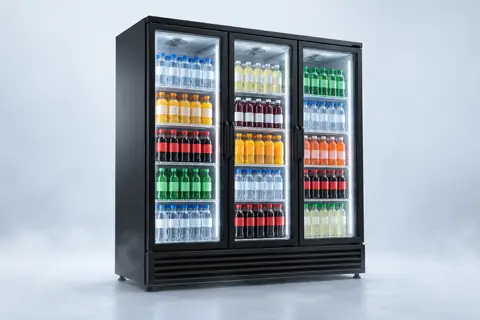
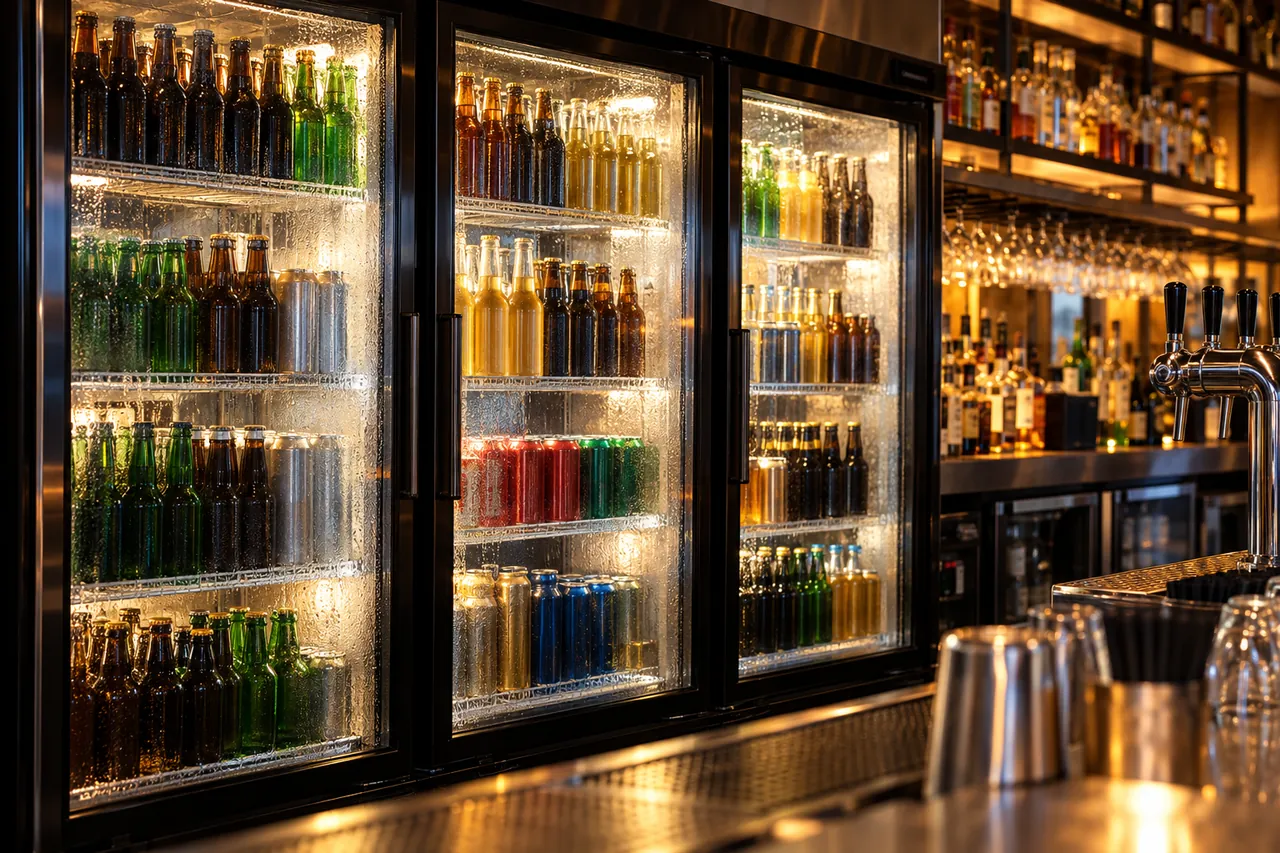
A beer refrigerator with glass doors is the default for any shop or self-serve area: the product sells itself and staff can see stock levels from across the room. Look for fan-forced air, double- or triple-pane low-E glass, self-closing doors with hold-open at 90°, adjustable wire or gravity-feed shelves and LED lighting. A 3 door beer cooler about 1.6–1.9 m (63–75 in) wide is the common choice for a convenience store's beer section; four doors suit a dedicated beer wall.
Back bar and undercounter coolers
Commercial bar coolers fit under or behind the bar so bartenders can reach bottles without turning far. They are front-breathing (air in and out through the front grille), so they can be built in on three sides. A shallow mini bar fridge of about 400–500 mm (16–20 in) depth suits hotel rooms and narrow bars, but holds roughly a third less than a standard 600 mm (24 in) deep unit.
Reach-in solid door beer coolers
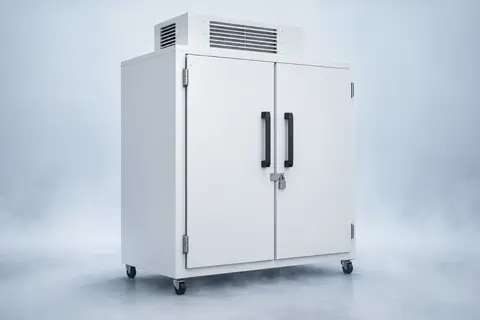
A reach-in beer cooler with solid doors is a back-of-house stock fridge: better insulated than glass, so it holds temperature with less energy, and it hides stock. Use one in the cellar or storeroom to pre-chill beer before it goes into the display coolers. See our guide to 2-door and 3-door commercial refrigerators for reach-in sizes.
When do you need a walk-in beer cooler or beer cave?
You need a walk-in beer cooler once you hold more than about 150–200 cases or 8–10 kegs cold at once, or want a beer cave that customers walk into. At that point a panel-built cold room is cheaper per case than a line of reach-ins and lets you store kegs on the floor next to the draught lines.
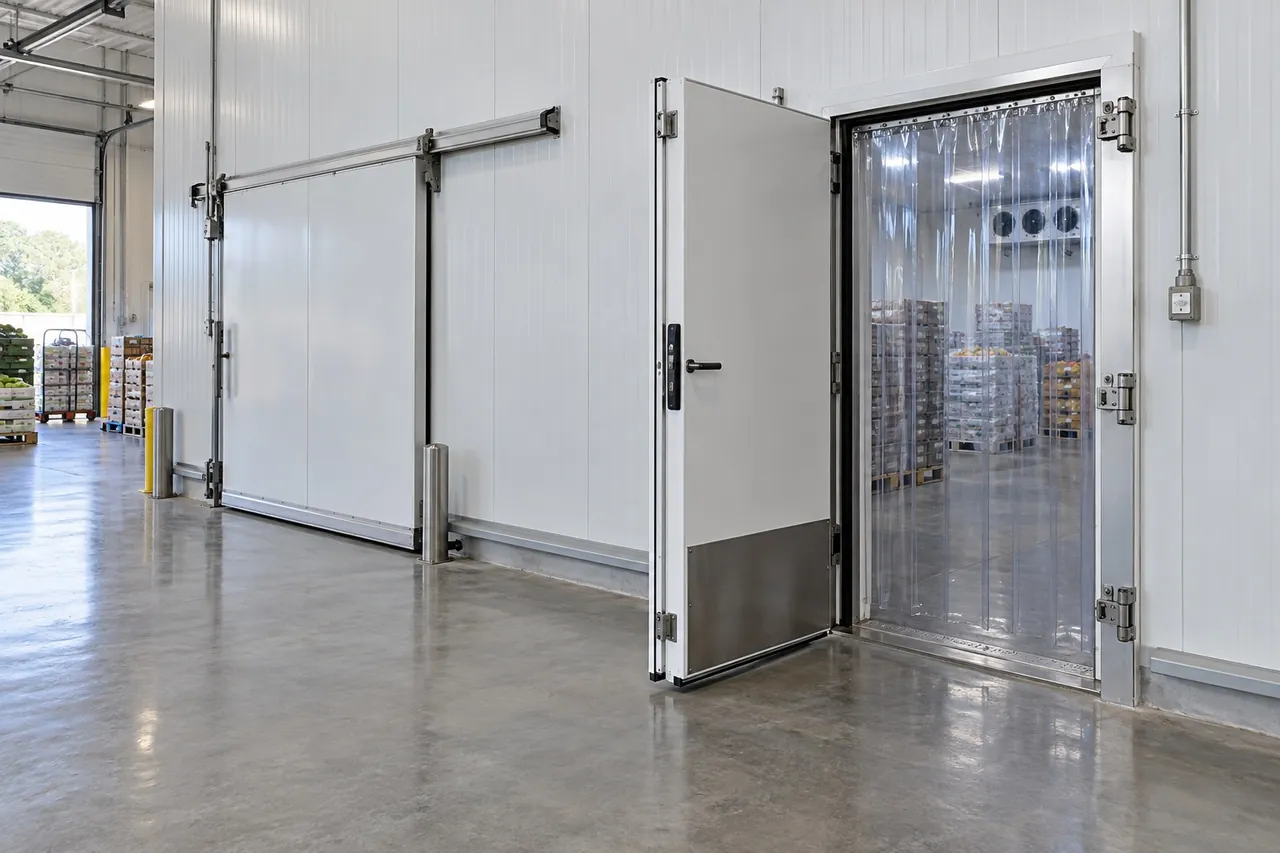
A walk-in beer cooler is a standard medium-temperature cold room: insulated PU or PIR panels, an evaporator inside, a condensing unit outside or on the roof, and a controller set to about +2 °C to +3 °C (36–38 °F). A beer cave adds customer-facing features:
- Glass merchandising doors on the shop side so customers can also pick from the front, with stock loaded from behind.
- A wide, self-closing customer door, usually with a strip curtain or air curtain to cut warm-air infiltration.
- Bright, low-glare LED lighting, non-slip flooring and an inside safety release on every door.
- Panels of 75–100 mm (3–4 in): a cooler does not need freezer-grade thickness.
Door openings drive the load in a beer cave far more than wall losses. A busy store can open the customer door several hundred times a day, so size the refrigeration for infiltration and for restocking with warm product, not just for the box. Our cold room refrigeration load calculator lets you enter door openings and daily product loads. For door options see the walk-in cooler door guide.
How do you size a commercial beer cooler?
Size a commercial beer cooler for your busiest day plus one restock: count the cans, bottles and kegs you sell on a peak day, add the stock you want held cold behind them, and choose a cooler whose cold, ready-to-sell capacity covers at least that total. Then check that the cooler can chill the restock in time.
Worked example: a convenience store beer section
- Peak Friday sales: 60 cases of 24 cans = 1,440 cans.
- Hold one day's sales cold on the shelves, because warm beer loaded on Friday afternoon will not be cold for the evening rush.
- At about 350–400 cans per door, 1,440 cans needs roughly 4 doors of glass door merchandiser.
- If the store also wants a week's back stock (about 250 cases), a small walk-in cooler of about 2.4 × 3.0 m (8 × 10 ft) with glass doors on the front is usually a better solution than more reach-ins.
Keg capacity
| Keg | Volume | Approx. size (diameter × height) | Pints (473 ml / 16 oz) per keg |
|---|---|---|---|
| US half barrel | 58.7 L (15.5 US gal) | 410 × 590 mm (16.1 × 23.3 in) | About 124 |
| US quarter barrel (slim) | 29.3 L (7.75 US gal) | 280 × 590 mm (11 × 23.3 in) | About 62 |
| US sixth barrel | 19.5 L (5.16 US gal) | 235 × 590 mm (9.25 × 23.3 in) | About 41 |
| European 50 L keg | 50 L (13.2 US gal) | About 380–410 × 530–600 mm | About 88 UK pints (568 ml) |
| European 30 L keg | 30 L (7.9 US gal) | About 380 × 360–400 mm | About 52 UK pints |
Keg dimensions vary by brewery; measure the kegs you actually buy before choosing a keg cooler or planning walk-in floor space. Allow at least 50 mm (2 in) around each keg for air flow and couplers.
Which features matter most in a beer cooler for a bar or shop?
The features that matter are the ones that keep beer evenly cold under real use: compressor capacity and recovery, fan-forced air flow, door and glass quality, the ambient rating and the controller. Styling comes last.
- Ambient or climate class: A cooler tested at 25 °C (77 °F) can struggle at 32 °C (90 °F) behind a busy bar. For hot rooms, ask for units tested to ISO 23953 climate class 4 (30 °C, 55% RH) or rated for 38–43 °C (100–110 °F) kitchens.
- Recovery: Ask how long the cooler takes to bring a full load of warm cans to +4 °C (40 °F). A low-cost unit can hold cold beer fine but take a full day to chill a restock.
- Refrigerant: R290 (propane) is now standard in new plug-in glass door coolers in many markets and is usually more efficient; see our R290 vs R404A comparison.
- Glass and frames: Low-E double or triple glazing, and heated frames in humid climates, stop condensation from hiding the product.
- Lighting: LED lighting runs cooler than fluorescent tubes. Light in the blue-violet range can still "skunk" beer in clear and green bottles over time, so keep those away from the brightest strips; cans are unaffected and brown bottles are largely protected.
- Locks and castors: A lockable beer fridge is needed for unattended sites and stock control; beer coolers on wheels (castors with brakes) make cleaning behind them and moving them for events easy.
- Controller: A digital controller with display, alarm and auto-defrost beats a mechanical dial; a data logging port helps with HACCP records.
Can you use an outdoor bar fridge or a bar fridge with an ice maker?
Yes, but only if the unit is built for the job. An outdoor bar fridge must be listed for outdoor use, with sealed electrics, corrosion-resistant cabinets and a compressor rated for summer ambient; an indoor unit on a terrace will run nonstop, lose temperature and fail early. Our guide to outdoor refrigerators and freezers covers ratings and placement.
A bar fridge with an ice maker is mostly a residential or hotel-suite product: a small compartment makes a few kilograms of ice a day, far below what a bar uses. A commercial bar normally pairs its undercounter bar fridge with a separate under counter ice machine making 25–160 kg (55–350 lb) a day; see the under counter ice maker guide. Panel ready bar fridges that take a cabinet door front are likewise built for homes and hotel rooms, not front-of-house bar use.
Should you buy new or used beer coolers?
Used beer coolers for sale can be good value if they are less than about half way through a 10–15 year service life, run on a refrigerant still serviceable in your market and hold temperature in a 24-hour test. Old glass door coolers often have worn door gaskets, failing fans and inefficient fluorescent lighting, so the energy and repair cost can quickly exceed the saving.
Before buying used, check that the doors self-close and seal on a paper slip, the condenser is clean, the cabinet has no wet or swollen insulation and the unit reaches +3 °C (38 °F) from warm within a few hours empty. Our used vs new commercial refrigeration checklist covers this in detail. Indicative pricing for new glass door merchandisers varies widely by market, door count and certification; importing direct can cut the cost per door substantially for buyers who order several units.
How to choose a commercial beer cooler: checklist
- List what you sell: cans, bottles, kegs, and how much on a peak day.
- Decide who picks the beer: customers (glass door merchandiser or beer cave) or staff (back bar or undercounter cooler).
- Set the target: +2 °C to +3 °C (36–38 °F) for most beer and kegs; a separate warmer cooler only if you sell a lot of cellar-temperature styles.
- Size for one day's peak sales cold on the shelf, plus back stock in a reach-in or walk-in.
- Measure the space, including ventilation clearances and door swing; built-in units must be front-breathing.
- Check the ambient rating against your hottest room, and ask for the recovery time from warm.
- Confirm voltage and frequency, plug type, refrigerant and certification for your market.
- Over about 150–200 cases or 8–10 kegs, price a walk-in beer cooler against more reach-ins.
Be There supplies upright glass door display refrigerators with one to four doors holding +2 °C to +8 °C (36–46 °F), with LED lighting, low-E glass and an R290 option, plus complete walk-in cooler kits with PU or PIR panels, glass or insulated doors and matched refrigeration for beer caves and keg rooms. Send your beer volumes, room size, voltage and target market through the inquiry form and we will quote FOB, CIF or DDP.