Short answer
A walk-in cooler door is an insulated, foam-filled door with perimeter gaskets, self-closing hinges or a sliding track and an inside safety release. Hinged doors about 0.8–1.2 m (32–48 in) wide suit most walk-ins; sliding doors suit openings from about 1.2 m for pallets; glass merchandising doors let customers pick drinks from the front of the cooler.
Key takeaways
- Most hinged walk-in cooler doors have a clear opening of about 0.8–0.9 m × 1.9–2.0 m (32–36 × 76–78 in); 1.0–1.2 m (40–48 in) suits trolleys and kegs.
- Freezer doors need a heater wire in the frame and a pressure-relief port; cooler doors near 0 °C often benefit from a frame heater too.
- Glass doors on walk-in coolers are typically about 0.76 m (30 in) wide each and use double or triple low-E or heated glass to prevent fog.
- A PVC strip curtain with 50% overlap or more can sharply reduce warm air entering through a busy door.
- Door gaskets are wear parts; inspect them monthly and expect to replace them every 1–3 years in busy kitchens.
What is a walk-in cooler door, and which types are there?
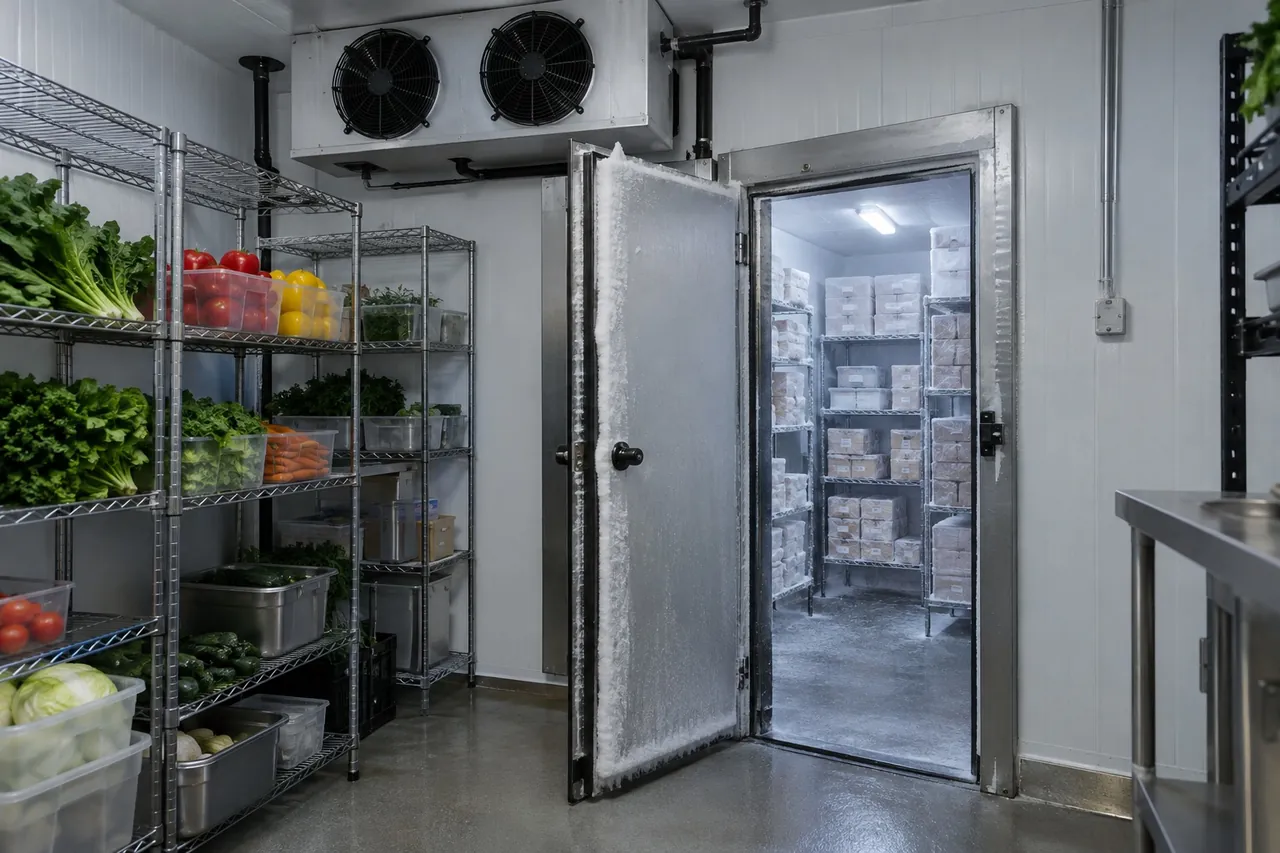
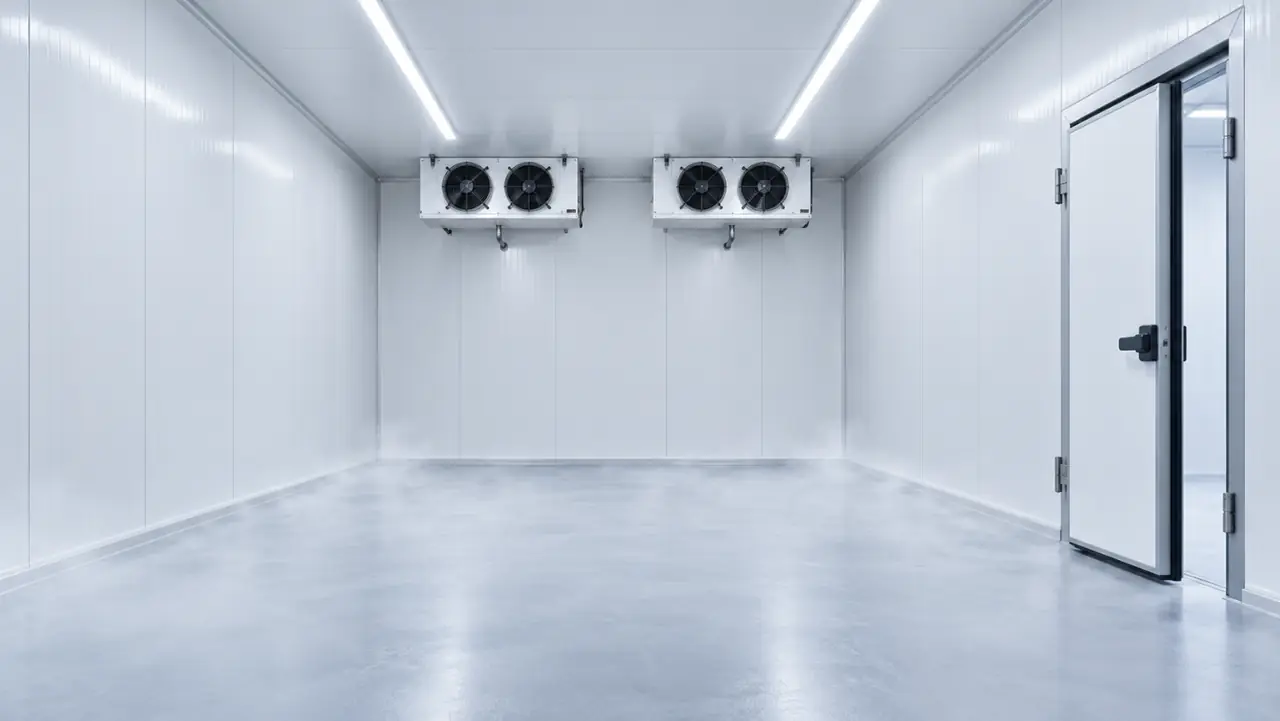
A walk-in cooler door is an insulated door built into a cold room panel wall, designed to seal tightly, close by itself and open from both sides. Its leaf is filled with the same PU or PIR foam as the walls, typically 75–100 mm thick for coolers and 100–150 mm for freezers, with metal skins, perimeter gaskets and a frame that locks into the panels.
The main types of cooler doors are:
| Door type | Typical clear opening | Best for |
|---|---|---|
| Hinged (swing) door | 0.8–1.2 m × 1.9–2.1 m (32–48 × 76–84 in) | Restaurant, shop and home walk-ins |
| Double hinged door | 1.4–2.0 m wide | Wide openings where space allows a swing |
| Sliding door (manual or electric) | 1.2–3.0 m wide × 2.0–3.5 m high | Pallet traffic, warehouse cold rooms, tight corridors |
| Glass merchandising doors | About 0.76 m (30 in) per door | Convenience stores, beer caves, beverage coolers |
| Rapid roll door | 1.5–4.0 m wide | Forklift traffic in distribution cold stores |
| Strip curtain / air curtain | Fits any opening | Reducing air exchange while the main door is open |
Every Be There walk-in cold room kit includes a hinged or sliding insulated door matched to the panel thickness and room temperature.
Hinged walk-in cooler doors: sizes and features
Hinged doors are the standard walk-in door for rooms up to about 30 m² (300 ft²). A good hinged walk-in cooler door has:
- Self-closing hinges: cam-rise or spring hinges that lift the door slightly as it opens and pull it shut, so it closes even when staff forget.
- Gaskets on all four sides: magnetic gaskets on the hinge and latch sides and top, and a double sweep or compression gasket at the floor.
- An inside safety release: a push knob or bar that opens the latch from inside, even when the door is locked from outside. This is essential for safety.
- A lockable handle for stock security.
- Kick plate and strike plate in stainless or aluminium to resist trolley damage.
- Optional view window, hold-open stop and door-ajar alarm.
Size the clear opening for what goes through it, not for the person. A 0.8–0.9 m (32–36 in) opening suits carried cases; 1.0–1.2 m (40–48 in) suits keg trolleys, roll cages and wheelchairs. Height is usually 1.9–2.0 m (76–78 in) clear. Check the swing clearance outside the room; if there is no space for a swing of about 1 m, choose a sliding door.
Door thickness should match the walls. For guidance on the right panel and door thickness by temperature, see our cold room panel thickness guide.
Sliding and warehouse cold room doors
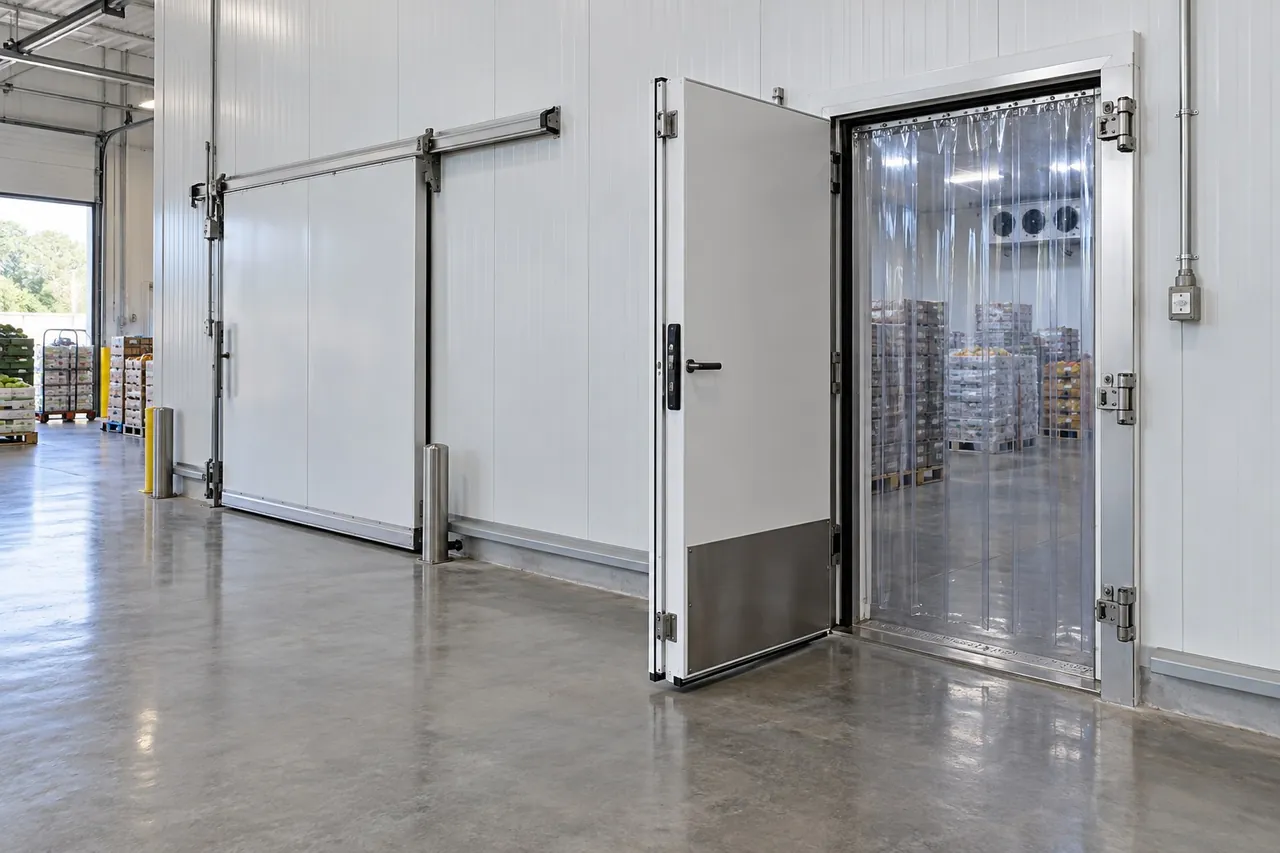
A sliding cold room door hangs from an overhead track and moves sideways along the wall, then presses into its gaskets as it closes. It suits wide openings, pallet trucks and places where a swing door would block a corridor. Manual sliding doors are common from about 1.2 m (4 ft) wide; electric sliding doors with pull-cord, radar or remote control suit warehouse cold room doors with frequent forklift traffic.
Points to specify for sliding and warehouse doors:
- Clear opening width and height for the largest load, plus about 100–200 mm clearance either side of a pallet.
- Wall space beside the opening, at least equal to the door width, for the leaf to slide into.
- Door heater in the frame and threshold for freezer rooms, and often for coolers that run near 0 °C.
- Pressure-relief port on freezers so air pressure equalises after closing.
- Impact protection: bollards, buffers and kick plates where forklifts pass.
- Safety: inside emergency release and, on powered doors, obstruction sensors.
For loading docks and high-traffic distribution centres, a rapid roll door inside the insulated sliding door is often combined with it: the rapid door opens and closes in seconds during operations, and the insulated door seals the room at night. If you are planning a larger building, see our guide to cold storage warehouse construction.
Walk-in coolers with glass doors
Walk-in cooler glass doors are reach-in merchandising doors fitted into the front wall of a walk-in. Customers open a glass door to take a drink from the shelf, while staff restock from behind inside the cold room. This is the layout of most convenience store beverage coolers and beer caves.
What to look for in a walk-in cooler with glass doors:
- Glazing: double-pane low-E glass with argon fill for coolers; triple-pane or heated glass for freezers and humid climates, to stop the glass fogging.
- Frame heaters to prevent condensation on the frame and mullions.
- Self-closing hinges with hold-open at about 90°, and magnetic gaskets that can be replaced without tools.
- LED lighting in the mullions, which adds little heat.
- Shelving or gravity-feed racks behind the doors, sized to the door module, typically about 0.76 m (30 in) per door.
Glass doors let in more heat than solid panels, so the refrigeration must be sized for them and for frequent openings. Use solid insulated doors for staff entry and glass doors only on the customer face.
If you only need a few doors of drinks, a stand-up cooler with glass doors may be the simpler choice. Be There glass door display fridges come with one to four doors and hold +2 °C to +8 °C (36–46 °F).
Strip curtains, air curtains and rapid doors
Even the best walk-in door lets in warm, moist air every time it opens. In a busy kitchen or warehouse, that air can be one of the largest parts of the refrigeration load, and in freezers it becomes frost on the coil and ice on the floor. Three accessories reduce it:
- PVC strip curtains: overlapping flexible strips hung inside the door frame. Standard strips are about 200 mm (8 in) wide with at least 50% overlap; use low-temperature (polar) PVC in freezers so the strips stay flexible. Replace strips that are scratched, cloudy or missing.
- Air curtains: a fan above the door that blows a sheet of air across the opening. They keep the opening clear for forklifts but are less effective than strips on cold rooms.
- Rapid roll doors: fabric doors that open and close quickly in high-traffic openings, used with an insulated door that closes the room overnight.
Good habits matter as much as hardware: keep the door closed while loading, use a door-ajar alarm set to about 1–3 minutes, and plan deliveries so the door is not propped open. For freezers, a cooler or anteroom in front of the freezer door reduces moisture entering it; our comparison of walk-in coolers and walk-in freezers explains this layout.
Cooler door parts: gaskets, hinges, heaters and locks
Most walk-in cooler door problems come from a handful of wear parts. Knowing them makes repairs quick.
| Part | Sign of failure | Typical check / replacement |
|---|---|---|
| Magnetic or compression gasket | Torn, flattened or frosted gasket; light visible round the closed door | Inspect monthly; replace every 1–3 years in busy use |
| Door sweep / bottom gasket | Draught or frost at the threshold | Inspect monthly; adjust or replace yearly |
| Self-closing hinges / closer | Door does not close fully, drops or drags | Adjust or replace when it fails to close from 30–45° open |
| Frame heater wire | Ice on frame, gasket freezing to frame, sweating | Check with a meter at service visits |
| Pressure-relief port | Freezer door hard to reopen after closing | Check heater and clear ice every 6 months |
| Latch, handle and inside release | Stiff latch, release not working | Test the inside release monthly |
| Strip curtain | Missing, cloudy or brittle strips | Replace individual strips as needed |
When ordering cooler door parts, note the door size, hinge side, panel thickness and gasket profile, and photograph the label or existing part. Gaskets are profile-specific, so a generic one may not seal.
Walk-in cooler door repair and replacement
Repair first. Most walk-in cooler door repair jobs are adjustments: tightening or re-shimming hinges so the door sits square, adjusting the closer, replacing a gasket or sweep, or fixing a failed heater. A simple test is to close the door on a sheet of paper at several points round the frame; if the paper pulls out easily, the gasket is not sealing there.
When to replace. Consider a replacement walk-in cooler door when the leaf is warped or delaminated, the foam is wet (a heavy door, rusting skin or constant sweating), the frame is damaged by impact, or the opening needs to be wider. Replacing a door is also a chance to add a heated frame, a view window or a sliding door where swing space is tight.
A cooler door replacement needs the exact panel thickness, the opening size, hinge side and the joint type of the surrounding panels. Many doors are supplied as a door panel with frame, which replaces one wall panel.
Glass cooler door replacement. For merchandising doors, a fogged or cracked glass pack can often be replaced on its own; if frames are corroded or heaters have failed, replacing the whole door and frame is usually better. Keep up with gasket and hinge checks in your refrigeration maintenance checklist.
How to choose a walk-in cooler door: checklist
- Room temperature: cooler, freezer or blast room, which sets door thickness and whether heaters are needed.
- What passes through: people with cases, trolleys, kegs or pallets, which sets clear width and height.
- Traffic: openings per hour; add a strip curtain, door-ajar alarm or rapid door for busy entrances.
- Space outside: swing clearance for a hinged door, or wall length for a sliding door.
- Customer access: glass merchandising doors on the sales face if customers pick product.
- Safety and security: inside release, lockable handle, lighting and alarm.
- Finish: painted steel, stainless or aluminium, plus kick plates where trolleys hit.
Be There supplies insulated hinged and sliding doors as part of complete walk-in cooler and freezer kits. For a new room, send your sizes and temperature through our inquiry form; for a replacement door in an existing room, add the opening size, panel thickness, joint type and hinge side and we will confirm whether we can match it.