Short answer
A cold storage temperature chart puts chilled food at 0 °C to +5 °C (32–41 °F) and frozen food at −18 °C (0 °F) or colder. Leafy greens and apples like 0 °C at 90–100% humidity, bananas and tomatoes +13 °C (55 °F), ice cream −25 °C (−13 °F) and most vaccines +2 °C to +8 °C (36–46 °F).
Key takeaways
- Frozen food must be stored at −18 °C (0 °F) or colder; ice cream and long-stored fish are better at −25 °C (−13 °F).
- A walk-in cooler should run at about +1 °C to +4 °C (34–39 °F) and never above +5 °C (41 °F).
- Bananas, tomatoes and other tropical produce suffer chilling injury below about +10 °C to +13 °C (50–55 °F).
- Food held at −18 °C stays safe indefinitely; quality limits range from 1–2 months for bacon to 12 months for whole poultry.
- Most vaccines are stored at +2 °C to +8 °C (36–46 °F); CDC allows MMR between −50 °C and +8 °C.
What temperature should cold storage be?
This cold storage temperature chart starts with the short answer: chilled food belongs at 0 °C to +5 °C (32–41 °F) and frozen food at −18 °C (0 °F) or colder. Within those bands, each product has its own ideal temperature and humidity, and some fruits are damaged if you keep them as cold as meat.
Cold stores are usually designed around one of these temperature classes:
| Storage class | Temperature | Typical products |
|---|---|---|
| Controlled ambient | +15 °C to +25 °C (59–77 °F) | Medicines labelled ‘store below 25 °C’, chocolate, wine |
| Cool / produce | +8 °C to +15 °C (46–59 °F) | Bananas, tomatoes, citrus, potatoes, cucumbers |
| Chilled | 0 °C to +5 °C (32–41 °F) | Meat, fish, dairy, leafy greens, cooked food |
| Pharma chilled | +2 °C to +8 °C (36–46 °F) | Vaccines, insulin, many biologics |
| Frozen | −18 °C to −23 °C (0 °F to −10 °F) | Frozen meat, vegetables, ready meals |
| Deep frozen | −25 °C to −30 °C (−13 °F to −22 °F) | Ice cream, fish for long storage |
| Ultra-low | −60 °C to −80 °C (−76 °F to −112 °F) | Sashimi-grade tuna, some vaccines and lab samples |
The tables below give typical commercial values. Treat them as starting points and follow the supplier’s specification or your HACCP plan where they differ.
Fruit and vegetable storage temperatures and humidity
Fresh produce is still alive: it breathes, loses water and, in some cases, gives off ethylene gas that ripens its neighbours. Good fridge fruit storage therefore depends on three things – temperature, high relative humidity (RH) and keeping incompatible items apart.
| Product | Temperature | Humidity | Typical storage life |
|---|---|---|---|
| Apples | −1 °C to +4 °C (30–39 °F) | 90–95% | 1–12 months by variety |
| Grapes | −1 °C to 0 °C (30–32 °F) | 90–95% | 1–6 months by variety |
| Strawberries and berries | 0 °C (32 °F) | 90–95% | 3–10 days |
| Lettuce and leafy greens | 0 °C (32 °F) | 98–100% | 2–3 weeks |
| Carrots (topped) | 0 °C (32 °F) | 98–100% | 4–6 months |
| Onions (dry) | 0 °C (32 °F) | 65–70% | 1–8 months |
| Potatoes | +4 °C to +10 °C (39–50 °F) | 90–95% | Up to 5–10 months |
| Oranges | +3 °C to +9 °C (37–48 °F) | 85–90% | 3–8 weeks |
| Tomatoes (mature green) | +13 °C to +15 °C (55–59 °F) | 90–95% | 1–3 weeks |
| Bananas (green) | +13 °C to +14 °C (55–57 °F) | 90–95% | 1–4 weeks |
Tropical and subtropical produce – bananas, mangoes, tomatoes, cucumbers, peppers – suffers chilling injury below about +10 °C to +13 °C: pitting, browning and poor ripening. Keep them in a separate cool room, not in the 0 °C produce chiller. Store ethylene producers such as apples and ripe bananas away from leafy greens, carrots and flowers.
Meat, fish, dairy and egg storage temperatures
Animal products are less sensitive to chilling injury and simply last longer the closer you keep them to freezing. The upper food safety limit for cold holding under the FDA Food Code is 5 °C (41 °F), so most chillers run well below it.
| Product | Temperature | Humidity | Typical chilled life |
|---|---|---|---|
| Fresh beef, lamb, pork | −1 °C to +2 °C (30–36 °F) | 85–90% | Days to weeks; longer vacuum-packed |
| Fresh poultry | −1 °C to +2 °C (30–36 °F) | 85–90% | About 1 week |
| Fresh fish (on ice) | 0 °C to +2 °C (32–36 °F) | 95–100% | About 4–14 days by species |
| Milk and cream | 0 °C to +4 °C (32–39 °F) | — | About 1–2 weeks |
| Hard cheese | +1 °C to +7 °C (34–45 °F) | 70–85% | Weeks to months |
| Shell eggs | +1 °C to +7 °C (34–45 °F) | 80–85% | Several weeks |
| Ready-to-eat cooked food | +5 °C (41 °F) or below | — | Up to 7 days (FDA date marking) |
Cooked food must reach the chiller quickly as well as stay cold. The FDA requires cooling from 57 °C to 21 °C (135 °F to 70 °F) within 2 hours and to 5 °C (41 °F) within 6 hours in total – see our 2-stage cooling method guide. A blast chiller does this far faster than a storage room.
In the US, shell eggs must be held at 7 °C (45 °F) or below. Butter, cheese and eggs absorb odours, so do not store them beside onions, fish or ripening fruit.
At what temperature should frozen food be stored?
Frozen food must be stored at −18 °C (0 °F) or colder. This is the international benchmark used by the FDA, USDA, the EU quick-frozen food rules and the Codex Alimentarius, and it is the right answer to the common question ‘frozen food must be stored at what temperature?’. At −18 °C bacteria cannot grow, and enzyme and fat changes slow enough to keep quality for months.
Colder is better for some products:
- Ice cream: store at −25 °C (−13 °F) or colder; it softens and forms ice crystals if held near −18 °C for long. Serving cabinets run warmer, around −14 °C to −12 °C (7–10 °F).
- Fish and seafood for long storage: −25 °C to −30 °C (−13 °F to −22 °F) slows fat oxidation in oily species.
- Sashimi-grade tuna: ultra-low storage at about −60 °C (−76 °F) keeps the red colour.
- Bagged ice: only needs −12 °C to −6 °C (10–21 °F) – colder makes it brittle and sticky.
For food safety, freezer temperature should be checked at least daily and logged. Brief rises during defrost are normal; a reading above −12 °C (10 °F) for more than an hour is worth investigating. A commercial walk-in freezer is usually set at −20 °C to −23 °C (−4 °F to −10 °F), giving a margin below −18 °C when the door is opened.
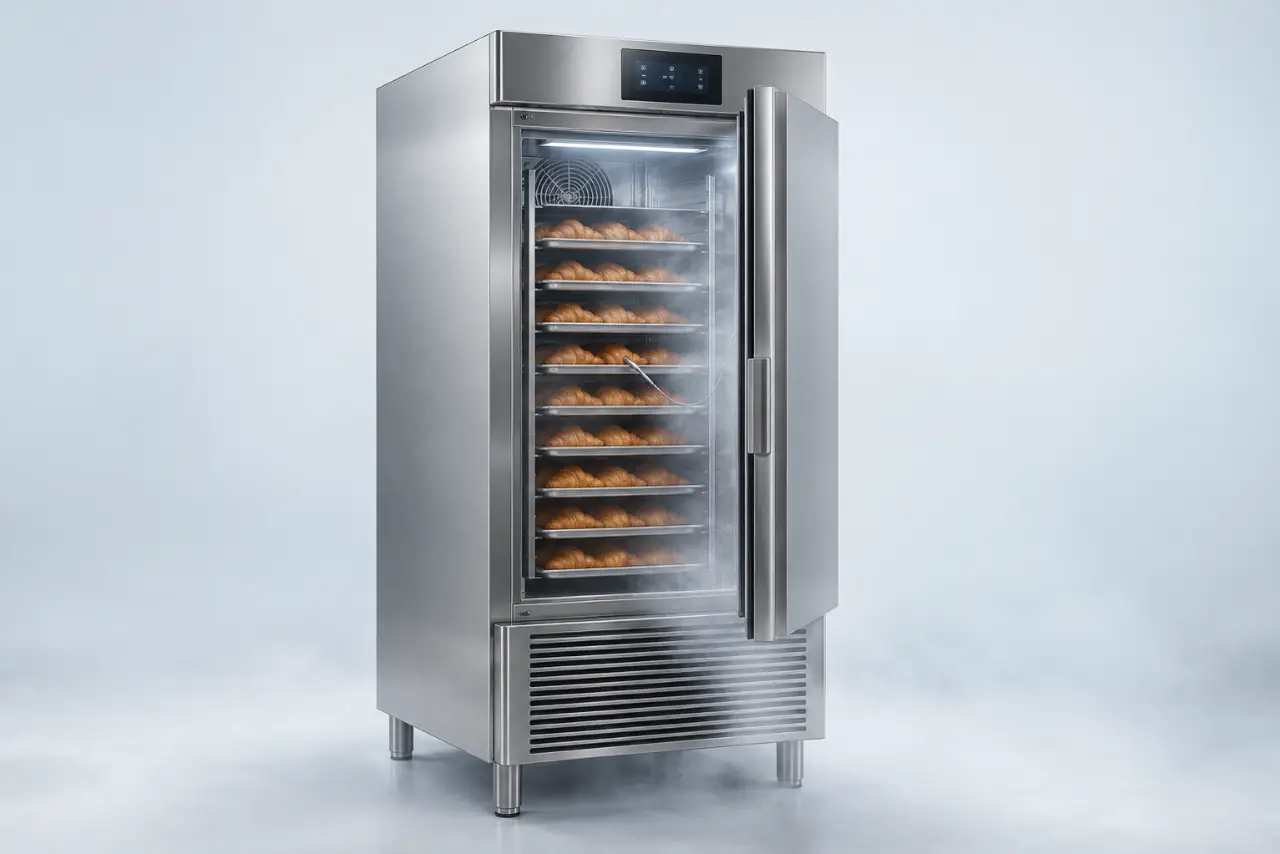
Freezing in a storage freezer is slow. To freeze product quickly, use a shock freezer that takes the core to −18 °C within about 240 minutes.
How long does food last in the freezer?
Food kept constantly at −18 °C (0 °F) stays safe indefinitely, because microbes cannot grow. What changes is quality: flavour, texture and colour decline, and freezer burn appears where packaging lets air in. So the real question – how long can food stay in the freezer and still taste good – has a time limit. These are typical quality guidelines based on USDA advice:
| Food | Recommended freezer time at −18 °C (0 °F) |
|---|---|
| Beef, pork, lamb steaks and roasts | 4–12 months |
| Chops | 4–6 months |
| Ground (minced) meat | 3–4 months |
| Whole chicken or turkey | Up to 12 months |
| Chicken parts | About 9 months |
| Bacon and sausages | 1–2 months |
| Lean fish (cod, hake) | 6–8 months |
| Fatty fish (salmon, mackerel) | 2–3 months |
| Cooked leftovers, soups and stews | 2–6 months |
| Ice cream | 2–3 months once opened |
| Blanched vegetables | 8–12 months |
Commercial kitchens should label every frozen item with the product name and freeze date, and rotate stock first-in, first-out. Vacuum packing and storage at −23 °C (−10 °F) or colder extend quality life. Thaw in a chiller at 5 °C (41 °F) or below, never on a bench.
What temperature should a walk-in cooler, freezer or cold well be?
Equipment set points sit a little below the food safety limit to leave a margin for door openings and defrost:
| Equipment | Typical setting |
|---|---|
| Walk-in cooler | +1 °C to +4 °C (34–39 °F); never above +5 °C (41 °F) |
| Walk-in freezer | −18 °C to −23 °C (0 °F to −10 °F) |
| Glass door display fridge | +2 °C to +8 °C (36–46 °F); +2 °C to +5 °C for dairy and meat |
| Display freezer | −18 °C to −24 °C (0 °F to −11 °F) |
| Drop-in or countertop cold well | Food held at +5 °C (41 °F) or below |
| Ice merchandiser | −12 °C to −6 °C (10–21 °F) |
So what temperature should a walk-in cooler be? Aim for about +3 °C (37 °F). Colder risks freezing lettuce and soft fruit near the evaporator; warmer leaves no margin below 41 °F. Be There walk-in cold rooms are built for 0 °C to +10 °C as chillers and −18 °C to −25 °C as freezers.
A cold well is a refrigerated or ice-cooled well that holds food pans on a buffet, salad bar or serving line. A drop-in cold well is built into a counter; a countertop cold well stands on top. Both are for holding food that is already cold, not for cooling it down. Keep pans filled no higher than the cold zone and check the food temperature every 2–4 hours. Be There does not make cold wells; for refrigerated holding, see our refrigerated prep table guide.
How long does it take to make ice cream or freeze yogurt?
Freezing time depends on the equipment, so here are typical commercial figures:
- Batch freezer for hard ice cream or gelato: about 8–15 minutes per batch to churn the mix to around −6 °C to −8 °C (18–21 °F). The ice cream then needs hardening at −25 °C to −35 °C (−13 °F to −31 °F) – a few hours in a hardening or blast freezer, longer in a storage freezer.
- Soft serve machine: the first freeze from cold mix takes roughly 10–15 minutes; after that the machine serves continuously at −6 °C to −4 °C (21–25 °F).
- Popsicle machine: 40-stick molds freeze in about 15–25 minutes in brine at −25 °C to −30 °C.
- Home ice cream maker: 20–30 minutes of churning, then 2–4 hours in the freezer to firm up.
How long does it take to freeze yogurt? In a soft serve and frozen yogurt machine, about the same 10–15 minutes as soft serve. A cup of yogurt placed in a −18 °C freezer takes about 2–4 hours to freeze solid; a large tub may need overnight. A shock freezer at −35 °C cuts these times sharply and gives smaller ice crystals.
Store finished ice cream and frozen yogurt at −25 °C (−13 °F) or colder, and keep the mix itself at +4 °C (39 °F) or below before freezing.
Vaccine, MMR and climate-controlled storage temperatures
Medicines have their own rules and should be kept in purpose-built pharmaceutical or medical-grade refrigerators, not food equipment.
- Most refrigerated vaccines: +2 °C to +8 °C (36–46 °F), with a target of about +5 °C (41 °F). Freezing destroys many of them.
- MMR storage temperature: US CDC guidance allows MMR vaccine to be stored in either the freezer or the refrigerator, between −50 °C and +8 °C (−58 °F and +46 °F), protected from light. Its diluent is kept at room temperature or in the refrigerator, never frozen. Always follow the current package insert.
- Frozen vaccines (such as varicella): −50 °C to −15 °C (−58 °F to +5 °F).
Climate controlled storage temperature means something different. A climate-controlled self-storage unit or warehouse is not a cold room: it is typically kept between about 13 °C and 29 °C (55–85 °F), often with humidity held around 50–55%, to protect furniture, documents, electronics and wine from heat and damp.
If you store goods that need tighter control – chocolate, wine, seeds, cosmetics – specify an exact band such as +12 °C to +16 °C (54–61 °F). A small chiller room with good insulation holds that band more steadily than an air-conditioned space.
How to keep cold storage at the right temperature
A chart is only useful if the room actually holds the number. Use this checklist:
- Group products by temperature class. Do not mix bananas with lettuce or ice cream with frozen vegetables if you can give each its own room or zone.
- Size the refrigeration for the real load, including daily product intake and door openings – our cold room load calculator gives a first estimate.
- Log temperatures continuously. Learn how to monitor freezer temperature remotely with wireless sensors and phone alerts in our cold room temperature monitoring guide.
- Control humidity for produce with the right evaporator size and air speed.
- Keep air moving: leave 10–15 cm (4–6 in) between pallets and walls, and never block the evaporator.
- Rotate stock first-in, first-out and label freeze dates.
Planning a new chiller or freezer? Tell us the products, daily intake and room size, and we will quote a matched walk-in cold room kit with the right panel thickness and refrigeration. Request a quotation – we reply within one working day.