Short answer
A chest freezer opens from the top, holds more per square metre and uses less energy: ENERGY STAR estimates about 215 kWh a year versus about 395 kWh for an upright freezer. An upright freezer stands like a fridge, takes less floor space and is faster to organise and pick from. Choose chest for bulk storage, upright for daily access.
Key takeaways
- Both chest and upright freezers should hold frozen food at −18 °C (0 °F) or colder; commercial ice cream storage runs at −20 °C to −25 °C (−4 °F to −13 °F).
- ENERGY STAR estimates a certified chest freezer uses about 215 kWh per year and an upright about 395 kWh, because cold air stays in a top-opening cabinet.
- An upright freezer needs roughly half the floor area of a chest freezer of similar volume, but loses some space to shelves, drawers and the door.
- Household deep freezers are rated for home use and a narrow room-temperature range; a busy shop or kitchen needs a commercial unit rated for 30 °C (86 °F) or more.
- Once you need several upright freezers of storage, a small walk-in freezer is usually cheaper to run per litre and easier to organise.
Chest freezer vs upright freezer: what is the difference?
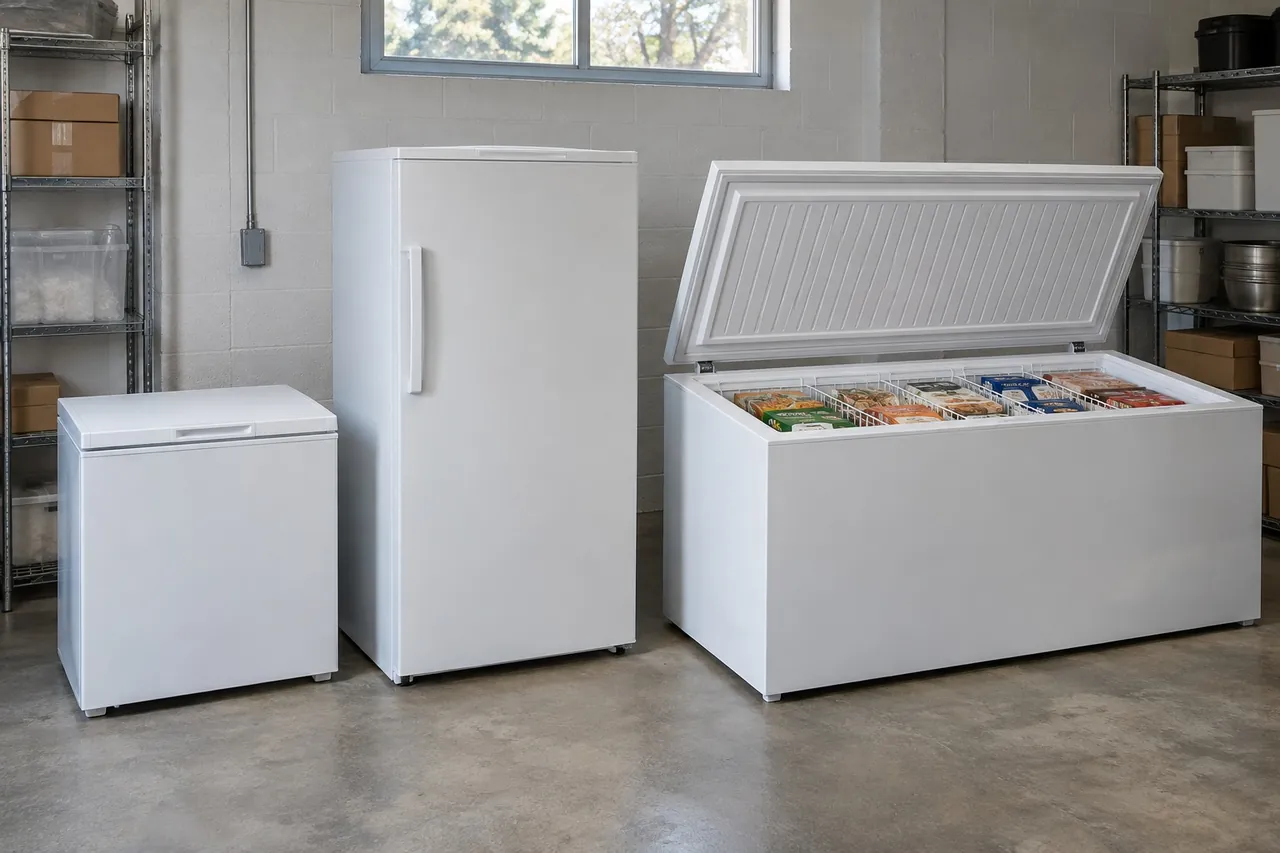
A chest freezer is a box-shaped freezer with a lid on top; an upright freezer (also called a stand up freezer or upright deep freezer) is a tall cabinet with a front door, like a refrigerator. Both are "deep freezers": the term simply means a freezer-only appliance that holds food at −18 °C (0 °F) or colder, as opposed to the small freezer compartment of a fridge.
The design difference drives everything else. Cold air is heavier than warm air, so when you lift a chest freezer lid most of the cold air stays inside. When you open an upright freezer door, cold air spills out across the floor and warm room air replaces it. That is why chest freezers usually use less energy, recover temperature faster and keep food steadier during a power cut.
Uprights win on access. Shelves and drawers put every product at eye or hand level, so staff can find and rotate stock in seconds instead of digging through layers.
For a business, there is a third question: home or commercial? Many "chest freezers for sale" and "upright freezers for sale" in retail stores are household appliances. They work well as backup storage, but they are not designed for constant door openings in a hot kitchen or shop. We cover that in detail below, along with the commercial display freezers that let customers see what is inside.
Chest vs upright freezer at a glance
This table compares typical freezer-only units of similar internal volume. Exact figures vary by model, insulation thickness and defrost type.
| Factor | Chest freezer | Upright freezer |
|---|---|---|
| Opening | Top lid (solid or glass) | Front door (solid or glass), 1–4 doors |
| Floor space for ~400 L (14 cu ft) | About 1.3 × 0.7 m (51 × 28 in) | About 0.7 × 0.7 m (28 × 28 in) |
| Usable space | Very high; loose packing to the walls | Lower; shelves, drawers and door bins take space |
| Typical energy use (ENERGY STAR estimate) | About 215 kWh/year | About 395 kWh/year |
| Cold air loss when opened | Low | Higher; cold air falls out |
| Defrost | Usually manual; some auto-defrost | Manual or frost-free (auto-defrost) |
| Organisation and picking | Needs baskets or bins | Easy: shelves, drawers, eye-level stock |
| Hold-over in a power cut | Longer | Shorter |
| Best for | Bulk, slow-moving stock; meat, ice, ice cream back-up | Daily picking; kitchens with little floor space |
Energy figures are ENERGY STAR averages for certified US models; frost-free uprights sit at the high end.
What size deep freezer do you need?
Freezers are sold in litres or cubic feet (1 cu ft ≈ 28.3 L). A useful planning figure is that each cubic foot holds roughly 15–16 kg (about 35 lb) of well-packed frozen food. The table below shows common size bands; our guide to freezer sizes in cubic feet has full dimensions.
| Size band | Volume | Typical footprint | Typical business use |
|---|---|---|---|
| Mini / small chest freezer | 100–200 L (3.5–7 cu ft) | 0.55–0.95 m wide | Staff room, café back-up, market stall |
| Medium chest freezer | 250–400 L (9–14 cu ft) | 1.0–1.3 m wide | Small restaurant, butcher, ice back-up |
| Large / big chest freezer | 450–700 L (16–25 cu ft) | 1.4–2.0 m wide | Bulk meat freezer, ice cream stock |
| Mini or compact upright freezer | 50–150 L (2–5 cu ft) | 0.5–0.6 m wide | Bar, office kitchen |
| Full-size single door freezer | 400–650 L (14–23 cu ft) | 0.6–0.8 m wide | Restaurant kitchen, shop |
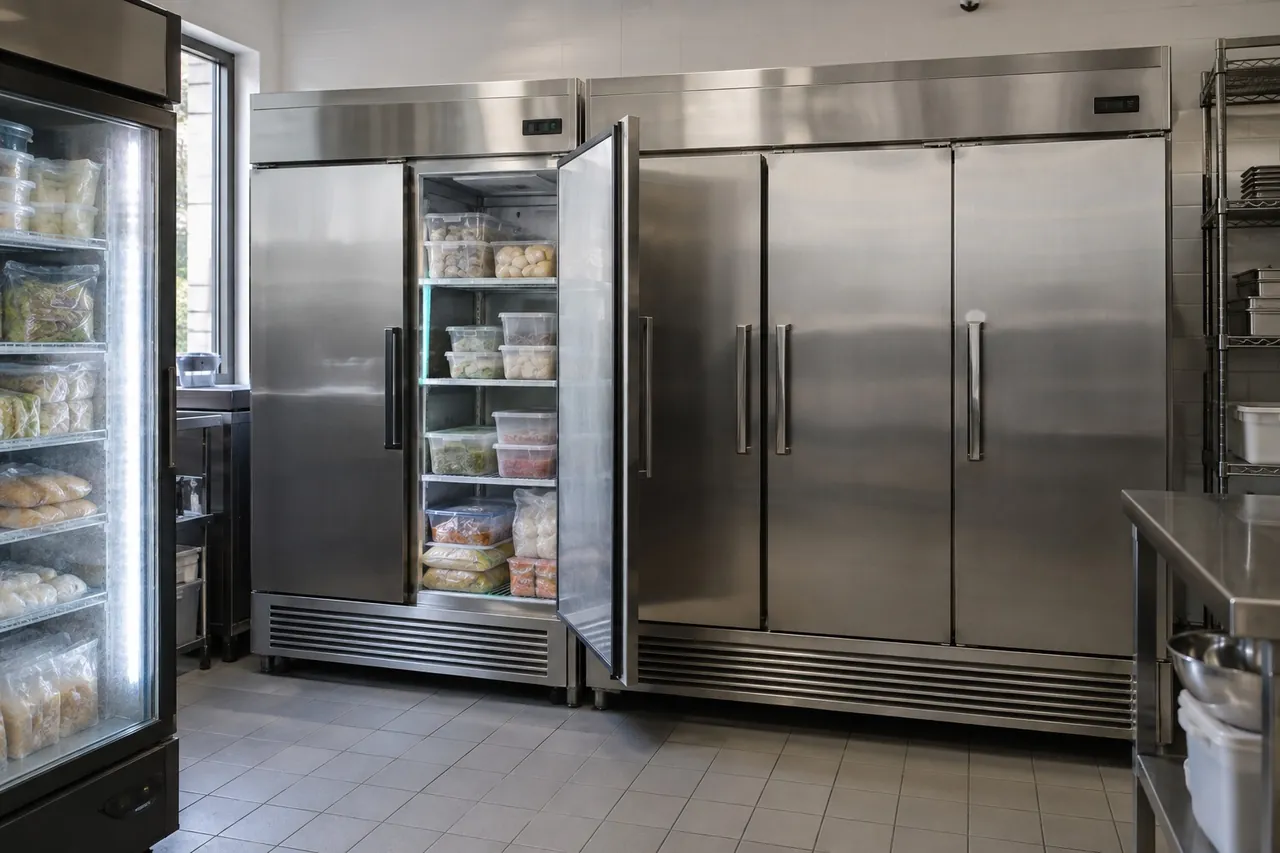
| Double door upright freezer | 900–1,400 L (32–49 cu ft) | 1.2–1.4 m wide | Busy kitchen, supermarket back-of-house |
Size to your peak week, not your average: the day before a delivery, or the week of a promotion. Leave around 10–20% free space so air can circulate, especially in an upright with fans. If you sell frozen goods, add your display stock on top of storage stock; a glass-top chest display freezer holds about 300–700 L (10–25 cu ft) and an upright glass-door model about 400–1,600 L.
Which uses less energy, and how cold does a deep freezer get?
For the same volume, a chest freezer almost always uses less electricity. ENERGY STAR puts an average certified chest freezer at about 215 kWh per year and an upright at about 395 kWh. Less cold air escapes from a top opening, and chest cabinets rarely have fan or defrost heaters.
In a commercial setting the gap can widen or shrink. An upright that is opened 100 times a day in a 30 °C (86 °F) kitchen works much harder than the label figure. A chest freezer that sits in a hot, unventilated store room loses its advantage because the condenser cannot shed heat.
How cold do deep freezers get?
- Food storage standard: −18 °C (0 °F) or colder. Most chest and upright freezers can be set to about −15 °C to −24 °C (5 °F to −11 °F).
- Ice cream and frozen desserts: −20 °C to −25 °C (−4 °F to −13 °F) for storage; display freezers hold −18 °C to −24 °C.
- Bagged ice: −12 °C to −6 °C (10–21 °F) so bags do not fuse; that is the job of an ice merchandiser rather than a standard deep freezer.
- Low temperature and ultra cold freezers: −40 °C (−40 °F) to about −86 °C (−123 °F). These are laboratory and medical units, not food equipment.
A storage freezer is not built to freeze large amounts of warm food quickly. If you cook and freeze, a blast freezer takes food to −18 °C at the core in about 240 minutes and keeps quality higher.
Access, organisation and defrost: drawers, bins and locks
How your staff use the freezer matters more than the brochure. Ask how many times a day it will be opened and by whom.
Upright freezers with drawers and shelves
An upright freezer with drawers or wire shelves lets you see every product, run first-in-first-out rotation and pick an item in seconds. Tall freezers with drawers suit kitchens that pull small quantities many times a shift. A double door stand up freezer splits the cabinet so you open only half at a time, which cuts air loss.
Chest freezer bins and baskets
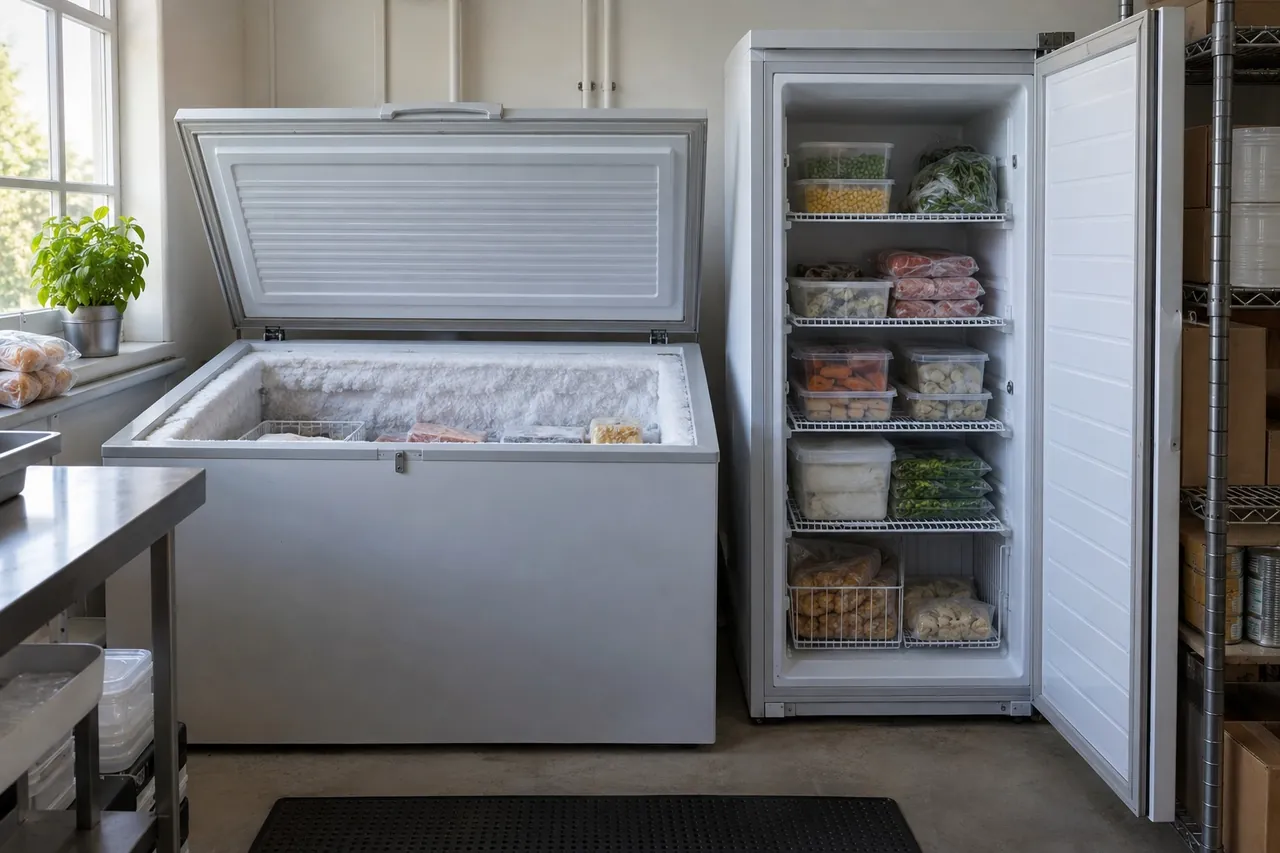
Without organisation, a large chest freezer turns into a pile. Use hanging baskets on the rim and stackable bins or deep freezer storage containers labelled by product and date. Keep fast movers in the top baskets and bulk cartons below.
Frost-free or manual defrost?
Most chest freezers are manual defrost: ice builds on the walls and you empty and defrost them every few months, or when frost passes about 6 mm (¼ in). Many uprights are frost-free, using a fan and timed heater to melt frost automatically. That saves labour but costs energy and can slightly dry unwrapped food. See our frost-free vs manual defrost guide for the trade-offs.
Lockable deep freezers
Lockable chest and upright freezers protect high-value stock such as seafood or meat, and are often required where customers or temporary staff have access. A lock on a glass display freezer is a common option on commercial models.
Commercial chest freezer or household deep freezer?
A household deep freezer for sale at a big-box store can be a sensible buy for a business, but only in the right role. The key differences are in the ambient rating, build and certification.
| Feature | Household chest / upright freezer | Commercial freezer |
|---|---|---|
| Ambient rating | Usually climate class N or ST (up to 32–38 °C) | Typically tested to 30–43 °C room conditions |
| Door openings | A few per day | Dozens to hundreds per day |
| Compressor and fans | Small, sized for steady loads | Larger, faster recovery after openings |
| Interior | Painted steel or plastic liner | Stainless steel or food-grade liners; cleanable corners |
| Food-safety certification | Rarely NSF | NSF/ANSI 7 (US), CE / EN standards (EU) |
| Warranty in business use | Often limited or void | Covers commercial use |
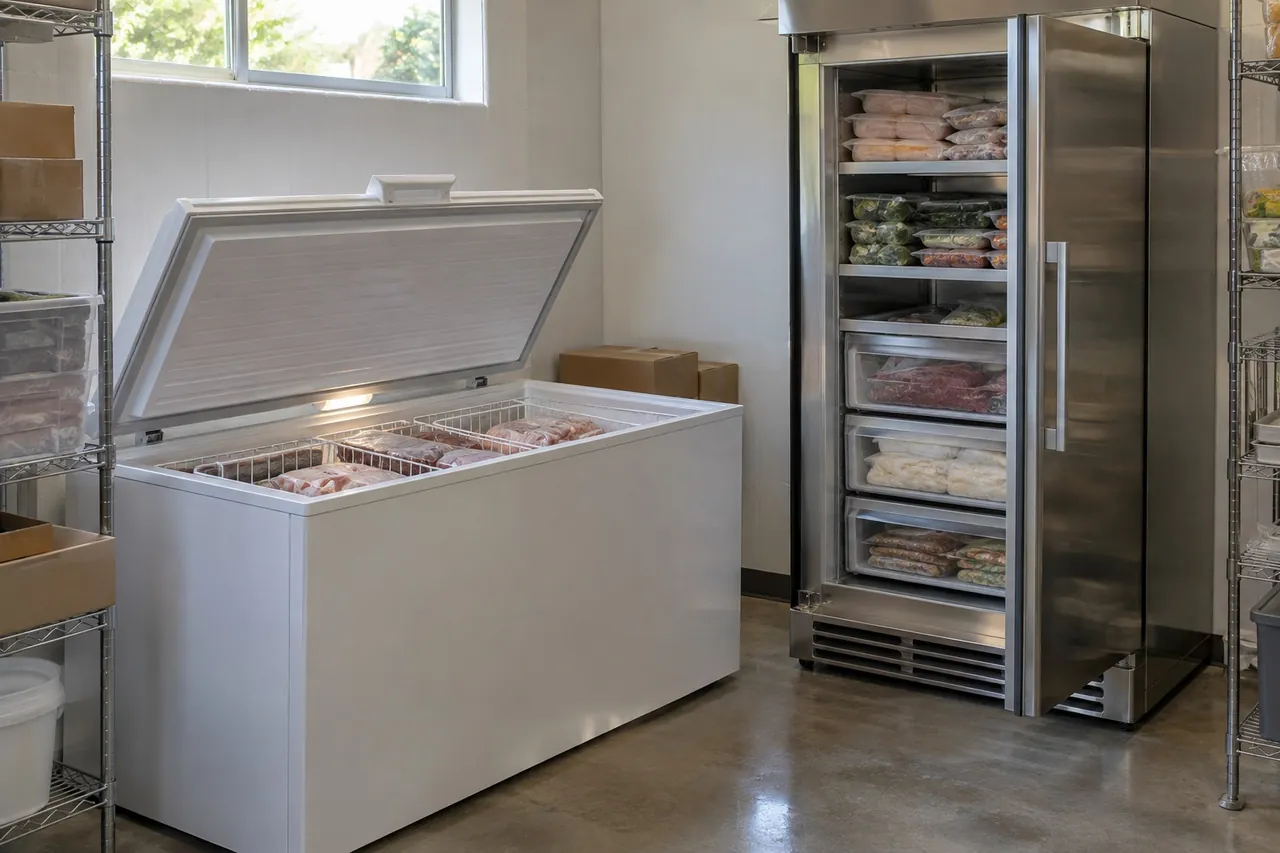
A home unit is usually enough for packaged back-up stock in a cool room that is opened once or twice a day. If the freezer is in the customer area, inside a hot kitchen, or opened all day, choose a commercial chest freezer or commercial upright freezer. In the US, many health inspectors expect NSF-listed equipment in food prep areas; check with your local authority.
For selling frozen food, commercial glass-top chest and glass-door upright display freezers combine storage with merchandising: heated glass stops fogging, LED lighting shows the product, and the cabinet is built for constant opening.
Can you put a deep freezer in a garage or outside?
You can, but only a freezer rated for the temperatures it will see. Household appliances carry a climate class: SN (10–32 °C / 50–90 °F), N (16–32 °C / 61–90 °F), ST (16–38 °C / 61–100 °F) and T (16–43 °C / 61–109 °F). A garage that reaches 40 °C (104 °F) in summer needs class T; one that drops below 10 °C (50 °F) in winter needs a model the maker approves for low ambient, often sold as a "garage freezer".
Problems with the wrong unit are predictable: in heat the compressor runs non-stop and the cabinet warms; in cold the thermostat may barely call for cooling and food can partly thaw, while the compressor oil thickens.
Truly outdoor freezers face rain, sun and dust as well. They need weatherproof electrics, corrosion-resistant cabinets, a lock and shade from direct sun. Commercial outdoor chest freezers and outdoor ice merchandisers are built for this; a standard indoor deep freezer outside is likely to fail early and may not be electrically safe. Our outdoor refrigerator and freezer guide covers ambient ratings, weatherproofing and siting in detail.
Whatever you choose, plug it into a dedicated, protected outlet (in the US, outdoor and garage outlets normally require GFCI protection) and fit a temperature alarm so you know about a failure before the stock is lost.
When should a business move up to a walk-in freezer?
Freezers bought one at a time tend to multiply. Three uprights and two chest freezers mean five compressors heating the room, five sets of seals to maintain and stock spread across five places.
A small walk-in freezer becomes worth pricing when:
- you need more than about 2,000–3,000 L (70–105 cu ft) of frozen storage;
- you receive pallets or full cartons rather than a few cases;
- staff spend time searching through several chest freezers; or
- the kitchen is overheating from many plug-in condensers.
A walk-in freezer kit from Be There includes 120–150 mm PU or PIR panels, an insulated door, a matched condensing unit and evaporator and a digital controller, and holds −18 °C to −25 °C (0 °F to −13 °F). A 2 × 2 × 2.2 m room gives about 8.8 m³ (310 cu ft) of gross volume, several times a large upright, with the condensing unit placed outside the kitchen. See our walk-in cooler and freezer kits.
Plug-in freezers still have a place next to a walk-in: a chest or display freezer at the point of sale, or an upright on the cook line for the items used every few minutes.
How to choose: chest or upright freezer checklist
- List what you freeze and how often you take it out. Bulk and slow-moving: chest. Many picks per hour: upright.
- Measure the space including clearances. Most units need about 50–100 mm (2–4 in) at the sides and back, and a chest lid needs headroom to open fully.
- Size for peak stock using about 15–16 kg per cubic foot (35 lb per cu ft) and keep 10–20% free.
- Check the ambient rating against the hottest and coldest day in that room, garage or yard.
- Decide on defrost: manual for efficiency and low cost, frost-free for labour saving.
- Choose household or commercial: commercial if the unit is in a hot kitchen, a customer area or opened all day, or if your inspector requires NSF-listed equipment.
- Confirm power and refrigerant: voltage, frequency and plug type for your country; R290 or R600a is now the norm for new plug-in units in many markets.
- Add a lock and an alarm for high-value or unattended stock.
If you sell frozen food or ice cream, Be There supplies glass-top chest and glass-door upright display freezers, outdoor ice merchandisers and walk-in freezer kits, built to your voltage and quoted per order (FOB, CIF or DDP). Send your sizes, temperatures and destination through our quotation form and we will reply within one working day.