Short answer
A blast freezer room freezes product to −18 °C (0 °F) core by forcing air at −35 °C to −40 °C through it at about 2–5 m/s. Design it from batch weight and freezing time, use 150–200 mm PU/PIR panels, a heated XPS-insulated floor, a heated door and a pressure relief valve. A 2,000 kg batch frozen in 8 hours needs roughly 40 kW of refrigeration.
Key takeaways
- Blast freezer rooms run air at −35 °C to −40 °C (−31 °F to −40 °F) and freeze; product is then stored at −18 °C to −25 °C.
- Batch weight = daily volume ÷ cycles per day; cycle time is set by the thickest product and its packaging.
- Air must pass through the load at about 2–5 m/s, with baffles and 50–100 mm gaps between trolleys or pallets.
- Use 150–200 mm PU/PIR panels, 150–200 mm XPS under a heated floor, a heated door frame and a pressure relief valve.
- Product and fans make up over 90% of the load: 2,000 kg of chicken frozen in 8 hours needs about 40 kW at −42 °C evaporating.
- IQF means individually quick frozen; loose pieces need a tunnel, spiral or fluidised-bed freezer, not a static blast room.
What is a blast freezer room?
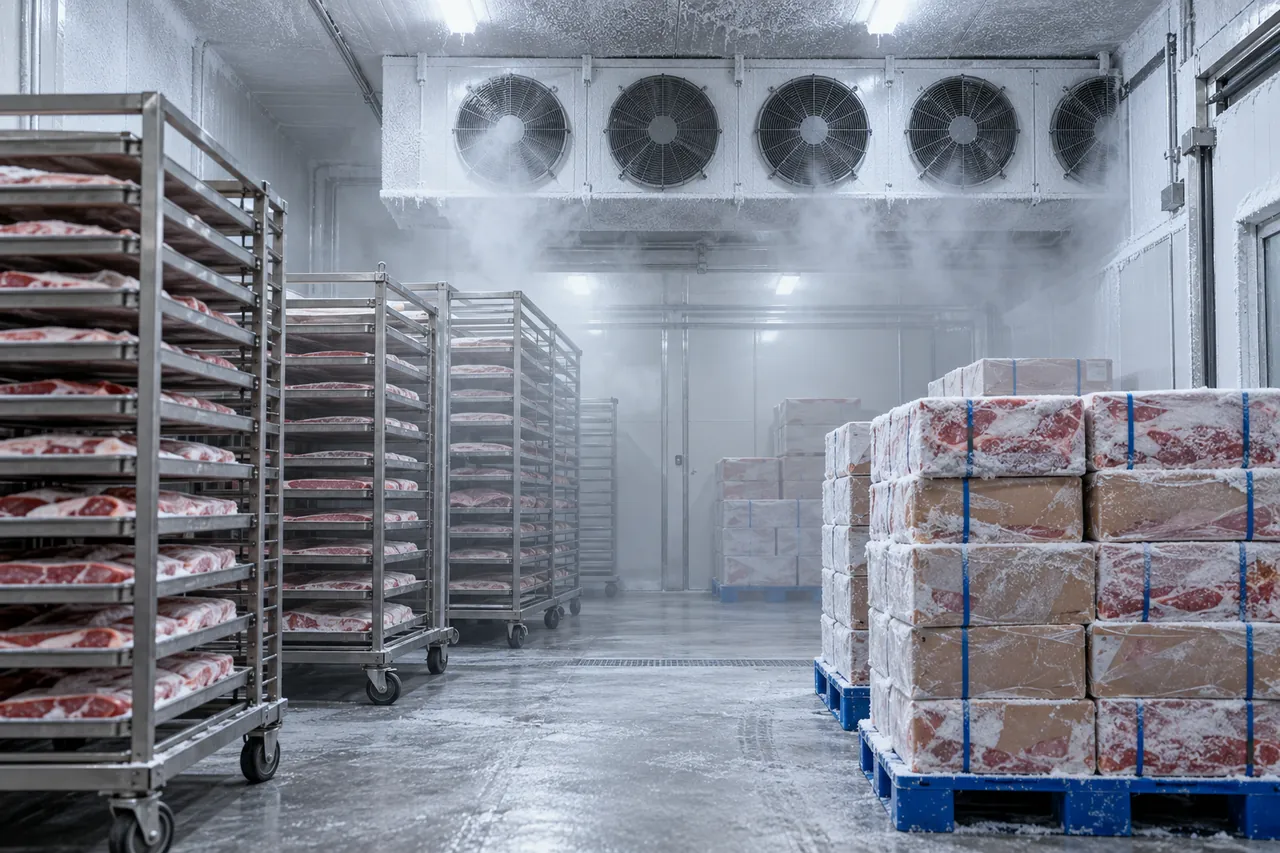
A blast freezer room is an insulated room in which high-velocity air at about −35 °C to −40 °C (−31 °F to −40 °F) is blown through trolleys, racks or pallets of product to freeze it to −18 °C (0 °F) at the core in hours rather than days. It freezes; it does not store. Once frozen, product moves to a holding freezer at −18 °C to −25 °C.
Good blast freezer room design balances five things: how much product you freeze per batch, how fast it must freeze, how air reaches every piece, how well the envelope keeps heat and moisture out, and a refrigeration plant sized for the peak load at the start of the cycle. Get any one wrong and the room either fails to freeze in time or ices up.
The reason for fast freezing is product quality: food that passes quickly through the −1 °C to −5 °C (30–23 °F) zone forms small ice crystals and loses less drip on thawing. The science is in what is a flash freezer.
Blast freezer room, cabinet or tunnel: which do you need?
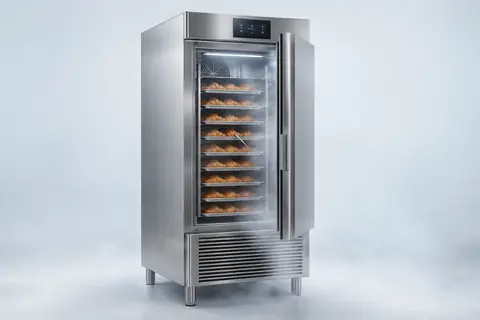
Choose by throughput: a reach-in or roll-in blast freezer cabinet for up to roughly 100 kg per cycle, a blast freezer room for hundreds of kilograms to tens of tonnes per batch, and a continuous IQF tunnel or spiral freezer when you freeze loose pieces at a steady hourly rate.
| Type | Typical capacity | Air temperature | Best for |
|---|---|---|---|
| Reach-in blast freezer (5–10 trays) | About 15–40 kg (35–90 lb) per cycle | −35 °C to −40 °C | Restaurants, bakeries, caterers |
| Roll-in blast freezer (up to 20 trays) | About 50–100 kg (110–220 lb) per cycle | −35 °C to −40 °C | Central kitchens, small processors |
| Blast freezer room (trolley or pallet) | 500–10,000+ kg per batch | −35 °C to −40 °C | Meat, poultry, fish, packaged ready meals, ice cream hardening |
| IQF tunnel / spiral blast freezer | 500–5,000 kg (1,100–11,000 lb) per hour | −35 °C to −40 °C | Loose shrimp, vegetables, fillets, nuggets |
Be There supplies reach-in and roll-in blast chillers and shock freezers from 5 to 20 trays, and blast room kits down to −35 °C. Continuous IQF lines are explained in the spiral and IQF tunnel freezer guide; liquid nitrogen options in the cryogenic freezer guide.
How do you size a blast freezer room?
Size a blast freezer room from the batch weight and the freezing time: batch weight = daily production ÷ number of cycles per day, and the cycle time is set by the thickest product you freeze. Room dimensions then follow from how many trolleys or pallets carry that batch with correct air gaps.
- Daily volume: e.g. 4,000 kg (8,800 lb) of packaged chicken per day.
- Freezing time: for 75 mm (3 in) packs on open trolleys, plan about 6–8 hours to −18 °C core, plus 1 hour for loading, unloading and defrost.
- Cycles per day: 24 h ÷ 9 h ≈ 2 cycles, so the batch is 2,000 kg.
- Trolleys or pallets: at about 200–250 kg per trolley, 8–10 trolleys; at 600–800 kg per pallet with spacers, 3 pallets.
- Room size: trolleys in rows with 50–100 mm (2–4 in) gaps between them, an air return path and a loading aisle. Ten trolleys in two rows typically fit a room about 6 × 4 m (20 × 13 ft) inside, 3–3.5 m high.
How product thickness changes freezing time
Freezing time rises steeply with thickness: doubling the thickness of a pack roughly doubles to quadruples the time. Packaging, carton walls and tight stacking add more.
| Product format | Typical time to −18 °C core at −35 °C air, good air flow |
|---|---|
| Unwrapped portions or trays, 25–50 mm (1–2 in) | 1–3 hours |
| Vacuum packs or trays, 50–75 mm (2–3 in) | 3–8 hours |
| Cartons of 10–25 kg on spaced pallets, 100–150 mm thick product | 12–24 hours |
| Tightly stacked cartons with no spacers | 24–72 hours (avoid) |
These are planning ranges; confirm with a trial on your own product and packaging using a core probe.
How should air flow in a blast freezer room?
Air in a blast freezer room must be forced through the product, not around it: air velocity across the product of about 2–5 m/s (400–1,000 ft/min), with baffles or a false ceiling that make air pass between trolleys or pallets before returning to the evaporator. Air that can bypass the load will.
- Evaporator placement: mount high-throw, low-temperature unit coolers at one end or along the ceiling, blowing along the length of the room. Long rooms may need a plenum or ducted air guide.
- Air guide or false ceiling: a sheet-metal or panel baffle over the load closes the gap between the top of the trolleys and the ceiling, so air goes through, not over.
- Spacing: leave 50–100 mm between trolleys and use pallet spacers or slatted pallets so air reaches every carton face.
- Return path: keep 600–1,000 mm (24–40 in) clear in front of the evaporator coil.
- Load evenly: a half-loaded row is a bypass channel; fill rows end to end or block gaps with blanking panels.
Fan power is significant. All fan energy ends up as heat inside the room, so blast room evaporators with large fans add several kilowatts to the refrigeration load. Our guide to evaporator coils and unit coolers covers fin spacing for frosting conditions; blast room coils typically use wide fin spacing of about 7–12 mm so they can carry frost between defrosts.
Panels, floor and door for a blast freezer room
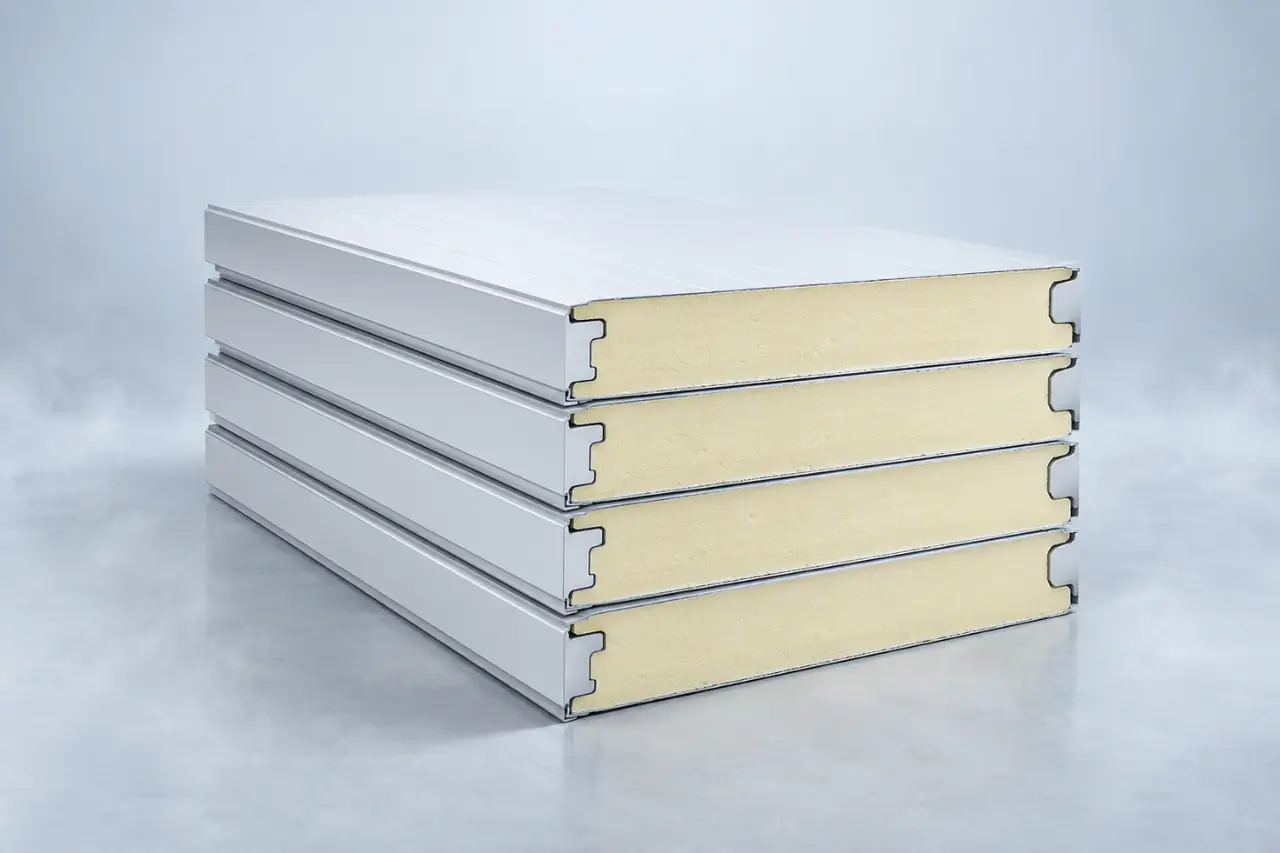
A blast freezer room needs 150–200 mm (6–8 in) PU or PIR panels, an insulated and heated floor, a heated-frame insulated door and a pressure relief valve. The temperature difference between the room and a hot plant can be 70 K or more, so every joint counts.
| Element | Recommended specification | Why |
|---|---|---|
| Wall and ceiling panels | 150–200 mm PU/PIR, λ ≈ 0.022 W/(m·K), cam-lock or tongue-and-groove | Limits heat gain at ΔT of 60–75 K |
| Floor | 150–200 mm XPS under a concrete wearing slab, with vapour barrier | Takes trolley and forklift loads; XPS absorbs under 1% water |
| Underfloor heating | Glycol pipes or electric mats, or ventilated sub-floor | Prevents frost heave of the ground |
| Door | Insulated hinged or sliding door with heated frame and gasket, inside safety release | Stops the door freezing shut |
| Pressure relief valve | Heated pressure balancing port, sized to the room volume | Air shrinks as it cools; without relief, the room pulls a vacuum that strains panels and locks the door |
| Lighting and fittings | Low-temperature LED fittings, heated drain lines | Standard fittings fail or ice up at −35 °C |
Be There supplies 150–200 mm PU and PIR sandwich panels up to 12 m long and XPS foam board with 150–700 kPa compressive strength for the floor. See the cold room panel thickness guide, the under-slab insulation guide and how to build a walk-in cold room for installation.
How do you calculate a blast freezer room's refrigeration load?
A blast room's refrigeration load is dominated by the product: the heat removed to cool it to freezing, freeze its water and cool it further to −18 °C, divided by the freezing time. Add panels, fans, trolleys and door losses, then a peak factor because product gives up heat fastest at the start of the cycle.
Worked example: 2,000 kg of packaged chicken, +5 °C to −18 °C in 8 hours
| Load | Calculation | Result |
|---|---|---|
| Cool to freezing point (about −2 °C) | 3.3 kJ/(kg·K) × 7 K | 23 kJ/kg |
| Latent heat of freezing | About 245 kJ/kg for chicken (≈ 73% water × 334 kJ/kg) | 245 kJ/kg |
| Cool frozen product to −18 °C | 1.7 kJ/(kg·K) × 16 K | 27 kJ/kg |
| Product total | 295 kJ/kg × 2,000 kg ÷ 28,800 s | 20.5 kW average |
| Peak factor for early pull-down | × 1.5 | 30.7 kW |
| Panels: 118 m² at U ≈ 0.147 W/(m²·K), 150 mm PU, ΔT 65 K | 118 × 0.147 × 65 | 1.1 kW |
| Evaporator fans | 3 fans × 1.1 kW | 3.3 kW |
| Steel trolleys, door and lighting | Allowance | 0.9 kW |
| Subtotal + 10% safety margin | 36.0 kW × 1.1 | about 40 kW at −42 °C evaporating |
Notice that the panels are under 3% of the load; product and fans are over 90%. That is why a blast room cannot be sized like a storage room by volume. For storage rooms, the cold room load calculator applies the same method with product, door and panel loads. Specific heats and latent heats vary by product, so use values for your product's water content.
Which refrigeration system and defrost suit a blast freezer?
A blast freezer room needs low-temperature refrigeration that keeps capacity at evaporating temperatures of about −40 °C to −45 °C (−40 °F to −49 °F): typically semi-hermetic two-stage or compound compressors, screw compressors on larger plants, or cascade systems, with hot-gas or electric defrost.
- Evaporating temperature: design about 6–8 K below the room air, so −42 °C evaporating for a −35 °C room.
- Compressors: single-stage compression loses efficiency and runs hot at these ratios; two-stage or compound units, often with economisers, are standard for industrial blast freezers. See hermetic, semi-hermetic and scroll compressors.
- Defrost: unwrapped product releases a lot of moisture, so coils frost fast. Plan a defrost at the end of each cycle and, for long cycles, mid-cycle; hot-gas defrost is quicker than electric on large coils.
- Controls: product core probes to end the cycle, room and coil sensors, and alarms connected to your temperature monitoring system.
Industrial blast chiller rooms for cooked food work the same way at warmer air temperatures (about −10 °C to 0 °C) and use medium-temperature refrigeration.
What does IQF mean in food?
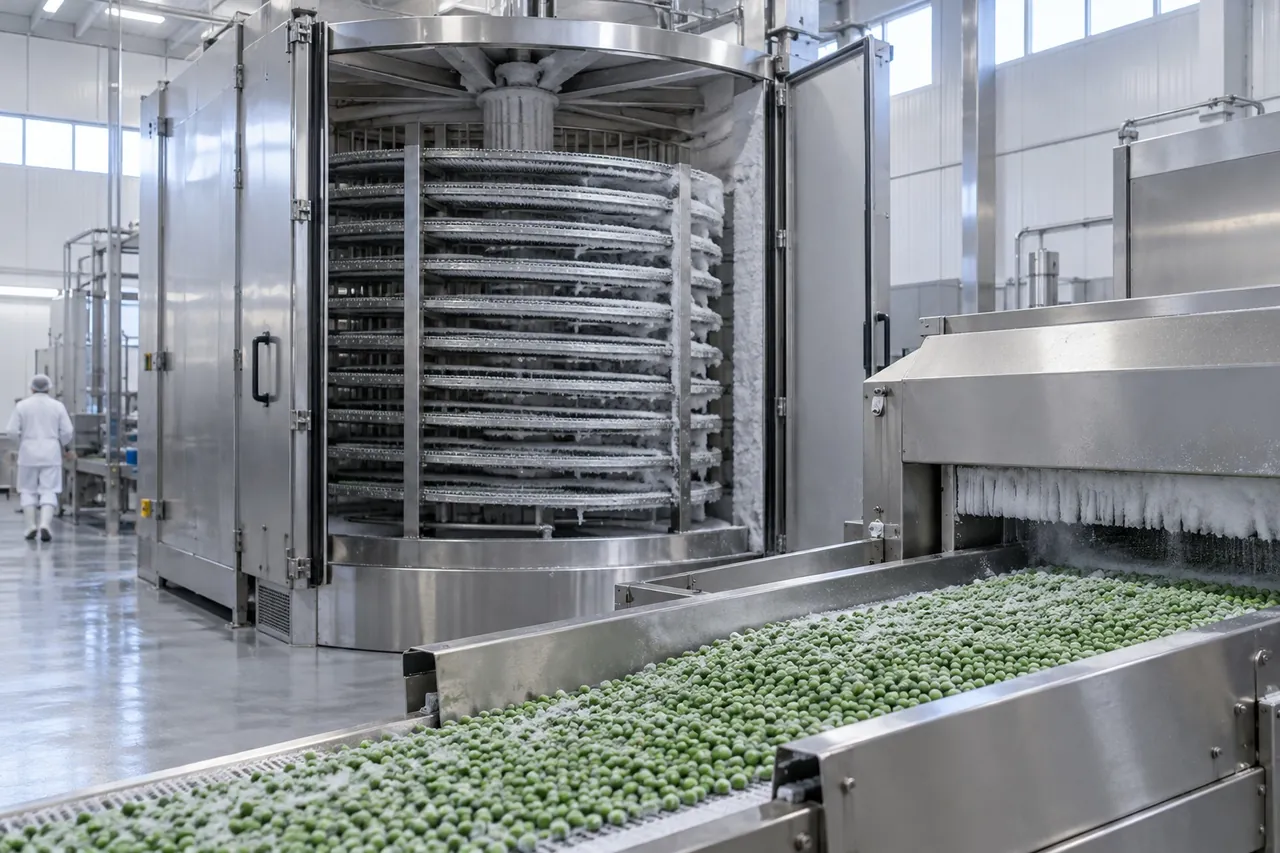
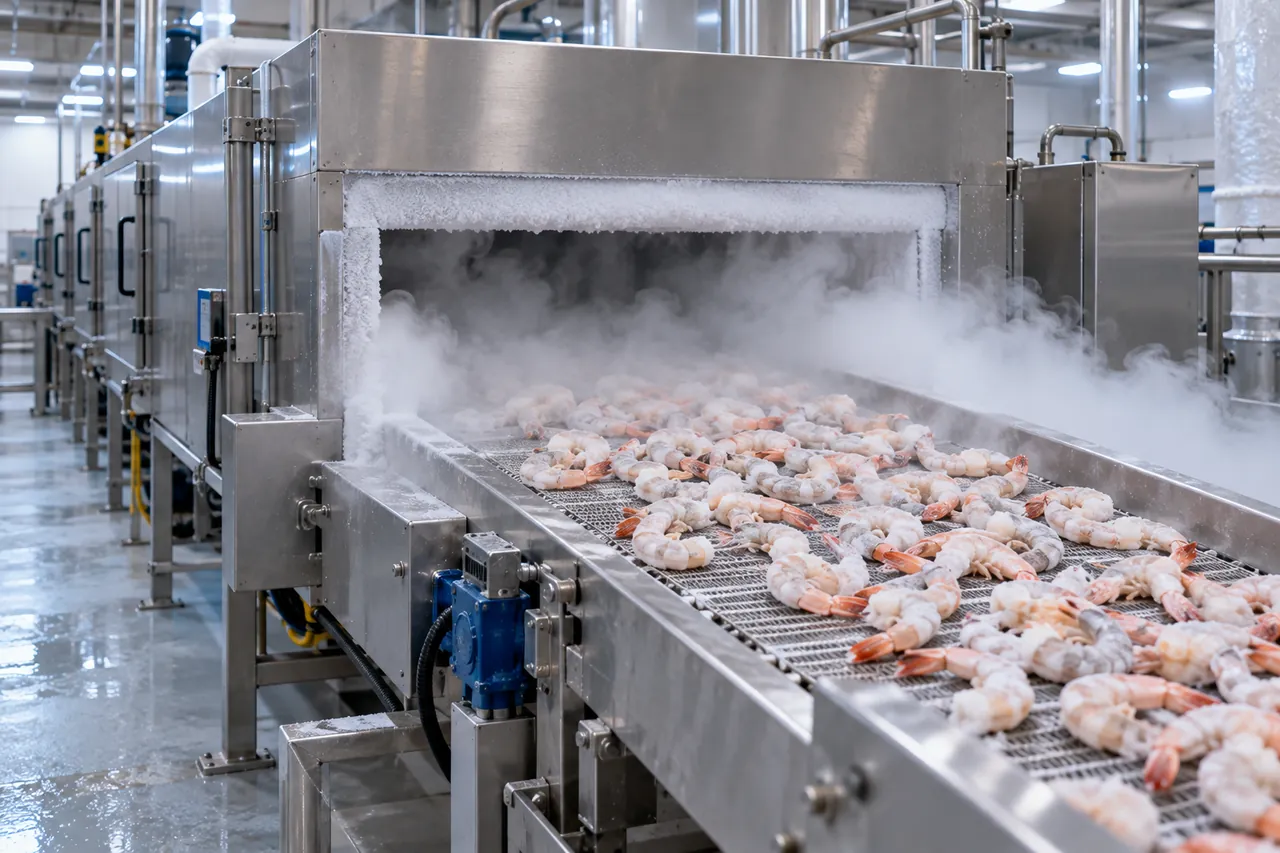
IQF stands for individually quick frozen (or individual quick freezing): each piece of food, such as a shrimp, pea, berry or chicken cube, is frozen separately and fast, so the pieces stay loose instead of freezing into a block. IQF shrimp, IQF fish and IQF meat can be poured out and portioned without thawing the whole pack.
How does IQF work? Product travels on a mesh belt or is lifted on a fluidised bed of cold air at about −35 °C to −40 °C, so cold air reaches every surface and pieces do not touch while they freeze. Seafood is often glazed with a thin coat of ice afterwards to protect it from drying in storage. A static blast freezer room is not an IQF freezer: it freezes packs, trays and cartons, and loose pieces in it stick together. IQF freezing equipment means tunnels, spiral blast freezers and fluidised-bed freezers, covered in our IQF tunnel and spiral freezer guide.
Should you buy a new or used blast freezer?
A used commercial blast freezer for sale can be good value if its refrigerant is still serviceable in your market, its compressors and evaporator fans pass a pull-down test to −35 °C, and the panels and door are dry and undamaged. Many used units fail on the last point: waterlogged insulation and cracked floors are common after years at −35 °C.
For blast rooms, the panels, floor and door are site-specific, so used rooms rarely move well. Check the points in our used vs new commercial refrigeration guide, and compare with new prices before deciding. Indicative costs depend heavily on capacity, refrigerant and market, so get like-for-like quotes.
Blast freezer room design checklist
Use this checklist before asking for quotations, so every supplier designs to the same brief.
- Product, packaging, thickness and entry temperature.
- Daily volume, batch weight and required freezing time to −18 °C core.
- Trolley, rack or pallet format and the room's internal size with air gaps.
- Room air temperature (−35 °C to −40 °C) and air velocity across product (2–5 m/s).
- 150–200 mm PU/PIR panels, XPS floor with heating, heated door and pressure relief valve.
- Refrigeration load from product, fans and envelope, with a peak factor and safety margin.
- Low-temperature compressor type, defrost method and controls with core probes.
- Holding freezer capacity for product leaving the blast room.
- Voltage, refrigerant rules and certification in your market.
Be There supplies reach-in and roll-in blast chillers and shock freezers from 5 to 20 trays, and complete blast room kits down to −35 °C with 150–200 mm PU or PIR panels, XPS floor board, heated doors, pressure relief valves, matched low-temperature condensing units and evaporators, plus walk-in holding freezers at −18 °C to −25 °C. Send your product, packaging, daily volume, target freezing time and voltage through the inquiry form and our engineers will design the room and quote FOB, CIF or DDP.