Short answer
A used commercial refrigerator is worth buying when it is under about half its typical service life, runs on a refrigerant still serviceable in your market, matches your voltage, holds temperature in a pull-down test and has clean coils, tight gaskets and dry insulation. Reach-in units typically last 10–15 years and ice machines 7–10, so older equipment often costs more in energy and repairs than it saves.
Key takeaways
- Check the nameplate first: age, refrigerant, voltage, frequency and certification decide whether a used unit is even usable.
- Run a pull-down test: an empty fridge should reach and hold +2 °C to +5 °C (36–41 °F), and a freezer −18 °C (0 °F), without the compressor running constantly.
- R22 production and import ended in the US in 2020, and EU rules restrict servicing older high-GWP systems, so old refrigerants can make repairs expensive.
- Walk-in cooler panels can often be reused if cam-locks, skins and foam are undamaged, but the refrigeration system must be re-sized for the new room.
- Used reefer trucks and trailers need checks on unit engine hours, box insulation and ATP or local certification status.
Should you buy a used commercial refrigerator or new?
A used commercial refrigerator can be a sound buy when it is young, well maintained and suited to your power supply and refrigerant rules. It becomes a false economy when it is near the end of its life, runs on a refrigerant that is hard to service, or has wet insulation that no repair will fix. The same logic applies to used commercial freezers, walk-in coolers, ice machines, soft serve machines and refrigerated vehicles.
Refrigeration is different from most second-hand equipment because the expensive failures are invisible. A cabinet can look spotless and still have a tired compressor, a slow refrigerant leak or foam insulation soaked with water. You only find out when it fails to hold temperature on the hottest day of the year, with stock inside.
This guide gives you an inspection checklist for each common category, typical service lives, and the cases where buying new, including importing directly from a manufacturer, makes more sense. Be There builds new commercial refrigeration equipment, so we have an interest in new sales; we have tried to be fair about when used equipment is the better choice.
The short version: buy second-hand commercial refrigeration from sellers who let you test it running, ask for its service history, and check the nameplate before you discuss price.
Used vs new commercial refrigeration compared
| Factor | Used or second-hand | New |
|---|---|---|
| Purchase price | Often half of new or less; varies with age and demand | Higher; quoted per order by size and spec |
| Warranty | Usually none, or a short dealer warranty on refurbished units | Manufacturer warranty on parts, often longer on compressors |
| Energy use | Older compressors, fans and lighting often use more power | Current efficiency standards, LED lighting, EC fans |
| Refrigerant | May use R22, R404A or other phased-down gases | Current options such as R290, R600a or lower-GWP blends |
| Certification | Must match your market; labels may be missing | Specified for your market, such as UL/ETL, NSF or CE |
| Voltage | Fixed by the original market, e.g. 115 V/60 Hz | Built to your supply, e.g. 220–240 V/50 Hz |
| Remaining life | Unknown; depends on hours and maintenance | Full service life |
| Availability | Immediate, if local | Production plus shipping lead time |
Used equipment wins on speed and up-front cost. New equipment wins on predictability, energy and compliance. For a pop-up, a short lease or a test concept, used often makes sense. For a core asset you will run for a decade, the lifetime cost of new is frequently lower.
How to inspect any used commercial fridge or freezer
Use this checklist for reach-in fridges, used commercial freezers, chest freezers, display refrigerators and used beverage coolers.
- Read the nameplate. Note the manufacture date, refrigerant type and charge, voltage, frequency and amps, and any certification marks. A used 115 V/60 Hz unit will not run properly on 230 V/50 Hz without conversion.
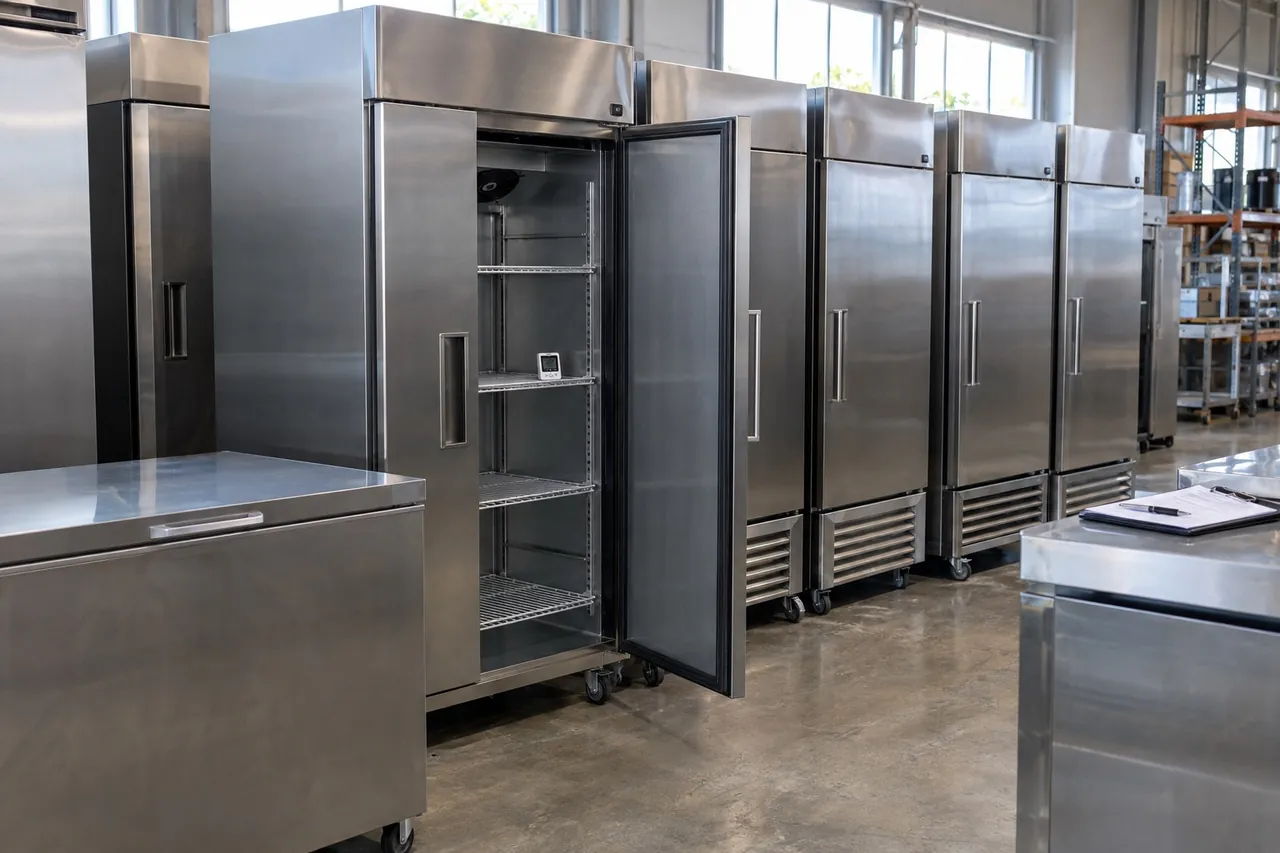
- Run a pull-down test. Ask for the unit to be switched on several hours before you arrive, or run it yourself. An empty fridge should reach +2 °C to +5 °C (36–41 °F) and a freezer −18 °C (0 °F) or colder, then cycle off. A compressor that never stops is a warning sign.
- Check the compressor. Listen for knocking or hard starts. Look for oil stains at joints, which can indicate a refrigerant leak.
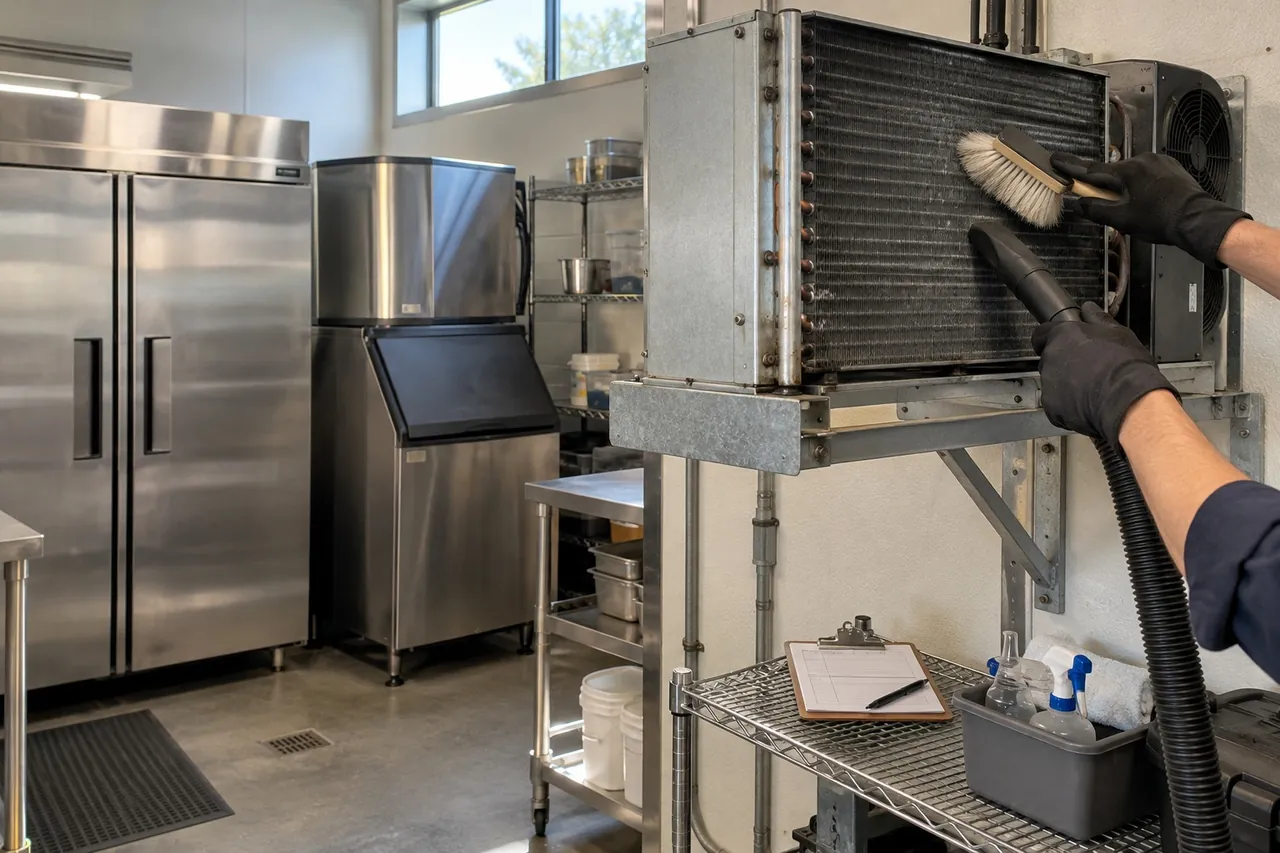
- Inspect coils. A clogged condenser shortens compressor life. Corroded or bent evaporator fins reduce capacity.
- Check gaskets, hinges and doors. Close a door on a sheet of paper; it should grip. Torn gaskets let in warm air and ice up the evaporator.
- Look for wet insulation. Condensation or frost on the outside of the cabinet, rust bubbles or a heavy, sagging door suggest water in the foam.
- Check controls and lights. Test the thermostat or controller, defrost, fans and lighting.
- Ask for history. Service records, reason for sale and parts availability.
Used walk-in coolers and walk-in freezers: what to check
A used walk-in cooler or used walk-in freezer is really two purchases: the insulated box and the refrigeration system. Judge them separately.
The panels
Sectional cam-lock panels can usually be dismantled and rebuilt. Check that every cam-lock turns and engages, panel skins are not dented or delaminated, and the foam is dry. Panels that were glued, screwed or foamed in place often break when removed. Freezer panels should be at least 100–150 mm (4–6 in) thick; a cooler box cannot usually be converted into a freezer without thicker panels, a heated or insulated floor and a new door with heater wires.
The floor and door
Used walk-in freezers need an insulated floor with protection against frost heave. Check the door closer, gasket, heater strips and threshold.
The refrigeration
The condensing unit and evaporator were sized for the original room, climate and product load. If your room is larger, hotter or loaded with warm product, the old system may be too small. Recalculate the load for your room, climate and product before you buy.
Be There supplies new walk-in cold room kits with PU or PIR panels of 75–200 mm, door, matched refrigeration and controller, which can be compared directly with the cost of moving and rebuilding a used box.
Used ice machines and ice makers: what to look for
A used ice machine or second-hand ice maker for sale is one of the riskier refrigeration purchases, because it handles water constantly and scale damage is hard to see. Commercial ice machines typically last about 7–10 years with good maintenance.
- Scale: look at the evaporator, water distribution tube and sump. Heavy white or grey deposits mean poor maintenance and possible coating damage.
- Hygiene: check the bin, chute and water system for slime, mould or odour. Plan a full clean and sanitise before use whatever you buy.
- Output test: run the used commercial ice machine for a full cycle, weigh the harvest and compare with its rating. A machine that has lost a lot of output has a hidden fault.
- Harvest: cubes should release cleanly and evenly. Stuck slabs or partial harvests point to scale, valves or sensors.
- Bin: check the liner for cracks and the insulation for water; bins are often sold separately from the head.
- Water-cooled units: check the condenser for scale and local rules on once-through water cooling.
Then budget for a new water filter, a full clean, and possibly a new water pump and inlet valve. If a used commercial ice maker for sale is close to the price of new after those costs, compare it with new commercial ice machines from 25 kg (55 lb) to 20 t per day.
Used soft serve, ice cream and blast freezer equipment
A used soft serve machine or used ice cream machine for sale deserves extra care because it handles dairy mix, which is a food-safety risk if hoppers or cylinders do not hold temperature.
- Hopper refrigeration: mix must be held below +5 °C (41 °F). Test it with a thermometer over several hours.
- Freezing cylinder and beater: check for scoring, worn scraper blades, and noise from the gearbox or drive belt.
- Seals and O-rings: these wear and are cheap, but check that the correct kit is still available.
- Serving temperature: product should come out at about −6 °C to −4 °C (21–25 °F) with consistent texture.
- Cleaning history: ask how often it was disassembled and cleaned.
The same applies to a used gelato machine or used batch freezer: inspect dasher blades, cylinder surface and compressor. For a used blast freezer, check that it still reaches its rated air temperature, typically −35 °C to −40 °C for shock freezing, and that the core probe and controller work. A blast chiller is used to cool cooked food from +70 °C to +3 °C (158 °F to 37 °F) in about 90 minutes; if a used one cannot meet that, it fails its purpose.
Be There supplies new soft serve and frozen yogurt machines making about 18–36 litres per hour with refrigerated hoppers.
Used reefer trailers, refrigerated trucks and food vans
Used reefer trailers for sale, used refrigerated trucks and used food vans combine vehicle risk with refrigeration risk. Have the vehicle inspected by a mechanic, then check the cold side separately:
- Refrigeration unit hours: diesel-driven units have their own engine hours; electric standby hours matter too. Ask for service records.
- Pull-down test: the box should reach its set point, for example −20 °C (−4 °F) for frozen, in a reasonable time and hold it with doors closed.
- Box insulation: insulation performance declines with age and damage. Look for delamination, soft floors, damaged door seals and water in the walls.
- Certification: in countries that use ATP, check the certificate class and expiry. Elsewhere, check local food transport rules.
- Refrigerant and parts: confirm the refrigerant and that parts for the unit are still available.
Food trucks used for cooking add gas, electrical and fire-safety checks that are outside this guide; check that fridges, freezers and any ice cream equipment on board are sized for the generator or shore power.
If the vehicle or box is sound but the refrigeration unit is worn, replacing only the unit can be cheaper than buying a different truck. Be There supplies truck refrigeration units for 4–45 m³ boxes, engine-driven, independent diesel or electric, holding −20 °C to +15 °C (−4 °F to 59 °F).
How long does commercial refrigeration last?
Typical service life is the best guide to what a used price is worth. If a unit has used most of its expected life, discount it heavily or walk away.
| Equipment | Typical service life with good maintenance | Main wear items |
|---|---|---|
| Reach-in fridge or freezer | About 10–15 years | Compressor, fans, gaskets |
| Glass door display or beverage cooler | About 8–12 years | Compressor, door heaters, lighting |
| Commercial ice machine | About 7–10 years | Water pump, valves, evaporator |
| Walk-in panels (box) | Often 20 years or more | Door, gaskets, floor |
| Walk-in condensing unit | About 10–15 years | Compressor, fan motors |
| Soft serve machine | About 10 years or more | Beaters, seals, gearbox |
These are typical ranges reported across the industry, not guarantees; harsh climates and poor maintenance shorten them. Add expected energy use and repairs to the purchase price before comparing. If you are weighing new equipment from abroad, our guide to importing refrigeration equipment from China covers voltage, certification, Incoterms and inspection.
Next steps: used or new checklist
- Confirm voltage, frequency, refrigerant and certification on the nameplate before negotiating.
- Test it running: pull-down, cycling and, for ice machines, a weighed harvest.
- Inspect coils, gaskets, insulation and the compressor area for oil stains.
- Ask for service records and confirm parts are available for your market.
- Add the cost of transport, installation, cleaning and likely repairs.
- Compare the total with new equipment that carries a warranty.
Pay particular attention to refrigerant. R22 production and import ended in the US on 1 January 2020, so servicing an R22 unit now relies on reclaimed gas. In the EU, the F-gas rules have restricted servicing larger systems that use very high-GWP gases such as R404A with virgin refrigerant since 2020. Older equipment can still run legally in most markets, but a leak can turn a cheap unit into an expensive repair.
If the numbers favour new, send us your requirements and we will quote matched equipment from our full product range on FOB, CIF or DDP terms. Request a quote and we reply within one working day.