Short answer
A cold room temperature monitoring system uses NTC or RTD sensors, a data logger recording every 5–15 minutes and alarms sent by SMS, app or phone call. Set chillers to alarm above +5 °C to +8 °C (41–46 °F) and freezers above −15 °C to −12 °C (5–10 °F), with a 15–60 minute delay so defrost cycles do not trigger false alarms.
Key takeaways
- A temperature monitoring system combines sensors, a data logger, a gateway or cloud platform and escalating alarms.
- NTC thermistors read about ±0.5 °C and suit food rooms; Pt100 RTD sensors are more stable for pharma and reference use.
- Insulated metal panels block Wi-Fi, so use an external probe lead, an external antenna, sub-GHz radio or cellular sensors.
- Typical freezer alarm settings are −15 °C to −12 °C (5–10 °F) with a 30–60 minute delay to cover defrost.
- CDC VFC guidance asks for digital data loggers accurate to ±0.5 °C (±1 °F) logging every 30 minutes or less.
What is a cold room temperature monitoring system?
A temperature monitoring system for a cold room is a set of sensors, a data logger and an alarm that measures the air (and often product) temperature continuously, records it at fixed intervals and warns you when it leaves a safe band. For a chiller that band is usually 0 °C to +5 °C (32–41 °F); for a freezer it is −18 °C (0 °F) or colder.
The refrigeration controller on your walk-in already reads a sensor to switch the compressor, but it is not a record. A separate system answers the questions an inspector, insurer or customer will ask: what was the temperature at 3 a.m. last Tuesday, how long was it out of range, and who was told?
Most cold room temperature monitoring setups have four parts:
- Sensors temp probes – thermistor, RTD or thermocouple probes, plus a temp and humidity sensor where moisture matters.
- Data logger – stores readings every 1–30 minutes, either standalone or inside a wireless transmitter.
- Gateway or cloud platform – collects data from wireless temperature sensors over Wi-Fi, LoRa, cellular or Bluetooth.
- Alarms – local siren and light, plus SMS, app, e-mail or phone-call alerts for remote temperature monitoring.
Whether you run a single walk-in cooler or freezer or a whole warehouse, the principle is the same; only the number of sensors and the reporting change.
Which temperature sensors work best in coolers and freezers?
Three sensor technologies cover almost every cold room and freezer. The choice depends on accuracy, temperature range and budget more than on brand.
| Sensor type | Typical range | Typical accuracy | Best use |
|---|---|---|---|
| NTC thermistor | −50 °C to +110 °C (−58 °F to 230 °F) | ±0.2–0.5 °C (±0.4–0.9 °F) | Refrigerator temp sensors, controllers, wifi temperature sensors |
| RTD (Pt100 / Pt1000) | −200 °C to +500 °C (−328 °F to 932 °F) | Class A ±0.15 °C, Class B ±0.3 °C at 0 °C | Industrial temperature sensors, warehouses, pharma, reference probes |
| Thermocouple (type T) | −200 °C to +350 °C (−328 °F to 662 °F) | About ±1 °C (±1.8 °F) | Blast freezer core probes, thermocouple data logger for mapping |
| Capacitive humidity sensor | 0–100% RH | ±2–3% RH | Temperature and humidity sensor for produce rooms and dry stores |
RTD temp sensors (a Pt100 reads 100 Ω at 0 °C) are the most stable over years, which is why they are used for industrial temperature monitoring and as reference probes. NTC thermistors are cheaper and accurate enough for food storage in the −40 °C to +40 °C band. Thermocouples are rugged and fast but less accurate, so they suit core-temperature probes in a blast freezer more than room air.
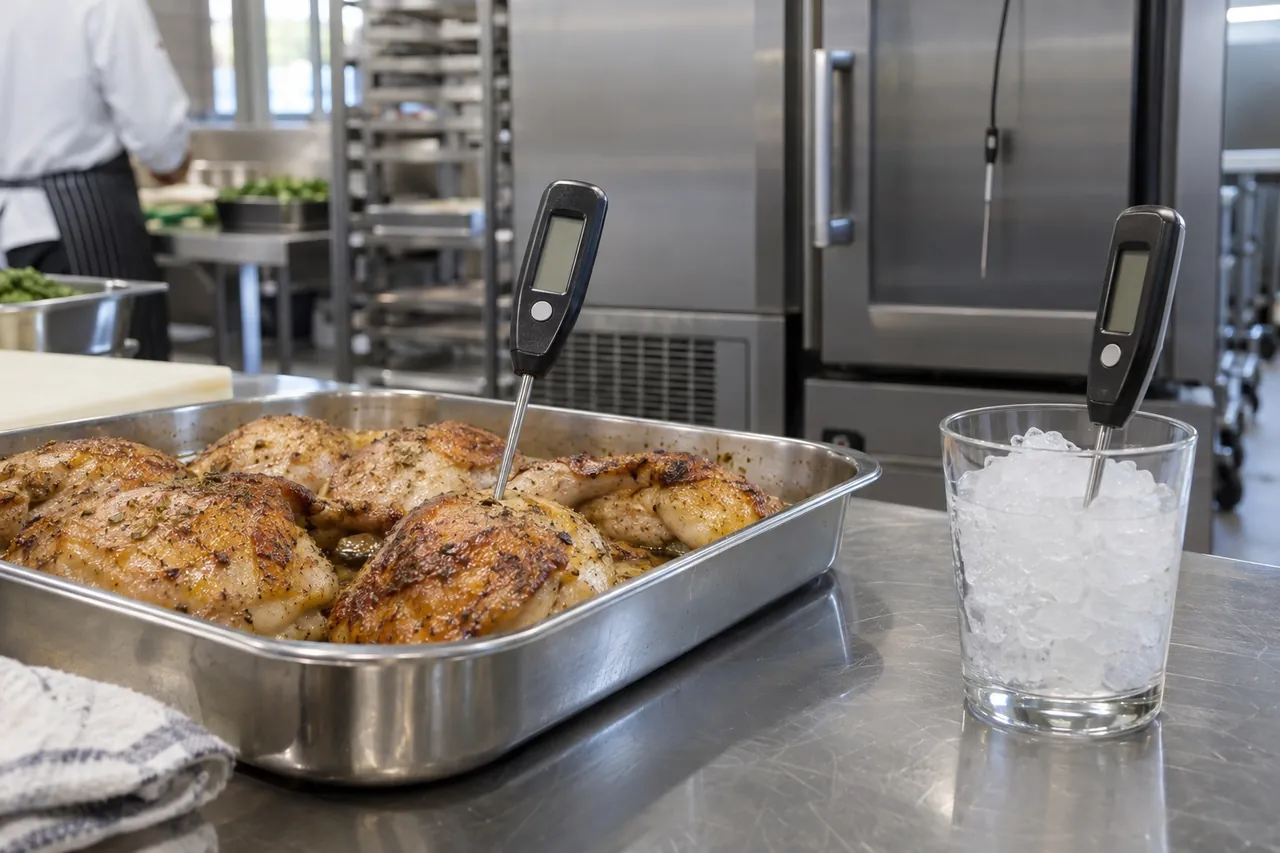
For product temperature, put the probe in a buffer (a small bottle of glycol or glass beads). It slows the reading to match the food, so a door opening does not trigger a false alarm. Our food temperature probe guide covers probe calibration in more detail.
Temperature data logger vs wireless temperature monitoring: which do you need?
A temperature data logger is a small battery-powered device that records readings to memory; you download it by USB, NFC or Bluetooth. A wireless temperature monitoring system sends every reading to a gateway or the cloud in real time, so you can see it on a phone and get alerts. Many businesses use both: fixed wireless sensors in the rooms and portable data loggers in shipments.
| Option | How data gets out | Alerts | Typical use |
|---|---|---|---|
| USB / NFC data logger | Manual download | Local LED only | Spot checks, shipments, temperature mapping |
| Bluetooth data logger | Phone app within about 10–30 m | When a phone is nearby | Small kitchens, delivery vans |
| Wi-Fi temperature sensor | Site Wi-Fi to cloud | App, e-mail, SMS | Restaurants, shops, single walk-ins |
| LoRa / sub-GHz wireless sensor | Long-range radio to a gateway | App, SMS, call | Warehouses, multi-room sites |
| Cellular (LTE-M / NB-IoT) monitor | Mobile network, no Wi-Fi needed | SMS, app, call | Remote sites, containers, reefers |
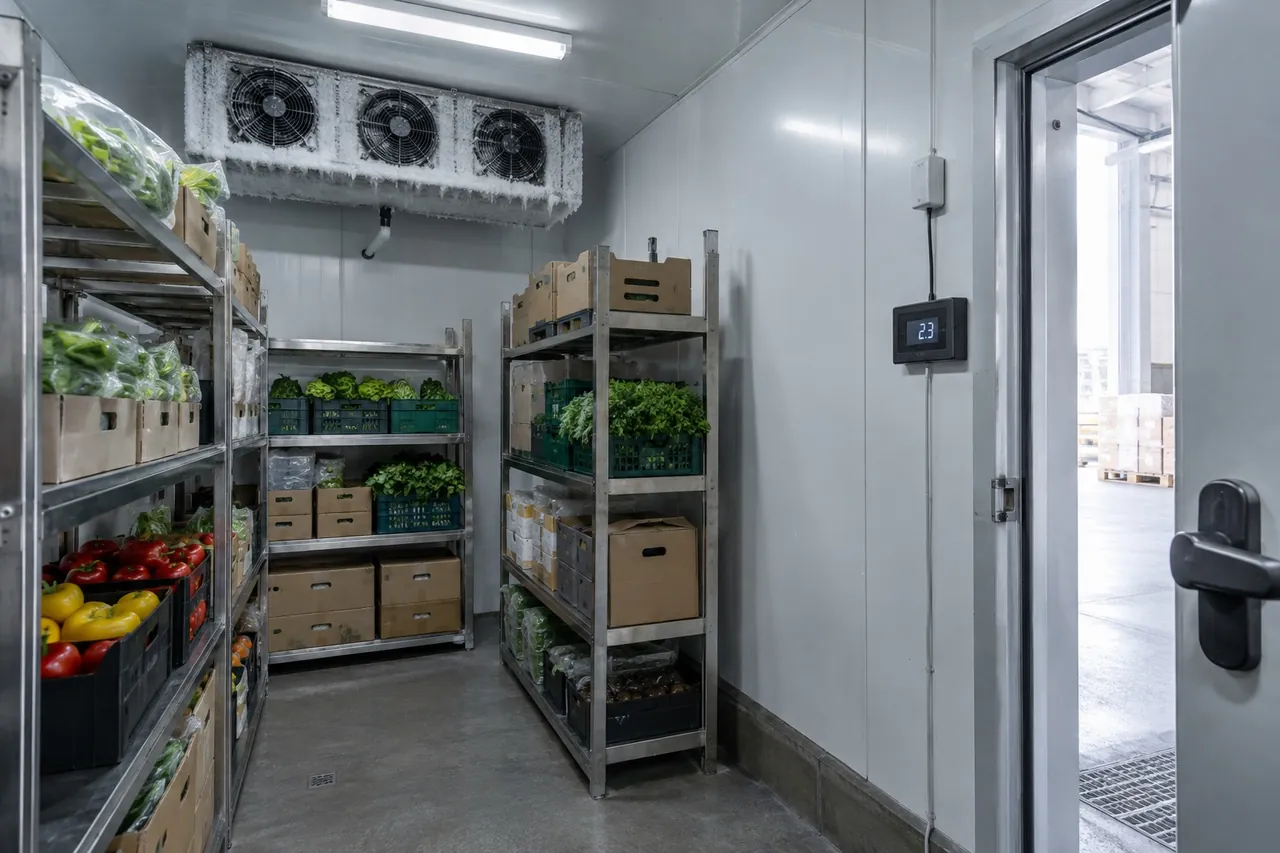
A practical warning: a cold room is a steel box. Insulated panels with metal skins block Wi-Fi and Bluetooth, so a wifi thermometer inside the room may not reach your router. Choose a wireless temp sensor with an external probe on a flat cable through the door seal, an external antenna, or a sub-GHz system whose signal penetrates better. Test the signal with the door closed before you mount anything.
Look for a digital data logger that keeps logging if the network drops and uploads the gap later; otherwise an outage leaves holes in your records.
Where should you place sensors in a cold room?
One sensor in the wrong place can say the room is fine while the back shelf is warm. Follow these placement rules for refrigeration monitoring:
- Not in the evaporator air stream. Air leaving the coil is several degrees colder than the room; air entering it is warmer. Mount the main sensor at product height in the middle of the room, 30–50 cm (12–20 in) from walls.
- Not next to the door. Every opening brings warm air in. A second sensor near the door is useful for detecting doors left open, but not as the compliance reading.
- Warmest spot for compliance. The FDA Food Code expects the thermometer in cold holding equipment to read the warmest part of the unit, usually near the door at the top shelf or the far corner away from the evaporator.
- One sensor per room, more for large rooms. Small walk-ins need one or two; a warehouse usually needs a grid based on a temperature mapping study.
Temperature mapping for warehouses
Before choosing permanent positions in a warehouse or pharmaceutical store, run a mapping study: place 10–30 data loggers at different heights and corners, record for at least 24–72 hours (and in summer and winter for regulated goods) and find the hot and cold spots. The permanent warehouse temperature monitoring system then watches those spots. Mapping also shows whether the refrigeration is undersized – something you can check with our cold room load calculator.
What should a freezer alarm and cooler alarm be set to?
Set alarms close enough to catch a failure early, but with a delay so defrost cycles and deliveries do not cause constant false alarms. The values below are common starting points; adjust them to your product and your HACCP plan.
| Room | Set point | High alarm | Low alarm | Typical delay |
|---|---|---|---|---|
| Chiller / walk-in cooler | +2 °C to +3 °C (36–37 °F) | +5 °C to +8 °C (41–46 °F) | 0 °C (32 °F) | 15–30 min |
| Vaccine / pharma fridge | +5 °C (41 °F) | +8 °C (46 °F) | +2 °C (36 °F) | Short, product buffered |
| Walk-in freezer | −20 °C (−4 °F) | −15 °C to −12 °C (5–10 °F) | −30 °C (−22 °F) | 30–60 min (covers defrost) |
| Ice cream store | −25 °C (−13 °F) | −18 °C (0 °F) | −35 °C (−31 °F) | 30–60 min |
A good freezer temperature alarm system escalates: first a local buzzer and light, then an SMS or app push to the duty manager, then a phone call to a second person if nobody acknowledges within 15–30 minutes. Add a door-open alarm (typically 2–5 minutes), a power-failure alarm and a low-battery warning. A freezer alarm that connects to phone networks over cellular keeps working when the site internet goes down with the power.
Low alarms matter too: a stuck contactor can freeze lettuce in a chiller or dairy products just as surely as a failure can warm them.
Do you need a temperature and humidity sensor?
For frozen food, humidity is rarely logged. For fresh produce, flowers, cheese, chocolate, dry stores and pharmaceuticals, it often matters as much as temperature, so a temperature and humidity data logger is worth the small extra cost.
- Fresh fruit and vegetables: most need 85–95% relative humidity (RH) to avoid wilting and weight loss; leafy greens and carrots want 95–100% RH.
- Onions, garlic and dried goods: need dry air, around 65–70% RH, or they sprout and grow mould.
- Cheese ageing rooms: commonly 80–90% RH at +8 °C to +13 °C (46–55 °F).
- Pharmaceutical and climate-controlled stores: many labels specify both a temperature band and a maximum RH.
Capacitive humidity sensors read about ±2–3% RH when new but drift with time, condensation and cleaning chemicals, so check them against a reference at least once a year. Mount a wireless humidity sensor away from the evaporator and the door, where air is mixed. If readings stay near 100% RH in a chiller, look for a missing door seal or warm, wet product being loaded; if they are very low, the evaporator may be undersized and running too cold.
Our cold storage temperature chart lists temperature and humidity targets by product.
What do HACCP, FDA and VFC rules require for temperature logging?
Rules differ by market and product, but these are the references buyers most often meet:
- FDA Food Code (US): cold-held TCS food at 5 °C (41 °F) or below; air thermometers in cold holding units accurate to ±1.5 °C (±3 °F). It does not require electronic logging, but local inspectors expect records under a HACCP plan.
- HACCP: cold storage is a critical control point. You need a critical limit, a monitoring frequency, corrective actions and kept records. Continuous temperature monitoring with automatic records meets this more reliably than a clipboard twice a day.
- EN 12830 (EU): the standard for temperature recorders used in the storage and transport of chilled and frozen food; EU rules call for recorders that conform to it for quick-frozen food.
- VFC temperature log (US vaccines): CDC guidance for the Vaccines for Children program asks for a digital data logger with a buffered probe, accuracy of ±0.5 °C (±1 °F), a logging interval of 30 minutes or less, min/max display, alarm and a valid calibration certificate. Fridges hold 2–8 °C (36–46 °F).
- Electronic records: in US pharmaceutical work, systems may need to meet 21 CFR Part 11 (audit trail, user log-ins, no editable data).
Whatever the rule, keep calibration certificates, check sensors against a reference thermometer at least yearly, and store logs for the period your regulator or customer requires – often two to three years.
Checklist: how to choose a temperature monitoring system
Use this list when comparing temperature monitoring devices, from a single wifi freezer alarm to an industrial temperature monitoring system:
- Count the points. One sensor per small room, a mapped grid for warehouses, plus door and power alarms.
- Match the sensor to the range. NTC for food rooms, RTD for pharma and reference, thermocouple for blast freezer core probes. Ultra-low freezers need sensors rated to −80 °C (−112 °F).
- Prove the connection. Test Wi-Fi or radio with the cold room door closed; choose cellular for remote sites.
- Check the logger. Interval of 15 minutes or less, local memory for network outages, battery life, and exportable reports (PDF/CSV).
- Set escalating alarms with delays and at least two contacts.
- Plan calibration and buy probes with a certificate traceable to national standards.
Is a home temperature monitor or wireless fridge thermometer enough? For a domestic-style fridge in an office, yes. For a commercial walk-in holding stock worth thousands, choose a commercial system with escalation, audit-ready records and calibration support.
Be There supplies complete walk-in cold room kits with a digital controller. If you need a controller with an alarm relay or a remote monitoring option, list it in your quotation request and we will confirm what is available for your room.