Short answer
A spiral freezer carries food on a belt that winds up around a rotating drum through air at about −35 °C to −40 °C (−31 °F to −40 °F), freezing 500–5,000 kg (1,100–11,000 lb) per hour in a small footprint. IQF tunnel freezers use a straight belt or fluidised bed; nitrogen freezers spray liquid nitrogen at −196 °C (−321 °F) for freezing in minutes.
Key takeaways
- Individual quick freezing (IQF) freezes each piece separately so berries, peas, shrimp or diced meat stay free-flowing in the bag.
- Mechanical IQF and spiral freezers run air at about −35 °C to −40 °C (−31 °F to −40 °F) and reach −18 °C (0 °F) at the core in roughly 3–60 minutes depending on product size.
- A nitrogen freezer uses liquid nitrogen at −196 °C (−321 °F) and typically consumes about 1–1.5 kg of nitrogen per kg of product frozen.
- Spiral freezers suit long dwell times and large output in a small floor area; straight tunnels suit thin products and lower budgets.
- Below roughly 200–300 kg (440–660 lb) per hour, batch blast freezers or a blast room are usually cheaper than a continuous line.
What is a spiral freezer and how is it different from a tunnel freezer?
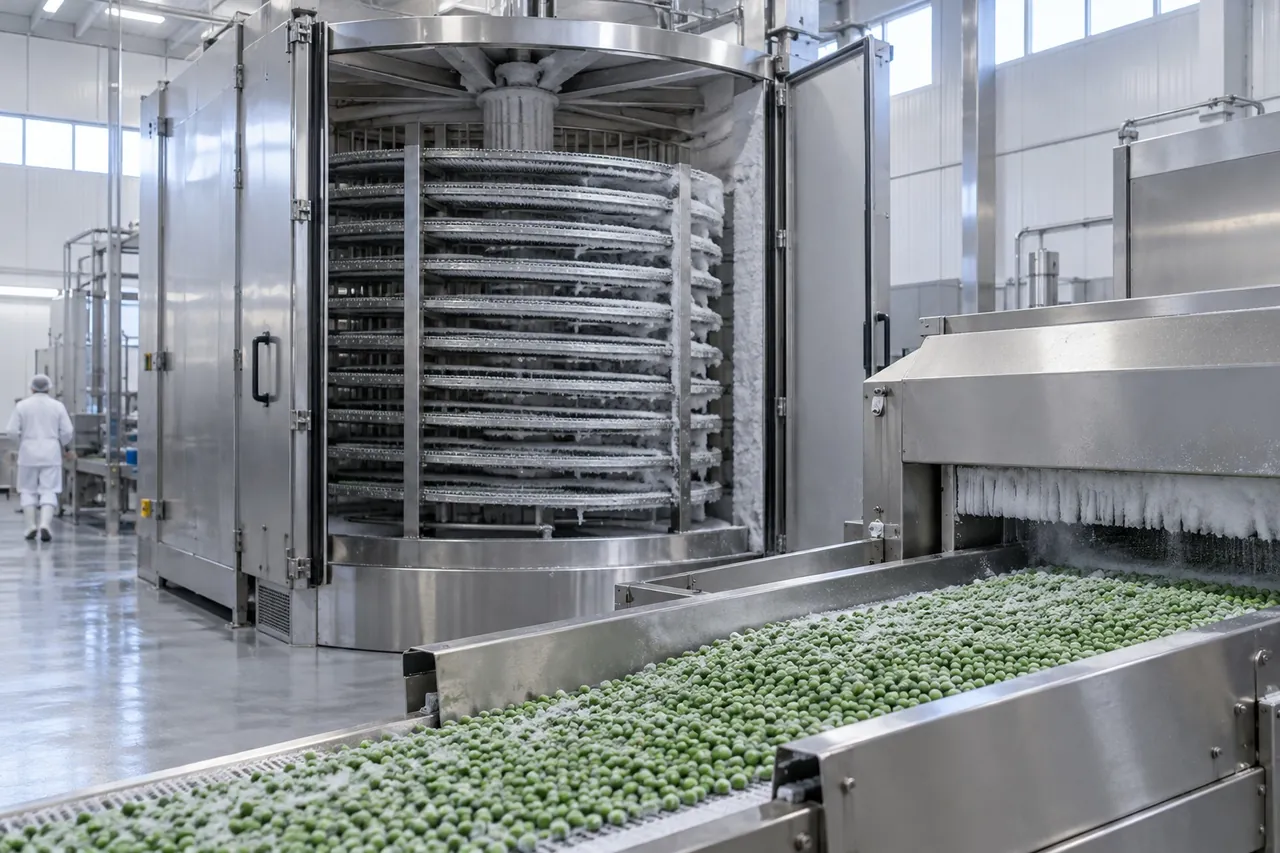
A spiral freezer is a continuous freezer in which a flexible stainless steel belt winds upward (or downward) in a helix around a rotating drum inside an insulated enclosure. Cold air at about −35 °C to −40 °C (−31 °F to −40 °F) is blown across the tiers, so each piece of product spends anywhere from 10 minutes to more than 2 hours inside while occupying only a few square metres of floor.
A tunnel freezer does the same job on a straight belt. Product enters at one end, passes under banks of evaporators and fans, and leaves frozen at the other. Tunnels are simpler and easier to clean, but because dwell time equals belt length divided by belt speed, a long freezing time needs a long tunnel. That is why thin, fast-freezing items (burgers, fish fillets, shrimp) suit tunnels while thick or wrapped items (whole chicken parts, ready meals, bakery) suit spirals.
Both are forms of quick freezing: they push the product core through the zone of maximum ice crystal formation, roughly −1 °C to −5 °C (30 °F to 23 °F), as fast as possible. Fast freezing forms small ice crystals that do less damage to cell walls, so thawed food loses less drip and keeps its texture. When the line is set up so pieces do not touch, the result is individual quick freezing (IQF).
What is individual quick freezing (IQF) and how does the IQF process work?
Individual quick freezing IQF means every piece of food is frozen separately rather than as a solid block. A bag of IQF peas pours out as loose peas; a block-frozen carton has to be thawed whole. IQF technology adds value because customers can portion product without thawing, and processors can grade, glaze and pack after freezing.
A typical IQF process on a mechanical line runs in six stages:
- Preparation – wash, sort, cut, blanch (vegetables) or cook (ready foods).
- Dewatering – shaker or air knife removes surface water so pieces do not freeze together.
- Crust freezing – a fast first zone sets the surface so pieces stop sticking to the belt and each other.
- Deep freezing – the main zone brings the core to −18 °C (0 °F) or below.
- Glazing (optional) – seafood is sprayed or dipped in chilled water to form a protective ice glaze.
- Packing and cold storage – product is weighed, bagged and moved to a store at −18 °C to −25 °C (0 °F to −13 °F).
The crust stage is what separates an IQF freezer from a simple freezing tunnel. Fluidised-bed IQF machines blow air up through a perforated belt so small pieces such as peas, corn, diced carrot and blueberries float and tumble, which keeps them separate. Larger or delicate items such as fish fillets and strawberries ride a solid or mesh belt with air from above, sometimes with impingement jets that strip away the boundary layer of warm air for faster heat transfer.
Types of IQF equipment and fast freezer machines compared
"IQF equipment" covers several machine designs, from a compact IQF freezing machine to a multi-tonne spiral. The table below compares the main options with typical engineering values; all flash freezing equipment is sized to the product, so treat the numbers as starting points for a supplier conversation.
| Freezer type | Freezing medium | Typical freezing time | Typical output | Best for |
|---|---|---|---|---|
| Fluidised-bed IQF tunnel | Air at −35 °C to −40 °C | 3–15 min | 500–10,000 kg/h | Peas, corn, diced vegetables, berries |
| Straight belt / impingement tunnel | Air at −35 °C to −45 °C | 5–30 min | 200–3,000 kg/h | Burgers, fillets, shrimp, flat bakery |
| Spiral freezer | Air at −35 °C to −40 °C | 15–180 min | 500–5,000 kg/h | Chicken parts, ready meals, dough, thick products |
| Nitrogen tunnel freezer | Liquid nitrogen at −196 °C | 2–15 min | 100–1,500 kg/h | Seafood, premium or delicate items, seasonal peaks |
| Plate freezer | Refrigerated metal plates | 1–3 h | Batch | Fish blocks, cartons (not IQF) |
| Batch blast freezer / blast room | Air at −35 °C to −40 °C | 1–4 h | Batch, 20–2,000 kg per cycle | Small producers, trays and cartons |
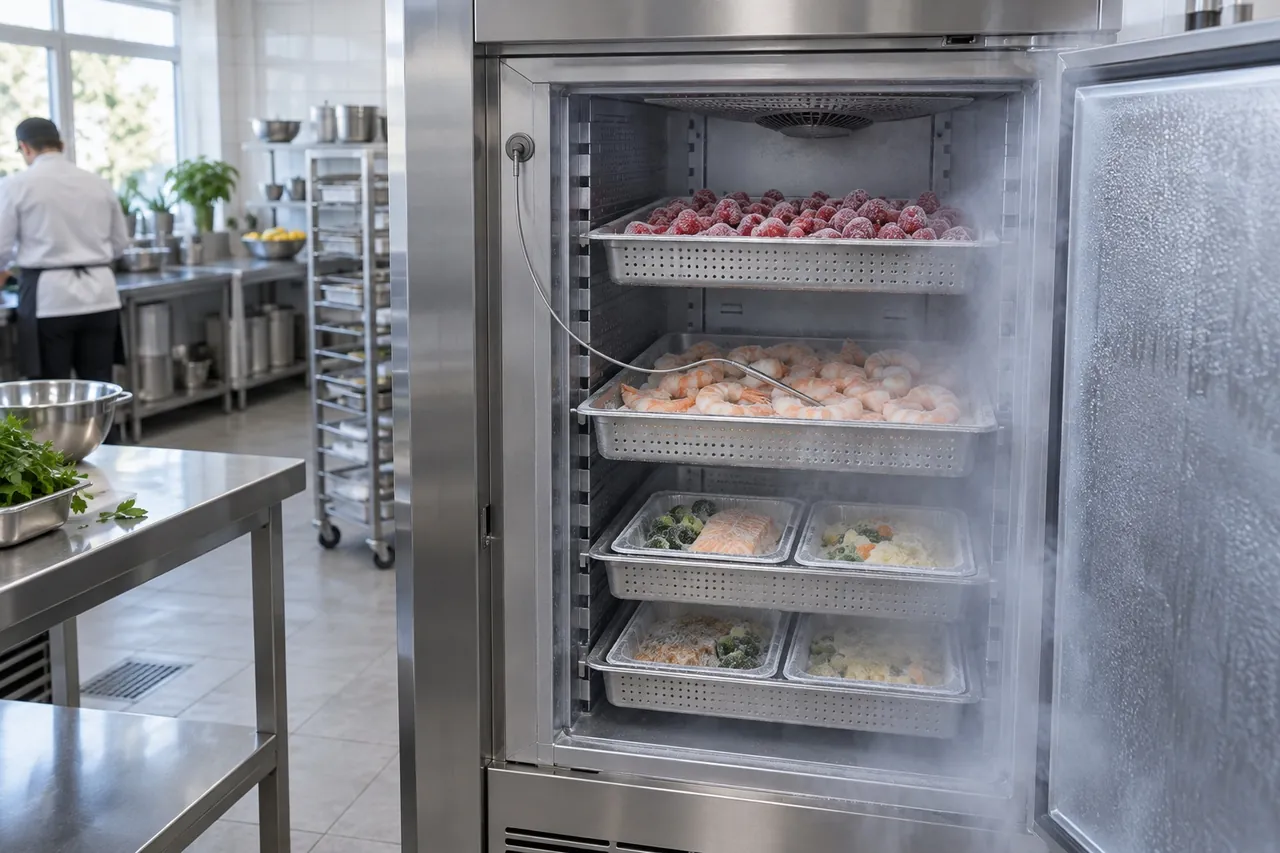
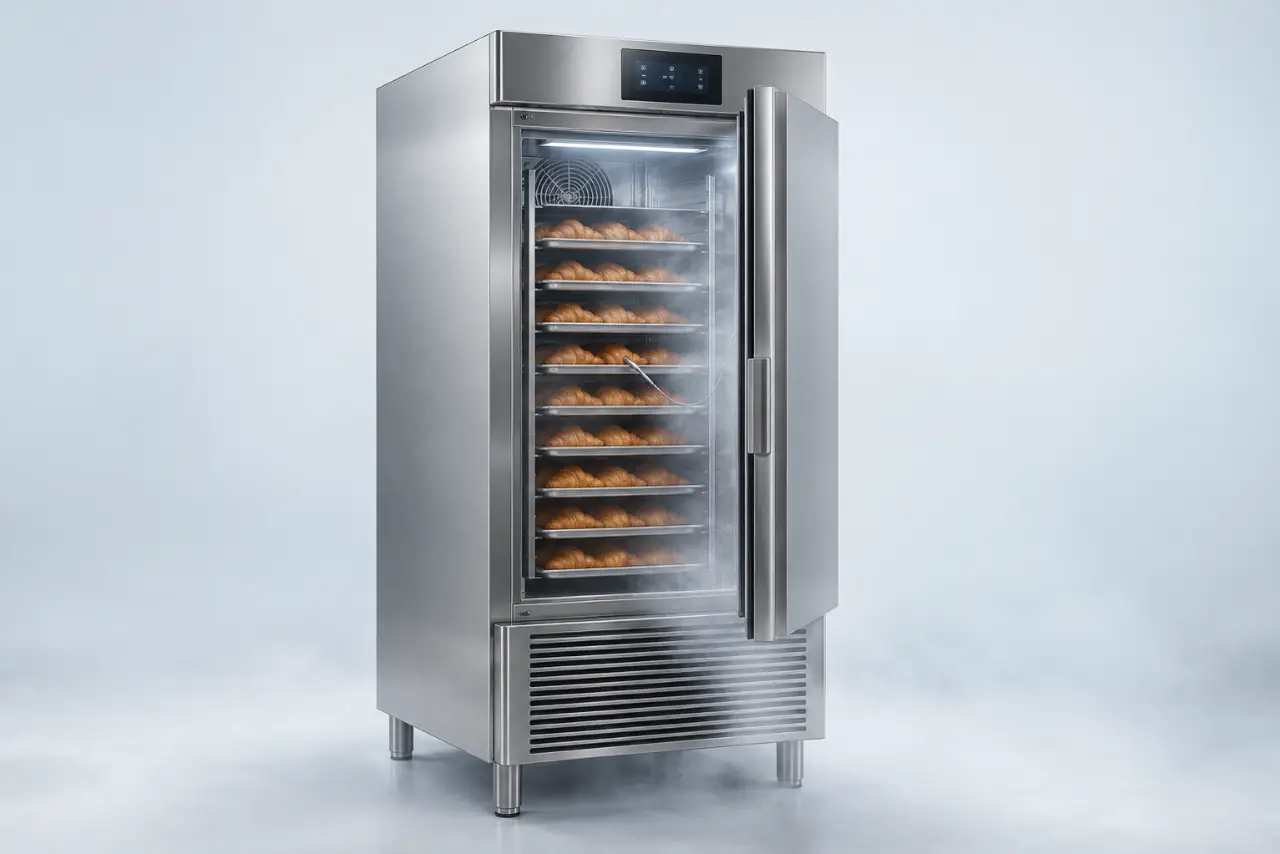
When people search for a "fast freezer machine" or "quick freeze machine", they are often a small business that needs one of the last two rows. A reach-in or roll-in blast freezer takes cooked food to −18 °C (0 °F) at the core in about 240 minutes, and a walk-in blast room built from cold room panels can run down to −35 °C (−31 °F).
Nitrogen freezers: flash frozen in liquid nitrogen
To flash freeze with liquid nitrogen, a nitrogen freezer — a cryogenic freezer — sprays or immerses food in liquid nitrogen (LN2) boiling at −196 °C (−321 °F). Product that is flash frozen in liquid nitrogen freezes several times faster than in mechanical air, so ice crystals are very small and dehydration losses are usually below 1% of product weight, compared with roughly 1–3% in a mechanical air freezer.
A nitrogen tunnel freezer is the most common cryogenic design: product enters on a belt, cold nitrogen gas pre-cools it, and liquid nitrogen is sprayed near the exit. Fans move the gas counter-current to the belt to use as much of its cooling as possible. Immersion baths and cryogenic spirals also exist, and some plants fit a nitrogen "crust freezer" in front of a mechanical spiral to set sticky products quickly.
Mechanical vs cryogenic: the trade-off
- Capital cost – a nitrogen tunnel freezer costs much less to buy and install than a mechanical spiral of the same output, and it needs no compressor plant.
- Running cost – you buy the nitrogen. Consumption is typically about 1–1.5 kg of LN2 per kg of product, so cost per kg depends heavily on the local gas price and delivery terms.
- Safety – nitrogen displaces oxygen. Rooms need exhaust ventilation and oxygen-depletion alarms.
- Flexibility – cryogenic lines are quick to start and suit seasonal or trial production; mechanical lines win on cost per kg for steady, high-volume work.
Carbon dioxide (CO2) cryogenic freezers work in a similar way at −78.5 °C (−109 °F).
How to size an IQF tunnel freezer or spiral freezer
Sizing an IQF tunnel freezer or spiral freezer starts with four numbers you should have before you contact any supplier:
- Throughput in kg (lb) per hour at peak, not average.
- Product dimensions – thickness matters most. Freezing time rises roughly with the square of thickness, so a 20 mm piece takes about four times as long as a 10 mm piece.
- Infeed and outfeed temperature – a product entering at +10 °C (50 °F) needs far less refrigeration than one entering straight from a fryer or cooker at +70 °C (158 °F).
- Product type and packaging – water content, fat, and whether it is wrapped or in trays.
Refrigeration load is the heat removed from the product (sensible heat above freezing, latent heat of freezing and sensible heat below freezing) plus belt, fan, defrost and enclosure losses. Lean meat or vegetables release roughly 300–350 kJ per kg (130–150 BTU/lb) when cooled from +10 °C to −18 °C, so a 1,000 kg/h line needs on the order of 100 kW of product load before losses and a safety margin. A mechanical line is usually served by a two-stage ammonia, CO2 or HFC plant running evaporating temperatures around −40 °C to −45 °C (−40 °F to −49 °F).
Also plan defrost. Moisture from the product forms frost on the evaporator; long-run spirals use sequential defrost or air-side cleaning so the line keeps running through a production shift.
Small IQF tunnel freezers vs batch blast freezers
A small IQF tunnel freezer typically starts around 100–300 kg (220–660 lb) per hour. Below that output, a continuous line is hard to justify: it needs a dedicated room, infeed and packing staff, and a large refrigeration plant that runs inefficiently at part load.
For many small processors, caterers and seafood traders, batch freezing gives the same quality at a fraction of the cost:
| Daily output | Practical option | Notes |
|---|---|---|
| Up to about 100 kg (220 lb) | Reach-in shock freezer, 5–10 trays | Product on trays, separate pieces for IQF-style results |
| 100–500 kg (220–1,100 lb) | Roll-in blast freezer, 15–20 trays, or small blast room | Trolley loading, several cycles per shift |
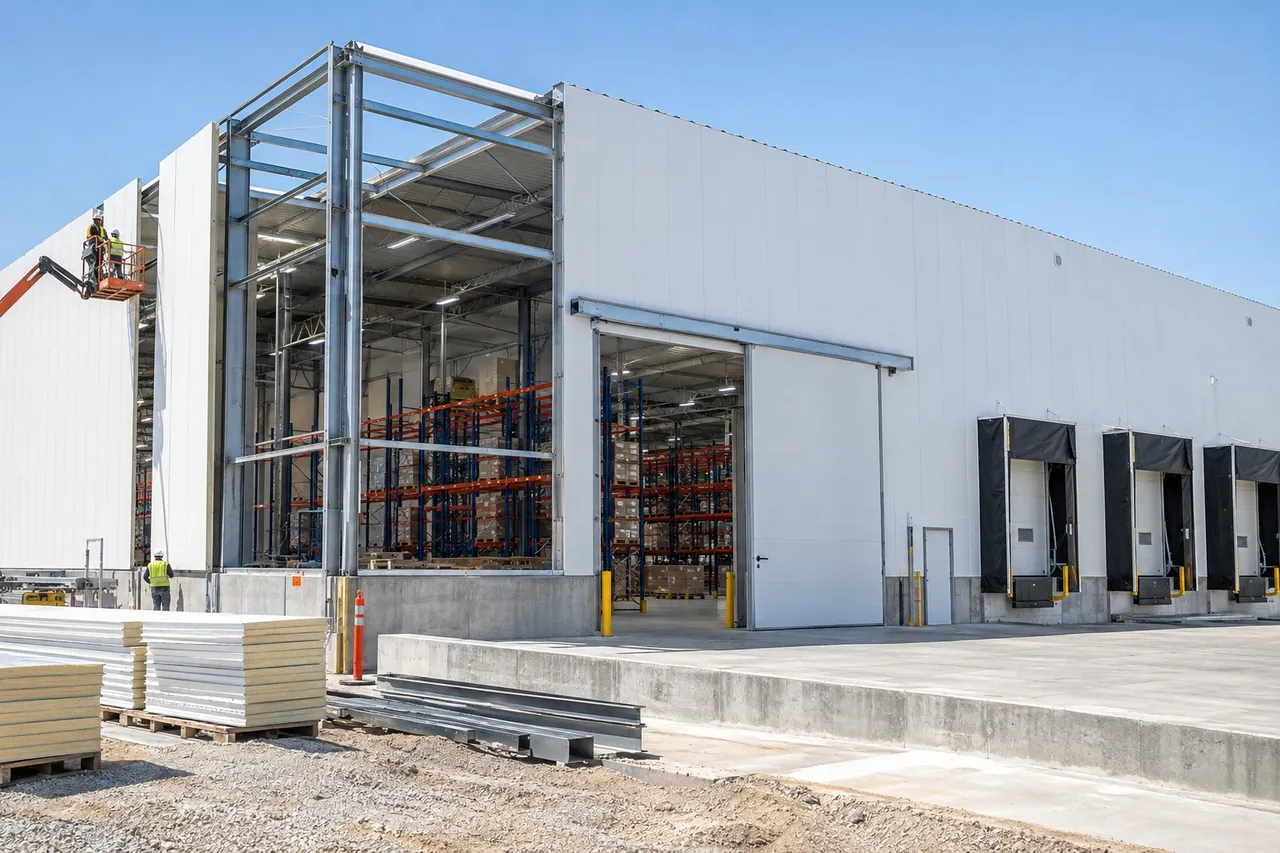
| 0.5–5 t (1,100–11,000 lb) | Walk-in blast room at −35 °C plus cold store | Pallets or racks, forced-air layout |
| Above about 3–5 t continuous | IQF tunnel, fluidised bed or spiral freezer | Labour and quality savings justify the line |
To get an IQF-style result from a batch shock freezer, spread pieces in a single layer on perforated trays, freeze, then bag. Read our guide to flash freezing for tray-loading tips, and use the cold room load calculator to estimate a blast room.
What to check when comparing spiral freezer manufacturers
Whether you are buying from spiral freezer manufacturers in Europe, North America or Asia, or answering an "IQF machine for sale" listing for a used line, the same checks apply:
- Guaranteed output and outfeed temperature for your actual product, written into the contract, ideally with a freezing test on samples.
- Hygienic design – stainless steel structure, sloped floors and drains, open belt construction, clean-in-place (CIP) options and belt washers. Ask which food-safety standards the design follows.
- Refrigerant and plant – ammonia, CO2 or HFC; who supplies the compressor plant; evaporating temperature; defrost method.
- Insulated enclosure – panel thickness (usually 150–200 mm PU or PIR for −40 °C), floor heating and vapour sealing.
- Dehydration loss – every 1% of weight lost is 1% of saleable product.
- Energy and utilities – kW per kg/h, water for defrost, compressed air, and for cryogenic lines, nitrogen supply contracts.
- Service – spare belts, bearings, fan motors and local technicians, plus remote monitoring.
Our guide to choosing a refrigeration equipment manufacturer covers factory audits, test reports and payment terms in more detail.
Next steps: choosing quick freezing equipment
Use this short checklist to decide which quick freeze freezer fits your operation:
- Write down peak kg (lb) per hour, product thickness and infeed temperature.
- If output is below about 200–300 kg (440–660 lb) per hour, price batch blast freezers or a blast room first.
- If pieces must stay loose and output is high, choose a fluidised-bed IQF tunnel for small items or a straight belt tunnel for flat ones.
- If dwell time exceeds about 30 minutes or floor space is tight, choose a spiral freezer.
- If you need flexibility, premium quality or seasonal capacity, price a nitrogen freezer and get a local nitrogen quote.
- Plan the frozen store at −18 °C to −25 °C (0 °F to −13 °F) at the same time.
Be There supplies batch blast chillers and shock freezers from 5 to 20 trays and complete walk-in blast rooms down to −35 °C (−31 °F). We do not list continuous IQF lines as a standard product, but if you send your product, output and site details through the quotation form, we will tell you honestly whether batch freezing will do the job or whether you need a continuous line.