Short answer
An evaporator coil is the finned heat exchanger inside a fridge, cold room or air conditioner where liquid refrigerant boils and absorbs heat from the air. In a walk-in cooler it is part of a ceiling-hung unit cooler running about 6–10 K below room temperature; in a −20 °C (−4 °F) freezer it evaporates near −28 °C (−18 °F) and needs electric defrost 2–4 times a day.
Key takeaways
- An evaporator is always inside the space being cooled; refrigerant leaving it flows through the suction line to the compressor.
- Coil temperature difference (TD) controls humidity: about 5–6 K gives 90–95% RH for produce, 8–10 K gives about 80% RH for packaged goods.
- Fin spacing is about 4 mm (6 fins per inch) for coolers, 6–7 mm (4 FPI) for freezers and 8–12 mm for blast freezers, so frost does not block air flow.
- Rooms held at +2 °C (36 °F) or warmer can use off-cycle defrost; freezers need electric or hot-gas defrost, typically 2–4 cycles a day of 20–30 minutes.
- Most frozen coils trace back to failed defrost, stopped fans, low refrigerant charge or doors left open.
- Compare unit cooler capacities only at the same rating condition (air-on temperature and DT1), never by nominal catalogue size.
What is an evaporator coil?
An evaporator coil is a heat exchanger made of tubes and fins in which refrigerant boils at low pressure, absorbing heat from the air or liquid passing over it. It is the part of any refrigeration or air conditioning system that actually produces cooling.
To define an evaporator simply: it is the cold side of the vapour-compression cycle. The expansion valve feeds it a low-pressure mix of liquid and flash gas; the liquid boils as it picks up heat; and the vapour leaves through the suction line to the compressor. The compressor and condenser then reject that heat outside. If you are new to the cycle, start with condenser vs evaporator vs compressor, which explains how the three main parts divide the work.
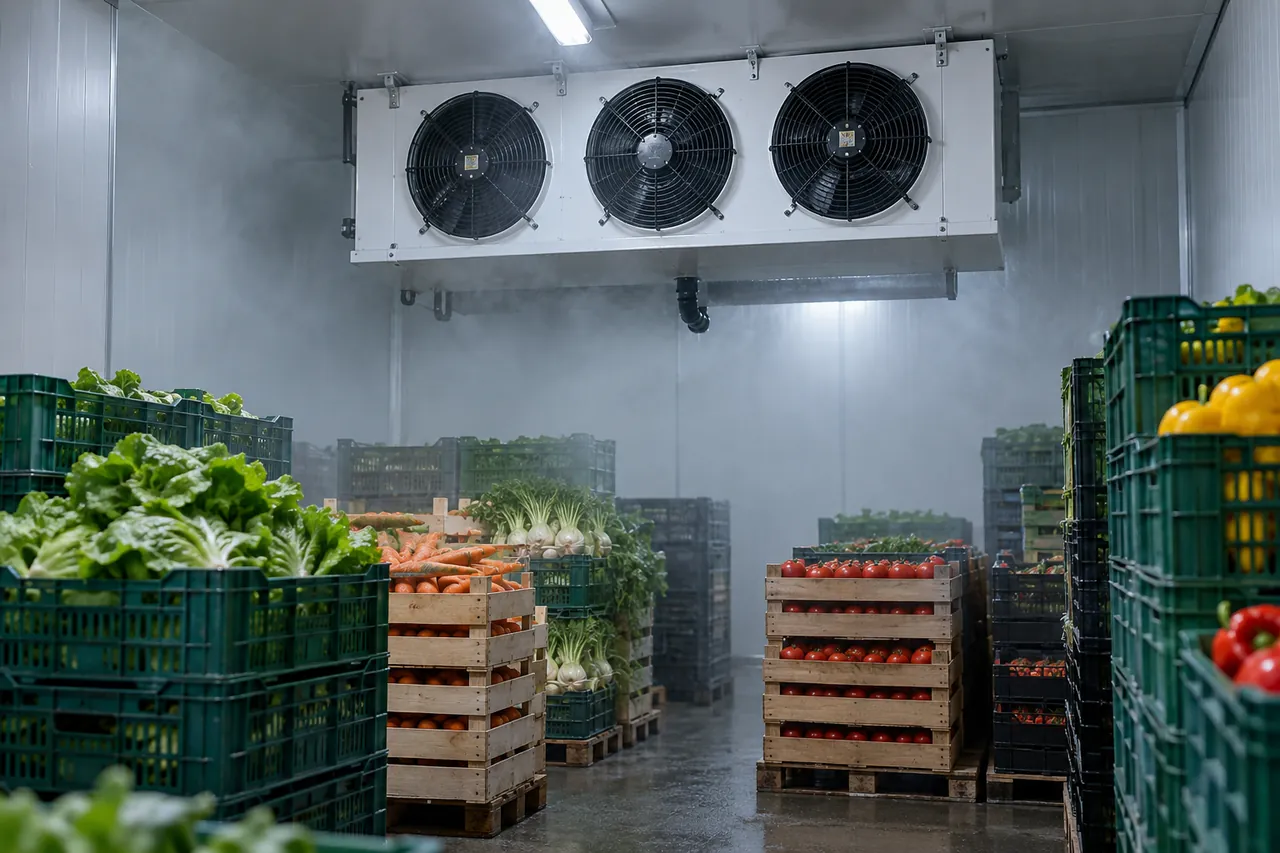
In commercial refrigeration the evaporator is usually packaged with fans, a drain pan, a casing and defrost heaters as a unit cooler, also called an evaporator unit or air cooler. That is the box you see hanging from the ceiling of a walk-in cooler or freezer.
How does an evaporator work?
An evaporator works because a liquid absorbs a large amount of heat when it boils, without rising in temperature. Refrigerant at low pressure boils well below the room temperature, so heat flows from the warmer air into the colder coil.
- Liquid refrigerant at high pressure reaches the expansion valve (often called the "evaporator valve" or TXV) at the coil inlet.
- The valve drops the pressure; part of the liquid flashes to vapour and the mix cools to the evaporating temperature, for example −8 °C (18 °F) in a +2 °C (36 °F) room.
- A distributor splits the flow into several parallel tube circuits so each part of the coil gets an equal share.
- Fans draw room air through the fins. The air cools by about 3–6 K and, if the coil is below the dew point, gives up moisture as condensate or frost.
- By the coil outlet all liquid has boiled off and the vapour is 4–8 K warmer than the evaporating temperature. This superheat protects the compressor from liquid.
- The vapour travels through the insulated suction line to the compressor.
So where does refrigerant go when it leaves the evaporator? Always to the compressor, either directly or, in large systems, via a suction accumulator or a surge drum.
Direct expansion vs flooded evaporators
Almost all cold rooms, cabinets and air conditioners use direct expansion (DX) coils, where the expansion valve meters just enough liquid to boil completely. A flooded evaporator is kept full of liquid fed from a surge drum or low-pressure receiver; vapour bubbles off the top and returns to the compressor. Flooded and pumped-liquid coils transfer heat better because the whole tube surface is wetted, so they are standard on industrial ammonia plants and large water or brine chillers, but they need much more refrigerant and more controls.
Where is the evaporator coil located?
The evaporator coil is always inside the space or air stream being cooled. In a cold room it hangs from the ceiling; in a cabinet it sits behind an inner panel; in an air conditioner it is in the indoor unit.
| Equipment | Where the evaporator is | What it looks like |
|---|---|---|
| Walk-in cooler or freezer | Ceiling-hung unit cooler, inside the room | Metal box with 1–4 fans on the front and a finned coil behind |
| Reach-in or display fridge | Behind a fan panel at the top or rear of the cabinet | Small fin-and-tube coil with one fan |
| Domestic fridge (static) | Behind the rear inner wall, foamed in | Invisible, or a frost patch on the back wall |
| Chest freezer | Copper or aluminium tube wrapped around the inner liner | Hidden in the walls |
| Split air conditioner | Indoor wall unit or air handler | Angled finned coil behind the filter |
| Ducted HVAC system | On top of the furnace or in the air handler plenum | A frame evaporator coil shaped like an upside-down V |
| Vehicle air conditioning | Behind the dashboard | Compact evaporator core with flat tubes |
In heat pumps the roles swap with the season: the outdoor coil is the evaporator in heating mode and the indoor coil in cooling mode. Car and home air conditioning follow the same principle as commercial refrigeration but run warmer, at about +3 °C to +10 °C (37–50 °F) evaporating. Be There does not supply air conditioning; this guide concentrates on refrigeration evaporator coils.
What types of evaporator coil and unit cooler are there?
Commercial refrigeration evaporator coils are chosen by room height, air throw and temperature. The main shapes are low-profile, medium-profile and long-throw ceiling unit coolers, plus dual-discharge and special coils for blast freezing.
| Unit cooler type | Typical use | Air throw | Notes |
|---|---|---|---|
| Low-profile | Small walk-ins with ceilings under about 2.5 m (8 ft) | About 4–8 m (13–26 ft) | Slim, 1–3 small fans; often blows from the back wall forwards |
| Medium-profile | Walk-ins and small cold stores | About 8–15 m (26–50 ft) | Larger fans and coil depth; most common for coolers and freezers |
| Large ceiling / long-throw | Cold stores and warehouses | 15–30 m (50–100 ft) or more | High-static fans; often fed by a rack or ammonia plant |
| Dual-discharge (centre mount) | Prep rooms, flower and produce coolers | Short, gentle, both sides | Low air velocity over product; reduces drying |
| Blast freezer coil | Blast rooms and tunnels | High velocity across the product | Wide or variable fin spacing, powerful fans, heavy defrost |
| Brine or glycol coil | Process cooling, secondary systems | Varies | Fed by a chilled fluid instead of refrigerant |
Evaporator coil components
- Copper tubes, typically 9.52 mm (3/8 in) or 12.7 mm (1/2 in), or stainless steel for ammonia.
- Aluminium fins, plain or epoxy-coated for corrosive or salty environments.
- Distributor and feeder tubes for even refrigerant flow.
- Expansion valve (TXV or electronic) and its sensing bulb on the suction outlet.
- Axial fans with guards; EC motors save energy.
- Drain pan, drain line and, in freezers, pan and drain-line heaters.
- Defrost heaters in the coil, plus defrost termination and fan delay sensors.
How do fin spacing and TD affect a cold room?
Fin spacing decides how long the coil can run before frost blocks it, and the temperature difference (TD) between room air and refrigerant decides how much moisture the coil pulls out of the room. Get both wrong and you either dry out the product or ice up the coil.
A small TD means a larger coil running closer to room temperature, which removes less moisture and keeps humidity high. That suits fresh produce, flowers and unwrapped meat. A large TD means a smaller, cheaper coil, but it dries the air and the product, causing weight loss. Our guide to humidity in cold storage covers target RH by product.
| Application | Room temperature | Coil TD | Resulting RH (approx.) | Fin spacing |
|---|---|---|---|---|
| Fresh produce, flowers | 0 °C to +4 °C (32–39 °F) | 4–6 K | 90–95% | About 4–6 mm (6–4 FPI) |
| Fresh meat, dairy | 0 °C to +2 °C (32–36 °F) | 6–8 K | 85–90% | About 4–6 mm |
| Packaged goods, drinks | +2 °C to +8 °C (36–46 °F) | 8–10 K | 75–80% | About 4 mm (6 FPI) |
| Storage freezer | −18 °C to −25 °C (0 °F to −13 °F) | 5–8 K | Not critical; frost control matters | About 6–7 mm (4 FPI) |
| Blast freezer | −30 °C to −40 °C (−22 °F to −40 °F) | 6–10 K | Not critical | 8–12 mm, often variable |
Rating conditions matter when comparing coils. Catalogue capacity is quoted at a stated air-on temperature and DT1, the difference between air entering the coil and the evaporating temperature. A coil rated 5 kW at DT1 = 10 K delivers only about 3.5–4 kW at DT1 = 7 K. In Europe unit coolers are tested to EN 328; in the US to AHRI 420, and walk-in unit coolers also fall under US DOE efficiency rules.
How do evaporator coils defrost?
Any coil running below 0 °C (32 °F) collects frost, and frost must be removed regularly or air flow stops. The defrost method depends on room temperature and system size.
- Off-cycle (air) defrost: the compressor stops and the fans keep running, melting frost with room air. Works for rooms at about +2 °C (36 °F) and warmer.
- Electric defrost: heaters in the coil and drain pan melt frost, typically 2–4 times a day for 20–30 minutes, terminating when the coil reaches about +10 °C to +13 °C (50–55 °F). Standard for every walk-in freezer evaporator.
- Hot-gas defrost: hot discharge gas is diverted through the coil. Faster and more efficient; common on rack systems and industrial plants.
After defrost, a fan delay keeps the fans off until the coil is cold again, so water droplets are not blown into the room. The drain line in a freezer must be heated and run outside the room with a trap. For how defrost works on cabinets, see frost free vs manual defrost.
Why is my evaporator coil freezing up?
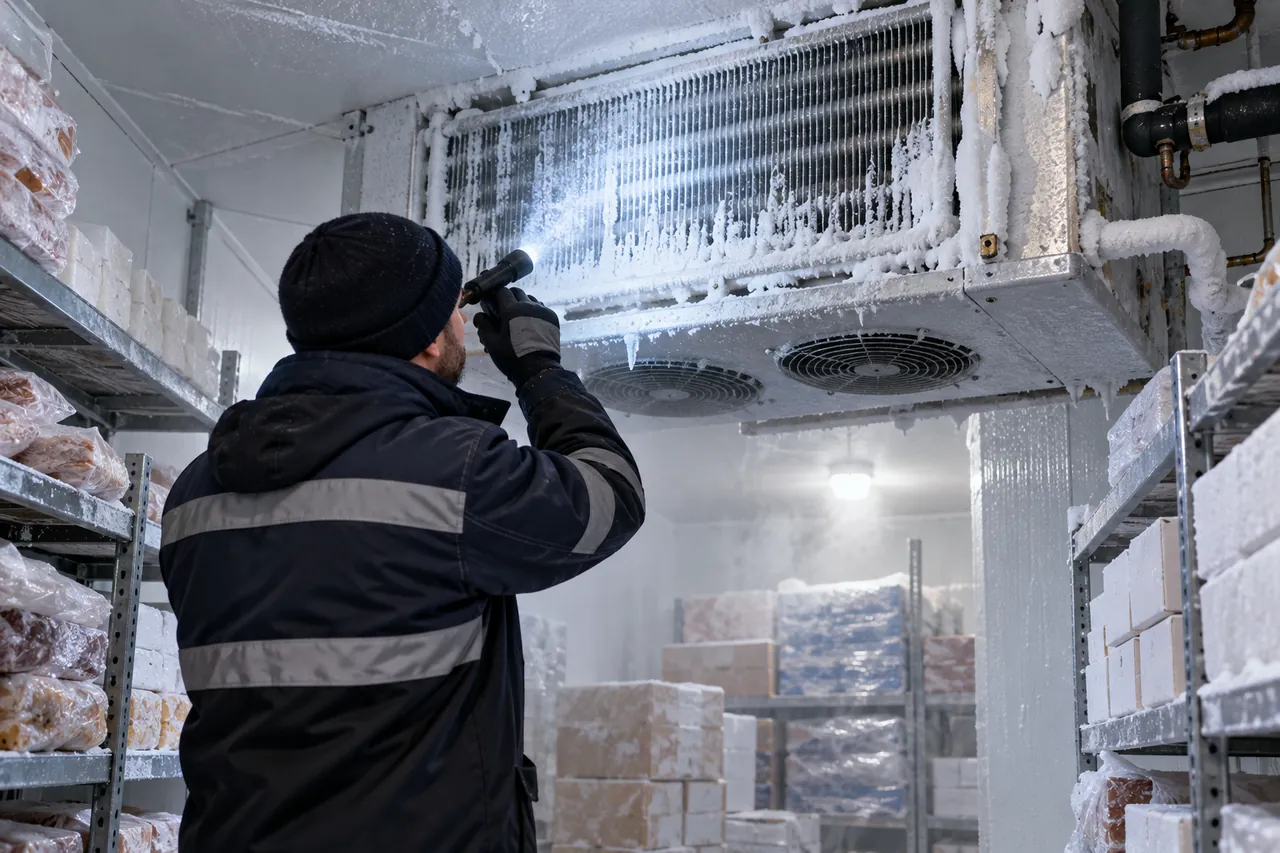
An evaporator coil freezes up when frost forms faster than defrost removes it, or when the coil runs much colder than designed. A thin, even white frost on a freezer coil is normal; a solid block of ice that hides the fins is a fault.
- Defrost failure: burnt heater, failed termination sensor, controller fault or wrong defrost schedule.
- Evaporator fan stopped: the coil keeps getting colder and ices from the inlet.
- Low refrigerant charge: low suction pressure makes the coil run colder than normal; frost often appears only on the first few rows. Check for a refrigerant leak.
- Door left open, a torn strip curtain or a bad gasket, which floods the coil with warm, moist air.
- Blocked air flow from product stacked against the coil.
- Blocked drain: water refreezes in the pan and climbs into the coil.
- In AC systems, a dirty air filter or a closed return grille.
Fridge evaporator coils frozen solid in a reach-in or domestic fridge usually point to a failed defrost heater or timer. For a step-by-step fault guide on cold rooms, see walk-in freezer troubleshooting.
How to choose an evaporator coil for a walk-in
Choose a walk-in evaporator coil for capacity at your real evaporating temperature, for the humidity your product needs, and for an air pattern that covers the whole room. Use this checklist:
- Calculate the heat load with the cold room refrigeration load calculator and divide by running hours.
- Set the room temperature and target humidity, then choose the TD from the table above.
- Select a coil whose capacity at that TD matches the condensing unit at the same evaporating temperature. For matching the outdoor side, see the walk-in condensing unit and evaporator guide.
- Pick the profile by ceiling height and the throw by room length; very long rooms may need two coils.
- Choose fin spacing and defrost type for the temperature: off-cycle for coolers at +2 °C and above, electric or hot gas for freezers.
- Mount it on the wall facing the door so it blows along the longest dimension towards the door, never directly above the door, with at least 300 mm (12 in) clearance behind.
- Specify coated fins or stainless casings for fish, salted products or coastal sites, and confirm voltage for fans and heaters.
Be There supplies complete walk-in cooler and freezer kits with the unit cooler, condensing unit, controller and PU/PIR panels already matched, from chillers at 0 °C to +10 °C to freezers at −18 °C to −25 °C, and blast freezers with high-velocity coils down to −35 °C. Send your room size, temperature, product and power supply through the inquiry form and we will quote FOB, CIF or DDP.