
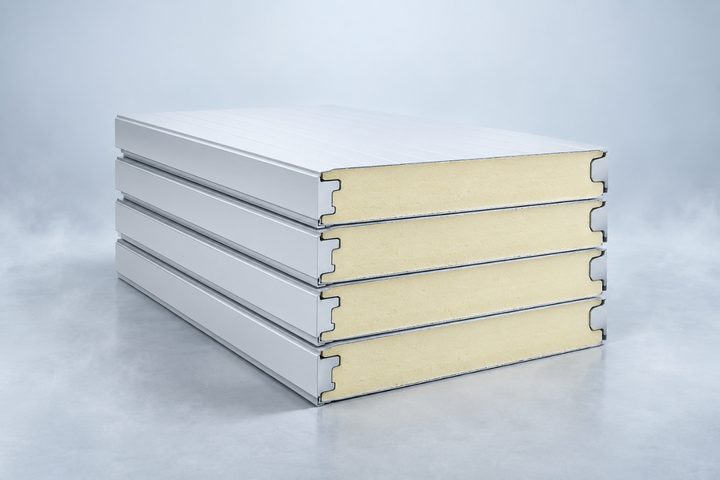
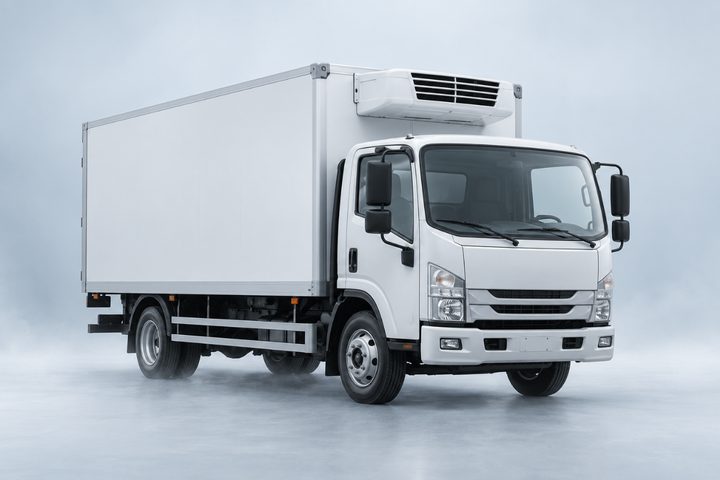
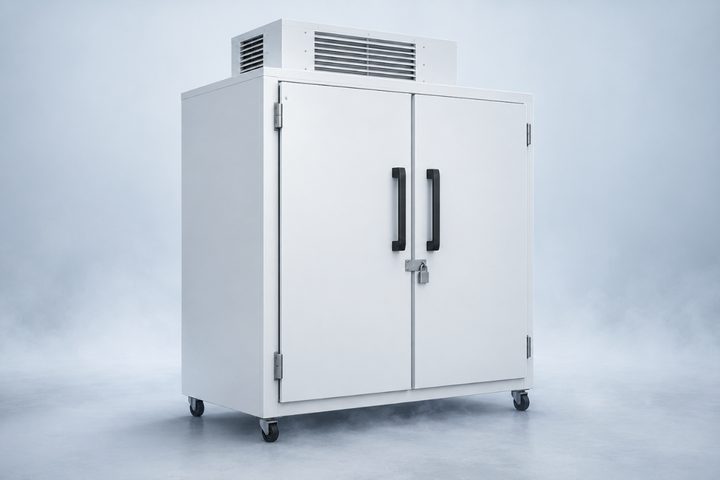
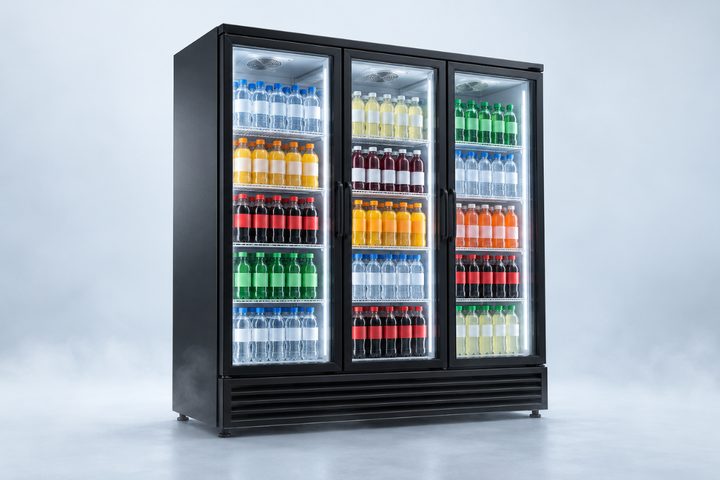
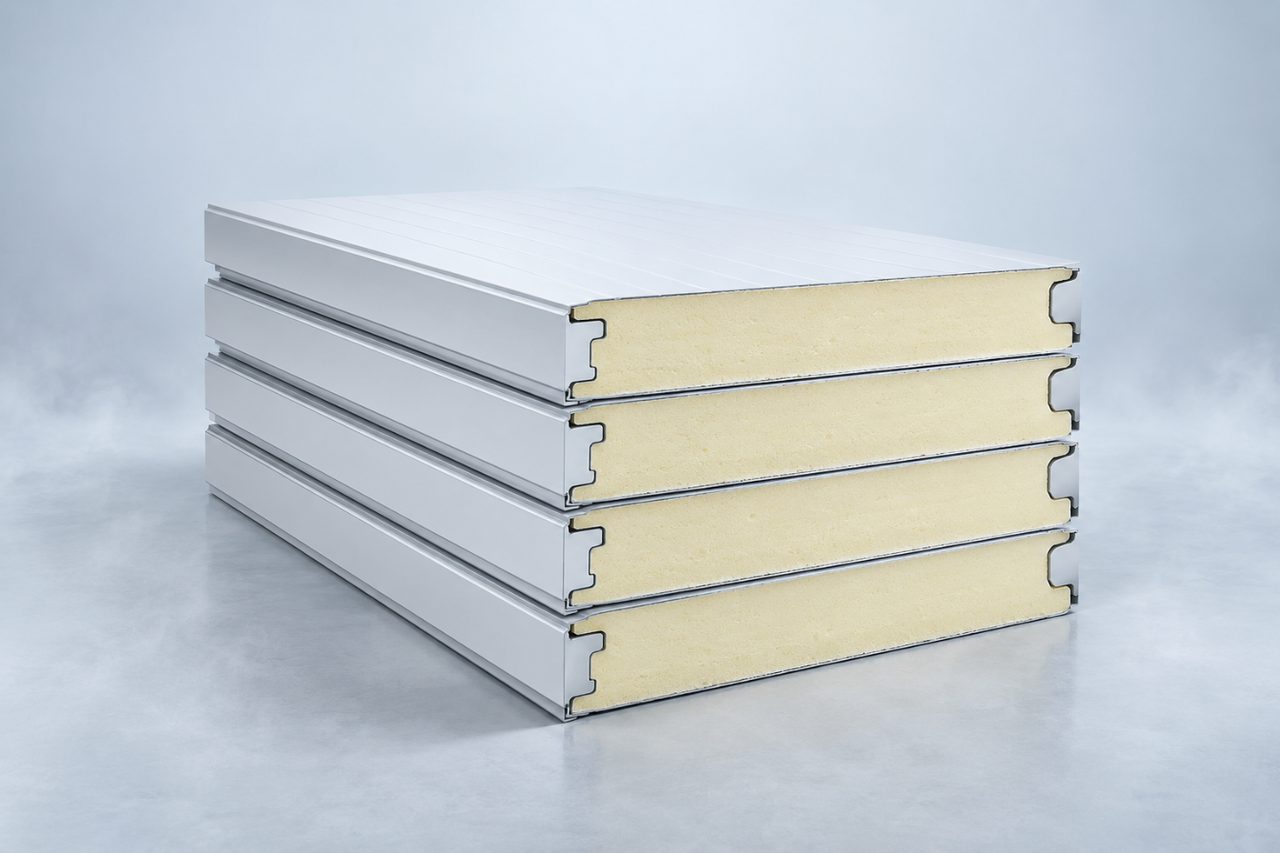
Panel thickness is the single biggest decision when you build a cold room. Too thin and the compressor runs all day, the walls sweat and the room never holds temperature in summer. Too thick and you pay for insulation you never use. This guide gives you the numbers we use when we quote a room.
The quick answer
| Room temperature | Typical use | Wall & ceiling panel | Floor |
|---|---|---|---|
| +10 °C to +15 °C | Wine, chocolate, pharma storage | 50–75 mm | Not needed |
| 0 °C to +5 °C | Fruit, vegetables, dairy, meat chill | 75–100 mm | Usually not needed |
| −18 °C to −20 °C | Frozen food storage | 120–150 mm | 100–150 mm + anti-frost |
| −25 °C to −30 °C | Ice cream, seafood, long storage | 150 mm | 150 mm + anti-frost |
| −35 °C to −40 °C | Blast freezing, tunnel rooms | 150–200 mm | 150–200 mm + anti-frost |
Move one step thicker when the room stands outdoors, under a metal roof, or in an ambient that regularly passes 35 °C.
How thickness turns into heat load
Heat flows through a panel roughly in proportion to its U-value, and for a sandwich panel the U-value is close to the core’s thermal conductivity (λ) divided by its thickness. Polyurethane and PIR cores sit around λ = 0.022 W/(m·K).
| Thickness | Approx. U-value | Heat through 100 m² at ΔT 40 K |
|---|---|---|
| 75 mm | 0.29 W/(m²·K) | ≈ 1,170 W |
| 100 mm | 0.22 W/(m²·K) | ≈ 880 W |
| 120 mm | 0.18 W/(m²·K) | ≈ 730 W |
| 150 mm | 0.15 W/(m²·K) | ≈ 590 W |
| 200 mm | 0.11 W/(m²·K) | ≈ 440 W |
A freezer room at −20 °C in a +20 °C hall has a temperature difference of 40 K. Going from 100 mm to 150 mm panels on 100 m² of wall and ceiling removes roughly 300 W of continuous heat load. Over a year of 24-hour operation that is around 2,600 kWh of heat the refrigeration unit no longer has to move.
PU, PIR, rock wool or XPS?
PU (polyurethane)
The standard core for cold rooms. Density 40–42 kg/m³, closed-cell content above 90%, very low water uptake and good stiffness. It is the most economical choice where fire rules allow it.
PIR (polyisocyanurate)
Very similar thermal performance with better fire behaviour. PIR chars rather than melting and typically reaches B1 in Chinese GB 8624 testing. Choose PIR for food factories, warehouses with sprinklers, or anywhere an insurer asks for it.
Rock wool
Non-combustible (A1) but with roughly double the conductivity of PU, so it needs much thicker panels for the same performance. It is used for fire walls and partitions, not as the main cold room envelope.
XPS board
Extruded polystyrene boards are the usual choice for insulating the floor slab under a freezer room because they carry high compressive loads (150–700 kPa) and absorb very little water.
Joints, doors and the details that leak
- Cam-lock joints pull panels tight and are the standard for freezer rooms. Tongue-and-groove joints are fine for chillers.
- Sealing. Every joint on the warm side should be sealed with silicone or a vapour-tight tape. Moisture that enters a freezer wall turns into ice and slowly destroys the insulation.
- Doors are often the weakest point. Freezer doors need a heated frame, a pressure-relief valve and a strip curtain for busy rooms.
- Ceilings over 6–7 m span need hangers or a steel structure. Ask for a load calculation when the room is large.
Freezer floors: do not skip this
Below 0 °C, cold slowly travels into the ground under the room. Moisture in the soil freezes, expands and can lift the slab. A freezer floor therefore needs an insulation layer (XPS or PU), a vapour barrier, and either a heating mat or ventilation pipes under the insulation. Small modular freezers can stand on insulated floor panels instead of a built slab.
What to send for a quotation
- Inner dimensions (length × width × height).
- Room temperature and what is stored.
- Indoor or outdoor installation, and the hottest ambient temperature on site.
- Number and size of doors, and how often they open.
- Panel facing preference: pre-painted steel, stainless steel or embossed aluminium.
With these five answers we can return a panel layout, a door schedule and a matched refrigeration unit in one quotation.