
Short answer
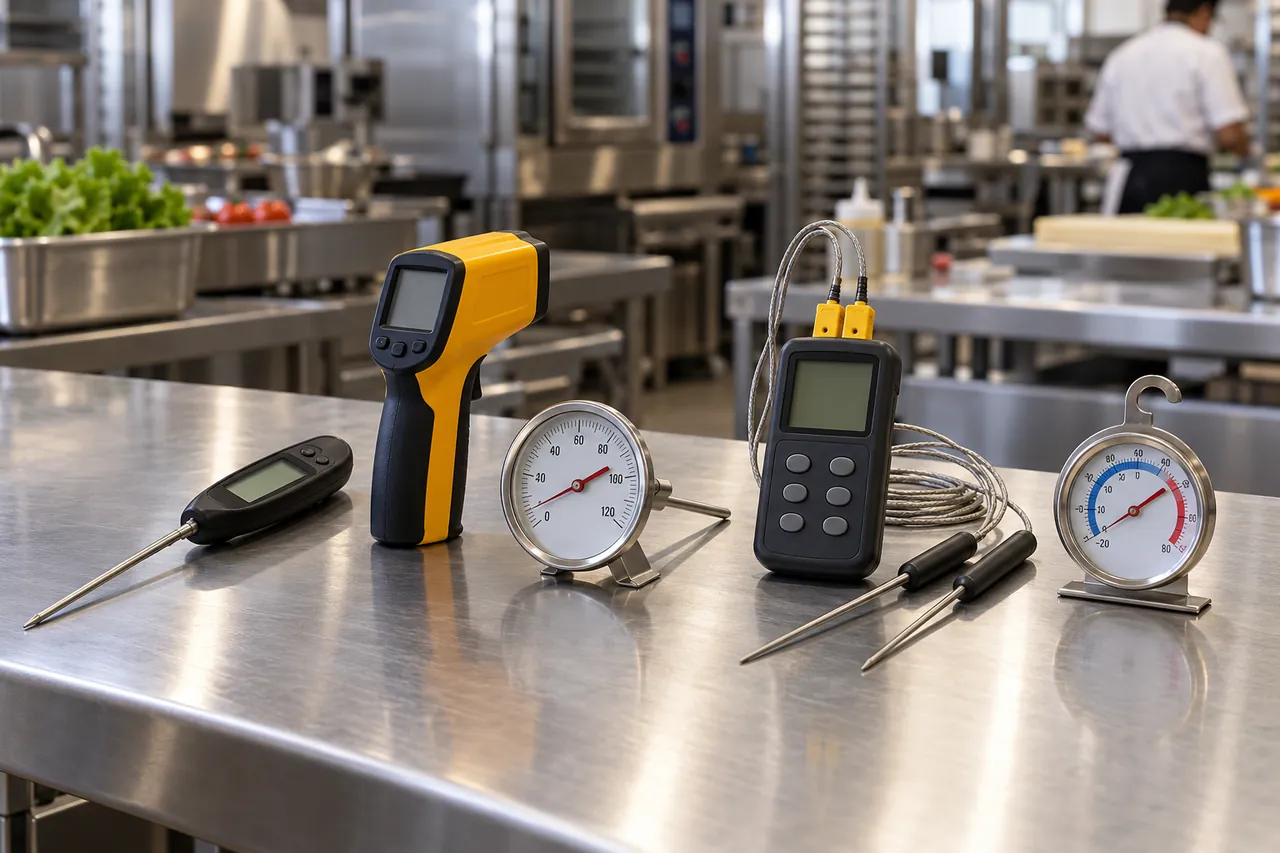
The main types of thermometers for food service are digital instant-read probes, thermocouple thermometers, bimetallic dial thermometers, leave-in and wireless meat thermometers, infrared thermometers and appliance thermometers for fridges and freezers. The FDA Food Code requires food thermometers accurate to ±1 °C (±2 °F) and a thin probe for thin foods; infrared units read surfaces only.
Key takeaways
- The FDA Food Code requires food thermometers accurate to ±1 °C (±2 °F) and holding-unit thermometers to ±1.5 °C (±3 °F).
- Digital instant-read probes settle in 2–6 seconds; bimetallic dial thermometers take 15–20 seconds.
- Dial thermometers sense along 50–65 mm (2–2.5 in) of the stem, so they cannot read thin foods.
- Infrared thermometers read surfaces only and cannot confirm internal cooking or cold holding temperatures.
- Place a fridge or freezer thermometer in the warmest part of the cabinet, usually near the door at the top.
- Clean and sanitise probe thermometers before and after each use and between raw and ready-to-eat foods.
What types of thermometers are used in food service?
The main types of thermometers used in food service are digital instant-read probe thermometers, thermocouple thermometers, bimetallic dial thermometers, leave-in and wireless meat thermometers, infrared (non-contact) thermometers, appliance thermometers for fridges and freezers, and candy or deep-fry thermometers. Each is suited to a different job, and a commercial kitchen normally needs at least three of them.
Under the FDA Food Code, a food thermometer used to check food must be accurate to ±1 °C (±2 °F), a thermometer measuring air in cold or hot holding units to ±1.5 °C (±3 °F), and kitchens that cook thin foods such as burger patties and fish fillets must have a small-diameter probe that can read them. Glass thermometers are not allowed for food unless encased in a shatterproof coating, as some candy thermometers are.
| Thermometer type | How it senses | Typical response time | Typical accuracy | Best use |
|---|---|---|---|---|
| Digital instant-read (thermistor) | Sensor in the last few mm of the probe tip | 2–6 seconds | ±0.5–1 °C | Cooking, cooling, hot and cold holding checks |
| Thermocouple thermometer | Junction of two metals at the tip | 1–3 seconds | ±0.5–1 °C | Fast checks, thin foods, high temperatures |
| Bimetallic dial (instant-read) | Coil along 50–65 mm (2–2.5 in) of the stem | 15–20 seconds | ±1 °C when calibrated | Thick foods, roasts, backup thermometer |
| Oven-safe dial or leave-in probe | Stays in food during cooking | Continuous | ±1–2 °C | Roasts, whole birds, smokers |
| Wireless meat thermometer | Probe with radio or cable to a display or phone | Continuous | ±0.5–1 °C | Long cooks, ovens, smokers |
| Infrared non-contact thermometer | Reads surface infrared radiation | Under 1 second | ±1–2 °C, surface only | Receiving screening, grills, hot surfaces |
| Appliance (fridge/freezer) thermometer | Dial, liquid or digital, hangs in the cabinet | Minutes (reads air) | ±1–1.5 °C | Fridges, freezers, walk-ins, display cases |
| Candy / deep-fry thermometer | Long stem, clip to pan | 10–30 seconds | ±1–2 °C | Sugar work, frying oil to about 200 °C (390 °F) |
What is an instant read thermometer?
An instant read thermometer is a handheld probe thermometer that shows food temperature within a few seconds and is designed for spot checks, not to stay in food in the oven. Digital versions use a thermistor or thermocouple sensor near the tip; dial versions use a bimetallic coil along the stem.
Digital instant-read probes are the default probe thermometer for most kitchens: they read thin and thick foods, settle in 2–6 seconds, and many fold away to protect the probe. Choose one with a stem at least 100–130 mm (4–5 in) long for roasts and stock pots, a tip of about 1.5 mm for thin foods, IP65 or better water resistance and a reading range of at least −40 °C to +200 °C (−40 °F to 392 °F). The sensors inside are compared in our guide to RTD, thermocouple and thermistor sensors.
Thermocouple thermometers
A thermocouple thermometer uses a meter with interchangeable probes: needle probes for thin foods, penetration probes for meat, immersion probes for liquids and surface probes for griddles. It is the fastest and most flexible option, which is why many health inspectors carry one, but meters and probes cost more than a basic digital stick thermometer.
Dial thermometers
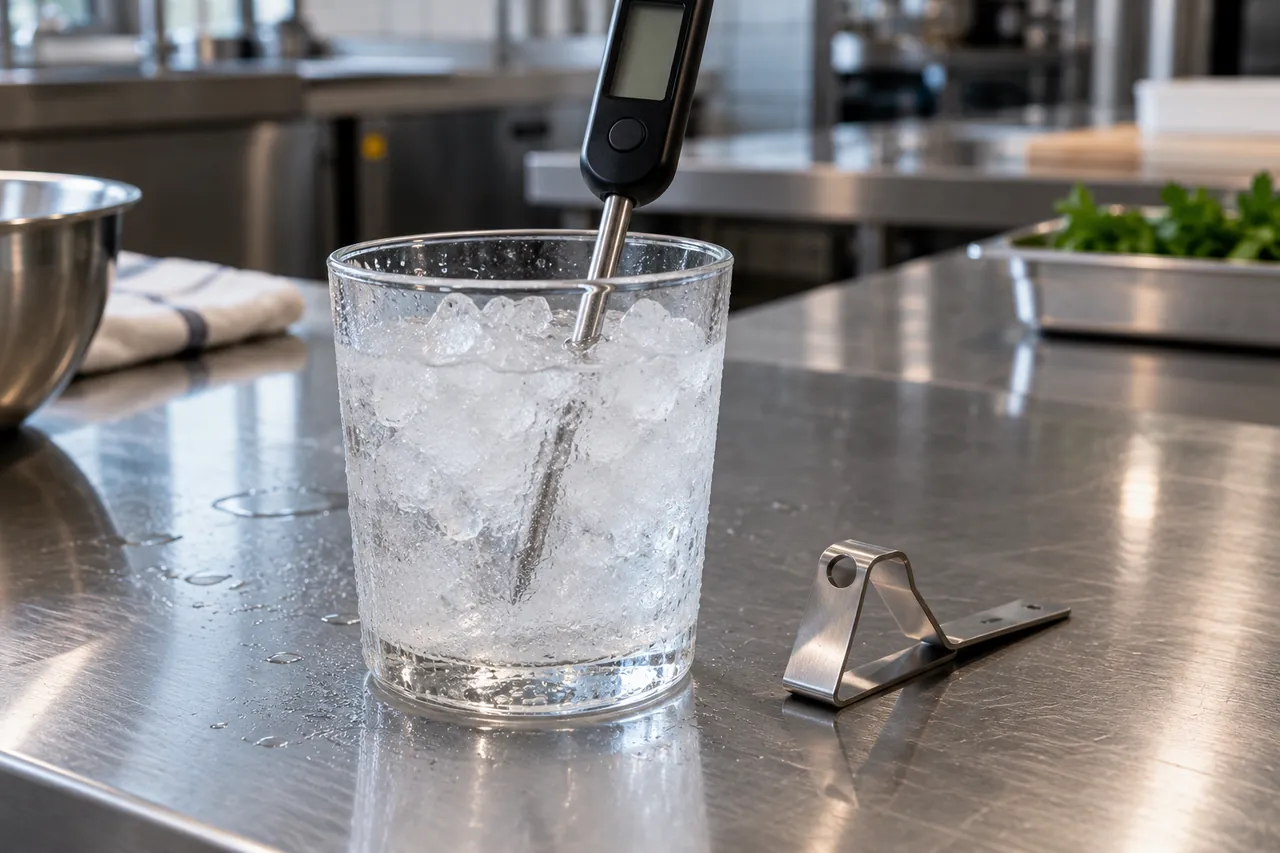
Bimetallic dial thermometers are cheap and need no batteries, but the sensing area runs from the tip up to a dimple on the stem about 50–65 mm (2–2.5 in) long. They cannot read a thin burger or fish fillet, they react slowly, and they lose calibration when dropped. Use them for thick foods and as backups, and calibrate them weekly; see how to calibrate a thermometer.
Are wireless and leave-in meat thermometers worth it?
A wireless meat thermometer or wired leave-in probe is worth it for long cooks such as roasts, whole turkeys, brisket and smoked pork, because it reports the core temperature continuously and alarms at the target, so the oven door stays shut. It does not replace a handheld thermometer for checking several pieces or several spots.
- Wired leave-in probes: a heat-resistant cable runs from the probe to a display outside the oven; reliable and inexpensive.
- Truly wireless probes: the whole probe sits in the meat and transmits by Bluetooth to a phone or base, typically 10–50 m (30–160 ft) in open air, less through a steel oven door.
- Multi-sensor probes: several sensors along the shaft show the coolest point automatically.
- Limits: probes rated only to about 100 °C internal and 300 °C ambient; check before using under a broiler or on an open flame.
Commercial combi ovens and blast chillers often include a built-in core probe that does the same job, logging the core temperature through cooking or cooling. See how a blast chiller works for how core probes control the cycle.
How do you use an infrared thermometer, and what can't it do?
Use an infrared thermometer by aiming it at the food or surface from a short distance, usually within 30–60 cm (1–2 ft), and reading the surface temperature. A non contact thermometer measures only the surface, so it cannot confirm that meat is cooked or that the centre of a product is cold.
- Check the distance-to-spot ratio: at 12:1, the thermometer reads a circle 25 mm wide at 300 mm away. Get close enough that the spot is smaller than the item.
- Aim at the food, not at packaging, glass or shiny stainless steel, which reflect infrared and give low readings.
- Use it for fast screening: delivery packaging, griddle and fryer surfaces, display food surfaces.
- If a reading is near a limit, confirm with a probe thermometer in the food itself.
Infrared thermometers are useful at receiving, where a quick scan of many cartons can identify the one to probe. The receiving limits themselves are in our guide to the temperature danger zone and TCS foods.
Which thermometer is best for a fridge or freezer?
The best thermometer for refrigerator or freezer use is one accurate to ±1 °C (±2 °F) that is placed in the warmest part of the cabinet, usually near the door at the top. Commercial units have a controller display, but that shows the air temperature at the controller's sensor, which may be colder than the food.
| Job | Recommended thermometer | Target reading |
|---|---|---|
| Reach-in fridge, prep table, display case | Hanging dial or digital appliance thermometer; probe in a glycol bottle | +1 °C to +4 °C (34–39 °F); food at 5 °C (41 °F) or below |
| Freezer or display freezer | Digital fridge freezer thermometer with external probe | −18 °C (0 °F) or colder |
| Walk-in cooler or freezer | Wall thermometer plus data logger or wireless sensor | As per room setpoint |
| Checking stored food | Instant-read probe, between packs or in the product | Chilled at 5 °C (41 °F) or below |
| Produce and dry stores | Thermometer hygrometer | Temperature and relative humidity per product |
For a permanent record rather than a spot reading, use a logger; see our temperature data logger guide. For setpoints by appliance, see what temperature a fridge and freezer should be.
How do you use a meat thermometer properly?
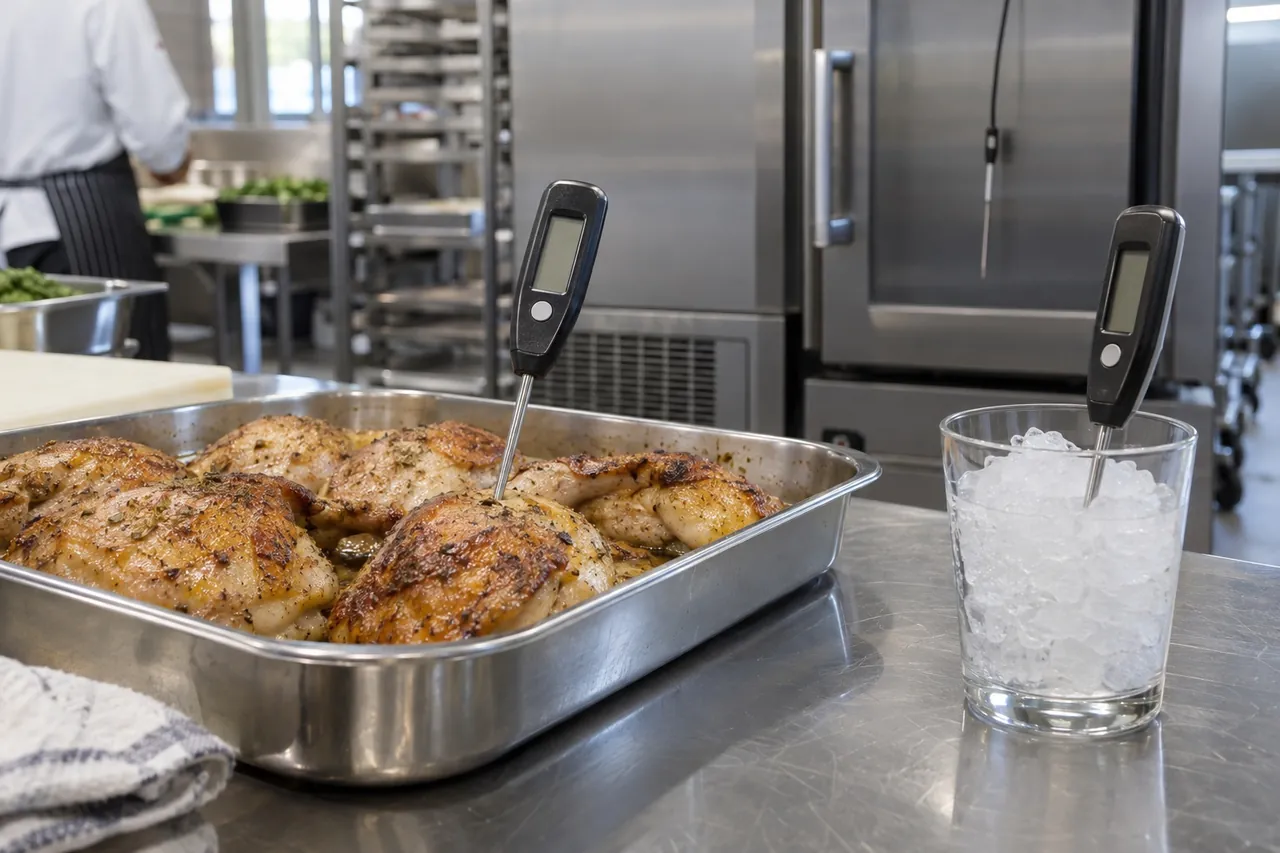
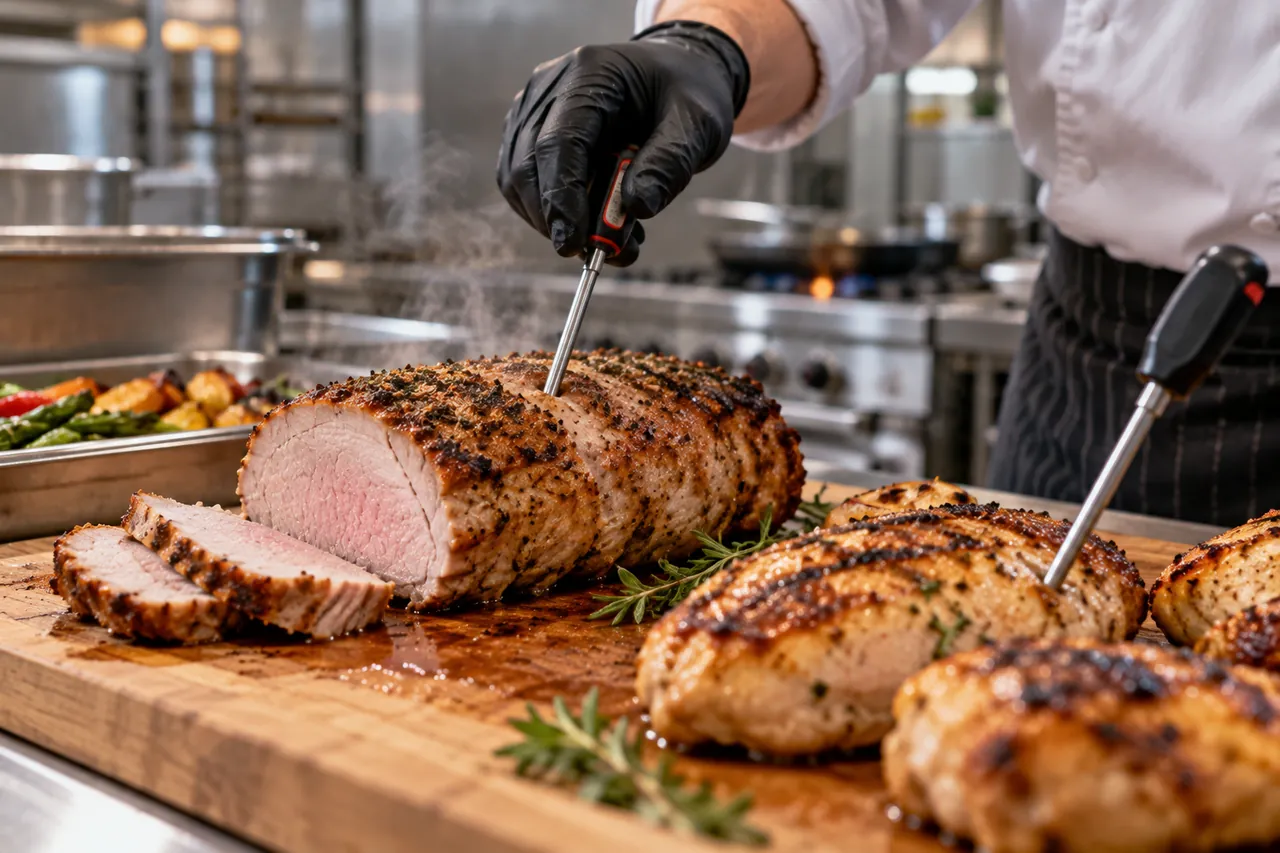
To use a meat thermometer properly, insert the probe into the centre of the thickest part of the food, away from bone, fat and gristle, wait until the reading stops changing, and compare it with the required minimum temperature.
- Sanitise the probe and let it dry.
- Insert to the correct depth: tip in the centre for digital probes; past the dimple for dial thermometers.
- For thin foods such as burgers, chicken breasts and fillets, insert from the side.
- Wait for a stable reading: a few seconds for digital, 15–20 seconds for dial.
- Check the largest piece and at least one other; for whole poultry, check thigh, breast and wing.
- Clean and sanitise the probe before checking another food, and always between raw and ready-to-eat foods.
Target temperatures for poultry, pork, beef and fish are in our safe internal cooking temperatures chart.
When must probe thermometers be cleaned and sanitised?
Probe thermometers must be cleaned and sanitised before and after each use, and every time you move from one food to another, especially from raw meat, poultry or fish to ready-to-eat food. Wash, rinse, sanitise with an approved sanitiser or alcohol wipe, and air-dry. Store probes in their sheaths.
How do you look after food thermometers?
Look after food thermometers by keeping them clean, dry, calibrated and powered: most thermometer failures in kitchens come from flat batteries, water inside the housing, bent probes and dial thermometers that were dropped and never re-checked.
- Batteries: a weak battery can make a digital thermometer read wrongly before the display fades. Replace batteries on a schedule, for example every 6–12 months, and keep spares at each station.
- Water: choose IP65–IP67 rated thermometers for kitchens and never immerse a non-waterproof handle in sanitiser or a sink.
- Heat: do not leave instant-read thermometers on a hot range, in an oven or under a salamander; their housings and electronics are not heat-rated.
- Probes and cables: replace probes that are bent, cracked or have damaged cables, because water gets in and readings drift.
- Storage: keep probes in their sheaths in a clean, dedicated place, separate from raw food areas.
- Identification: number every thermometer so calibration checks and replacements can be recorded against it.
As a rule of thumb, a well-used digital probe thermometer in a busy kitchen lasts one to three years, and a dial thermometer should be replaced as soon as it will not hold calibration from one weekly check to the next. Keeping two or three spare thermometers costs far less than a failed inspection or a batch of food thrown away because nobody could prove its temperature.
How to choose thermometers for a commercial kitchen: checklist
A commercial kitchen needs one thermometer for each job: checking food, monitoring storage and recording temperatures over time.
- At least one digital instant-read or thermocouple probe per station, with a thin tip for thin foods and FDA Food Code accuracy of ±1 °C (±2 °F).
- One appliance thermometer in every fridge, freezer and display case, accurate to ±1.5 °C (±3 °F) or better.
- An infrared thermometer for receiving and surface checks, never as the only food thermometer.
- Leave-in or wireless probes for roasts, smokers and overnight cooking.
- A candy or deep-fry thermometer rated to at least 200 °C (390 °F) for sugar work and fryers.
- Data loggers or wireless sensors for walk-ins and freezers, where you need records and alarms.
- Spare batteries, sanitiser wipes, probe sheaths and a weekly ice-point calibration log.
Be There does not sell thermometers, but we supply the equipment they check: walk-in coolers and freezers with digital controllers and display, blast chillers with built-in core probes, and display fridges and freezers. Send your kitchen or store requirements through the inquiry form and we will quote FOB, CIF or DDP.