Short answer
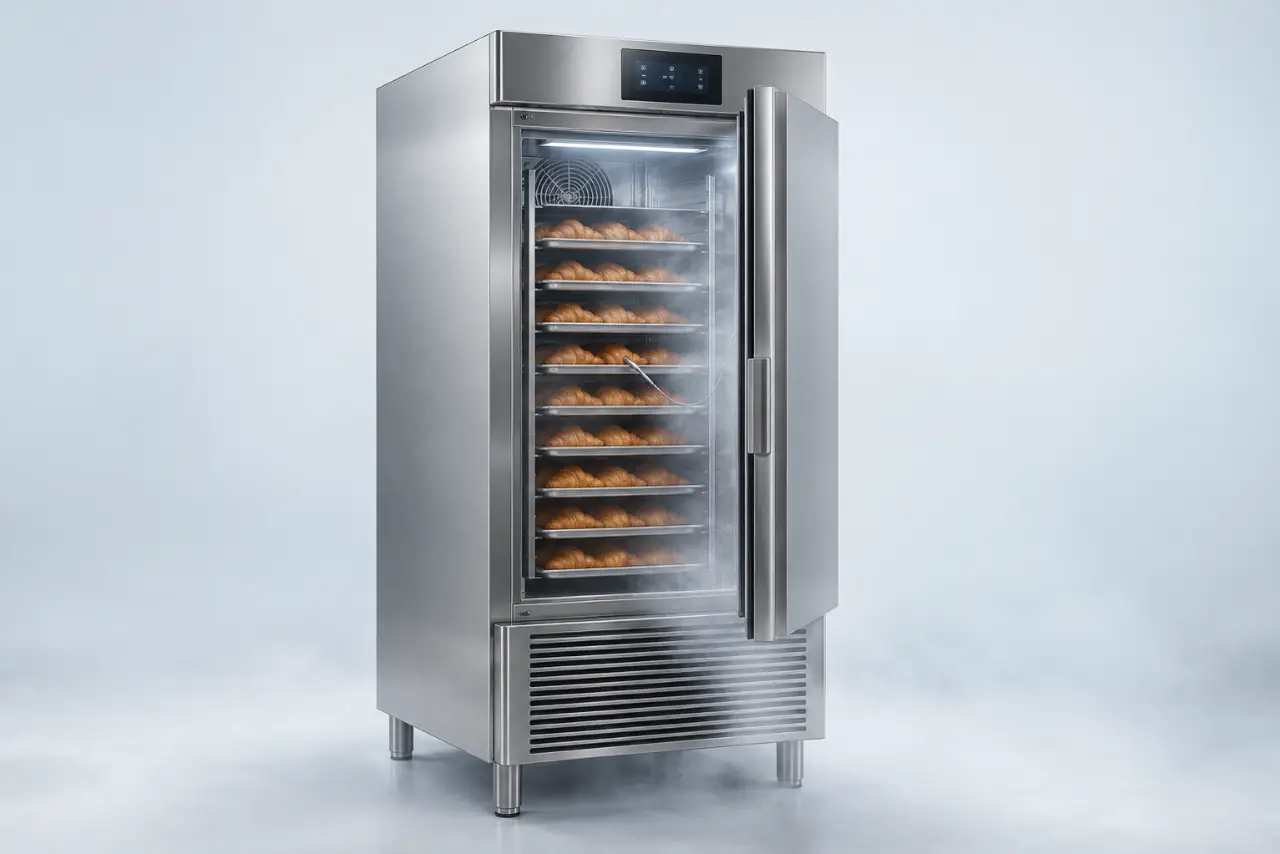
A blast chiller works by blowing air at about −20 °C to 0 °C (−4 °F to 32 °F) at high speed over shallow trays, removing heat far faster than a fridge. A core probe tracks the food, and the cycle brings cooked food from +70 °C to +3 °C (158 °F to 37 °F) in about 90 minutes, then holds it chilled until unloaded.
Key takeaways
- A blast chiller removes heat by forced convection: very cold air moving at several metres per second over food no deeper than about 50 mm (2 in).
- Standard cycles are soft chill (air near 0 °C), hard chill (air down to about −20 °C) and, on combined units, shock freezing (air at −35 °C to −40 °C).
- A probe cycle ends when the food core reaches the set point, typically +3 °C (37 °F) for chilling or −18 °C (0 °F) for freezing.
- Rated capacity is usually about 3–4 kg (7–9 lb) of food per GN 1/1 tray per chilling cycle, less for freezing.
- Blast chilling is the basis of the cook chill system, where chilled food is stored at 0–3 °C (32–37 °F) for up to 5 days.
How does a blast chiller work?
A blast chiller works by forcing very cold air across hot food at high speed, so heat leaves the food many times faster than it would in a refrigerator. A large compressor and evaporator chill the air to as low as −20 °C (−4 °F), powerful fans drive it across shallow trays, and a probe in the food tells the controller when the core has reached +3 °C (37 °F).
The result is a cooling time of about 90 minutes from +70 °C (158 °F) instead of 6 hours or more in a reach-in fridge. That matters for two reasons. First, food safety: bacteria multiply fastest between about +5 °C and +57 °C (41 °F and 135 °F), and the FDA Food Code 2-stage cooling rule requires cooked food to cool to 21 °C (70 °F) within 2 hours and to 5 °C (41 °F) within 6 hours. Second, quality: fast cooling limits moisture loss, keeps vegetables bright and stops sauces from over-thickening.
A normal refrigerator cannot do this job. It is designed to hold cold food, its compressor is small, and warm food placed inside raises the temperature of everything else. A blast chiller is designed for the opposite task: pulling heat out of a full load of hot food, then switching to a holding mode.
Many units are combined blast chillers and freezers: the same cabinet runs a chilling cycle or continues down to −18 °C (0 °F) as a blast freezer. Our guide to blast chiller vs shock freezer explains when you need each.
How does blast chilling reduce temperature so fast?
Heat leaves food in three steps: it conducts from the core to the surface, transfers from the surface into the air, and is carried away by the air to the evaporator. A blast chiller speeds up the last two steps, and you control the first through tray depth.
- Large temperature difference – heat flow is proportional to the gap between food and air. Air at −20 °C (−4 °F) against food at +70 °C gives a 90 K difference, compared with about 66 K in a +4 °C (39 °F) fridge.
- High air velocity – fans move air at roughly 2–6 m/s (400–1,200 ft/min) across the trays. Moving air strips away the insulating layer of warm, still air around the food; this cooling blast is the main reason a blast chiller outperforms a cold room at the same temperature.
- Oversized refrigeration – the compressor and evaporator are sized to absorb the heat released by a full load, so the air stays cold during the cycle instead of warming up.
- Shallow product – the core is never far from the surface. Food 50 mm (2 in) deep chills in roughly a quarter of the time of food 100 mm (4 in) deep.
The same principles apply to an air blast freezer; it simply runs colder air, about −35 °C to −40 °C (−31 °F to −40 °F), for longer. Lids slow the process, so most guidance is to chill uncovered or with perforated covers and cover once cold.
Blast chiller temperature: how cold does a blast chiller get?
How cold is a blast chiller? Air temperature changes with the cycle you choose. Typical controller settings are shown below; exact values vary by model.
| Cycle | Typical air temperature | Target core temperature | Typical time | Use for |
|---|---|---|---|---|
| Soft chill | About −2 °C to +2 °C (28–36 °F) | +3 °C (37 °F) | Up to 90 min | Delicate food: vegetables, rice, desserts, fish, thin portions |
| Hard chill | Starts at −15 °C to −20 °C (5 °F to −4 °F), rises near 0 °C at the end | +3 °C (37 °F) | Up to 90 min | Dense food: roasts, stews, sauces, large joints |
| Shock freeze | −35 °C to −40 °C (−31 °F to −40 °F) | −18 °C (0 °F) | Up to 240 min | Cook-freeze, bakery, seafood, ice cream hardening |
| Chill hold | +2 °C to +3 °C (36–37 °F) | — | Until unloaded | Automatic after chilling |
| Freeze hold | −18 °C to −22 °C (0 °F to −8 °F) | — | Until unloaded | Automatic after freezing |
Hard chill drops the air well below zero at the start to pull heat from a dense load quickly, then raises the air temperature once the surface approaches 0 °C, so the outside does not freeze while the core is still warm. Soft chill keeps air near zero all the way to protect texture. Many controllers also offer pre-cooling of the empty cabinet, defrost, and a UV or heated-probe function.
Core probes and timed cycles
A blast chiller can end a cycle in two ways:
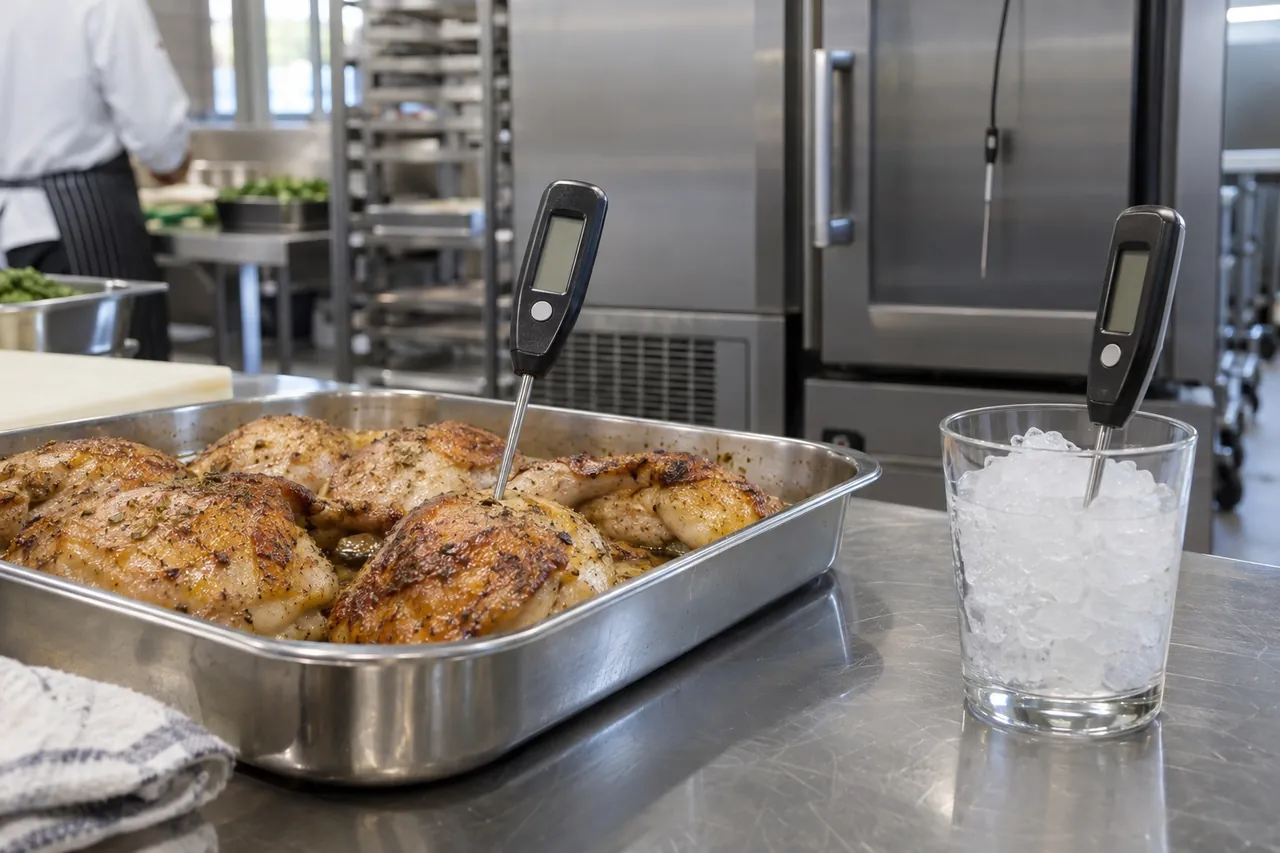
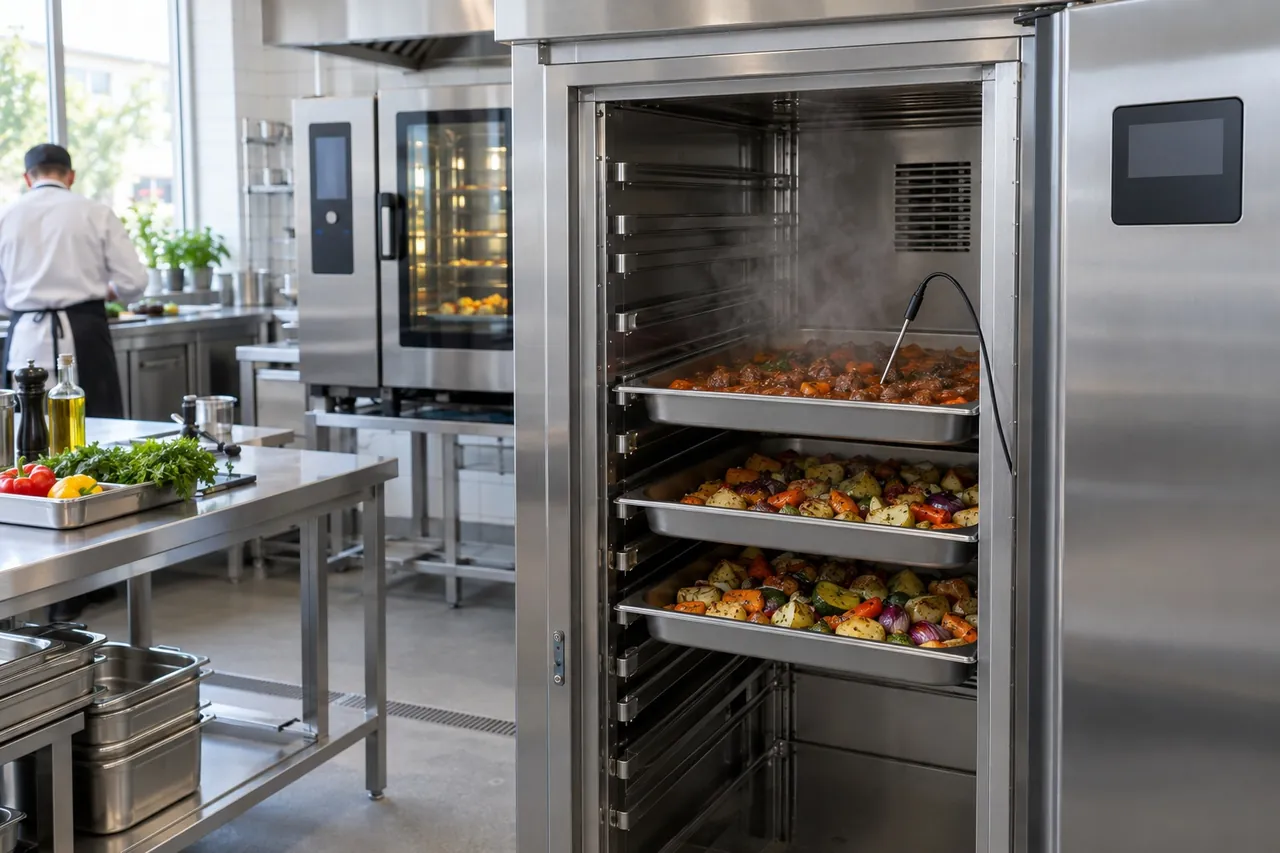
- Probe cycle – you insert a needle probe into the thickest piece of food in the load. The cycle runs until the probe reads the target, usually +3 °C (37 °F) for chilling or −18 °C (0 °F) for freezing, then switches to hold. This is the most reliable method and gives a temperature record for HACCP.
- Timed cycle – the unit runs for a set time, typically 90 minutes for chilling or 240 minutes for freezing. Useful for thin or small items where a probe is hard to insert, but you should still check core temperature with a hand thermometer before storage.
Good practice with probes:
- Insert the probe into the geometric centre of the largest piece, not touching the tray or bone.
- Clean and sanitise the probe between batches.
- Check probe accuracy regularly against an ice-point test at 0 °C (32 °F).
- For frozen products, use a heated probe or let it release before pulling it out.
Some cabinets have multi-point probes that read several depths, or several probes for mixed loads. Modern controllers store cycle data that can be downloaded by USB or sent to a monitoring system. Our food temperature probe guide explains probe types, accuracy and calibration in more detail.
Blast chiller capacity: how much food per cycle?
Tray count tells you how much space a cabinet has; rated capacity tells you how much heat it can remove. Manufacturers usually rate capacity per cycle with food about 40–50 mm (1.5–2 in) deep. Typical values for commercial blast chillers are:
| Size (GN 1/1 trays) | Typical chill capacity per cycle (+70 → +3 °C) | Typical freeze capacity per cycle (+70 → −18 °C) | Typical user |
|---|---|---|---|
| 3 trays (countertop) | 8–12 kg (18–26 lb) | 5–8 kg (11–18 lb) | Café, pastry counter |
| 5 trays (reach-in) | 15–20 kg (33–44 lb) | 10–15 kg (22–33 lb) | Restaurant, bakery |
| 10 trays (reach-in) | 30–40 kg (66–88 lb) | 20–30 kg (44–66 lb) | Busy restaurant, hotel |
| 15 trays | 45–60 kg (99–132 lb) | 30–40 kg (66–88 lb) | Banqueting, catering |
| 20 trays (roll-in trolley) | 60–100 kg (132–220 lb) | 45–70 kg (99–154 lb) | Central kitchen, cook chill production |
To size a unit, take the largest batch you need to chill at one time, not the daily total. A kitchen that cooks 60 kg of stock and stew in one afternoon session needs a 15–20 tray cabinet, even if it chills only 60 kg a day. With 90-minute cycles you can run several batches per shift, so a smaller unit works if production is spread out. Allow 10–20% margin if the kitchen is hot, because condenser performance falls above about 32 °C (90 °F) ambient.
The cook chill process: how blast chillers support cook chill cooking
Cook chill is a catering system in which food is cooked in bulk, blast chilled quickly, stored cold and reheated when needed. It lets hospitals, schools, airlines, hotel groups and restaurant chains cook in one central kitchen and serve elsewhere, or cook during quiet hours and serve at peak.
A typical cook chill process, based on widely used UK and EU catering guidance, runs like this:
- Cook to a safe core temperature, typically 75 °C (167 °F) or as your local code requires.
- Portion into shallow trays or bags within 30 minutes of cooking.
- Blast chill to 0–3 °C (32–37 °F) at the core within 90 minutes.
- Label and store at 0–3 °C, for a maximum of 5 days including the day of cooking and the day of consumption.
- Reheat to at least 70 °C (158 °F) for 2 minutes, or 74 °C (165 °F) under the FDA Food Code, and serve promptly.
A cook chill system needs more than a blast chiller: plan chilled storage at 0–3 °C, a clear labelling and stock-rotation method, temperature records at each stage, and staff training. For longer storage, cook-freeze uses the same steps but shock freezes to −18 °C (0 °F), extending shelf life to months. Large operations add walk-in chill rooms or roll-in blast chillers sized for full trolleys.
Types: countertop, reach-in, roll-in and industrial blast chillers
Countertop blast chiller – about 3 trays, plug-in, for cafés, pastry and small kitchens. A blast chiller for home or blast freezer for home is usually one of these; they work, but most households do not cool enough food to justify the cost.
Reach-in blast chillers – 5–15 trays, the standard choice for blast chillers for restaurants. Most are combined chiller-freezers with built-in condensing units.
Roll-in blast chillers – take a 15–20 tray trolley straight from the combi oven; often use a remote condensing unit.
Industrial blast chillers and freezers – walk-in rooms built from insulated panels with high-capacity evaporators, for pallets and racks; and continuous tunnel or spiral blast freezers for factory lines. See our guide to IQF, tunnel and spiral freezers for continuous equipment.
Portable blast freezers – container-based units on a skid or in a 20 ft or 40 ft insulated container, rented or bought for seasonal fish, meat or event catering.
Search terms such as "chill blasters", "blast fridge" or "rapid chiller" generally mean the same reach-in blast chiller. A wine chiller machine or drink chiller machine is different: it brings bottles or cans to serving temperature, and while a blast chiller will chill drinks fast, it is not built or priced for it.
How much does a blast chiller cost?
Blast chiller cost depends on capacity, build quality, controller, refrigerant, certification and where you buy. Indicative US retail ranges in 2026 are:
- Countertop, 3 trays – typically about $3,000–$7,000.
- Reach-in, 5 trays – typically about $5,000–$12,000.
- Reach-in, 10–15 trays – typically about $9,000–$25,000.
- Roll-in, 20 trays – typically $20,000–$45,000 or more, plus remote condensing unit installation.
Factory-direct imports usually cost less per unit but add freight, duty, local certification checks and installation. Before comparing a blast chiller price, compare rated kilograms per cycle, controller features, probe type, stainless steel grade, ambient rating and warranty, not just the tray count.
Buyers searching for blast chillers for sale or blast freezers in a particular state, such as New Jersey or Illinois, can buy locally or import direct. Be There ships commercial blast chillers and freezers worldwide with FOB, CIF or DDP terms; prices are quoted per order, by model, voltage and destination.
How to choose a commercial blast chiller
Work through these points before you request quotes:
- Largest single batch in kg (lb) and its depth in the tray.
- Chill only or chill and freeze – combined units cost more but add cook-freeze and bakery options.
- Tray format – GN 1/1, GN 2/1 or 600 × 400 mm, and rack spacing for your pans.
- Probe and records – single, multi-point or heated probe; USB, printer or remote HACCP logging.
- Power and installation – 220–240 V single-phase or 380–415 V three-phase, plug-in or remote condenser, ambient up to 32 °C or 43 °C.
- Certification for your market, such as NSF and UL/ETL in the US or CE in Europe.
- Chilled storage downstream at 0–3 °C, for example a walk-in cooler.
Send these details through our quotation form and we will propose a model, confirm capacity per cycle and quote delivered to your site.