Short answer
A temperature probe is a metal-sheathed sensor that measures the internal temperature of food, air or liquid. Food businesses mostly use thermistor or thermocouple probes; the FDA Food Code requires food thermometers accurate to ±1 °C (±2 °F). Check calibration in ice slush at 0 °C (32 °F) at least weekly and after any drop.
Key takeaways
- Thermistor probes are accurate to about ±0.2–0.5 °C between roughly −40 °C and +150 °C (−40 °F and 302 °F), which covers most food safety checks.
- Thermocouple probes respond in 1–5 seconds and cover very wide ranges, about −200 °C to over +1,000 °C, but are usually slightly less accurate.
- The FDA Food Code requires food probe thermometers accurate to ±1 °C (±2 °F) and a thin probe of 1.5 mm (0.059 in) or less for thin foods.
- Blast chillers and shock freezers use a needle core probe to end the cycle at +3 °C (37 °F) or −18 °C (0 °F) at the food core.
- An ice-point check at 0 °C (32 °F) takes about 10 minutes and should be logged as part of your HACCP records.
What is a temperature probe?
A temperature probe is a sensor sealed in a metal sheath, usually stainless steel, that you insert into food, liquid or air to measure its temperature. The sensing element sits near the tip; a cable or handle connects it to a display, a controller or a data logger. In kitchens the term covers hand-held probe thermometers, leave-in cooking probes and the core probe inside a blast chiller.
A temp probe is the most important food safety tool in a commercial kitchen because most HACCP critical limits are temperatures: cook to a minimum core temperature, cool within set times, hold hot above 57 °C (135 °F) and cold below 5 °C (41 °F). Surface temperature, air temperature and how long food has been cooking are not reliable substitutes for a core reading.
Three questions decide which probe you need:
- Sensor type – thermistor, thermocouple, RTD or bimetal, which sets range, accuracy and speed.
- Probe shape – needle, thin tip, surface, air or leave-in.
- Connection – hand-held reading, fixed controller (such as a blast chiller), or wireless logging.
The sections below cover each, then explain HACCP accuracy rules and calibration.
Types of temperature sensing probe compared
Every temperature sensing probe uses one of four sensing principles. Typical values are below; check the specification of any probe you buy.
| Sensor | How it works | Typical range | Typical accuracy | Response | Best for |
|---|---|---|---|---|---|
| Thermistor (NTC) | Resistance falls as temperature rises | −40 °C to +150 °C (−40 °F to 302 °F); special types to about +300 °C | ±0.2–0.5 °C | 3–10 s | Food probes, fridges, blast chiller core probes |
| Thermocouple (type K, T) | Voltage at the junction of two metals | Type T −200 °C to +350 °C; type K up to about +1,200 °C | ±0.5–2 °C with instrument | 1–5 s (thin tips) | Fast spot checks, ovens, fryers, grills |
| RTD (Pt100/Pt1000) | Platinum resistance rises with temperature | −200 °C to +600 °C | ±0.1–0.3 °C | 5–20 s | Industrial process, reference thermometers |
| Bimetal dial | Coiled metal strip moves a pointer | About −18 °C to +105 °C (0–220 °F) | ±1–2 °C | 15–30 s | Low-cost backup; needs deep insertion |
For most restaurants a digital thermistor or thermocouple probe thermometer is the practical choice. RTDs are favoured where traceable accuracy matters, for example as the reference against which other kitchen probes are checked.
Thermistor probes and high temperature thermistor probes
A thermistor probe contains a small ceramic semiconductor bead whose electrical resistance changes sharply with temperature. Most food and refrigeration probes use NTC (negative temperature coefficient) thermistors, typically rated around 10 kΩ at 25 °C (77 °F). Because the resistance change is large, electronics can read it precisely with a simple two-wire cable, which keeps cost low and accuracy high.
Strengths:
- High accuracy, about ±0.2–0.5 °C, across the food safety range.
- Stable over time and easy to interchange in controllers.
- Used as the core probe and air sensor in most fridges, freezers and blast chillers.
Limits:
- Standard epoxy-coated thermistors are rated to about +105 °C to +150 °C (221–302 °F).
- Accuracy and stability fall off near the top of the range.
High temperature thermistor probes use glass-encapsulated beads and high-temperature cable insulation such as PTFE or silicone with braided steel jackets. They are typically rated to around +250 °C to +300 °C (482–572 °F) for the probe, though the cable and handle often have lower limits. Above that, or for fryer oil, oven air and grill surfaces, a thermocouple is usually the better choice. Always check the separate ratings for tip, cable and handle before leaving a probe in an oven.
HACCP temperatures and how accurate a food probe must be
The FDA Food Code requires food temperature measuring devices to be accurate to ±1 °C in the Celsius scale or ±2 °F in the Fahrenheit scale. Thermometers that measure the air in refrigerators and hot holding units must be accurate to ±1.5 °C (±3 °F). A probe with a small diameter, 1.5 mm (0.059 in) or less, must be available for thin foods such as burger patties and fish fillets. Your local code may set different values, so check it.
| Control point | Typical critical limit (FDA Food Code) | Where to probe |
|---|---|---|
| Cooking poultry, stuffed foods | 74 °C (165 °F) for <1 s | Thickest part, away from bone |
| Cooking ground meat | 68 °C (155 °F) for 17 s | Centre of patty, from the side |
| Hot holding | 57 °C (135 °F) or above | Centre of the pan, after stirring |
| Cooling cooked food | 57 → 21 °C in 2 h; to 5 °C within 6 h total | Core of the thickest portion |
| Reheating for hot holding | 74 °C (165 °F) within 2 h | Core |
| Cold holding | 5 °C (41 °F) or below | Between packs or in a product simulant |
| Frozen storage | −18 °C (0 °F) or below | Between packs; avoid drilling frozen food |
Cooling is where probes are most often skipped. A blast chiller with a core probe records the curve automatically; see the 2-stage cooling method and how a blast chiller works.
Food probe designs: needle, thin-tip, leave-in and core probes
Sensor type sets accuracy; probe shape decides whether you can actually measure the right spot.
- Needle or penetration probe – a 3–4 mm (about 1/8 in) stainless shaft with a pointed tip, for roasts, stews, rice and cooked foods. Sensors sit within the last 5–10 mm of the tip.
- Thin-tip probe – a reduced tip of 1.5 mm or less for thin foods and fast response.
- Leave-in probe – a probe on a heat-resistant cable that stays in the meat in an oven or smoker, with the display outside.
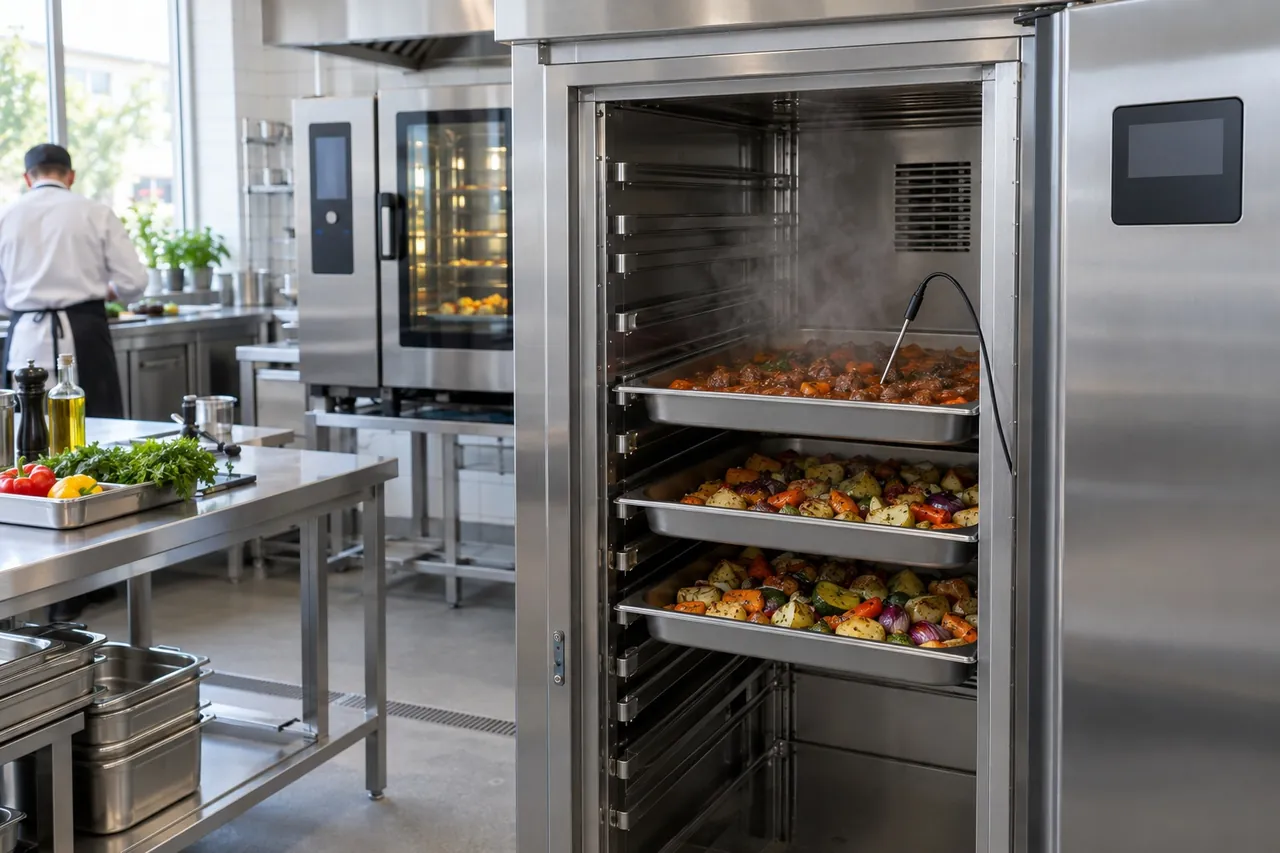
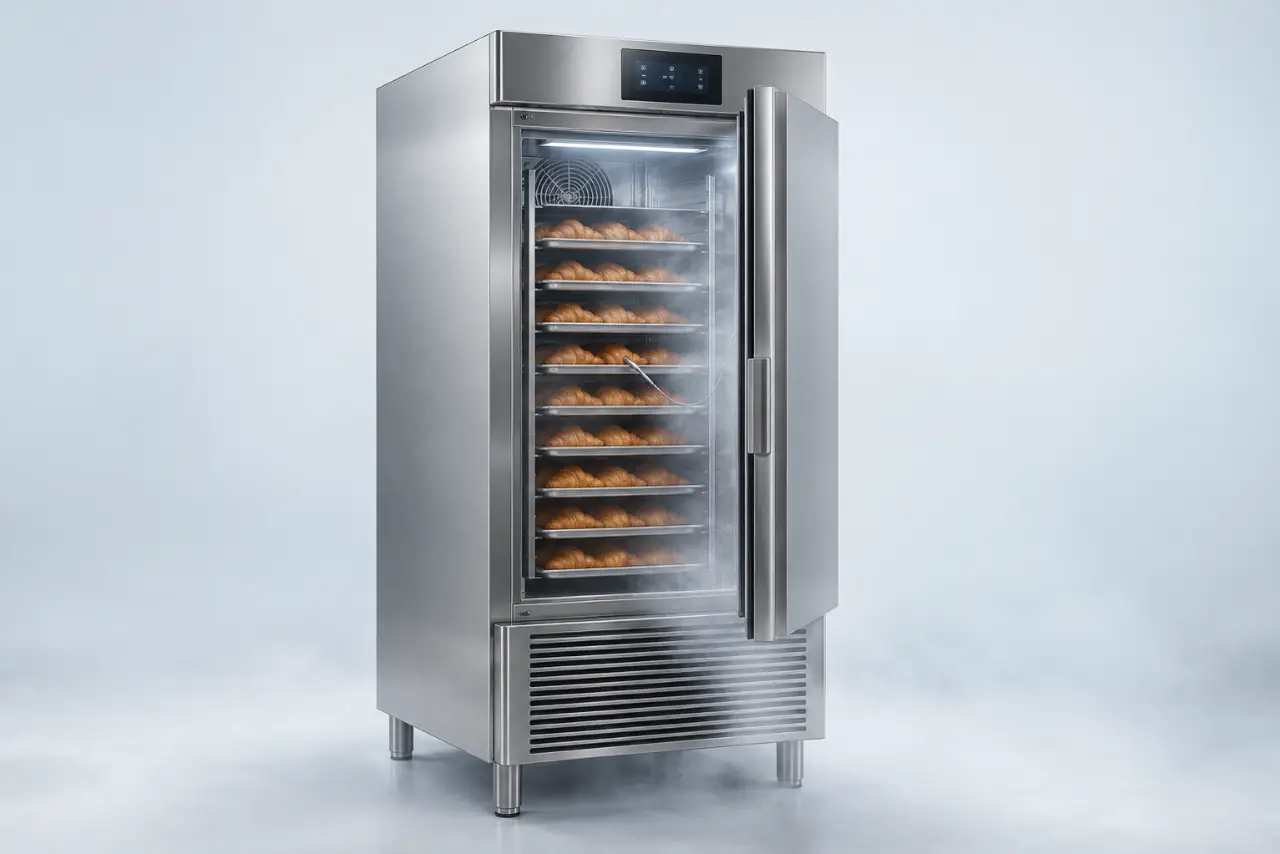
- Core probe – the fixed needle probe on a cable inside a blast chiller, shock freezer or combi oven. The controller ends the cycle when the core reaches its target. Multi-point core probes read several depths and use the warmest reading; heated core probes release from frozen food.
- Surface probe – a flat spring-loaded tip for griddles and hot plates.
- Air or immersion probe – open-tip or shielded probes for cabinet air, water baths, brine and oil.
Hygiene matters as much as accuracy. Clean and sanitise the probe before and after each use, typically with single-use alcohol wipes or a food-safe sanitiser, and store hand-held probes in a holder rather than loose in a drawer. In a blast chiller or shock freezer, wipe the core probe between batches and check the cable for cuts, which let moisture in and cause drifting readings.
How to calibrate a temperature probe (ice-point method)
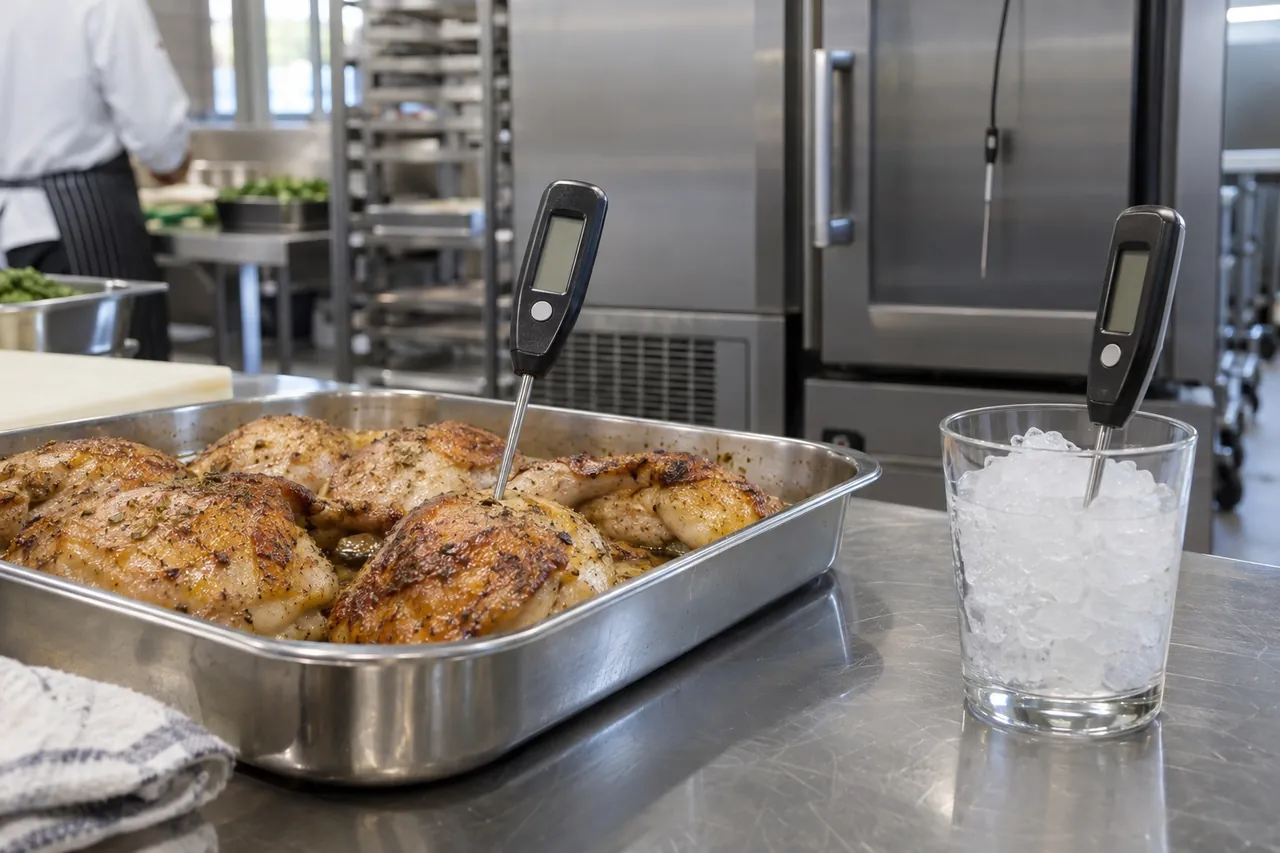
Check every food probe at least weekly, after it is dropped, and whenever readings look wrong. The ice-point method is the easiest and most reliable check because 0 °C (32 °F) does not change with altitude:
- Make an ice slush – Fill a glass or jug to the top with crushed ice made from clean water, then add cold water to just below the ice surface and stir.
- Let it settle – Wait about 3 minutes and stir again so the mixture reaches a stable 0 °C (32 °F) throughout.
- Insert the probe – Push the probe at least 50 mm (2 in) into the slush, in the centre, without touching the bottom or sides of the container.
- Wait for a stable reading – Wait until the reading has stopped moving for about 30 seconds; slow probes may need longer.
- Compare and adjust – The reading should be 0 °C (32 °F). If your unit has a calibration offset or nut, adjust it; otherwise record the offset.
- Record or retire – Log the date, probe ID, reading and action. Replace any probe that reads more than ±1 °C (±2 °F) out and cannot be adjusted.
The boiling-point method checks the upper range, but water boils below 100 °C (212 °F) at altitude: roughly 1 °C lower per 300 m, or about 1 °F lower per 500 ft above sea level. Use local boiling point, not 100 °C. Thermistor controllers in fridges and blast chillers usually allow an offset in the settings menu; ask your service technician to check them at each maintenance visit against a calibrated reference thermometer.
Smoke temperature probes and grill temperature probes for BBQ businesses
Barbecue restaurants, caterers and food trucks rely on temperature probes for smokers because low-and-slow cooking makes doneness hard to judge. A typical setup uses two kinds of probe:
- Pit or smoke temperature probe – an air probe clipped near the meat at grate level to read cooking chamber temperature, often 107–135 °C (225–275 °F). Mounting it at grate height matters; dome thermometers can read 10–30 °C off.
- Meat probes – leave-in needle probes in the thickest part of each brisket, shoulder or rack, read by a multi-channel unit or wireless transmitter.
Most grill temperature probes sold for BBQ are thermistors with braided steel cables rated to roughly 300–380 °C (572–716 °F) for short periods. They are convenient but are not always tested as food safety instruments, so a commercial kitchen should still verify final core temperatures, especially for poultry at 74 °C (165 °F), with a calibrated hand-held probe and record the result.
After smoking, cooling remains the biggest risk with large cuts. Slicing, spreading in shallow trays and blast chilling to +3 °C (37 °F) is the reliable way to meet cooling limits for leftovers and pre-cooked meat.
Industrial temperature probes and monitoring in cold rooms and trucks
Beyond the kitchen, industrial temperature measurement in the cold chain uses fixed probes that report continuously:
- Industrial temperature probe – a rugged sensor, usually Pt100 RTD or thermistor, in a stainless sheath with sealed cable gland, typically IP65–IP68, sometimes with a 4–20 mA transmitter for long cable runs to a control panel.
- Data loggers – battery or mains devices that record temperature every 1–15 minutes in cold rooms, freezers and reefer trucks, often with a second probe in a product simulant.
- Industrial temperature range monitor – a monitoring system that watches set high and low limits across many sensors and raises alarms by SMS, email or app when a room drifts out of range.
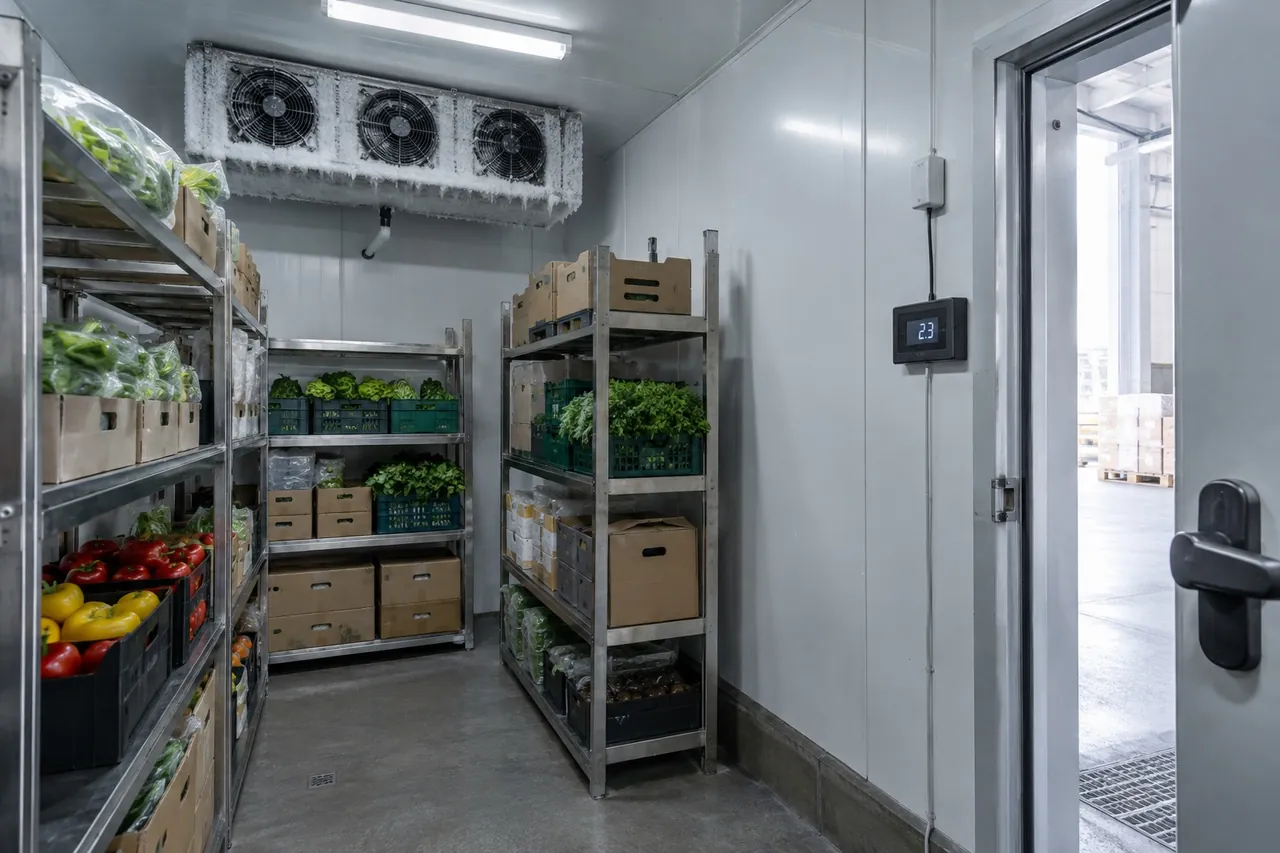
Place air probes in the return air of the evaporator for control, and in the warmest part of the room or load for records. Our guide to cold room temperature monitoring covers sensor positions, alarm settings and logging intervals. In transport, the reefer unit controller measures return and supply air, and a separate logger provides records for customers.
Checklist: choosing temperature probes for a food business
- At least one calibrated digital probe thermometer per kitchen section, accurate to ±1 °C (±2 °F) or better.
- A thin-tip probe of 1.5 mm or less for burgers, fish and thin cuts.
- Waterproof housing (IP65 or better) for cleaning, plus a sanitising wipe dispenser nearby.
- A blast chiller with a core probe, and ideally HACCP data download, for cooling records.
- Fixed probes and loggers in every fridge, freezer and cold room, with alarms.
- A written calibration log: weekly ice-point checks, annual check against a reference thermometer.
- Spare probes and batteries.
Be There supplies reach-in and roll-in blast chillers and shock freezers with core probe control, plus cold rooms with digital controllers. Tell us your daily volumes through the inquiry form and we will recommend a size and quote it.