
Short answer
For temperature measurement, an RTD (Pt100/Pt1000) is the most accurate and stable sensor, about ±0.15 °C at 0 °C for class A; an NTC thermistor is similarly accurate from −40 °C to +125 °C at the lowest cost; and a thermocouple covers −200 °C to +1,260 °C with fast response but only ±0.5–2.2 °C accuracy.
Key takeaways
- A Pt100 RTD rises about 0.385 Ω per °C; IEC 60751 class A tolerance is ±(0.15 + 0.002|t|) °C, or ±0.19 °C at −20 °C.
- Thermocouples produce about 40 µV per °C; type T (copper/constantan) is the best type for cold chain work at ±0.5 °C class 1.
- A 10 kΩ NTC thermistor changes about 4% per °C and is the standard air and defrost sensor in refrigeration controllers.
- Use 3- or 4-wire RTDs on long cable runs: each 0.4 Ω of lead resistance on a 2-wire Pt100 adds about 1 °C of error.
- Insert a probe at least 10–15 times its diameter into the product, and check it at the ice point (0 °C / 32 °F) regularly.
What are the main types of temperature sensor?
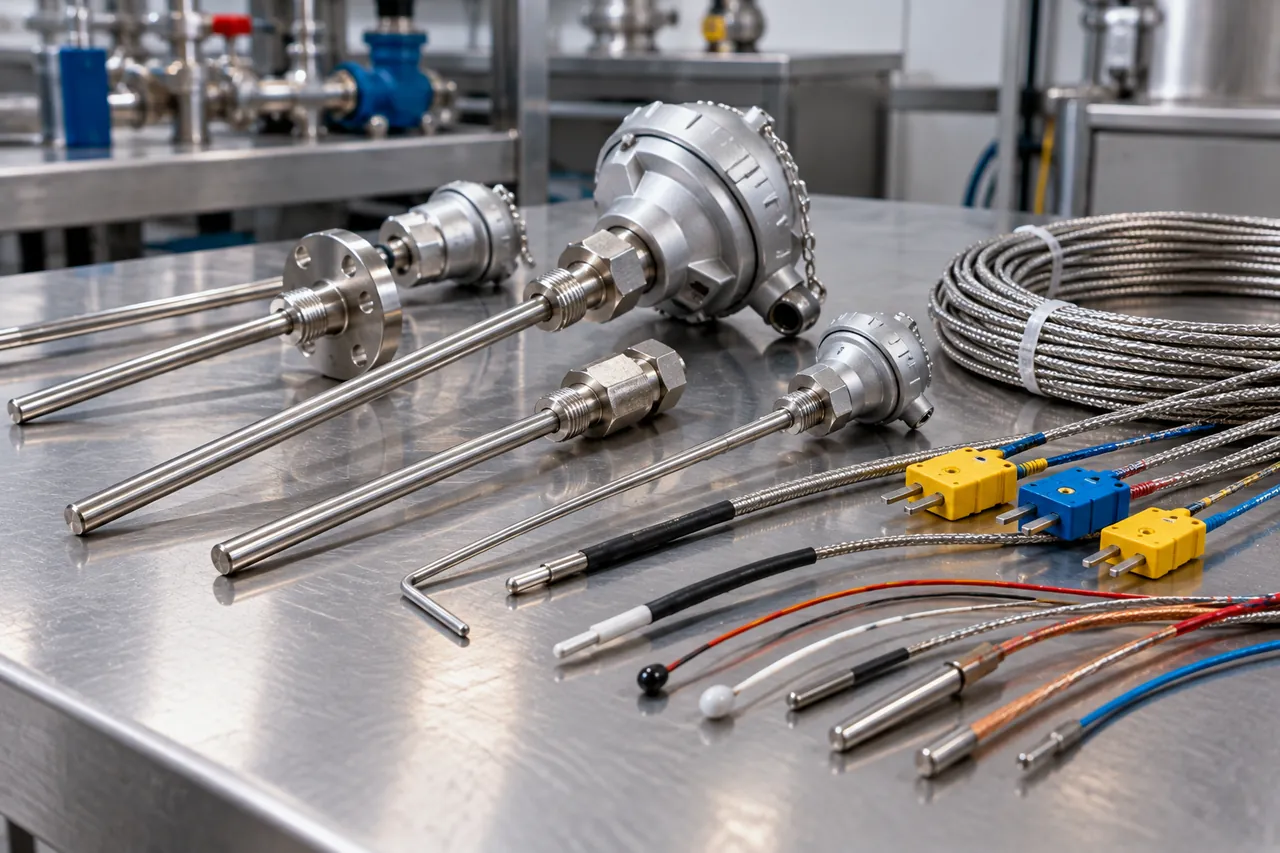
The three electronic sensors used for almost all industrial and cold chain temperature measurement are the RTD (resistance temperature detector), the thermocouple and the thermistor. An RTD changes resistance in a precise, nearly linear way; a thermocouple generates a small voltage where two different metals meet; a thermistor is a ceramic bead whose resistance changes sharply with temperature.
Every digital thermometer, data logger, cold room controller and alarm you buy contains one of these three elements. The display, logger or controller around it decides how well the reading is used, but the sensing element sets the limits on range, accuracy, stability and response time. Choosing the wrong one is the most common reason a temperature reading looks plausible but is wrong by 1–2 °C (2–4 °F), which in a vaccine fridge or a freezer audit is the difference between pass and fail.
Other temperature measuring instruments exist: liquid-in-glass and bimetal dial thermometers, infrared (non-contact) thermometers and semiconductor IC sensors. Our guide to types of thermometers for food service covers the handheld options. This article focuses on the three sensor types you specify when you buy or build monitoring, logging or control equipment.
How does an RTD temperature probe work?
An RTD temperature probe measures temperature through the electrical resistance of a fine platinum wire or thin film, which rises by about 0.385 Ω per °C for a standard Pt100 element. The instrument passes a small current through the element, measures the resistance and converts it to temperature using the curve defined in IEC 60751.
The common elements are Pt100 (100 Ω at 0 °C) and Pt1000 (1,000 Ω at 0 °C). A Pt100 reads about 93 Ω at −18 °C (0 °F) and about 103.1 Ω at +8 °C (46 °F). Pt1000 elements have ten times the resistance change per degree, so lead-wire resistance matters less and they suit battery-powered loggers that use very low measuring currents.
RTD accuracy classes
IEC 60751 sets tolerance classes for platinum RTDs. Tolerance grows with distance from 0 °C, which is why RTDs are so good at cold chain temperatures close to zero.
| IEC 60751 class | Tolerance formula | At 0 °C | At −20 °C (−4 °F) | At −80 °C (−112 °F) |
|---|---|---|---|---|
| Class AA (1/3 DIN) | ±(0.10 + 0.0017 |t|) °C | ±0.10 °C | ±0.13 °C | ±0.24 °C |
| Class A | ±(0.15 + 0.002 |t|) °C | ±0.15 °C | ±0.19 °C | ±0.31 °C |
| Class B | ±(0.30 + 0.005 |t|) °C | ±0.30 °C | ±0.40 °C | ±0.70 °C |
2-wire, 3-wire and 4-wire RTDs
The copper leads of an RTD add their own resistance to the reading. With a 2-wire Pt100, every 0.4 Ω of lead resistance adds roughly 1 °C of error, so a long cable run to a cold room can read high. A 3-wire connection cancels most lead resistance and is the industrial standard; a 4-wire connection cancels it completely and is used for laboratory references and calibration. For an air temperature RTD probe mounted several metres from its transmitter, specify 3-wire Pt100 or a Pt1000.
RTDs are stable for years, interchangeable without recalibration and accurate across −200 °C to +600 °C (−328 °F to 1,112 °F) in common sheathed designs. Their weaknesses are cost, a slightly slower response than a bare thermocouple, fragility of wire-wound elements under vibration, and self-heating if the measuring current is too high.
How does a thermocouple work?
A thermocouple is two wires of different metals joined at the tip; when the tip is at a different temperature from the other end, the junction produces a voltage of roughly 40 µV per °C (the Seebeck effect). The instrument measures that tiny voltage and the temperature at its own terminals, called the cold junction, and adds the two to calculate the tip temperature.
That cold-junction compensation is essential. If the instrument's terminal block warms up in the sun or sits next to a hot power supply and the compensation sensor does not track it, the reading drifts. Thermocouples also need the correct extension or compensating cable all the way to the instrument; joining type K wire with ordinary copper creates new junctions and new errors.
| Thermocouple type | Metals (+/−) | Typical useful range | Class 1 tolerance (IEC 60584) | Typical use |
|---|---|---|---|---|
| Type T | Copper / constantan | −200 °C to +350 °C (−328 °F to 662 °F) | ±0.5 °C or ±0.4% of reading, −40 °C to +350 °C | Food, cold chain, temperature mapping, low temperatures |
| Type K | Nickel-chromium / nickel-aluminium | −200 °C to +1,260 °C (−328 °F to 2,300 °F) | ±1.5 °C or ±0.4%, −40 °C to +1,000 °C | General purpose, ovens, fryers, handheld probes |
| Type J | Iron / constantan | −40 °C to +750 °C (−40 °F to 1,382 °F) | ±1.5 °C or ±0.4% | Older industrial equipment, plastics processing |
| Type E | Nickel-chromium / constantan | −200 °C to +900 °C | ±1.5 °C or ±0.4% | Highest output per degree, cryogenic work |
| Type N | Nicrosil / nisil | −200 °C to +1,260 °C | ±1.5 °C or ±0.4% | Stable high-temperature furnaces |
For refrigeration work, type T is the usual choice: its copper leg conducts well, it is stable at sub-zero temperatures and its class 1 tolerance is ±0.5 °C (±0.9 °F). Type K is cheaper and dominates handheld probes, but a standard type K probe is only good to about ±1.5–2.2 °C (±2.7–4 °F) unless it has been individually calibrated.
Thermocouples win on range, ruggedness, small tip size and price. A food thermocouple with a 1.5 mm (0.06 in) needle tip reaches a stable reading in a few seconds, which is why fast handheld food probes use them. Their weaknesses are the low signal (easily disturbed by electrical noise from compressors and inverters), the cold-junction dependence and lower basic accuracy than an RTD.
How does a thermistor work?
A thermistor is a small bead of metal-oxide ceramic whose resistance falls steeply as temperature rises (an NTC, or negative temperature coefficient, thermistor). A common 10 kΩ NTC changes by about 4% per °C, roughly a hundred times the relative change of a platinum RTD, so even simple electronics can resolve 0.1 °C.
The trade-off is non-linearity and limited range. A 10 kΩ NTC with a B-value of 3950 reads about 33.6 kΩ at 0 °C and about 93 kΩ at −18 °C (0 °F); the instrument converts resistance to temperature with the Steinhart–Hart equation or a lookup table. Most thermistors are specified from about −40 °C to +125 °C (−40 °F to 257 °F), which covers every chiller, freezer and food application but not ovens or ultra-low freezers below −80 °C.
NTC thermistors are the default sensor in refrigeration controllers. The air sensor, defrost-termination sensor and condenser sensor in a reach-in fridge, display freezer or cold room controller are almost always 2 kΩ, 5 kΩ or 10 kΩ NTC probes in an epoxy or stainless sleeve. They are cheap, sensitive and accurate to about ±0.2–0.5 °C (±0.4–0.9 °F) over 0–50 °C. Their main limitation is interchangeability: a replacement probe must have the same resistance and B-value as the controller expects, or the display will be wrong by several degrees.
PTC (positive temperature coefficient) thermistors, whose resistance rises with temperature, are used mainly as protection devices, for example as compressor motor overload or start relays, rather than for measurement.
RTD vs thermocouple vs thermistor: which is most accurate?
For most cold chain work, a class A RTD is the most accurate and stable sensor, a thermistor is equally accurate over a narrow range at lower cost, and a thermocouple is the least accurate but covers the widest range and responds fastest. The table compares them on the points that matter when specifying equipment.
| Property | RTD (Pt100 / Pt1000) | Thermocouple (type T / K) | Thermistor (NTC) |
|---|---|---|---|
| Typical range | −200 °C to +600 °C | −200 °C to +1,260 °C | −40 °C to +125 °C (some to −80 °C) |
| Typical accuracy near 0 °C | ±0.1–0.3 °C (class AA–B) | ±0.5 °C (T) to ±2.2 °C (K, standard) | ±0.1–0.5 °C |
| Linearity | Very good | Fair, needs polynomial | Poor, needs Steinhart–Hart |
| Long-term stability | Excellent (<0.05 °C/year) | Moderate, drifts at high temperature | Good if glass-encapsulated |
| Response time | Medium (2–10 s in liquid) | Fast (under 1–3 s for fine tips) | Fast to medium |
| Signal | 0.385 Ω/°C (Pt100) | About 40 µV/°C | About 4% of resistance per °C |
| Needs | 3- or 4-wire connection | Cold-junction compensation, matched cable | Matching resistance and B-value |
| Relative cost | High | Low | Lowest |
The instrument electronics, cable, mounting and calibration usually add more error than the element itself. A ±0.1 °C RTD wired to a poorly compensated input or mounted in the warm air stream next to an evaporator coil will not give you a true product temperature.
Which temperature sensor should you use for cold rooms, fridges and food?
Use NTC thermistors for equipment control, Pt100 or Pt1000 RTDs for regulated monitoring and reference measurements, and type T thermocouples for multi-point mapping and fast food probing. The table matches common applications to the usual choice.
| Application | Usual sensor | Why |
|---|---|---|
| Fridge, freezer or cold room controller (air and defrost probes) | NTC 2 kΩ, 5 kΩ or 10 kΩ | Cheap, sensitive, matched to the controller |
| Continuous monitoring of a cold room or warehouse | Pt100/Pt1000 or calibrated NTC | Stability and traceable accuracy for audits |
| Vaccine and pharmacy fridges | Calibrated thermistor or RTD in a buffered (glycol) probe | Reads product temperature, not door-opening air spikes |
| Ultra-low freezers to −80 °C (−112 °F) | Pt100/Pt1000 or type T | Most thermistors are not specified that low |
| Temperature mapping and qualification | Type T thermocouples or wireless RTD/NTC loggers | Many points, accurate near 0 °C |
| Handheld food core temperature | Type K or T thermocouple, or thermistor | Thin tip, fast reading |
| Blast chiller core probe | NTC or Pt1000 in a stainless needle | Robust, suited to the controller cycle |
| Ovens, fryers, refrigerant discharge lines above +125 °C | Type K thermocouple or Pt100 | Range beyond thermistors |
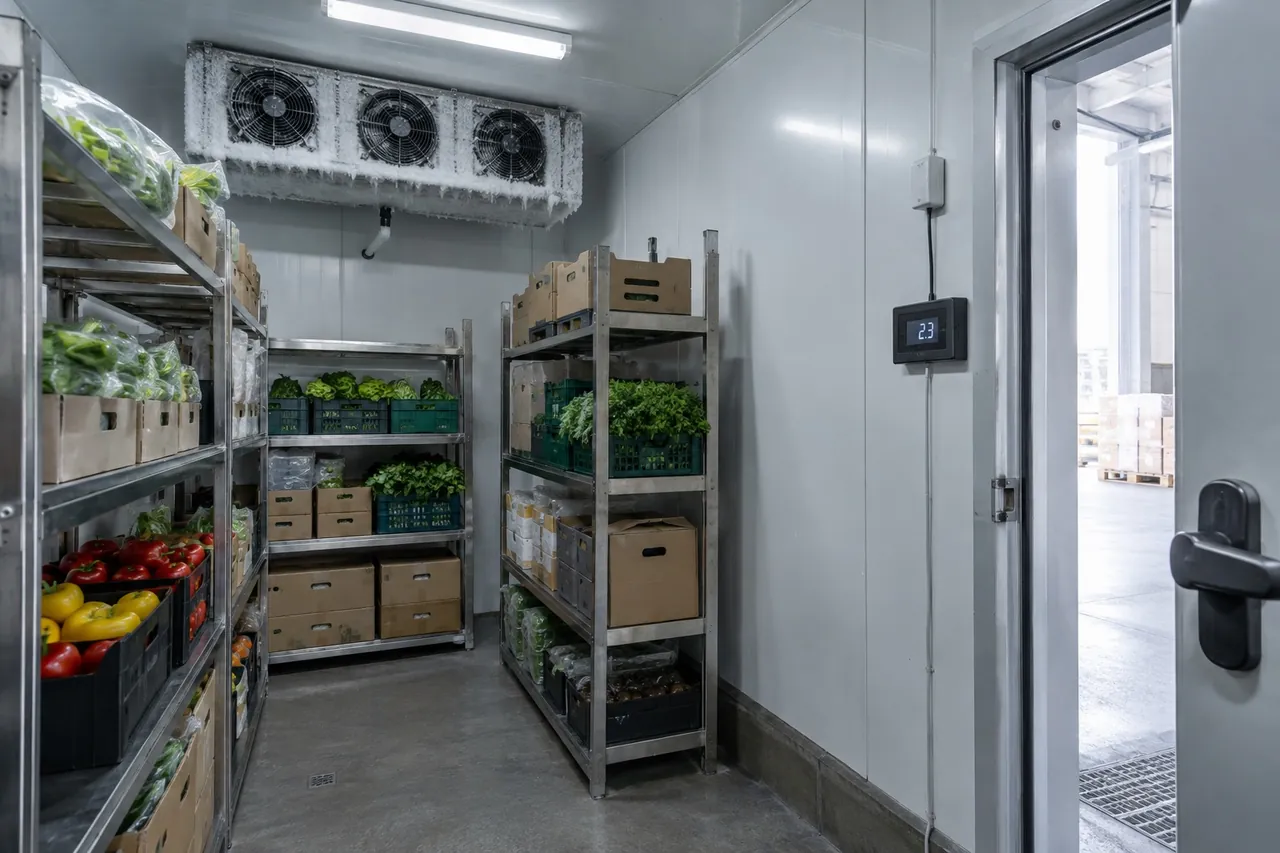
For an ambient temperature measurement device in a cold room, mount the sensor in free air away from the evaporator discharge, door and lights, at about two-thirds of the room height. For product temperature, use a probe in a buffer bottle of glycol or a product simulant so that brief air spikes during door openings do not trigger false alarms. Our cold room temperature monitoring guide explains placement, logging intervals and alarm delays, and the food temperature probe guide covers core probes for kitchens.
What is thermocouple data acquisition (DAQ)?
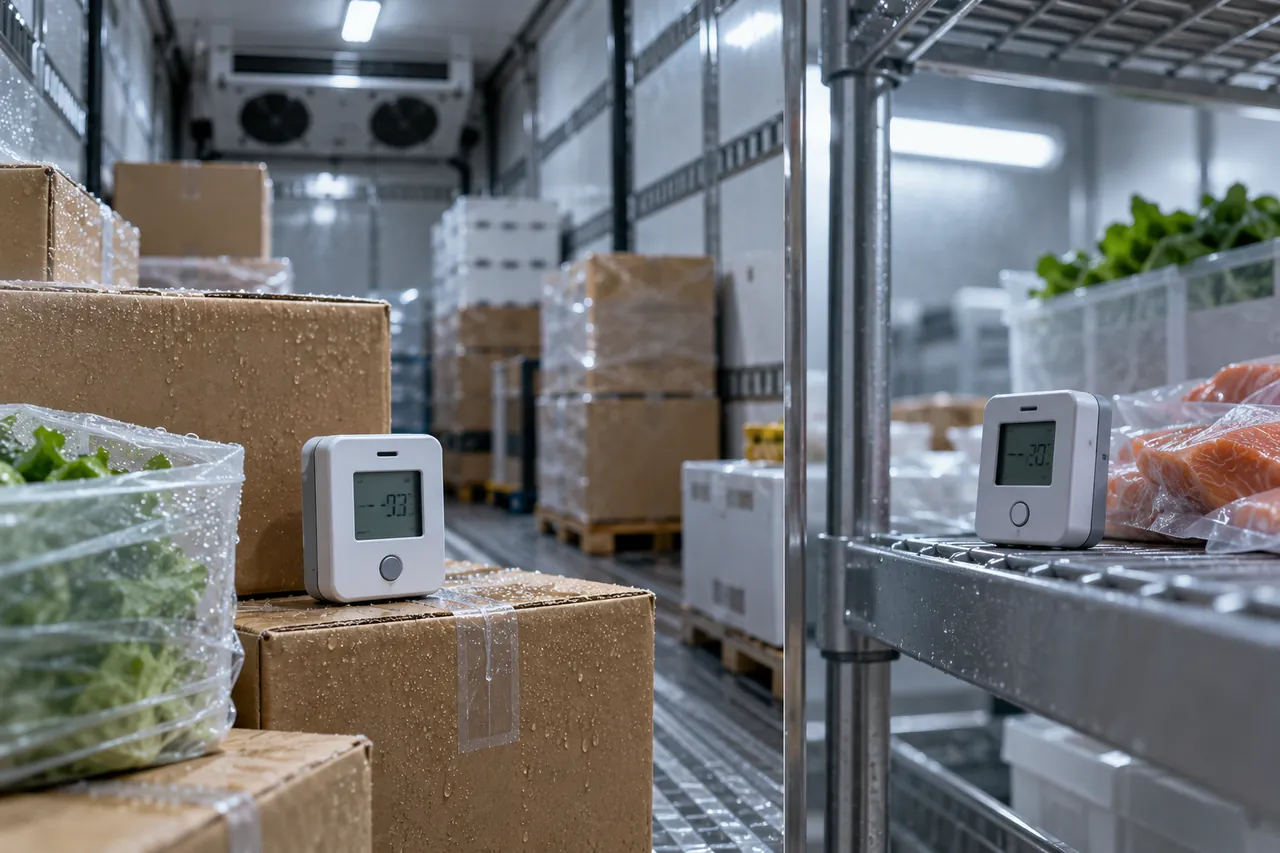
Thermocouple data acquisition means connecting several thermocouples to one instrument that measures, timestamps and stores every channel, so you can see temperature at many points at once. A thermocouple DAQ may be a multi channel thermocouple logger with 4–32 inputs, a USB module that streams to a PC, or a modular rack system with hundreds of channels.
Engineers use a thermocouple data acquisition system to commission refrigeration (recording suction, discharge, liquid line, evaporator in and out, and room air together), to pull-down test a new cold room, and to map warehouses before qualification. A thermocouple recorder or thermocouple logger USB unit with 4–8 channels is enough for most service work; temperature mapping a cold store often needs 15–40 points, which is why wireless loggers are now common there. See our guide to warehouse temperature mapping for how many points to use and where.
What to check in a thermocouple DAQ
- Thermocouple types supported: at least T and K, ideally J, E and N too.
- Cold-junction compensation accuracy: typically ±0.2–0.5 °C; it adds directly to the sensor error.
- Resolution and sampling rate: 0.1 °C resolution and 1-second sampling is plenty for refrigeration; fast thermal tests need more.
- Channel isolation: isolated inputs prevent ground loops when probes touch metal pipework at different potentials.
- Noise rejection: 50/60 Hz rejection matters next to compressors, fans and variable-speed drives.
- Software and export: CSV export, alarm limits and tamper-evident records if the data supports GDP or HACCP files.
For single-point long-term records, such as a freezer that must be logged every 10 minutes for a year, a dedicated standalone logger is simpler than a DAQ. Our temperature data logger guide compares USB, Bluetooth and cloud loggers.
What causes temperature measurement errors, and how do you calibrate?
Most temperature measurement errors come from installation, not the sensor: poor placement, too little immersion, lead resistance, electrical noise, slow response and drift since the last calibration. Check these before replacing a probe.
- Placement: a probe in the evaporator discharge reads 3–6 °C (5–11 °F) colder than the room average; one near the door reads warm after every opening.
- Immersion depth: insert a probe at least 10–15 times its sheath diameter into the product or liquid, so heat conducted down the stem does not bias the tip. A 3 mm probe needs 30–45 mm (1.2–1.8 in).
- Lead resistance: use 3- or 4-wire RTDs on long runs; with thermistors, higher resistance elements (10 kΩ) make lead effects negligible.
- Self-heating: keep RTD and thermistor measuring currents low, especially in still air.
- Cold-junction and cable errors: use correct thermocouple extension cable and keep the instrument terminals at a stable temperature.
- Response time: a sensor needs about five time constants to settle; a sleeved probe with a 20-second time constant needs nearly 2 minutes to read correctly after moving.
- Drift: compare every working sensor against a calibrated reference at least yearly, and immediately after any drop or impact.
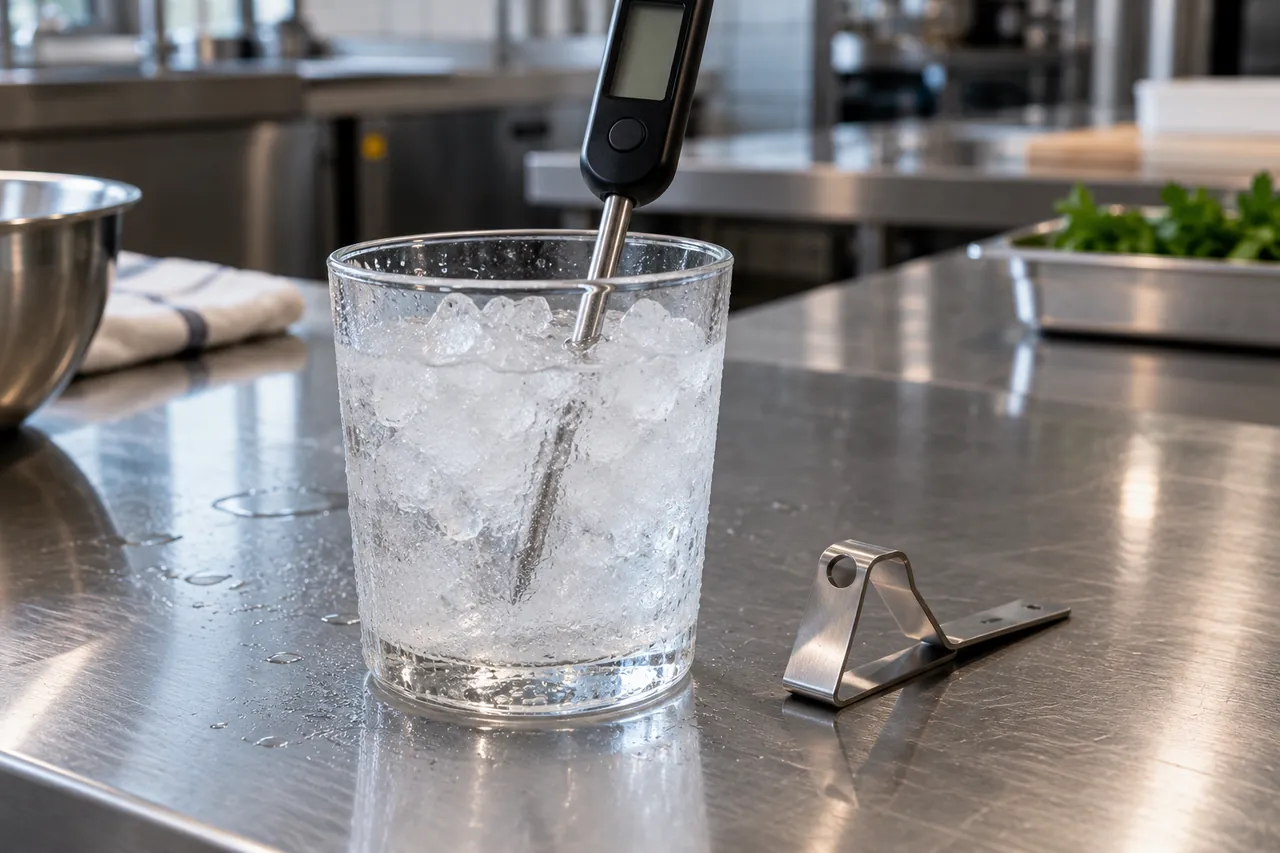
For quick field checks, an ice-point bath of crushed ice and water should read 0 °C ±0.5 °C (32 °F ±1 °F) on a good probe. Regulated sites need calibration traceable to national standards at points that bracket the working range, for example −20 °C, 0 °C and +10 °C for a vaccine store. Step-by-step methods are in our thermometer calibration guide. As a reference point, the FDA Food Code requires food temperature measuring devices accurate to ±1 °C (±2 °F) and ambient air thermometers in refrigeration accurate to ±1.5 °C (±3 °F).
How to choose a temperature measurement tool: checklist
Choose a temperature measurement tool by working from the measurement task to the sensor, not the other way round.
- Range: chillers and freezers between −40 °C and +40 °C suit any type; below −50 °C (−58 °F) choose RTD or type T; above +125 °C choose thermocouple or RTD.
- Accuracy you must prove: for audits and pharma storage, specify a calibrated RTD or thermistor with a certificate and a total system accuracy of ±0.5 °C (±0.9 °F) or better.
- What you are measuring: air, surface, liquid or product core, and choose a sheath, buffer or needle to match.
- Number of points: one controller probe, a few monitoring probes or a multi-channel DAQ for mapping and commissioning.
- Cable length and environment: long runs favour 3-wire Pt100, Pt1000 or 10 kΩ NTC; wet and wash-down areas need IP67 sealed stainless probes.
- Compatibility: replacement controller probes must match the controller's sensor type exactly.
- Records: decide how data is stored, alarmed and reviewed, and how often it is calibrated.
Be There does not sell thermometers or data loggers on their own, but every cold storage system we supply includes the control sensors it needs. Our walk-in coolers and freezers ship with a digital controller and NTC air and defrost probes, with alarm outputs ready for your monitoring system, and our blast chillers and shock freezers use a stainless core probe to end each cycle on product temperature. Send your room size, temperature range and monitoring requirements through the inquiry form and we will quote FOB, CIF or DDP.