






Short answer
Spray foam insulation is polyurethane mixed on site that expands to seal cavities: closed-cell gives about R-6 to R-7 per inch and open-cell R-3.5 to R-3.8. Rigid foam board is factory-made PIR (R-6 to R-6.5), XPS (about R-5) or EPS (R-3.6 to R-4.2). Spray foam wins on air sealing irregular areas; board is usually cheaper per R on flat surfaces.
Key takeaways
- Closed-cell spray foam gives about R-6 to R-7 per inch at 28–35 kg/m³; open-cell gives R-3.5 to R-3.8 at 7–10 kg/m³.
- PIR board gives about R-6 to R-6.5 per inch, XPS about R-5 and EPS R-3.6 to R-4.2.
- Indicative US installed cost: open-cell about US$0.45–0.75 and closed-cell about US$1.00–1.75 per board foot (1 ft² × 1 in).
- A 1,200 board-foot spray foam kit nominally covers 400 ft² (37 m²) at 3 in, with real yield often 10–30% lower.
- No foam is fireproof: codes generally require a thermal barrier such as 12.7 mm (½ in) gypsum board over interior foam.
- Existing closed walls take slow-rise injection foam through 20–25 mm holes, not ordinary spray foam.
Spray foam vs rigid foam board: the short version
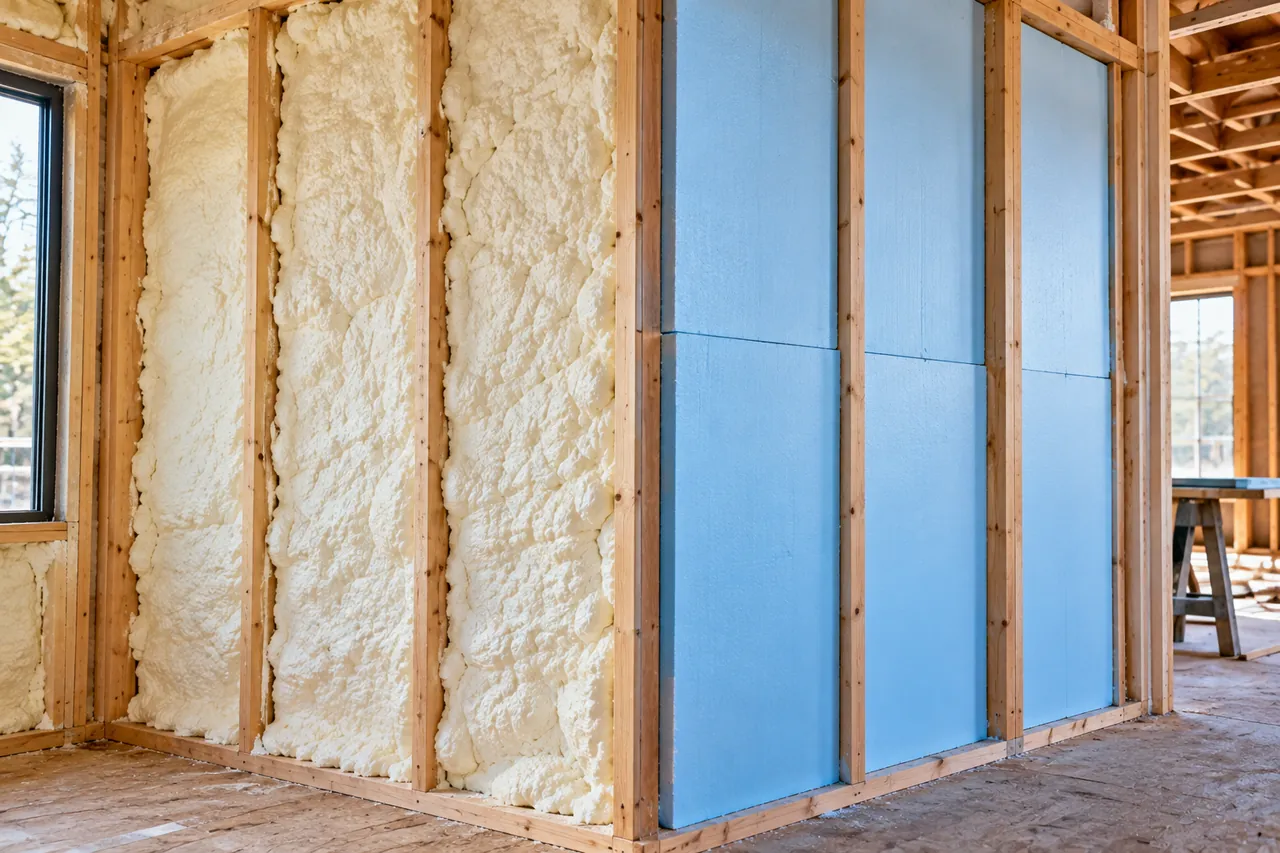
Spray foam insulation is polyurethane mixed and sprayed on site, where it expands to fill cavities and seal air leaks; rigid foam board is the same family of plastics (PIR, PU, XPS or EPS) foamed in a factory into flat sheets of fixed thickness. Spray foam wins on irregular surfaces and air sealing; foam board wins on cost per R-value over flat areas, quality control and ease of installation.
Both are good insulators. Closed-cell spray foam and PIR board have similar thermal performance per inch, roughly R-6 to R-7 for spray foam and R-6 to R-6.5 for PIR. The differences are in how they are installed, what they cost on your particular job, how they behave in fire and moisture, and how much depends on the skill of the applicator on the day.
What is spray foam insulation made of?
Spray foam insulation is made of two liquids, an "A-side" isocyanate (usually MDI) and a "B-side" polyol blend containing blowing agents, catalysts, surfactants and flame retardants, mixed at the spray gun. They react within seconds, releasing heat and expanding into a cellular polyurethane spray foam that sticks to whatever it hits.
Professional rigs heat both components to roughly 40–55 °C (100–130 °F) and pump them at high pressure through a heated hose to an impingement gun. The amount the foam expands and the size and structure of the cells decide whether it is open-cell or closed-cell.
Open-cell vs closed-cell spray foam
- Open cell spray insulation: about 7–10 kg/m³ (0.4–0.6 lb/ft³), expands roughly 100 times, cells are broken so air fills them. About R-3.5 to R-3.8 per inch, soft, vapour-open, good for sound.
- Closed-cell spray foam: about 28–35 kg/m³ (1.7–2.2 lb/ft³), expands roughly 30 times, sealed cells filled with blowing agent. About R-6 to R-7 per inch, rigid, adds racking strength, around 1 perm at 50 mm (2 in).
- High density spray foam for roofing: about 40–50 kg/m³ (2.5–3 lb/ft³), with enough compressive strength to walk on under a protective coating.
Spray foam insulation R-values vs foam board R-values
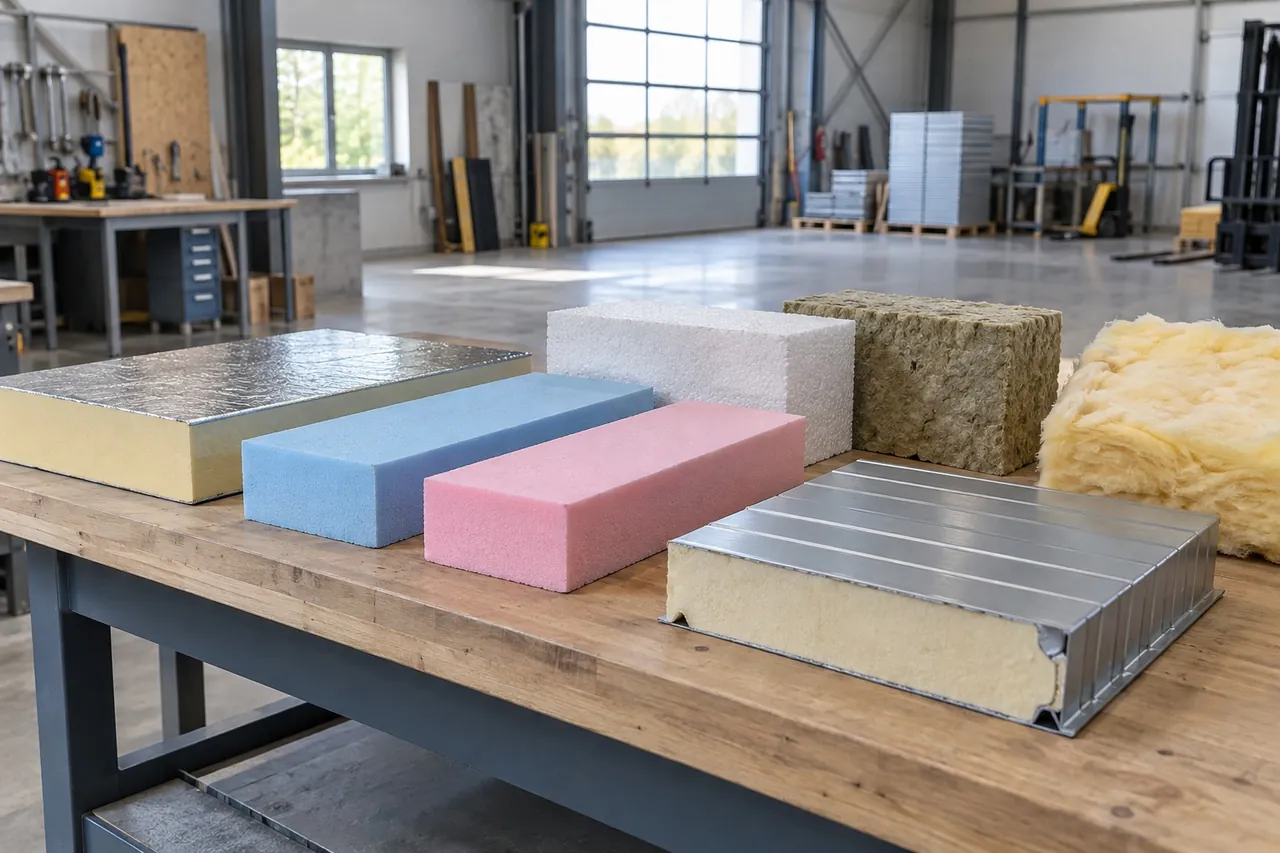
Per inch, closed-cell spray foam (R-6 to R-7) and PIR board (R-6 to R-6.5) are the best common insulations, followed by XPS board (about R-5), EPS board (R-3.6 to R-4.2) and open-cell spray foam (R-3.5 to R-3.8).
| Material | Density | R per inch (25 mm) | λ, W/(m·K) | Vapour permeance | Compressive strength |
|---|---|---|---|---|---|
| Open-cell spray foam | 7–10 kg/m³ | R-3.5 to R-3.8 | ≈ 0.037–0.040 | Vapour-open (≈ 10+ perm at 100 mm) | Very low |
| Closed-cell spray foam | 28–35 kg/m³ | R-6 to R-7 | ≈ 0.021–0.024 | ≈ 1 perm at 50 mm | About 150–200 kPa |
| Roofing spray foam | 40–50 kg/m³ | R-6 to R-6.5 | ≈ 0.022–0.024 | Low | About 280–400 kPa |
| PIR board (foil-faced) | 30–35 kg/m³ | R-6 to R-6.5 | 0.020–0.024 | < 0.05 perm (foil, taped) | About 120–150 kPa |
| XPS board | 28–45 kg/m³ | About R-5 | 0.028–0.030 | ≈ 1 perm at 25 mm | 150–700 kPa |
| EPS board | 15–30 kg/m³ | R-3.6 to R-4.2 | 0.033–0.038 | ≈ 2–5 perm at 25 mm | 70–250 kPa |
Values are typical published ranges; check the product data sheet and the aged (long-term) value. For more materials, see our insulation R-value chart and the PIR vs PU vs XPS vs EPS comparison.
Why spray foam R-value claims vary
Spray foam's installed R-value depends on the applicator: thickness varies across a wall, passes that are too thick can overheat and crack, and cold or damp substrates reduce adhesion and yield. Foam board arrives at a measured thickness. In practice, a carefully taped board system and a well-applied spray foam layer of the same thickness perform similarly. The real advantage of spray foam is air sealing at awkward junctions, not a higher R-value per inch.
How much is spray foam insulation?
As an indicative US range, professionally installed open-cell spray foam costs roughly US$0.45–0.75 per board foot and closed-cell roughly US$1.00–1.75 per board foot, where one board foot is 1 ft² at 1 in thick. That puts 75 mm (3 in) of closed-cell foam at roughly US$3–5 per ft² (about US$30–55 per m²).
| Option for about R-19 to R-20 | Thickness needed | Indicative installed cost (US) | Notes |
|---|---|---|---|
| Closed-cell spray foam | About 75–80 mm (3–3.2 in) | About US$3.00–5.50 per ft² | Air seals, adds rigidity |
| Open-cell spray foam | About 130–140 mm (5.2–5.5 in) | About US$2.50–4.00 per ft² | Needs deep cavity, vapour-open |
| PIR board, taped joints | About 75–80 mm (3–3.2 in) | About US$2.00–4.00 per ft² | Flat surfaces; labour for cutting and taping |
| XPS board | About 100 mm (4 in) | About US$2.50–4.50 per ft² | Best for floors and below grade |
All prices are broad indications that vary by region, job size, access and material market; get local quotes on the same R-value. For large flat areas such as cold store walls, roofs and floors, board or factory-made panels are usually cheaper per R than spray foam, and they do not need a specialist rig on site.
DIY spray foam kits
Open cell spray foam kits and closed cell two-part kits are sold by nominal board feet, for example 200, 600 or 1200 board foot closed cell spray foam kits. A 1,200 board-foot kit nominally covers 1,200 ft² (111 m²) at 1 in, or 400 ft² (37 m²) at 3 in, and real-world yield is often 10–30% lower because of temperature, overspray and uneven passes. Can you DIY spray foam insulation? Small areas, such as rim joists, yes, if you follow the kit's temperature limits and wear full protection. Large areas are usually better left to professionals or done with board.
A single-component foam spray insulation can is a gap filler for gaps around windows, pipes and board edges, not an insulation layer.
How does spray foam insulation work and how is it applied?
Spray foam works by filling cavities and bonding to the surfaces it is sprayed on, so it insulates and blocks air movement in one layer. It is applied in passes of about 25–50 mm (1–2 in) for closed-cell foam, letting each pass cool before the next, until the design thickness is reached.
- Prepare the space: clean, dry substrate within the temperature range on the data sheet; mask windows and equipment.
- Protect people: applicators wear supplied-air or suitable respirators, full skin and eye protection; the area is ventilated and cleared of other occupants.
- Condition the chemicals to the required drum and hose temperature.
- Spray in passes, checking depth with a gauge as you go.
- Trim open-cell foam flush with studs if needed.
- Ventilate and wait before re-occupying; product instructions often give 24 hours or more.
- Cover the foam with a thermal or ignition barrier where codes require it.
Isocyanates are respiratory sensitisers, which is why the US EPA and occupational safety agencies publish specific guidance on spray foam. Off-gassing and odour problems usually trace back to off-ratio mixing or wrong temperatures, which is a quality risk that factory-made board does not carry.
Can you spray foam insulation into existing walls?
Not with ordinary spray foam: it expands too fast and too forcefully for a closed cavity and can bow plasterboard or leave voids. Existing closed walls are insulated with injection foam insulation, a slow-rise foam pumped through 20–25 mm (¾–1 in) holes drilled between studs, or with blown cellulose or fibre.
- Injection foam flows down the cavity and cures slowly; it typically gives about R-4 to R-5 per inch. An injection foam insulation kit for existing walls exists for DIY use, but the risk of voids and blowouts is high.
- Alternatively, add continuous rigid foam board outside the existing wall when re-cladding, which also removes thermal bridges at studs.
Is there fireproof spray foam?
No foam plastic is fireproof. Polyurethane spray foam and foam boards are combustible, so building codes require them to be separated from occupied space by a thermal barrier, typically 12.7 mm (½ in) gypsum board, or to be covered with a tested intumescent coating, with lighter ignition barriers allowed in some attics and crawl spaces.
- Fire resistant spray foam and fire rated spray foam are marketing terms for foams with flame retardants that pass required surface-burning tests (such as an ASTM E84 flame spread index of 75 or less, as the IRC requires for foam plastic), or for assemblies tested with a coating.
- Firestop spray foam and fire-rated can foams are separate products, tested for sealing service penetrations in fire-rated walls.
- Among boards, PIR has a more fire-stable chemistry than PU, XPS or EPS, chars rather than melts, and is the usual choice inside insulated sandwich panels. For non-combustible needs, use mineral wool.
Spray foam roofing vs rigid board on flat roofs
Spray foam roofing is high-density closed-cell foam sprayed directly onto a roof deck, typically 25–75 mm (1–3 in) or more, then covered with an elastomeric coating that protects it from UV. It forms a seamless, fully adhered roof and is popular for re-covering old metal and built-up roofs.
- The coating must be inspected and usually recoated every 10–20 years; uncoated foam degrades quickly in sunlight.
- Rigid PIR or polyiso board under a membrane is the more common new-build approach, and tapered board creates drainage falls. See our flat roof insulation guide.
- For cold stores and food plants, insulated sandwich roof panels avoid both wet trades.
Where spray foam works best and where foam board works best
Use spray foam for irregular shapes, hard-to-reach junctions and air sealing; use rigid foam board for flat, accessible surfaces, floors, below-grade work and anywhere you want a measured, inspectable thickness.
| Application | Better choice | Why |
|---|---|---|
| Rim joists, irregular framing, roof-wall junctions | Closed-cell spray foam | Seals air gaps around complex shapes |
| Metal building retrofit, underside of roof sheet | Closed-cell spray foam or PIR board + liner | Stops condensation on the sheet |
| Continuous exterior insulation on walls | PIR or XPS board | Flat, measured thickness, taped joints |
| Under concrete slabs and freezer floors | XPS board | High compressive strength, low water uptake |
| Basement and foundation walls | XPS board | Moisture-tolerant, below-grade rated |
| Flat roofs, new build | PIR board (tapered) under membrane | Falls, walkable, known R-value |
| Refrigerated van or truck body retrofit | Spray PU or bonded PU panels | Fills curved shell; panels give better finish |
| New cold room or freezer room | PU/PIR sandwich panels | Factory foam, vapour-tight steel skins |
For vehicle bodies, see our refrigerated van conversion guide; for steel buildings, metal building insulation compares spray foam, board and panels side by side. If you are fitting boards yourself, how to install foam board insulation covers fixing and taping.
How to choose between spray foam and foam board: checklist
Choose by surface shape, required R-value, moisture, fire rules and who will install it.
- Flat and accessible? Foam board is usually cheaper per R and easier to inspect.
- Irregular or full of penetrations? Closed-cell spray foam seals better.
- Below grade or under a slab? XPS board.
- Need a vapour retarder? Foil-faced PIR with taped joints, or closed-cell foam at 50 mm (2 in) or more; not open-cell foam. See our vapor barrier guide.
- Exposed inside a building? Plan a thermal barrier for either option.
- Cold room or freezer? Factory-made PU/PIR sandwich panels outperform both on site.
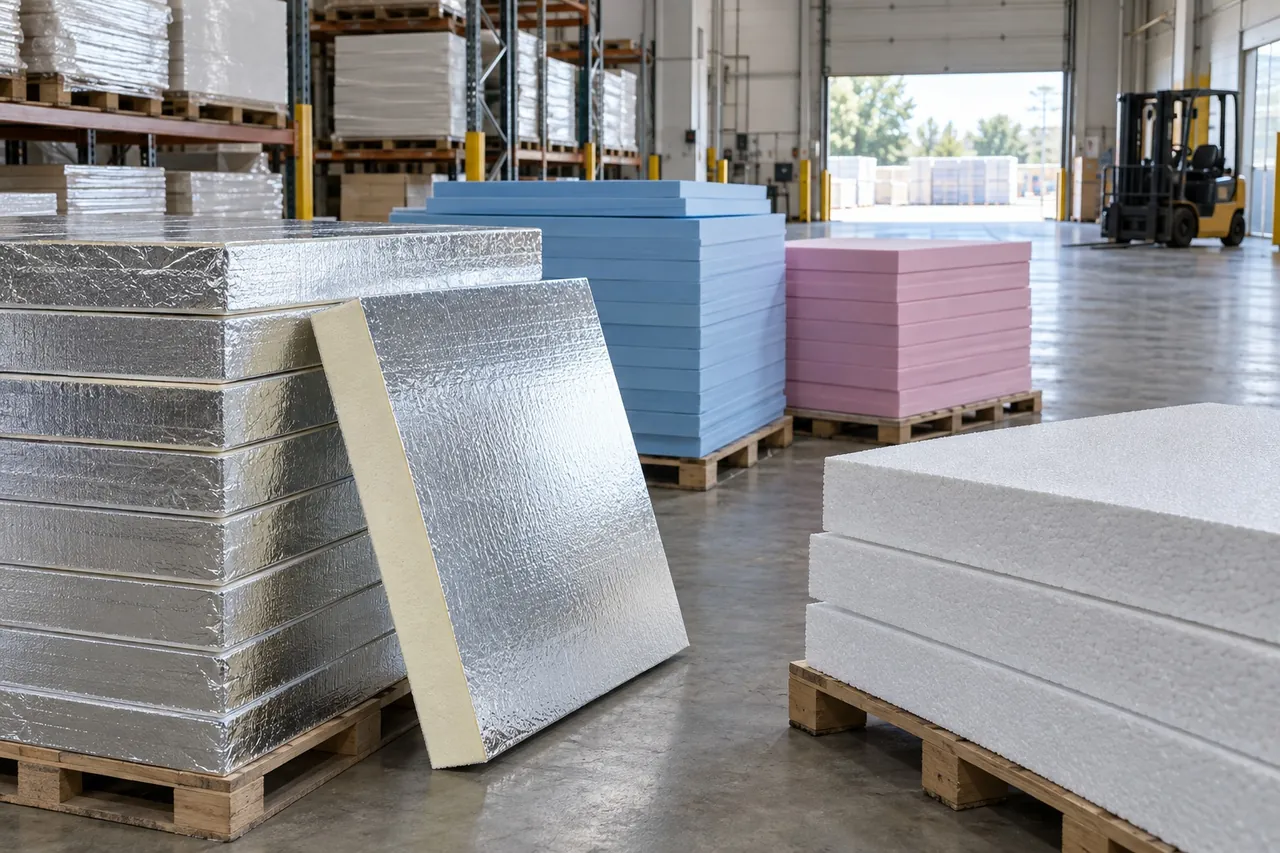
Be There does not sell spray foam equipment or chemicals. We supply foil-, kraft- or glass-tissue-faced PIR insulation boards 20–200 mm thick in 1200 × 2400 mm and 1200 × 600 mm sheets, XPS foam board for floors and foundations, and PU/PIR insulated sandwich panels for cold rooms and insulated buildings. Send your areas, target R-value or U-value and application through the inquiry form and we will quote FOB, CIF or DDP.