Short answer
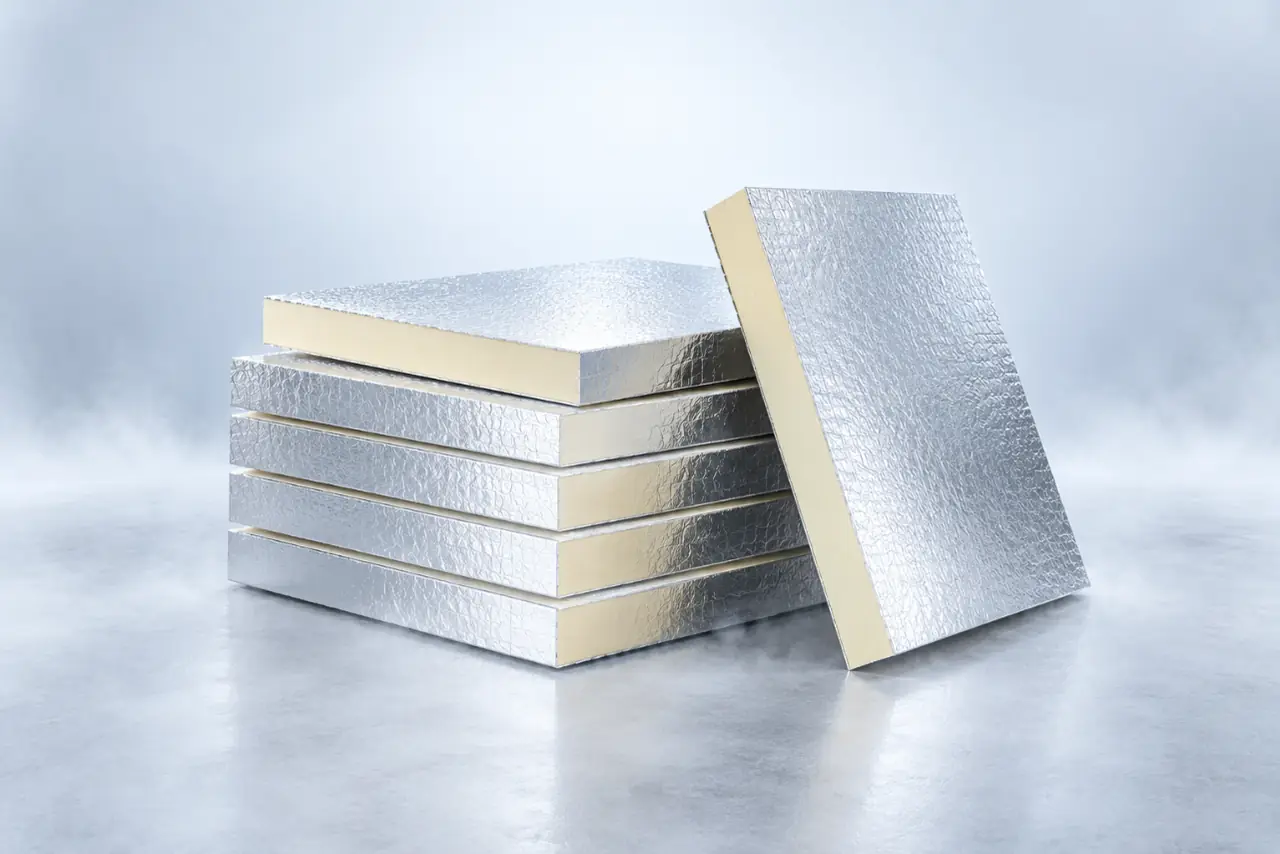
This insulation R-value chart gives typical R per inch: fiberglass batts R-2.9 to R-3.8, mineral wool R-3.7 to R-4.3, open-cell spray foam R-3.5 to R-3.8, EPS R-3.6 to R-4.2, XPS about R-5, closed-cell spray foam R-6 to R-7, and polyiso/PIR R-6 to R-6.5. A 100 mm (4 in) PU/PIR panel gives about R-24 to R-26.
Key takeaways
- R-value measures resistance to heat flow; US R-value (ft²·°F·h/Btu) equals the metric RSI (m²·K/W) multiplied by 5.678.
- Among common building materials, polyiso/PIR and closed-cell spray foam have the highest R-value per inch at about R-6 to R-7.
- For R-20 you need about 3.2 in (81 mm) of PIR, 4 in (102 mm) of XPS, about 5 in (127 mm) of EPS or about 5.3–6.9 in (135–175 mm) of fiberglass.
- Foam R-values are measured at about 24 °C (75 °F) mean temperature; some polyiso boards lose part of their R-value in cold weather, while XPS and EPS gain slightly.
- Fiberglass batts typically cost about $0.30–$2.10 per square foot installed in the US; insulating a 2,000 sq ft house with batts averages around $4,700.
What does R-value mean in insulation?
R-value is a material’s resistance to heat flow: the higher the R-value, the better the insulation. This insulation R-value chart uses US units (ft²·°F·h/Btu), which is how R-values are printed on North American products. Outside the US, the same property is given as RSI or simply R in m²·K/W, or as thermal conductivity (λ, lambda) in W/(m·K).
Conversions you will need:
- US R-value = RSI × 5.678. An RSI of 4.4 m²·K/W equals about R-25.
- R-value per inch = 0.1442 ÷ λ. A PIR board at λ = 0.022 W/(m·K) gives about R-6.5 per inch; XPS at 0.029 gives about R-5.
- RSI = thickness (m) ÷ λ. 100 mm of PIR at 0.022 = 0.100 ÷ 0.022 = 4.5 m²·K/W.
- U-value = 1 ÷ total R. Engineers use U-values to calculate heat flow: heat = U × area × temperature difference.
R-values add up in layers, so a wall of 3.5 in of R-15 rock wool plus 1 in of R-5 XPS is about R-20 before studs and air films. What R-values do not show is air leakage, moisture and thermal bridging through studs, fixings and joints, which is why continuous insulation and airtight insulated panels often outperform walls with a higher nominal cavity R-value. The R-value per inch listed for each material below is a typical range; always use the declared value of the actual product.
Insulation R-value chart per inch
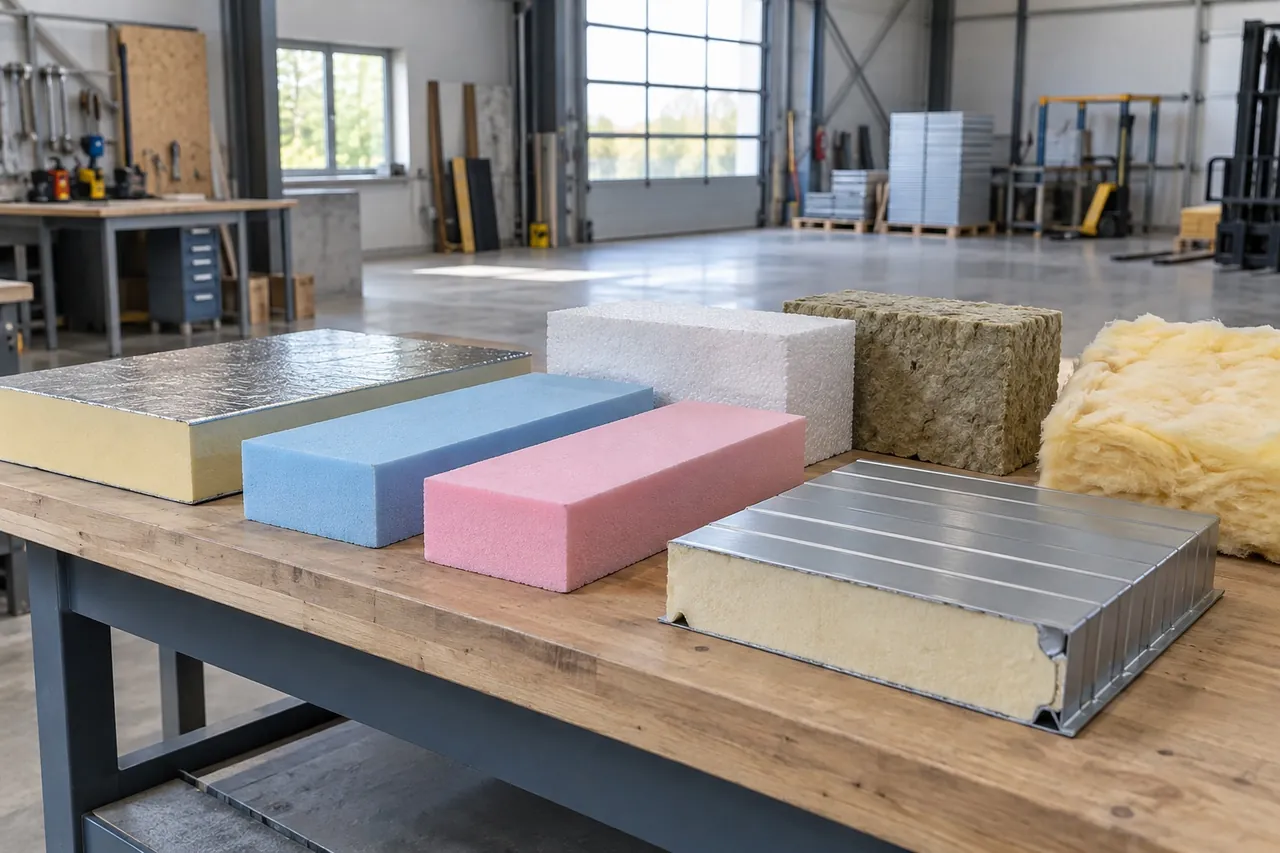
| Insulation type | R-value per inch | Thermal conductivity λ, W/(m·K) | Typical use |
|---|---|---|---|
| Fiberglass batts and rolls | R-2.9 to R-3.8 | 0.038–0.050 | Stud walls, attics |
| Blown fiberglass (loose fill) | R-2.2 to R-2.9 | 0.050–0.065 | Attics |
| Blown cellulose | R-3.2 to R-3.8 | 0.038–0.045 | Attics, dense-pack walls |
| Mineral wool (rock wool) batts and boards | R-3.7 to R-4.3 | 0.033–0.040 | Walls, fire stops, exterior boards |
| Open-cell spray foam | R-3.5 to R-3.8 | 0.038–0.041 | Walls and roofs in homes |
| Closed-cell spray foam | R-6 to R-7 | 0.021–0.024 | Metal buildings, rim joists, roofs |
| EPS (expanded polystyrene) | R-3.6 to R-4.2 | 0.033–0.040 | Below grade, SIP cores, EIFS |
| GPS (graphite polystyrene) | R-4.5 to R-4.8 | 0.030–0.032 | External wall insulation |
| XPS (extruded polystyrene) | about R-5 | 0.028–0.030 | Freezer floors, foundations, inverted roofs |
| Polyiso / PIR board | R-6 to R-6.5 | 0.020–0.024 | Roofs, walls, cold stores |
| PU/PIR sandwich panel core | R-6 to R-6.5 | 0.020–0.024 | Cold rooms, industrial walls |
| Rock wool sandwich panel core | R-3.2 to R-3.8 | 0.038–0.045 | Fire walls |
| Aerogel blanket | about R-9 to R-10 | 0.014–0.016 | Pipes, thin retrofits (costly) |
| Softwood lumber | about R-1.25 | 0.12 | Studs (thermal bridge) |
| Concrete | about R-0.08 | 1.4–2.0 | Slabs, precast walls |
Values are typical aged values at about 24 °C (75 °F) mean temperature. Spray foam ratings depend on the installer achieving the right density and thickness. For a deeper look at the four rigid foams see PIR vs PU vs XPS vs EPS insulation.
Foam board insulation R-value by thickness
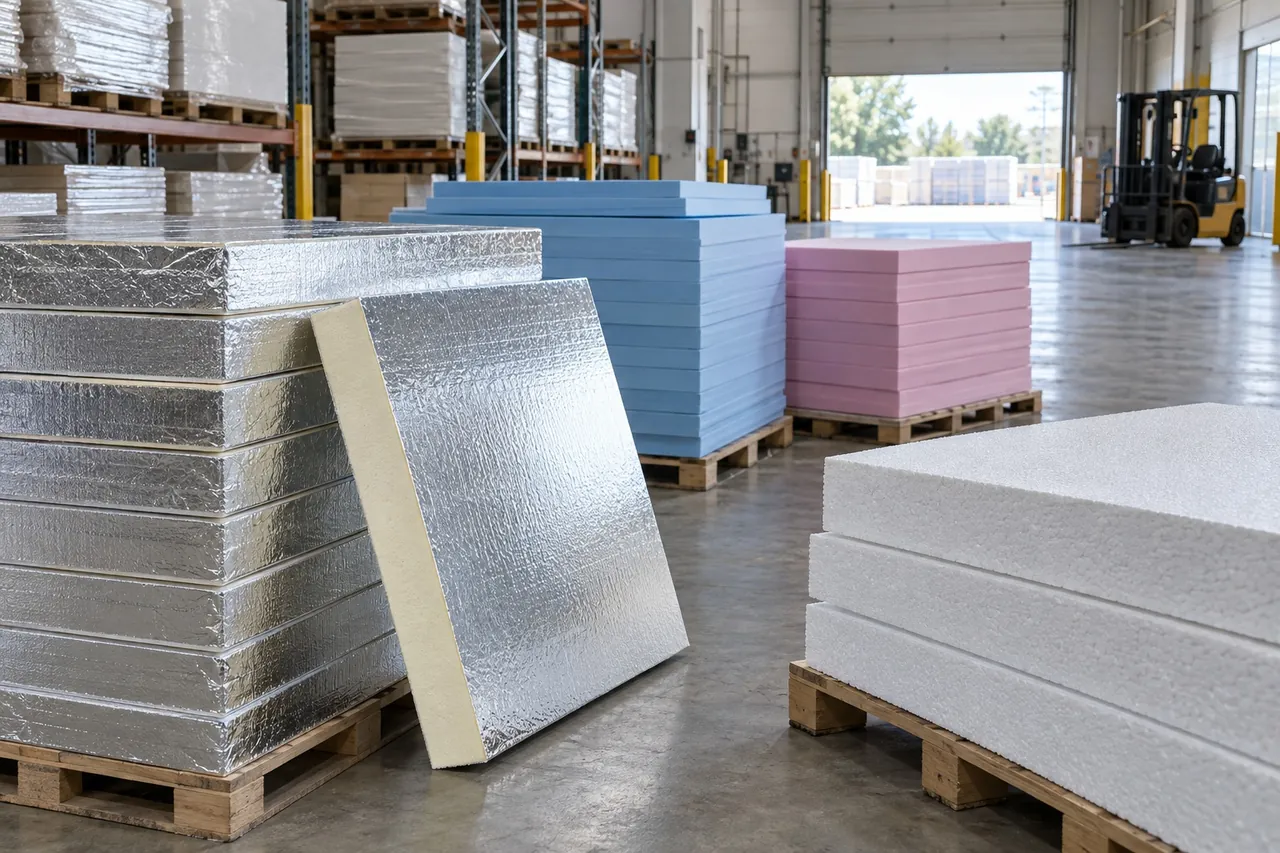
Rigid boards are sold by thickness, so this rigid insulation R value table is the one most buyers need. Values use EPS R-3.6 to R-4.2, XPS R-5 and polyiso/PIR R-6 to R-6.5 per inch.
| Board thickness | EPS | XPS | Polyiso / PIR |
|---|---|---|---|
| 1/2 in (12.7 mm) | R-1.8 to R-2.1 | R-2.5 | R-3 to R-3.3 |
| 1 in (25 mm) | R-3.6 to R-4.2 | R-5 | R-6 to R-6.5 |
| 1½ in (38 mm) | R-5.4 to R-6.3 | R-7.5 | R-9 to R-9.8 |
| 2 in (51 mm) | R-7.2 to R-8.4 | R-10 | R-12 to R-13 |
| 3 in (76 mm) | R-10.8 to R-12.6 | R-15 | R-18 to R-19.5 |
| 4 in (102 mm) | R-14.4 to R-16.8 | R-20 | R-24 to R-26 |
So the R value of 2 inch foam board is about R-7 to R-8 for EPS, R-10 for XPS and R-12 to R-13 for PIR. An R10 foam board is typically 2 in XPS or about 1.6 in PIR; an R15 foam board is 3 in XPS or about 2.4 in PIR.
Two notes on polyiso insulation R value. In North American roofing, polyiso is labelled with a long-term thermal resistance (LTTR) of about R-5.6 to R-5.7 per inch, slightly below fresh values. And some polyiso boards lose part of their R-value when the mean temperature falls below about 10 °C (50 °F), while XPS and EPS improve slightly as they get colder. For cold applications, ask the supplier for the value at your design mean temperature. Be There’s PIR insulation boards (0.020–0.024 W/(m·K)) and XPS foam boards (0.028–0.030 W/(m·K)) are supplied in 20–200 mm thicknesses.
Spray foam insulation R-values
Spray polyurethane foam is applied as a liquid that expands in place, so it fills gaps and seals air leaks as well as insulating.
| Spray foam type | Density | R-value per inch | Thickness for R-20 | Thickness for R-30 |
|---|---|---|---|---|
| Open-cell | about 8–12 kg/m³ (0.5–0.75 lb/ft³) | R-3.5 to R-3.8 | about 5.5 in (140 mm) | about 8–8.5 in (205–215 mm) |
| Closed-cell | about 30–35 kg/m³ (about 2 lb/ft³) | R-6 to R-7 | about 3–3.3 in (76–85 mm) | about 4.5–5 in (115–127 mm) |
What is the R-value of spray foam? About R-3.5 to R-3.8 per inch for open-cell and R-6 to R-7 for closed-cell. Closed-cell foam is also a vapor retarder at about 50 mm (2 in) and adds rigidity, which is why it is used on the underside of metal roofs and on rim joists. Open-cell foam is cheaper, absorbs sound and lets vapor pass.
The highest R-value spray foam insulation products are closed-cell foams with low-GWP blowing agents, rated up to about R-7 per inch. In practice, installed performance depends on the applicator: under- or over-sprayed layers, poor adhesion and shrinkage reduce it.
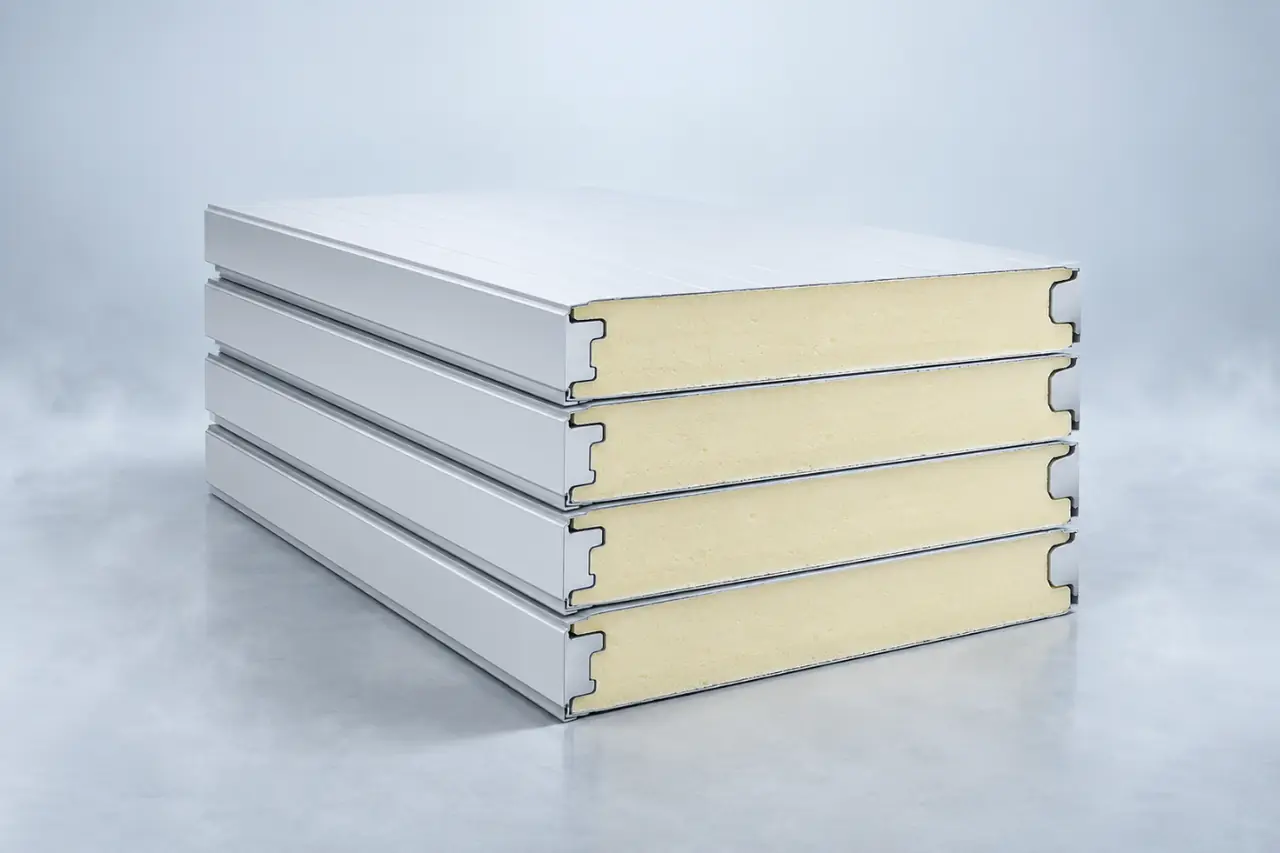
Factory-foamed PU and PIR sandwich panels are the industrial equivalent of closed-cell spray foam: the same chemistry, about R-6 to R-6.5 per inch, but foamed and cured under controlled conditions between steel skins, with a known density and thickness in every panel.
What is the highest R-value insulation?
The highest R-value insulation per inch for everyday construction is polyiso/PIR board and closed-cell spray foam at about R-6 to R-7, followed by XPS at R-5. Specialist materials go much higher but are rarely used for whole buildings:
- Aerogel blankets: about R-9 to R-10 per inch, used for thin retrofits and pipes; many times the cost of foam.
- Vacuum insulated panels (VIPs): R-25 to R-40 per inch or more in the centre of the panel, but they cannot be cut or pierced, and lose most of their value if punctured. Used in some appliances and shipping boxes.
“Best insulation” is not only about R-value. Match the material to the job:
- Best insulation for under floors and slabs: XPS, because of its compressive strength (150–700 kPa) and water absorption under 1% by volume.
- Best insulation for walk-in coolers and freezers: PU/PIR sandwich panels, 75–200 mm.
- Best insulation for fire separation: rock wool, which is non-combustible.
- Best insulation for a house on a budget: fiberglass or cellulose in cavities, plus rigid foam outside the sheathing in cold climates.
- Best insulation for bathroom and shower walls: moisture-tolerant mineral wool or closed-cell foam boards behind a proper waterproof backer and membrane.
When thickness is limited – a cold room inside an existing building, a van conversion, a thin wall lining – the highest R per inch saves the most usable space.
What R-value insulation do I need, and how thick is it?
Use this table to turn a target R-value into thickness. It answers questions like “R 20 insulation thickness” or “R30 rigid insulation thickness”.
| Target | PIR / polyiso | XPS | EPS | Fiberglass batt | Mineral wool |
|---|---|---|---|---|---|
| R-5 | 0.8 in (20 mm) | 1 in (25 mm) | 1.2–1.4 in | 1.3–1.7 in | 1.2–1.4 in |
| R-10 | 1.6 in (40 mm) | 2 in (51 mm) | 2.4–2.8 in | 2.6–3.4 in | 2.3–2.7 in |
| R-20 | 3.2 in (80 mm) | 4 in (102 mm) | 4.8–5.6 in | 5.3–6.9 in | 4.7–5.4 in |
| R-25 (US cooler minimum) | about 4 in (100 mm) | 5 in (127 mm) | 6–7 in | not used | not used |
| R-30 | 4.8 in (120 mm) | 6 in (152 mm) | 7.1–8.3 in | 8–10 in | 7–8.1 in |
| R-32 (US freezer minimum) | about 5 in (125 mm) | 6.4 in (163 mm) | 7.6–8.9 in | not used | not used |
Typical targets: US homes are advised to have roughly R-13 to R-21 in walls and R-30 to R-60 in attics depending on climate, with continuous exterior foam in colder zones. Under a heated slab, R-10 (2 in XPS) is common. Walk-in coolers need at least R-25 in walls and ceilings and freezers at least R-32 under US federal rules; in practice that means 100 mm panels for coolers and 120–150 mm for freezers.
For refrigerated rooms, the cost of extra thickness is repaid in compressor size and power. The cold room calculator shows how panel U-value changes the refrigeration load.
How much does insulation cost per square foot?
Insulation cost depends on the material, the thickness and how hard the space is to reach. Typical US installed ranges per square foot of area:
| Insulation type | Typical installed cost per sq ft | Notes |
|---|---|---|
| Fiberglass batts and rolls | about $0.30–$2.10 | Cheapest per R-value in open cavities |
| Blown-in fiberglass, cellulose or mineral wool | about $0.50–$2.30 | Attics and closed walls |
| Mineral wool batts | about $1.40–$2.10 | Fire and sound benefits |
| Rigid foam board | about $0.25–$2.00 | Higher when cut between studs |
| Spray foam | about $1.00–$4.50 | Closed-cell at the top of the range |
| Insulated metal wall panels | about $15–$30 | Includes finished faces, structure-spanning panel |
How much does it cost to insulate a house? Insulating a 2,000 sq ft home with fiberglass batts typically runs about $2,000–$7,400, averaging around $4,700, before opening or refinishing walls. These are 2025–2026 US averages; your local labour rates and access will move them.
For buildings and cold rooms, compare cost per R-value delivered and per year of energy saved, not cost per square foot alone. Be There supplies PU and PIR insulated panels, PIR and XPS boards and quotes per order, FOB, CIF or DDP.
How to use an R-value chart when comparing products
R-value charts are useful only if you compare like with like. Before you choose between two insulation types or two suppliers, check:
- Aged or initial value? Foams lose some R-value in their first years as blowing agents diffuse; reputable suppliers declare aged or long-term values.
- Mean test temperature. Most values are at 24 °C (75 °F). Ask for values at cold-store temperatures if you are insulating a freezer.
- Per inch or total? Labels on batts give total R; board data sheets often give λ or R per inch.
- Installed conditions. Compressed batts, gaps, wet insulation and studs all reduce real performance. Continuous insulation and sealed panels lose much less.
- Other properties. Fire class, compressive strength, water absorption and vapor permeance often decide the material before R-value does.
- Units. Convert RSI to US R-value by multiplying by 5.678 before comparing.
Rules of thumb: PIR or PU for the highest R per inch in walls, roofs and cold rooms; XPS for floors and anything wet or loaded; rock wool for fire walls; fiberglass or cellulose for low-cost cavities in houses. Read EPS vs XPS foam board if you are choosing between the two polystyrenes.
For a cold room or insulated building, send your sizes and temperatures through our inquiry form and Be There will recommend panel and board thicknesses with a quotation within one working day.