Short answer
Foam board insulation is rigid plastic foam sold in sheets, mainly PIR/polyiso (about R-6 to R-6.5 per inch), XPS (about R-5) and EPS (about R-3.6 to R-4.2). Standard sheets are 1200 × 2400 mm (4 × 8 ft) or 1200 × 600 mm, 20–200 mm (¾–8 in) thick. A 2 inch foam board gives about R-7 to R-13 depending on type.
Key takeaways
- PIR/polyiso foam board has the highest R-value per inch of common rigid insulation at about R-6 to R-6.5; XPS gives about R-5 and EPS about R-3.6 to R-4.2.
- Standard rigid insulation board sizes are 1200 × 2400 mm (about 4 × 8 ft) and 1200 × 600 mm, in thicknesses from 20 to 200 mm.
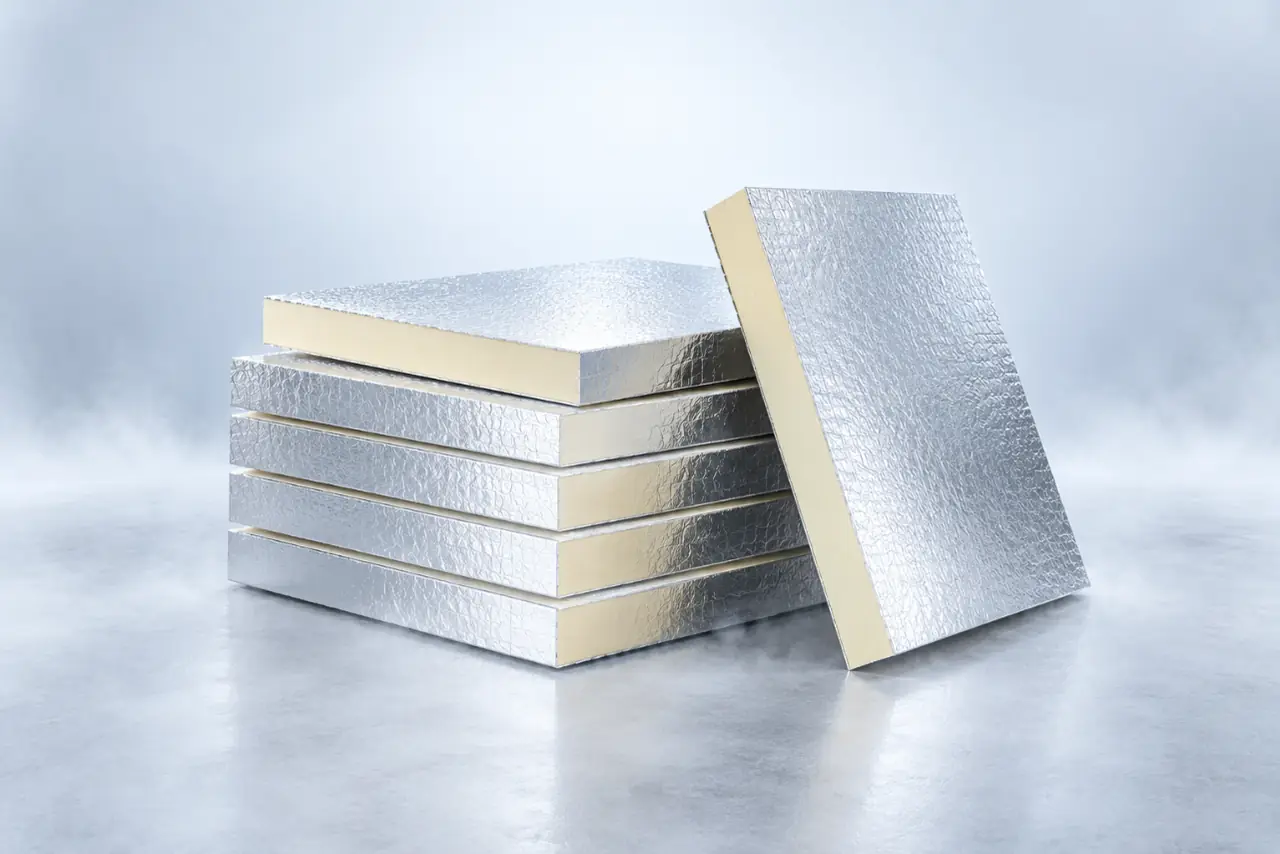
- Foil faced insulation boards add a low-emissivity surface and a near-vapor-tight facing; tape the joints with foil tape to make an air and vapor control layer.
- Foam boards are combustible and must be covered inside occupied spaces by a thermal barrier such as 12.7 mm (1/2 in) gypsum board.
- Rigid foam board typically costs about $0.25–$2.00 per square foot installed in the US, depending on type, thickness and access.
What is foam board insulation (rigid foam insulation)?
Foam board insulation, also called rigid foam insulation or rigid insulation board, is closed-cell plastic foam made into stiff, flat sheets that insulate walls, roofs, floors and cold rooms. Unlike fiberglass or mineral wool, it does not sag, it resists moisture, and it can carry loads, so it can go under slabs, over roof decks and outside sheathing as continuous insulation.
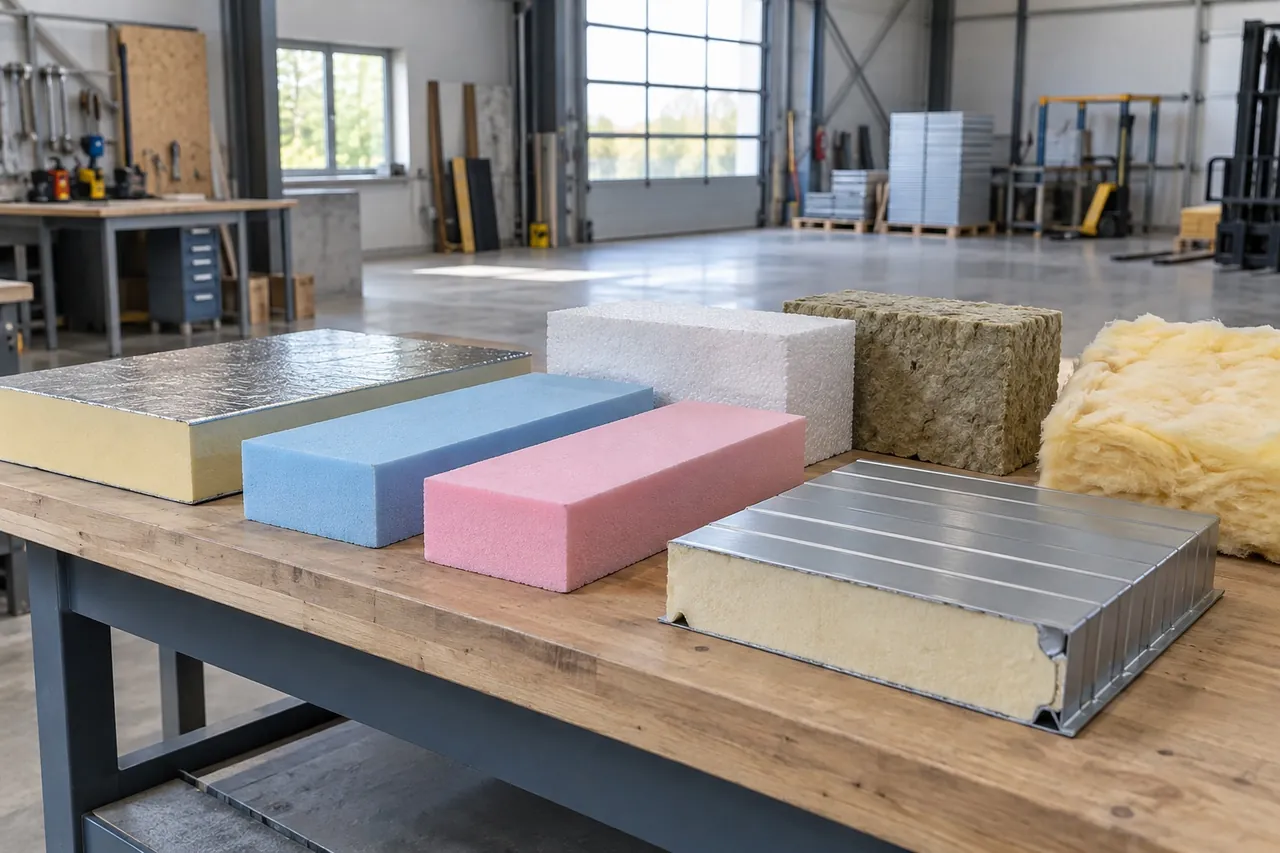
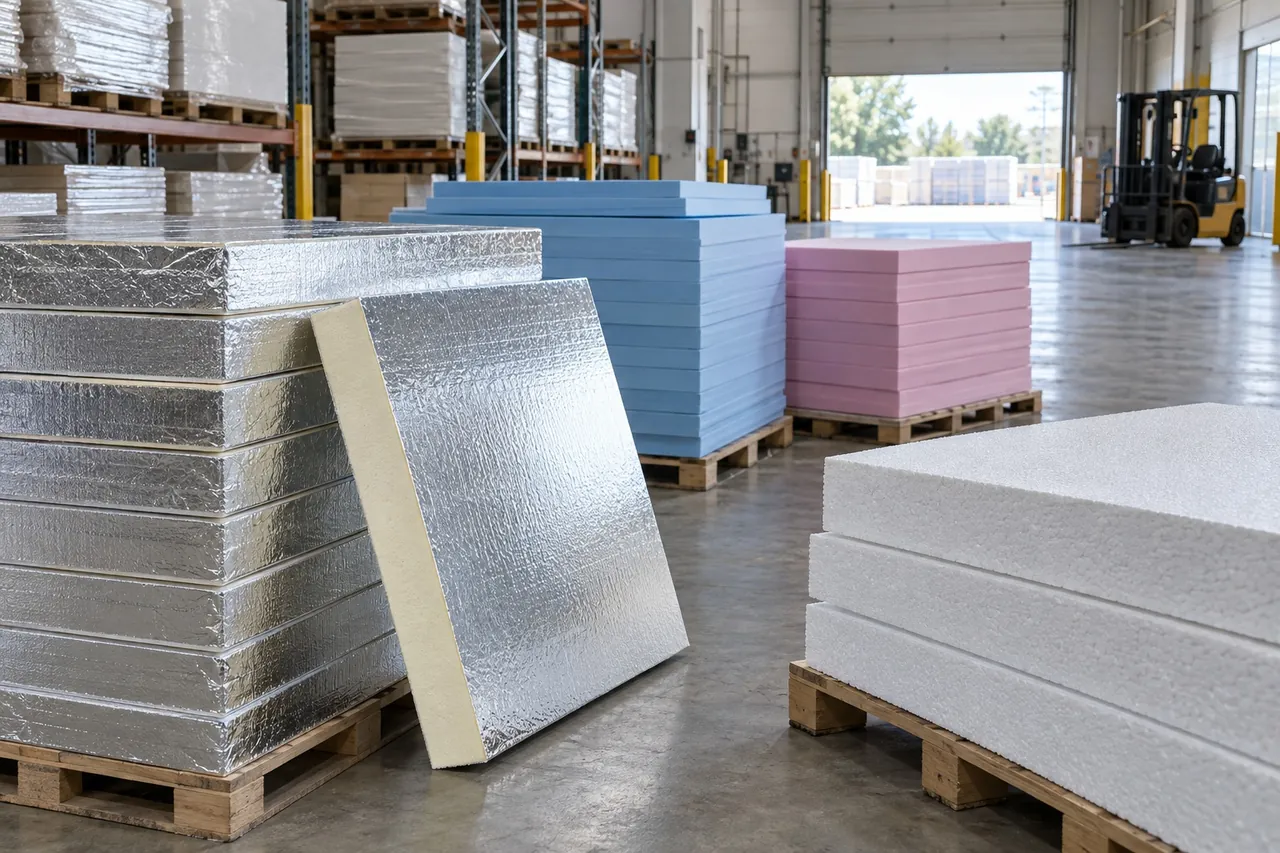
There are four main types of foam board insulation:
- PIR / polyiso (polyisocyanurate): the highest R-value per inch, usually with foil or glass-tissue facings.
- PU (polyurethane) board: similar thermal performance, used in panels and some boards.
- XPS (extruded polystyrene): strong and water-resistant; the standard under freezer floors.
- EPS (expanded polystyrene): the lowest cost, white bead board.
What is insulation made of? PIR and PU are thermoset plastics formed by reacting polyols with isocyanate (MDI) and a blowing agent, creating tiny gas-filled cells. XPS and EPS are polystyrene, a thermoplastic, foamed with a blowing agent. The trapped gas in the closed cells does most of the insulating. The same polyurethane chemistry insulates insulated coolers, display fridges and walk-in cold room panels.
Be There supplies PIR and PU insulation boards from 20 to 200 mm thick, plus XPS foam board and PU/PIR sandwich panels for cold rooms and insulated buildings.
PIR, polyiso, XPS or EPS: which rigid foam board should you choose?
| Board | R-value per inch | λ, W/(m·K) | Compressive strength | Water resistance | Fire behaviour | Best for |
|---|---|---|---|---|---|---|
| PIR / polyiso | R-6 to R-6.5 | 0.020–0.024 | about 100–150 kPa | Good with foil facings | Chars; best of the foams | Walls, roofs, ceilings, where thickness is limited |
| PU board | about R-6 | about 0.022–0.024 | about 100–150 kPa | Good | Burns more readily than PIR | General insulation, panels |
| XPS | about R-5 | 0.028–0.030 | 150–700 kPa | Excellent, under 1% by volume | Melts; must be covered | Floors, foundations, inverted roofs |
| EPS | R-3.6 to R-4.2 | 0.033–0.040 | about 70–250 kPa | Moderate | Melts; must be covered | Budget walls and roofs, EIFS |
A quick rule: use polyisocyanurate foam board above grade where you want the most insulation in the least thickness and the best fire performance among foams; use XPS anywhere wet or loaded; use EPS when cost per R-value matters most and the location is dry.
Two cautions on polyiso rigid insulation. Its labelled value in North American roofing is a long-term value of about R-5.6 to R-5.7 per inch, and some boards lose part of their R-value at low mean temperatures, so ask for the value at your design temperature for cold applications. For a full materials comparison see PIR vs PU vs XPS vs EPS, and for the polystyrene choice read EPS vs XPS foam board.
Foam board sizes and thicknesses
Foam board sizes follow building modules so boards fit between and across framing.
| Format | Metric | Imperial | Notes |
|---|---|---|---|
| Full sheet | 1200 × 2400 mm | about 4 × 8 ft (US boards are 48 × 96 in) | Walls, roofs, large areas |
| Half board | 1200 × 600 mm | about 4 × 2 ft | Floors, easy handling, roof tapered schemes |
| Floor / XPS board | 1200 × 600 or 1250 × 600 mm | 2 × 8 ft also common | Often shiplap edges |
| Thickness range | 20–200 mm | ¾–8 in | Thicker by laminating layers |
Common thicknesses and what they deliver with PIR / XPS / EPS:
- 1 1/2 inch foam board insulation (38 mm): about R-9 to R-9.8 / R-7.5 / R-5.4 to R-6.3.
- 2 inch foam board insulation (51 mm): about R-12 to R-13 / R-10 / R-7.2 to R-8.4.
- 3 inch foam insulation board (76 mm): about R-18 to R-19.5 / R-15 / R-10.8 to R-12.6.
- 4 in (102 mm): about R-24 to R-26 / R-20 / R-14.4 to R-16.8.
Be There PIR boards come in 1200 × 2400 mm and 1200 × 600 mm from 20 to 200 mm. For other R-values and materials see the insulation R-value chart.
A note on foam core board sizes and foam board for crafts: craft foam core is a 3–10 mm (1/8–3/8 in) polystyrene sheet with paper faces, sold in sizes such as 20 × 30 in for signs, models and artwork. It is not building insulation and has no useful R-value or fire rating.
Foil faced insulation, kraft and glass-tissue facings
Facings protect the foam during handling, change its fire and moisture behaviour, and sometimes add R-value.
- Foil faced insulation board: aluminium foil on one or both faces. The foil is almost vapor-tight, so taped foil faced foam board forms an air and vapor control layer. Facing a sealed air gap of about 20 mm (¾ in) or more, the low-emissivity foil adds roughly R-1 to R-3 depending on gap and direction of heat flow. A 2 inch foil faced insulation board of PIR is about R-12 to R-13 before any air-gap bonus.
- Kraft paper facing: cheaper, used where the board will be covered and vapor control is handled elsewhere.
- Glass-tissue (fiberglass mat) facing: more dimensionally stable and better for bonding membranes and render; common on roof boards.
- Unfaced boards: most XPS and EPS.
Can you paint foam board insulation? You can paint EPS and XPS with water-based acrylic or latex paint; solvent-based paints and spray-can propellants dissolve polystyrene. Foil-faced PIR needs a primer for metal. Paint is cosmetic only: it is not a fire barrier or UV protection for exterior use, and exposed foam inside occupied rooms still needs a proper thermal barrier.
Facings also matter for foil back insulation in garages and metal buildings: put the foil toward the air gap and the warm side, and tape every joint so moist air cannot reach cold metal and condense.
Where to use rigid insulation board
Exterior walls. Rigid board fixed outside the sheathing or masonry gives continuous insulation that blocks thermal bridging through studs. Use PIR for the most R per inch, EPS or GPS under render, and XPS at plinths and below grade. This is the most efficient way to improve house insulation outside walls without losing room space.
Roofs. Above-deck boards under membranes or metal sheets: PIR with glass-tissue facing, or tapered EPS for drainage falls. Inverted roofs use XPS above the waterproofing.
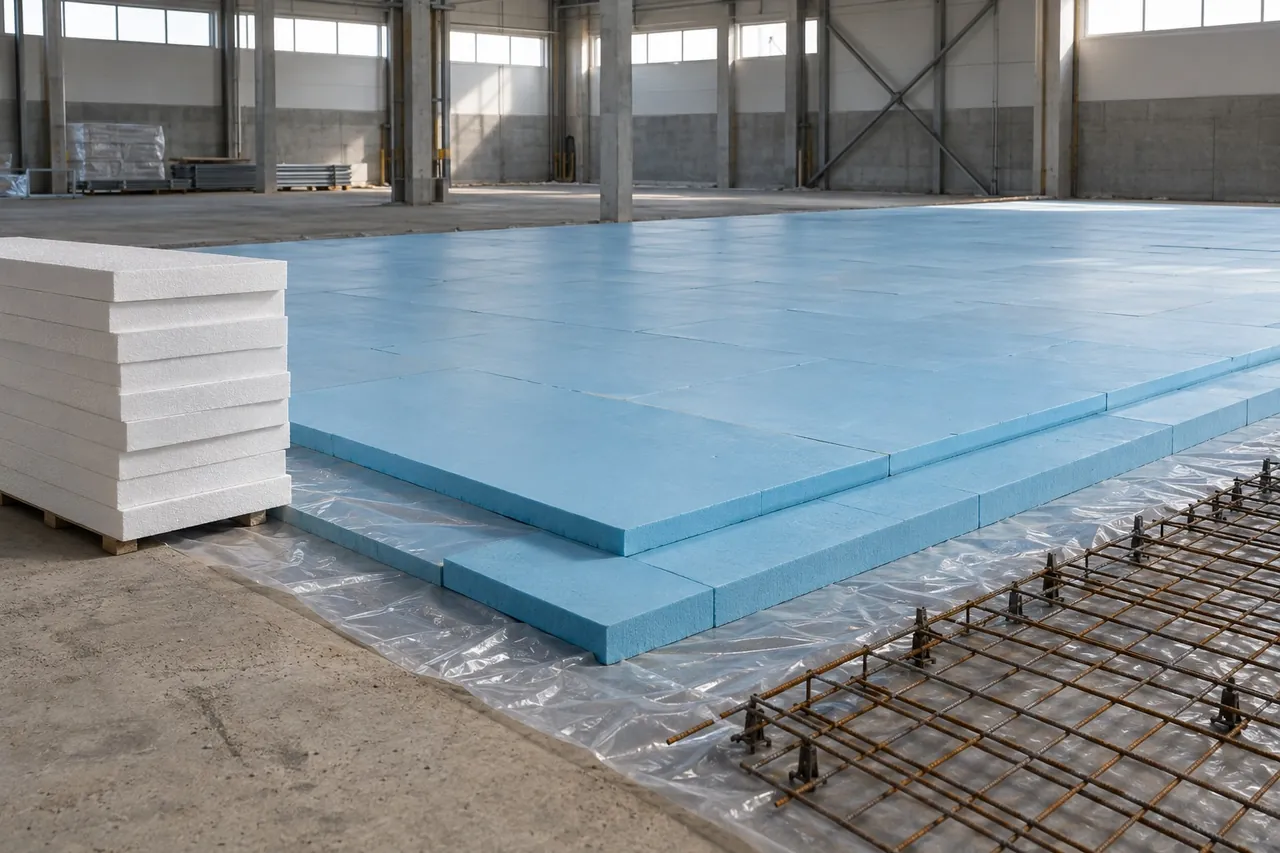
Floors and slabs. XPS or high-density EPS under slabs and around slab edges; XPS in cold store floors, often 100–200 mm in two layers.
Garages and workshops. Garage insulation panels of foil-faced PIR or EPS fit between studs or across ceiling joists; door kits use thin EPS or PIR cut to each section.
Metal buildings. Foil-faced PIR boards under the roof sheets and behind wall cladding, with taped joints, stop condensation dripping from cold steel.
Cold rooms. Boards are used under the floor and to upgrade existing rooms, but new walk-in coolers and freezers are built from factory-made PU/PIR sandwich panels, which combine the foam, vapor barrier and hygienic steel faces in one element. Use loose boards for walls only for small repairs or for insulating an existing masonry room, and then seal and line them carefully.
Commercial building insulation generally combines all of these: PIR on roofs and walls, XPS below grade and under loaded floors.
How to install foam board insulation
Correct installation matters as much as the board. Follow these steps for walls, roofs and floors:
- Check the surface. Make sure the wall, roof deck or slab is dry, sound and flat. Fix leaks and remove loose material, because foam board will not cure damp problems behind it.
- Plan the layout. Measure the area and plan full boards with joints staggered, ideally in two layers with offset joints, so there is no straight line for heat or air to pass.
- Cut the boards. Score with a sharp knife and snap thin boards; use a fine-tooth saw or hot wire for thick PIR, XPS or EPS. Cut tight so boards butt together without gaps.
- Fix the boards. Bond with a foam-compatible adhesive (solvent-based adhesives dissolve polystyrene) and/or fix with screws and large insulation washers into the structure, following the board supplier's pattern.
- Seal every joint. Tape joints with foil tape on foil-faced PIR, or seal with compatible tape or low-expansion foam. Sealed joints keep the air and vapor control layer continuous.
- Add the next layer. Lay a second layer with joints offset by at least 300 mm (12 in) from the first, then tape again.
- Cover the foam. Inside occupied rooms, cover foam with a thermal barrier such as 12.7 mm (1/2 in) gypsum board; outside, install cladding, render or a membrane promptly to protect it from sunlight and damage.
Extra tips: use foam board screws or insulation fasteners long enough to reach the structure by at least 25 mm (1 in); do not crush boards with over-driven fixings; on floors, lay XPS on a level, clean base over a vapor barrier; and on roofs, follow the membrane or sheet supplier’s fixing density for wind uplift.
Fire resistant foam board and fire safety
All foam plastics are combustible, so building codes treat them carefully. In the US, foam plastic insulation generally must have a flame-spread index of 75 or less and smoke-developed index of 450 or less in ASTM E84 tests, and inside occupied buildings it must be separated from the interior by a thermal barrier, typically 12.7 mm (1/2 in) gypsum board. In Europe, products carry an EN 13501-1 reaction-to-fire class.
How the foams compare:
- PIR forms a stable char layer when exposed to flame, which slows burning. It is the most fire resistant foam board of the common types and is often specified where codes or insurers are strict.
- PU ignites and spreads flame more easily than PIR.
- XPS and EPS soften at about 75–100 °C (165–212 °F), then melt and drip; they rely on flame retardants and coverings.
“Fire rated foam board” therefore usually means a board that has passed a specific system test, not a fireproof board. If you need truly non-combustible insulation – fire walls, cavity barriers, high-rise façades – use rock wool boards or rock wool cored panels. For cold stores, the usual answer is PIR boards and panels, with rock wool where the fire strategy demands it.
Keep foam boards away from hot work (welding, torch-on roofing without protection), flues and lights, and store them covered on site.
Price of insulation: how much does foam board cost?
The price of insulation boards depends on type, thickness, facings, quantity and freight. As a US guide, rigid foam board typically costs about $0.25–$2.00 per square foot installed, rising when boards are cut to fit between studs or installed in multiple layers. Relative to each other:
- EPS is usually the cheapest per R-value.
- XPS costs more per R-value, justified where strength or moisture resistance is needed.
- PIR / polyiso costs more per board than EPS, but gives the most R-value per inch, which saves thickness, fixings and space.
For export orders, freight is a large share of the delivered price because boards are light but bulky: a 40 ft high-cube container holds roughly 70–75 m³ of board. Thicker boards and mixed loads of boards and panels can be planned to fill the container.
Insulation installation cost depends on access and finish: re-cladding a wall to add exterior foam costs far more than the foam itself. When comparing quotes, check the declared λ or R-value, compressive strength, facing type, board size and thickness tolerance.
Be There quotes PIR insulation boards and XPS boards per order, FOB, CIF or DDP, with specifications confirmed on each quotation.
Buying checklist for rigid foam board
- Location: wall, roof, floor, below grade, garage, metal building or cold room.
- Target R-value and maximum available thickness.
- Board type: PIR for R per inch and fire behaviour, XPS for loads and moisture, EPS for budget dry areas.
- Compressive strength for floors and roofs with traffic (kPa or psi at 10% deformation).
- Facing: foil, kraft, glass tissue or unfaced.
- Size and edge: 1200 × 2400 or 1200 × 600 mm; square, shiplap or tongue-and-groove.
- Fire class and documents your authority or insurer needs.
- Accessories: foil tape, compatible adhesive, insulation fixings, thermal barrier.
Send your areas, thicknesses and application through our inquiry form and Be There will quote PIR and XPS boards, or matching sandwich panels for a cold room, within one working day.