Short answer
A deep freezer is a stand-alone freezer, usually a top-opening chest, that holds food at −18 °C (0 °F) or colder and can typically be set down to about −25 °C (−13 °F). Common sizes are 3.5–25 cu ft (100–700 L); a 7 cu ft chest holds about 85–100 kg of food and uses roughly 0.5–0.7 kWh a day.
Key takeaways
- Deep freezers should run at −18 °C (0 °F) or colder; most chest models can be set to about −15 °C to −25 °C (5 °F to −13 °F).
- Chest freezers come in about 3.5–25 cu ft (100–700 L); each cubic foot holds roughly 16 kg (35 lb) of packed frozen food.
- A household chest freezer draws about 60–150 W while running and typically uses 0.5–1.2 kWh a day.
- Garage-ready freezers are rated to work in ambient temperatures of roughly −18 °C to +43 °C (0–110 °F), depending on model.
- Defrost a manual chest freezer when frost reaches about 6 mm (¼ in); the job usually takes 1–3 hours.
- Chest deep freezers typically last 12–20 years if ventilated properly and kept within their climate class.
What is a deep freezer?
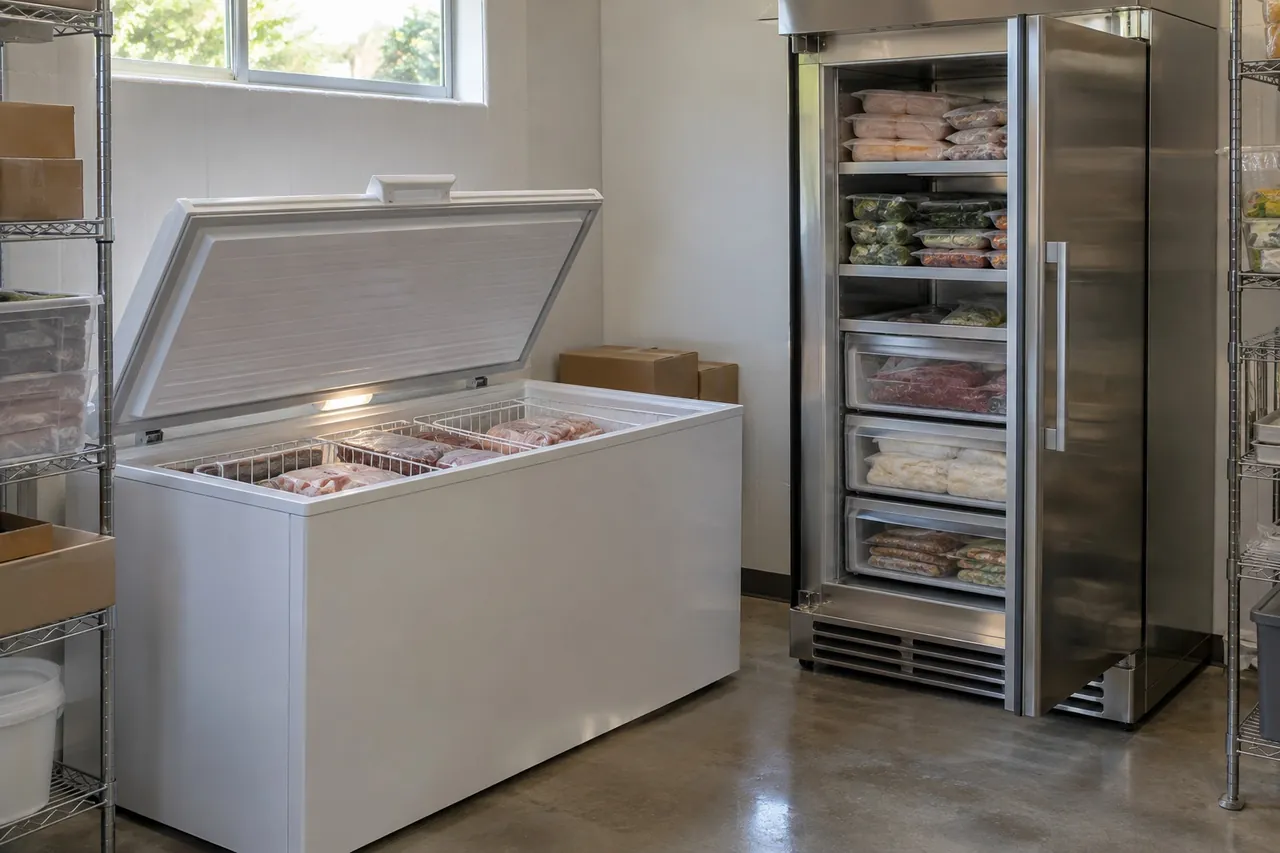
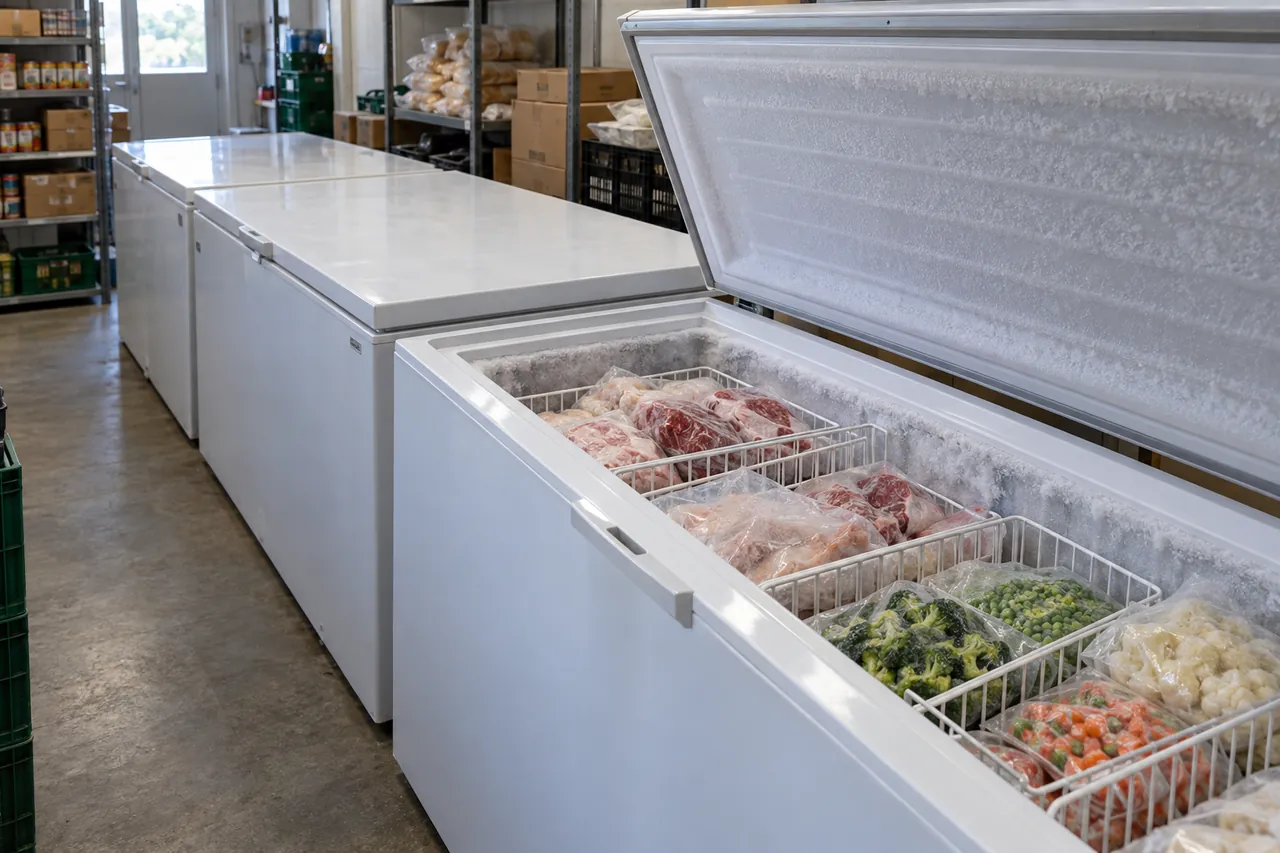
A deep freezer is a stand-alone freezer, most often a top-opening chest, that holds food at −18 °C (0 °F) or colder for long-term storage, as opposed to the small freezer compartment of a fridge. In everyday and trade use, "deep freezer" and "chest freezer" usually mean the same thing.
The name dates from when fridge freezer compartments ran at −6 °C to −12 °C (21–10 °F) and were only good for a week or two of storage, while a separate "deep freeze" could hold −18 °C or colder for months. Today the chest format dominates because cold air is heavier than warm air: when the lid opens, most of the cold stays inside the well. That makes the chest freezer and deep freezer category the cheapest way to store frozen stock per litre, both to buy and to run.
This guide covers chest deep freezers for shops, kitchens, farms and storerooms: how cold they get, sizes, what "garage ready" means, power use, defrosting and how long they last. For a head-to-head on formats, see chest freezer vs upright freezer.
How cold does a deep freezer get?
Most chest deep freezers can be set anywhere from about −15 °C to −25 °C (5 °F to −13 °F), and should normally run at −18 °C (0 °F) or a little colder. Some commercial low-temperature chest freezers reach −30 °C to −40 °C (−22 °F to −40 °F) for fish, ice cream hardening or sample storage.
The USDA and most food agencies treat −18 °C (0 °F) as the safe frozen-storage temperature: bacteria cannot multiply there, though they are not killed. Colder storage slows quality loss such as freezer burn and rancidity in fatty fish, which is why ice cream and seafood stores often run at −23 °C to −25 °C (−10 °F to −13 °F).
| Setting | Temperature | Typical use |
|---|---|---|
| Bagged ice storage | −12 °C to −6 °C (10–21 °F) | Ice merchandisers at petrol stations and shops |
| Standard frozen storage | −18 °C (0 °F) | Meat, vegetables, ready meals |
| Commercial frozen storage | −20 °C to −23 °C (−4 °F to −10 °F) | Restaurant stock, butchers, frozen food retail |
| Ice cream and fatty fish | −23 °C to −25 °C (−10 °F to −13 °F) | Ice cream storage, salmon, tuna |
| Low-temperature chest | −30 °C to −40 °C (−22 °F to −40 °F) | Specialist seafood, hardening, samples |
What size deep freezer do I need?
Size a deep freezer at roughly 1.5 cu ft (42 L) per person for a household, or by peak stock for a business: a chest freezer holds about 16 kg (35 lb) of packed frozen food per cubic foot, and you should plan to fill about 80% of it.
Chest freezers commonly come in 3.5, 5, 7, 10, 14–15 and 20–25 cu ft sizes. A small deep freezer of 3.5–5 cu ft (100–140 L) fits under a worktop or in a flat; the 7 cu ft chest freezer is the most popular all-rounder; and 14–25 cu ft (400–700 L) models suit farms, hunters, caterers and small shops. Our guide to freezer cubic feet explains how volume is measured; the table below gives planning dimensions.
| Chest size | Litres | Typical W × D × H | Food load at 80% fill | Typical buyer |
|---|---|---|---|---|
| 3.5 cu ft | 100 L | 55 × 52 × 85 cm (22 × 20 × 33 in) | about 45 kg (100 lb) | Flat, office, small bar |
| 5 cu ft | 140 L | 73 × 56 × 85 cm (29 × 22 × 33 in) | about 65 kg (140 lb) | 1–2 people, café back-up |
| 7 cu ft | 200 L | 94 × 56 × 86 cm (37 × 22 × 34 in) | 85–100 kg (185–220 lb) | Household of 3–5, small takeaway |
| 10 cu ft | 280 L | 105 × 70 × 85 cm (41 × 28 × 33 in) | about 130 kg (285 lb) | Large family, bakery stock |
| 14–15 cu ft | 400–425 L | 140 × 70 × 85 cm (55 × 28 × 33 in) | 180–195 kg (395–430 lb) | Caterers, butchers, farms |
| 20–25 cu ft | 565–700 L | 165–185 × 75 × 88 cm (65–73 × 30 × 35 in) | 255–320 kg (560–700 lb) | Bulk storage, hunters, shops |
Two practical limits matter as much as volume. First, a chest wider than about 1.2 m (47 in) gets hard to reach into, so baskets and a good loading plan become essential. Second, measure door frames: a 7 cu ft chest passes most 80 cm (31 in) doors, but a 20 cu ft model may need to go through on its side, which most makers allow only if it then stands upright for several hours before switching on.
What does garage ready freezer mean?
A garage ready freezer is a freezer designed to keep food frozen when the room around it is far colder or hotter than a normal kitchen, typically somewhere in a range of about −18 °C to +43 °C (0 °F to 110 °F), depending on the model.
Ordinary freezers struggle in garages for two reasons. In a cold garage, the thermostat sees a cabinet that is already cold and lets the compressor rest, and some combined fridge-freezer designs then let the freezer section warm up; compressor oil also thickens. In a hot garage, the compressor runs constantly and may still lose ground. What makes a freezer garage ready is usually a combination of controls that keep cycling in cold ambient, a compressor and condenser sized for heat, and sometimes a small heater near the thermostat. Chest freezers cope with cold garages better than fridge-freezers, but you should still check the stated ambient range or the climate class (SN 10–32 °C, N 16–32 °C, ST 16–38 °C, T 16–43 °C).
Can you keep a deep freezer outside?
You can keep a deep freezer outside only if it is specifically rated for outdoor use. Rain, sun and humidity corrode cabinets and electrics, and a sun-heated cabinet loses capacity fast. A covered, ventilated, shaded spot is the minimum; for forecourts and yards, use an outdoor-rated, lockable commercial unit. See outdoor refrigerators and freezers for ambient ratings and weatherproofing.
How are commercial chest freezers different?
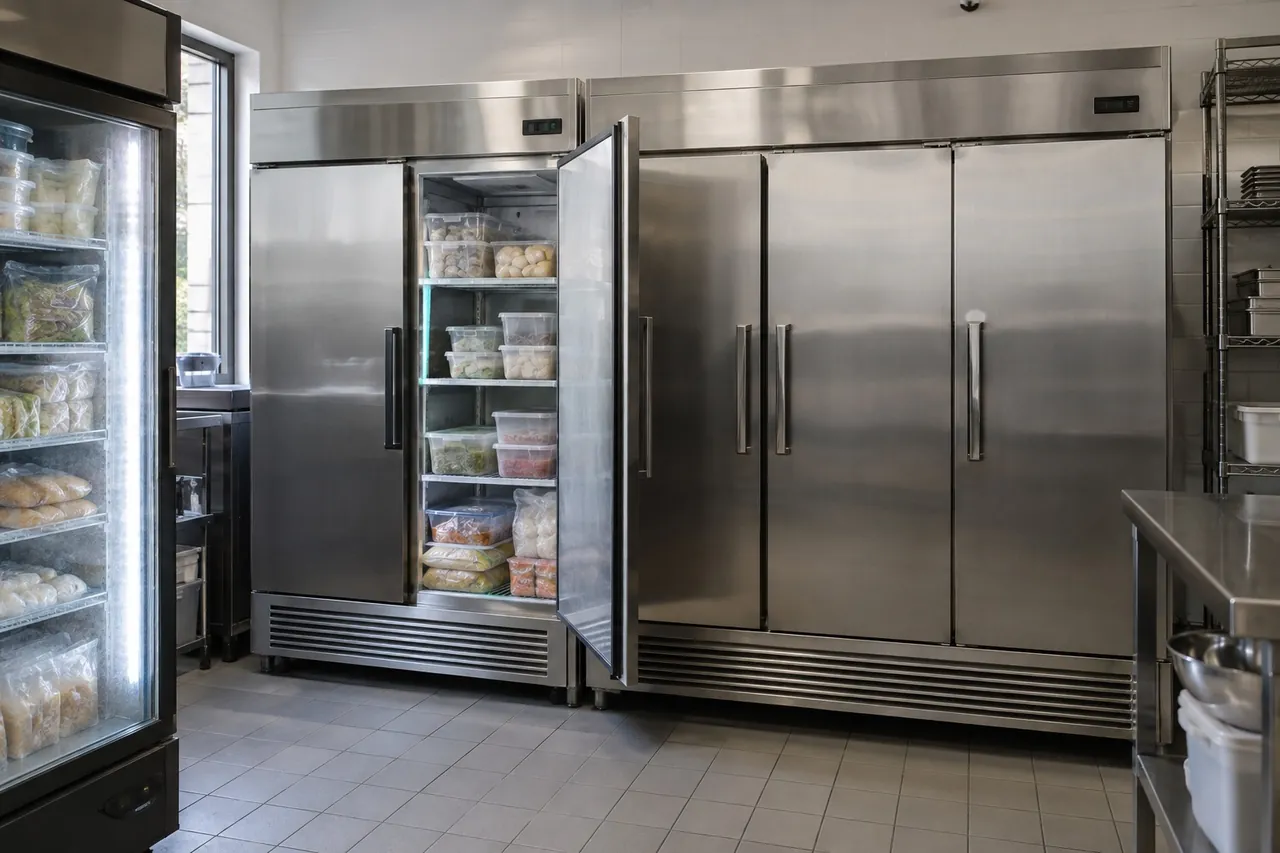
Commercial chest freezers have heavier lids and hinges, stronger compressors, coated or stainless interiors, locks and wider ambient ratings, and they are built for many openings a day rather than a few a week.
There are three common trade formats:
- Solid-lid storage chests for back-of-house stock in kitchens, butchers and bakeries. A stainless steel deep freezer or stainless-lined chest is easier to clean and better suited to inspection.
- Glass-top display chests with sliding curved or flat low-E glass lids, used for ice cream, frozen novelties and frozen meals at the point of sale. These are covered in our ice cream freezer guide.
- Dual-temperature (convertible) chests that switch between chiller and freezer, useful for seasonal stock such as drinks in summer and frozen goods in winter.
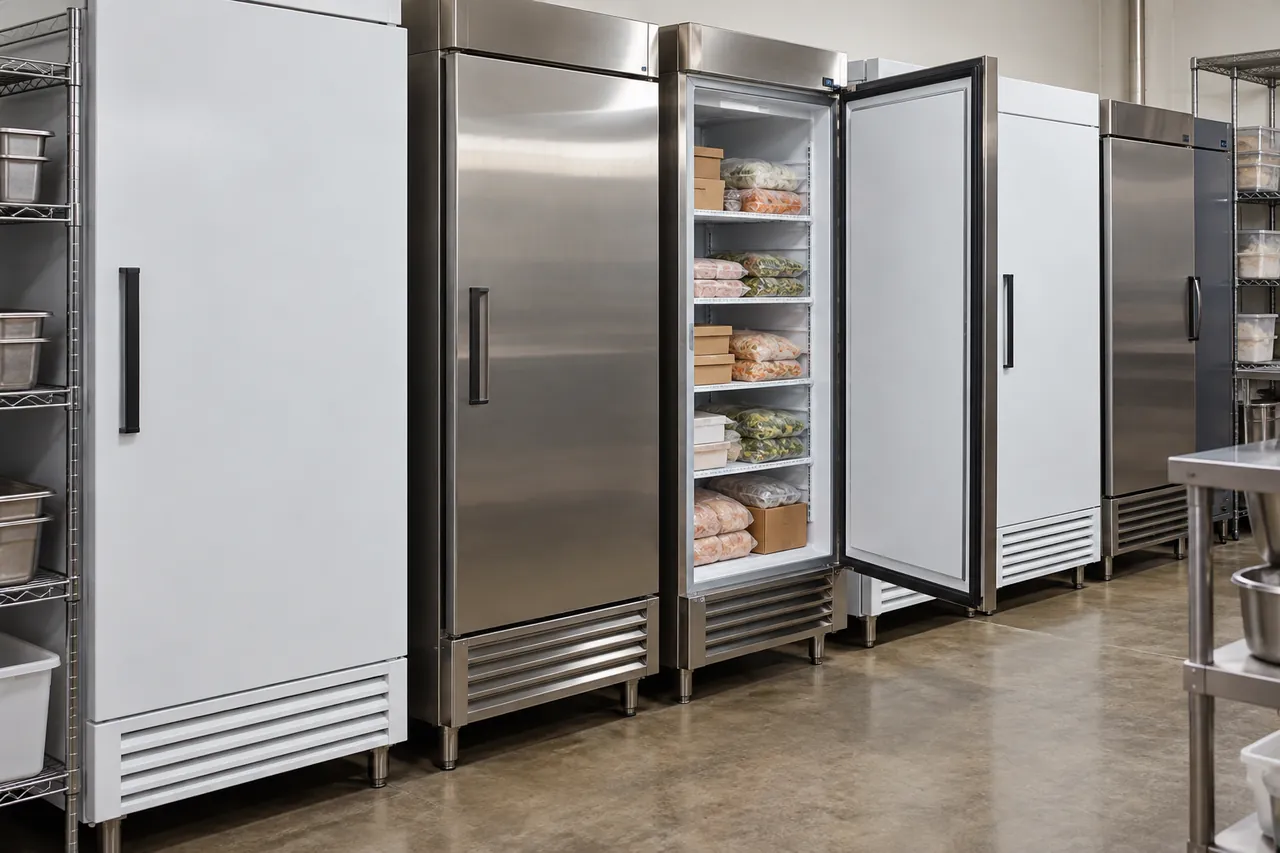
For choosing between chest, reach-in, display and walk-in freezers across a whole business, see the commercial freezer buying guide.
How many watts does a chest freezer use?
A household chest freezer typically draws about 60–150 W while its compressor runs, briefly several times that at start-up, and uses roughly 0.5–1.2 kWh a day (about 180–450 kWh a year) depending on size and room temperature. A 7 cu ft model is usually at the low end of that range.
Because the compressor cycles on and off, the average power is much lower than the running watts. Energy use rises steeply with room temperature: the same freezer in a 32 °C (90 °F) garage can use 50% or more energy than it does in a 20 °C (68 °F) room. Manual defrost chests are also usually more efficient than automatic defrost chest freezer models, because they have no defrost heater.
For backup power, size a generator or inverter for the start-up surge, not the running watts; many small chest freezers need about 600–1,000 W of surge capacity. Our guide to how many watts a refrigerator or freezer uses shows how to work out running cost from the label.
How do you defrost a chest freezer?
To defrost a chest freezer, switch it off, move the food to another freezer or insulated boxes, open the drain plug, let the ice melt with the lid open (helped by bowls of hot water), wipe it dry and run it empty for an hour before reloading.
- Plan the defrost when stock is low, and defrost once frost reaches about 6 mm (¼ in) thick.
- Switch off and unplug. Pack the food tightly in cool boxes with ice packs, or in another freezer.
- Open the drain plug and place a tray or hose under the outlet.
- Place pans of hot (not boiling) water inside and close the lid for 10–15 minutes at a time.
- Lift off loose sheets of ice with a plastic scraper; never use knives or heat guns.
- Wash with warm water and a little baking soda, rinse and dry thoroughly.
- Close the drain, switch on and wait until the cabinet reaches −18 °C (0 °F) before reloading.
Most chest freezers take 1–3 hours to defrost this way. For faster methods, causes of frost and ice that keeps coming back, see why a freezer ices up and how to defrost it.
How long do deep freezers last, and what do they cost?
A chest deep freezer typically lasts 12–20 years, longer than most uprights, because it has a simple static evaporator, no fans and no defrost heater in manual models.
Life is shortened by hot rooms, blocked ventilation around the condenser, damaged lid seals and frequent moves. As an indicative guide only, household chest freezers often retail for roughly US$150–700 depending on size and market, and commercial storage or glass-top chests for roughly US$400–1,500; import prices per unit depend on order volume, specification and freight terms.
Chest freezer organisation tips
- Use hanging baskets for small, frequently used items and stack bulk items below.
- Use chest freezer dividers or crates to keep categories (meat, vegetables, ready meals) in columns, so you lift one crate rather than dig.
- Label every pack with contents and date; rotate first in, first out.
- Keep a written inventory on the lid, and keep the freezer at least two-thirds full.
How to choose a deep freezer: checklist
Before searching for deep freezers for sale or asking for quotes, confirm:
- Temperature: −18 °C (0 °F) for general storage; −23 °C to −25 °C (−10 °F to −13 °F) for ice cream or fish.
- Size: peak stock in kg ÷ about 13 kg per cu ft (0.45 kg per litre) for an 80% fill.
- Location: indoor, garage or outdoor, with the matching ambient rating and 75–100 mm (3–4 in) ventilation clearance.
- Lid: solid for storage, glass for selling, lockable for shared or unattended sites.
- Defrost: manual for efficiency and long-term storage; automatic for busy, frequently opened chests.
- Power and refrigerant: 220–240 V 50 Hz or 110–120 V 60 Hz; R600a or R290 where required.
- Certification: CE, UL/ETL, SASO or other marks your market requires, plus food-equipment listings for commercial use.
Be There supplies commercial display freezers and glass-top chest freezers from about 300 to 700 L holding −18 °C to −24 °C (0 °F to −11 °F), lockable ice merchandisers for bagged ice, and walk-in freezer rooms once chests are no longer enough. Tell us the capacity, lid type, voltage and destination through the inquiry form and we will quote FOB, CIF or DDP.