
Short answer
An upright freezer is a front-opening, fridge-shaped freezer that holds food at −18 °C (0 °F) or colder. Household models run from about 5 to 21 cu ft (140–595 L); commercial reach-ins hold 20–75 cu ft (570–2,100 L). Choose frost-free for frequent access, manual defrost for lowest energy, and a garage-ready or T-class model for rooms outside 16–32 °C.
Key takeaways
- Upright freezers hold food at −18 °C (0 °F) or colder; household models are about 5–21 cu ft (140–595 L) and commercial reach-ins 20–75 cu ft (570–2,100 L).
- Plan to use only 70–80% of rated volume; 1 usable cu ft holds roughly 12–16 kg (26–35 lb) of frozen food.
- Manual defrost uprights typically use 35–40% less energy but need defrosting when frost reaches about 6 mm (¼ in).
- N-class household freezers are designed for 16–32 °C (61–90 °F) rooms; garages need a garage-ready or wide-ambient model.
- Commercial reach-in freezers are rated for 38–43 °C (100–110 °F) kitchens and frequent door openings; household units are not.
What is an upright freezer?
An upright freezer is a freezer that stands like a fridge, with a front-opening door, shelves or baskets and a footprint of roughly 0.3–0.9 m² (3–10 sq ft), holding food at −18 °C (0 °F) or colder. It is the format to choose when people need to see and pick stock quickly rather than dig for it.
The term covers several quite different machines. A home stand up deep freezer in a garage, a stainless steel reach-in freezer in a restaurant kitchen and a glass door merchandiser in a convenience store are all upright freezers, but they differ in how fast they recover after the door opens, what room temperature they tolerate and how long they last. This guide explains those differences, the standard sizes from 5 to 21 cu ft and the features worth paying for. If you are still deciding between formats, read our comparison of the chest freezer vs upright freezer first; this article assumes upright is the answer and helps you pick the right one.
What types of upright freezers are there?
There are four main types of upright freezer: residential uprights, garage-ready uprights, commercial reach-in freezers and glass door display freezers. They look similar from across a room, but the refrigeration system inside is sized for very different duty.
Residential upright freezers
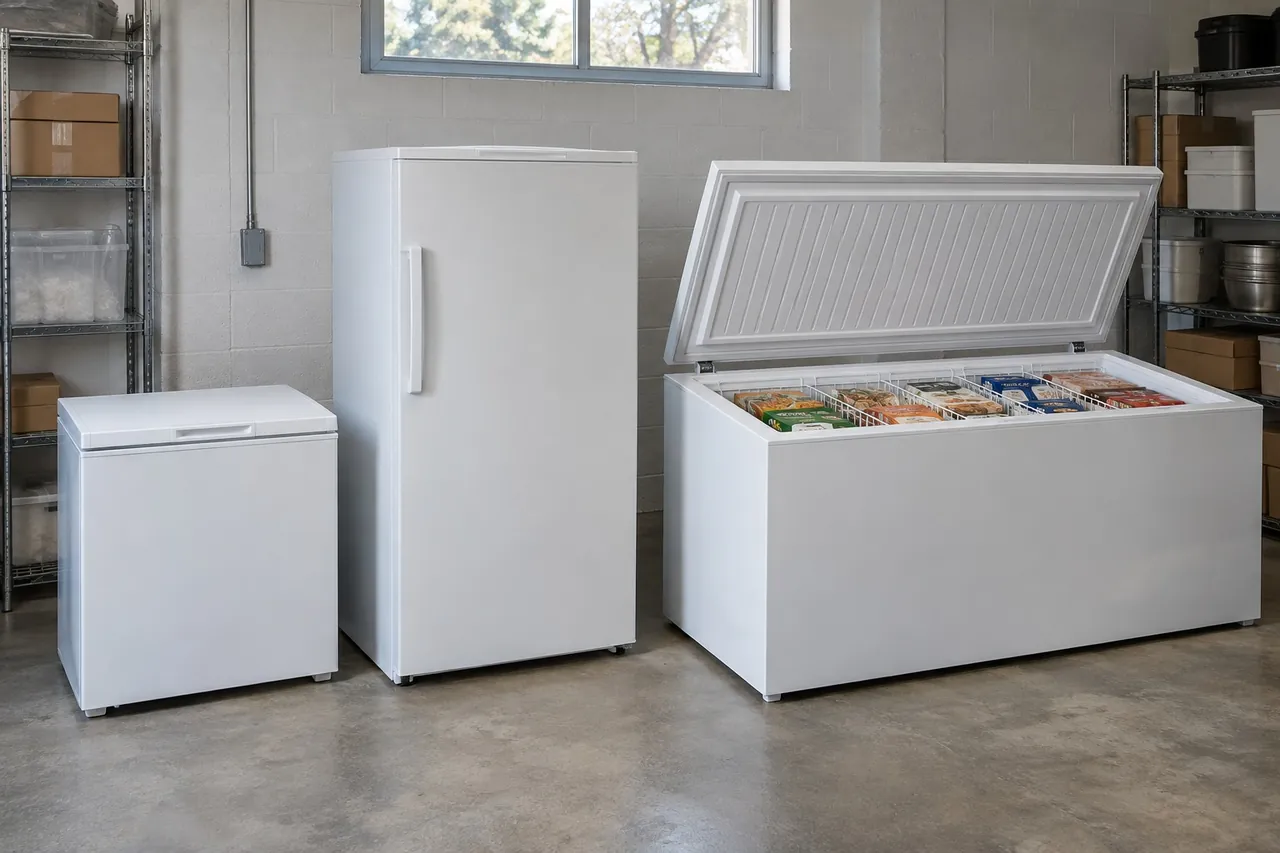
Household upright freezers run from compact 3–6 cu ft (85–170 L) models to full-size 20–21 cu ft (565–595 L) cabinets. They are designed for a kitchen or utility room at about 16–32 °C (61–90 °F), a few door openings a day and foam walls of about 50–70 mm (2–2.75 in). They are the cheapest per litre, but they are not built for trade use, and many food-safety inspectors will not accept them in a licensed kitchen.
Garage-ready upright freezers
A garage ready upright freezer is a residential freezer whose controls and compressor are rated to keep working when the surrounding air is very cold or very hot. A standard freezer's thermostat senses cabinet temperature, so in a cold garage the compressor may barely run, and in a hot one it may run continuously and still lose temperature. Garage-ready models extend the ambient range, commonly to something like −18 °C to +43 °C (0 °F to 110 °F) depending on the model, so always check the stated range rather than the label alone.
Commercial reach-in (stand up) freezers
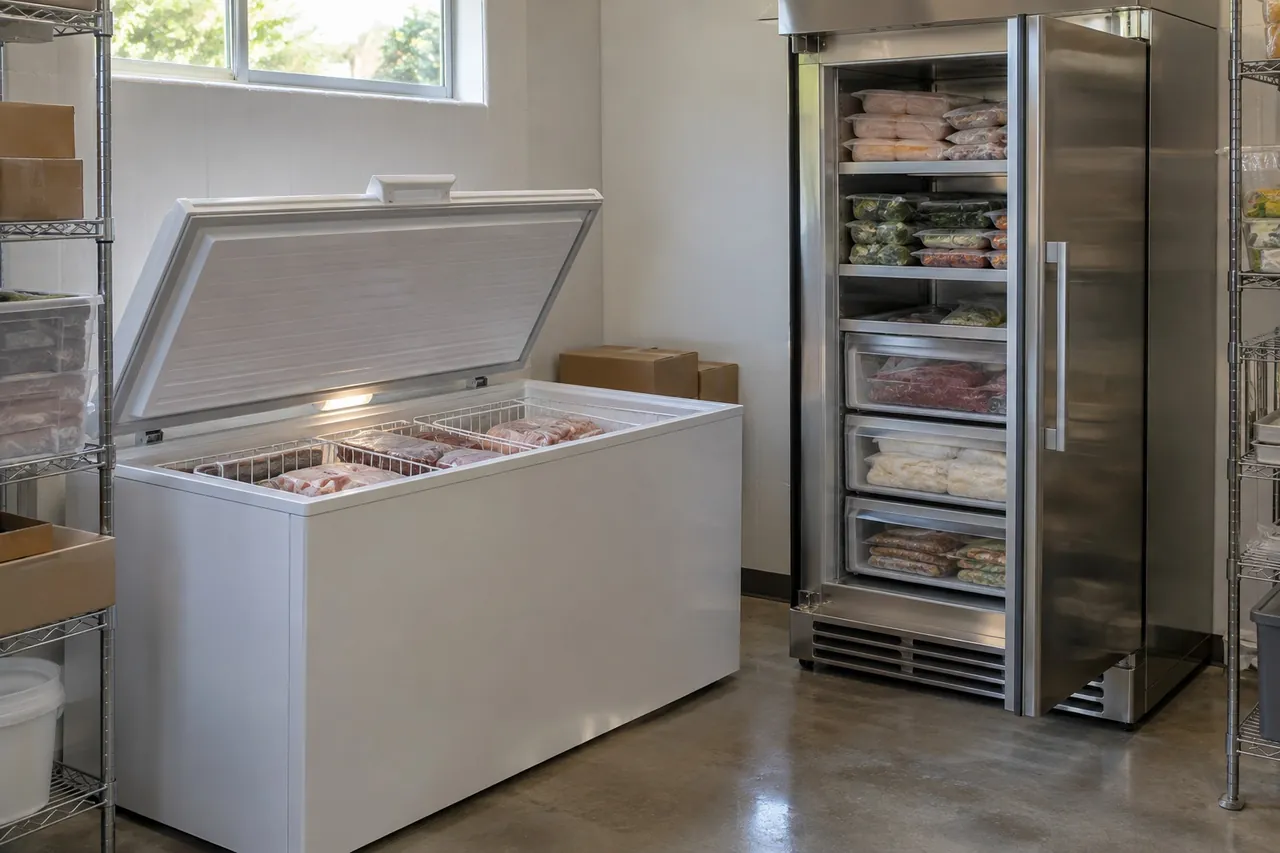
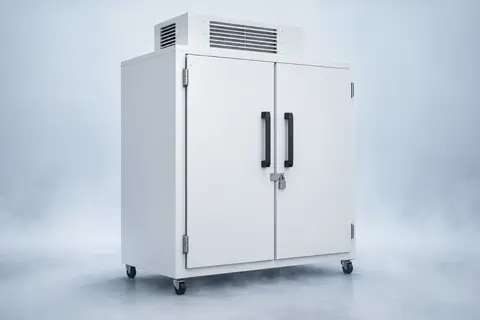
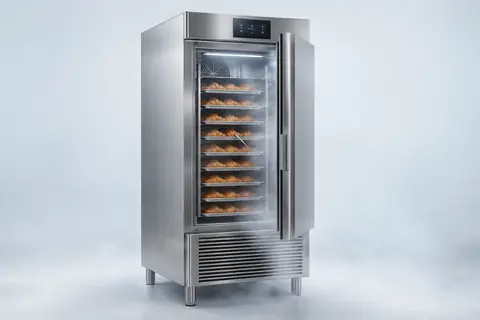
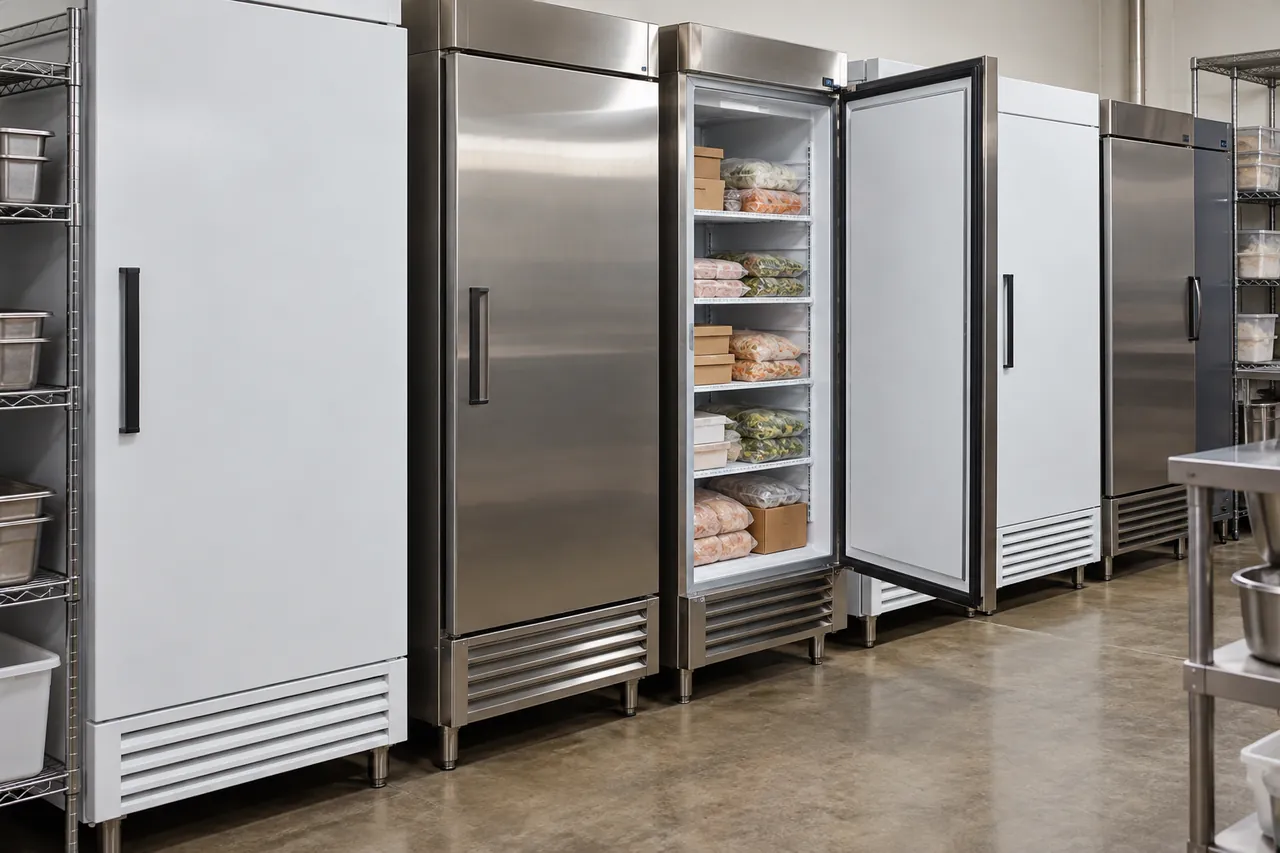
A commercial stand up freezer, or reach-in, is built for constant door openings in a hot kitchen. It has a larger compressor, a forced-air evaporator, self-closing doors, stainless or coated steel inside and out, and is typically rated for 38–43 °C (100–110 °F) rooms. One-, two- and three-door versions hold about 20–75 cu ft (570–2,100 L). See the commercial freezer buying guide for how reach-ins compare with chest, display and walk-in freezers.
Glass door display freezers
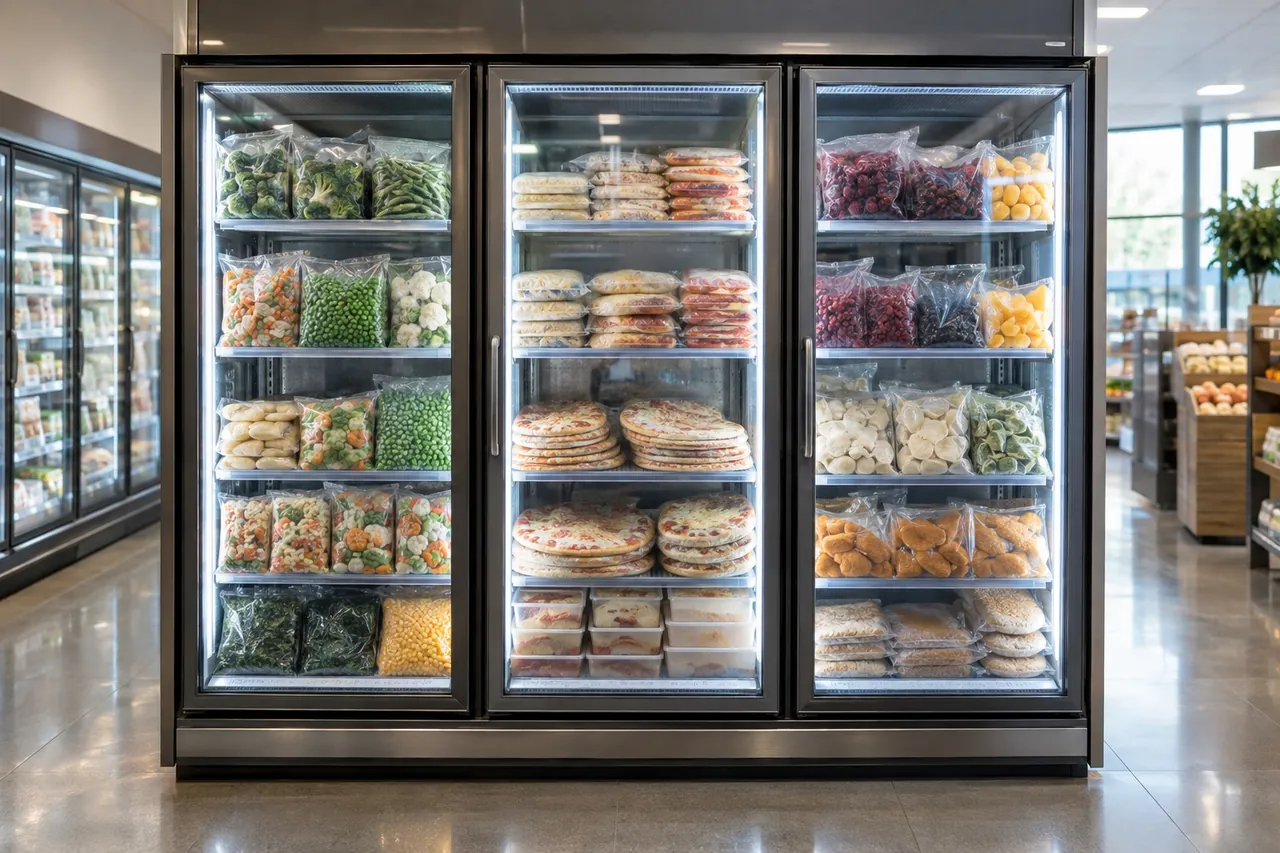
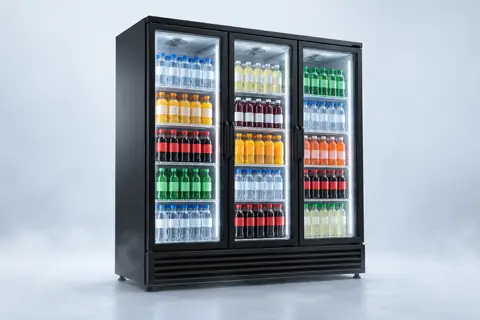
An upright display freezer has heated, multi-pane glass doors and LED lighting so customers can see the stock. Shops use them for ice cream, frozen meals and frozen vegetables. They are covered in detail in our glass door freezer guide.
| Type | Typical capacity | Ambient rating | Doors / interior | Typical use |
|---|---|---|---|---|
| Compact / miniature upright | 3–7 cu ft (85–200 L) | 16–32 °C (61–90 °F) | 1 solid door, wire shelves | Offices, staff rooms, flats |
| Full-size residential upright | 13–21 cu ft (370–595 L) | 16–32 °C (61–90 °F) | 1 solid door, shelves, door bins | Homes, small catering stock |
| Garage-ready upright | 7–21 cu ft (200–595 L) | Often about −18 °C to +43 °C (0–110 °F) | 1 solid door | Garages, sheds, unheated stores |
| Commercial reach-in | 20–75 cu ft (570–2,100 L) | Up to 38–43 °C (100–110 °F) | 1–3 solid doors, stainless | Restaurant and hotel kitchens |
| Glass door display freezer | 400–1,600 L (14–56 cu ft) | Commonly 30–40 °C (86–104 °F) shop rating | 1–4 heated glass doors | Shops, supermarkets, kiosks |
What sizes do upright freezers come in?
Upright freezer sizes run from about 3 cu ft (85 L) compact units to 21 cu ft (595 L) full-size models for homes, and 20–75 cu ft (570–2,100 L) for commercial reach-ins. The most common sizes are 5, 7, 10–11, 13–14, 16–17 and 20–21 cu ft.
A useful rule of thumb is that 1 cu ft (28.3 L) holds about 16 kg (35 lb) of mixed frozen food when packed solidly, but an upright loses some of that to shelves, door bins and the air gap needed for circulation. Plan on using 70–80% of the rated volume in practice. Our explainer on freezer cubic feet goes deeper into how volume is measured; the table below gives typical outside dimensions so you can check doorways and alcoves before ordering.
| Rated size | Approx. litres | Typical W × D × H | Usable food load | Who it suits |
|---|---|---|---|---|
| 5 cu ft | 140 L | 53 × 58 × 145 cm (21 × 23 × 57 in) | 55–65 kg (120–140 lb) | 1–2 people, office, small bar |
| 7 cu ft | 200 L | 55 × 60 × 150 cm (22 × 24 × 59 in) | 80–90 kg (175–200 lb) | Small household, café back-up |
| 10–11 cu ft | 280–310 L | 60 × 65 × 160 cm (24 × 26 × 63 in) | 115–140 kg (250–310 lb) | Family of 3–4 |
| 13–14 cu ft | 370–400 L | 70 × 70 × 160 cm (28 × 28 × 63 in) | 150–180 kg (330–390 lb) | Large family, small takeaway |
| 16–17 cu ft | 450–480 L | 76 × 74 × 170 cm (30 × 29 × 67 in) | 185–215 kg (410–475 lb) | Bulk buyers, small caterers |
| 20–21 cu ft | 565–595 L | 81 × 76 × 180 cm (32 × 30 × 71 in) | 230–265 kg (510–585 lb) | Farms, hunters, large households |
| 1-door commercial reach-in | 570–700 L (20–25 cu ft) | 69–74 × 80–85 × 200–210 cm (27–29 × 31–34 × 78–83 in) | 230–290 kg (500–640 lb) | Restaurant kitchen |
Dimensions vary by maker, so treat these as planning figures. Allow at least 50–75 mm (2–3 in) at the sides and back, and more at the top for top-breathing compressors, unless the unit is specifically front-breathing. Check that the door can swing past 90° so drawers and baskets can come out fully.
Should you choose a frost-free or manual defrost upright freezer?
Choose a frost-free (auto defrost) upright freezer if the door is opened often or nobody will defrost it, and a manual defrost upright freezer if you want the lowest energy use and the most stable temperature for long-term storage.
Uprights are more prone to frost than chests because cold air spills out at the bottom of an open door and warm, humid room air flows in at the top. In a manual defrost model that moisture freezes onto the cold shelves or wall plates, and the cabinet needs defrosting once frost reaches about 6 mm (¼ in). An auto defrost upright freezer (also sold as a self defrosting upright freezer or frost free stand up freezer) uses a fan and a hidden evaporator coil with a heater that runs short defrost cycles automatically.
- Frost-free: no defrost chore, even temperature shelf to shelf, easier to organise. Uses more energy and dries unwrapped food slightly faster.
- Manual defrost: typically 35–40% less energy, very stable temperature and fewer parts to fail. Needs defrosting one to three times a year, more with heavy use.
Commercial reach-in and display freezers are almost always frost-free. For the mechanics of defrost heaters, timers and drain lines, see frost free vs manual defrost freezers; if an existing unit is already caked in ice, our guide to why a freezer ices up and how to defrost it walks through causes and fixes.
Can you put an upright freezer in a garage?
You can put an upright freezer in a garage only if it is rated for the garage's coldest and hottest temperatures; a standard indoor freezer may stop running properly in winter and struggle in summer.
Household freezers are tested to a climate class under the international household refrigerating appliance standard (IEC 62552). The class tells you the room temperature range in which the appliance is designed to hold its rated temperature:
| Climate class | Ambient range | Suitable for |
|---|---|---|
| SN (extended temperate) | 10–32 °C (50–90 °F) | Cool, unheated rooms |
| N (temperate) | 16–32 °C (61–90 °F) | Heated indoor rooms |
| ST (subtropical) | 16–38 °C (61–100 °F) | Warm kitchens and climates |
| T (tropical) | 16–43 °C (61–109 °F) | Hot climates, hot back rooms |
A garage that falls below about 10 °C (50 °F) in winter or rises above 38 °C (100 °F) in summer needs a model that explicitly states a wider range. The best upright freezer for garage use also has a rust-resistant cabinet, sealed electrics and adjustable feet for an uneven floor. Do not run it from an extension lead. For yards, forecourts and kiosks, a lockable, outdoor-rated commercial freezer is a better choice than any garage-ready household model.
What makes the best upright freezer?
The best upright freezer is the one that holds −18 °C (0 °F) or colder in your room conditions, recovers quickly after the door opens, fits your space with clearance and has parts and service available where you are. Reviews and star ratings rarely tell you these things; specifications do.
Features worth paying for
- Digital controller and display showing actual cabinet temperature, ideally with a high-temperature alarm and a door-open alarm.
- Fast freeze (super freeze) setting that runs the compressor continuously for a few hours before a large load goes in.
- Lock for shared spaces, garages and staff areas.
- Baskets or drawers rather than only shelves in the lower half, so loose items do not fall out. Pull-out upright freezer baskets make organisation and first-in, first-out rotation much easier.
- Reversible door so the hinge suits the room layout.
- Stainless steel upright freezer finish for kitchens that are wiped down daily; painted steel is fine elsewhere.
- Natural refrigerant such as R600a (isobutane) in household units or R290 (propane) in commercial ones, which many markets now favour or require.
Features to question
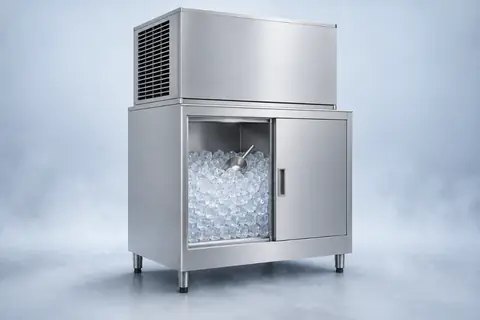
An upright freezer with ice maker needs a water line and takes shelf space; a business that needs regular ice is better served by a dedicated ice machine. A convertible upright freezer that switches between fridge and freezer modes is useful for seasonal stock, but check that it holds temperature in both modes at your room temperature. Colour options such as a black upright freezer are cosmetic and do not change performance.
How much electricity does an upright freezer use?
A typical full-size household upright freezer uses roughly 300–700 kWh a year, depending on size, defrost type and room temperature; a one-door commercial reach-in freezer commonly uses several times as much because of its larger compressor and heavy use.
Energy use rises with every degree of room temperature, every door opening and every layer of dust on the condenser. Practical ways to cut it:
- Set the freezer to −18 °C (0 °F); going much colder than about −20 °C (−4 °F) rarely improves food quality in a storage freezer and increases running cost.
- Keep it at least two-thirds full; frozen mass stabilises temperature after the door opens.
- Leave the recommended clearance and clean the condenser every 3–6 months.
- Check the door gasket: a sheet of paper closed in the door should be held firmly all the way round.
- Keep the freezer away from ovens, direct sun and boilers.
For the full calculation from wattage to kWh and running cost, see how many watts a refrigerator or freezer uses.
Is a used upright freezer worth buying?
A used upright freezer is worth buying if it is well under half its expected life, pulls down to −18 °C (0 °F) within a few hours empty, runs on a refrigerant still serviceable in your market and has a dry, odour-free interior with tight gaskets.
Household uprights typically last 10–20 years; commercial reach-ins about 10–15 years in a busy kitchen. Signs to walk away from include condensation or frost on the outside of the cabinet (a sign of wet insulation), a compressor that runs without stopping, rust inside the liner and a smell that cleaning will not shift. Run any second-hand freezer empty for 24 hours with a thermometer inside before loading food.
How to choose an upright freezer: checklist
Work through these points before you look at any upright freezer for sale or request a quote:
- Use: home, garage, back-of-house kitchen or selling to customers? This decides residential, garage-ready, reach-in or display.
- Capacity: estimate the frozen stock you hold at peak in kg, divide by about 12 kg per usable cu ft (roughly 0.42 kg per litre) and round up.
- Space: measure the alcove, doorways and stairs; add 50–75 mm (2–3 in) clearance each side and behind.
- Room temperature: match the climate class or ambient rating to the hottest and coldest days in that room.
- Defrost: frost-free for frequent access; manual defrost for long-term, low-energy storage.
- Power: confirm 220–240 V 50 Hz or 110–120 V 60 Hz and the plug type.
- Compliance: for food businesses, check food-equipment listings (for example NSF/ANSI 7 in the US) and electrical certification (UL/ETL, CE, SASO) for your market.
- Service: ask who stocks gaskets, controllers and fan motors locally.
Be There supplies commercial upright display freezers with one to four heated glass doors (about 400–1,600 L) holding −18 °C to −24 °C (0 °F to −11 °F), glass-top chest freezers for ice cream, and complete walk-in freezer kits for businesses that have outgrown upright cabinets. Send your required capacity, door count, voltage and destination port through the inquiry form and we will quote FOB, CIF or DDP.