Short answer
A commercial freezer is a heavy-duty freezer built to hold −18 °C to −23 °C (0 °F to −10 °F) through constant door openings in a hot kitchen or shop. Choose a reach-in for back-of-house picking, a chest for bulk stock, a glass-door or glass-top display freezer for selling, and a walk-in once you need more than about 2–3 m³ of storage.
Key takeaways
- Commercial freezers hold −18 °C (0 °F) or colder and are built for frequent openings and kitchen temperatures up to about 38–43 °C (100–110 °F).
- Typical reach-in sizes are about 0.7 m (28 in) wide for one door, 1.4 m (55 in) for two doors and 2.0 m (80 in) for three doors, at roughly 600, 1,300 and 2,000 L.
- In the US, food-service freezers are normally certified to NSF/ANSI 7 and an electrical safety standard such as UL 60335-2-89.
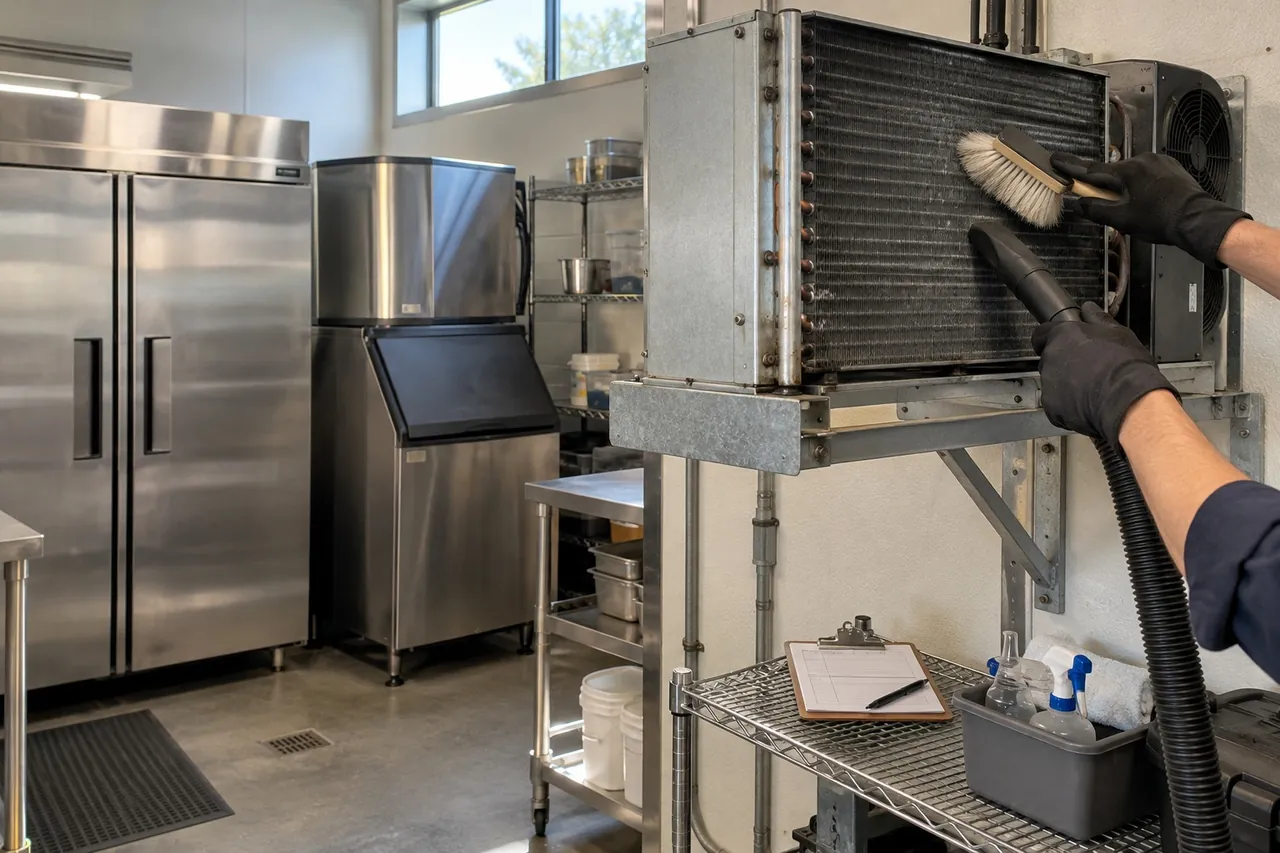
- A dirty condenser coil is one of the most common causes of a warm commercial freezer; cleaning it every 1–3 months prevents many repair calls.
- Fit a temperature alarm that warns when the cabinet rises above about −15 °C (5 °F), and log temperatures for HACCP.
What is a commercial freezer?
A commercial freezer is a freezer designed for food businesses: it holds frozen food at −18 °C (0 °F) or colder while being opened dozens or hundreds of times a day in a warm kitchen, bar or shop. Compared with a household deep freezer it has a larger compressor, faster temperature recovery, tougher hinges and gaskets, cleanable food-grade interiors and food-safety certification.
Restaurant freezers, hotel freezers and supermarket freezers fall into a few families:
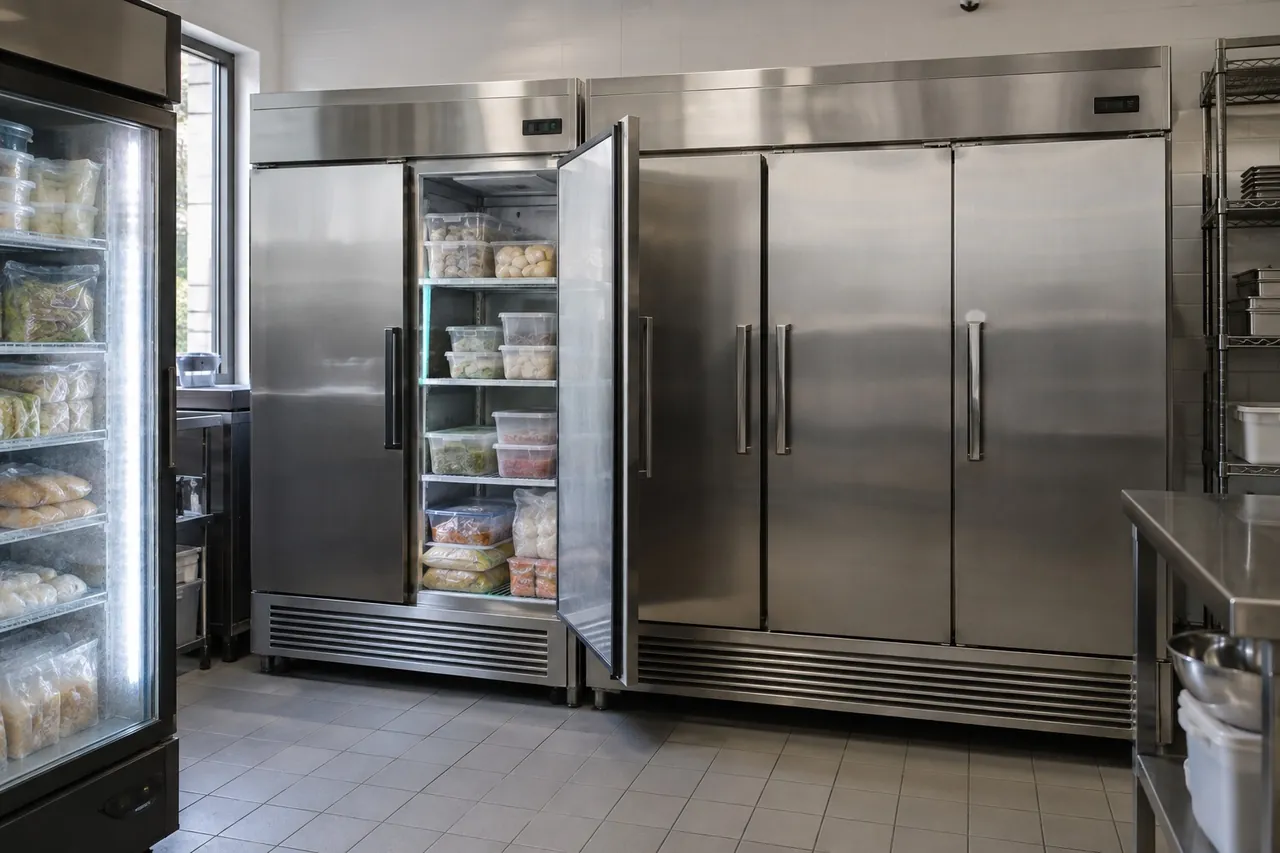
- Reach-in freezers: upright cabinets with one to three solid or glass doors, for back-of-house storage.
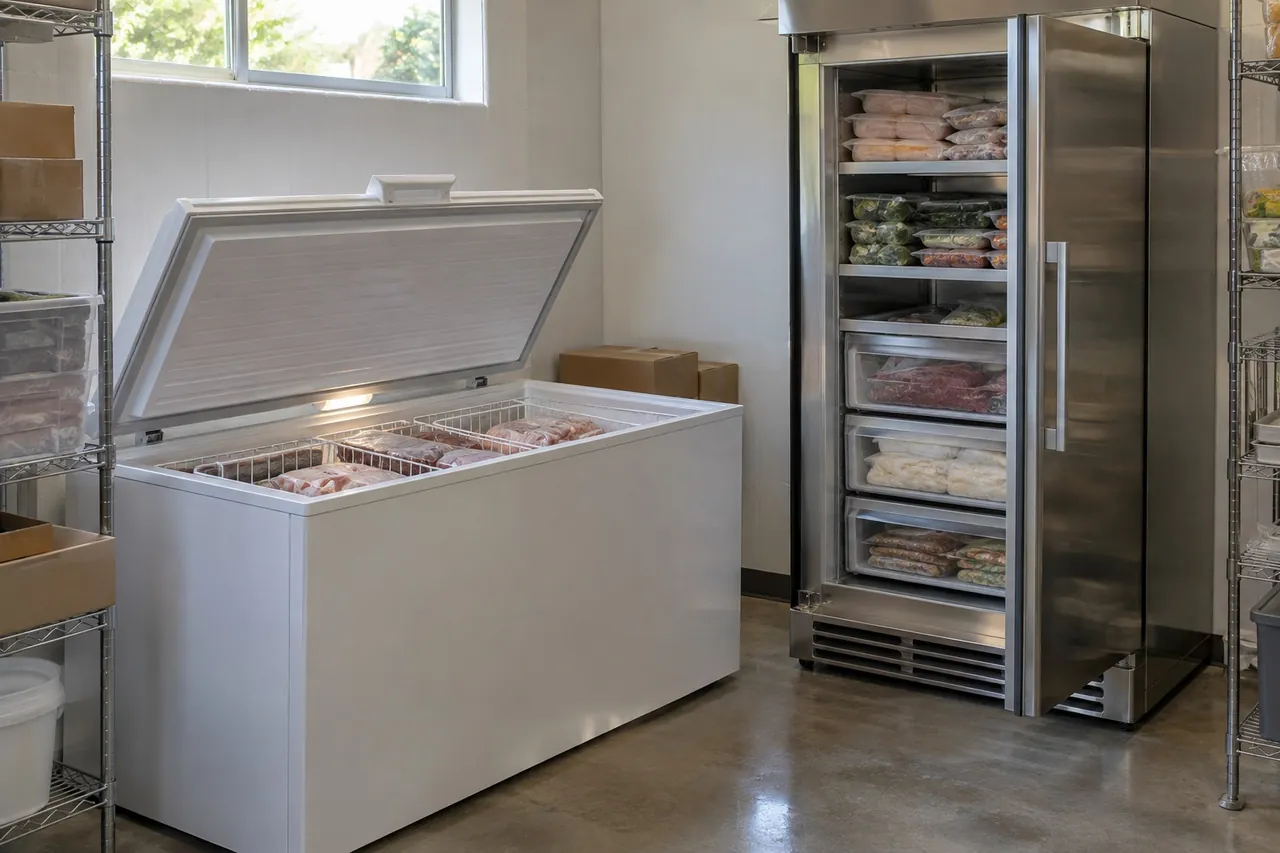
- Chest freezers: top-opening, for bulk stock and lowest energy use.
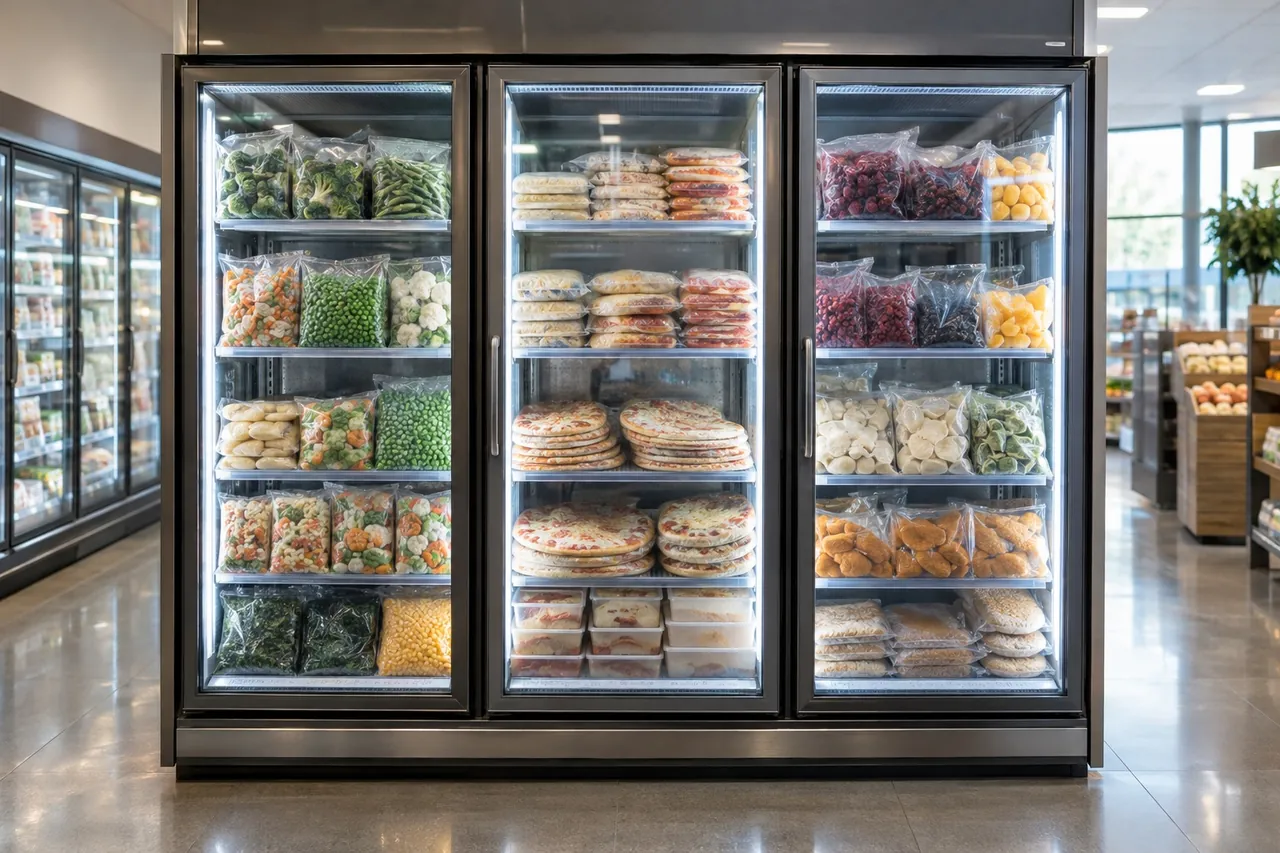
- Display freezers: glass-door uprights and glass-top chests that sell frozen food and ice cream.
- Ice freezers: ice merchandisers that store bagged ice at a warmer −12 °C to −6 °C.
- Industrial freezers: blast freezers that freeze food fast, and walk-in freezer rooms for bulk storage.
The right choice depends on what you store, who opens it, how much floor you have and whether the freezer also has to sell. If you are weighing top-opening against upright cabinets, our chest freezer vs upright freezer guide compares them in detail; this guide covers the wider commercial range.
Types of commercial freezers compared
| Type | Typical temperature | Typical capacity | Best for |
|---|---|---|---|
| Solid-door reach-in freezer | −18 °C to −23 °C (0 °F to −10 °F) | 550–2,000 L (19–72 cu ft) | Restaurant kitchens, hotels, hospitals |
| Glass door reach-in / upright display freezer | −18 °C to −24 °C (0 °F to −11 °F) | 400–1,600 L, 1–4 doors | Supermarkets, convenience stores, frozen food brands |
| Commercial chest freezer | −18 °C to −25 °C (0 °F to −13 °F) | 200–700 L (7–25 cu ft) | Bulk meat, seafood, back-up stock |
| Glass-top chest display freezer | −18 °C to −24 °C (0 °F to −11 °F) | 300–700 L (10–25 cu ft) | Ice cream, novelties, impulse frozen food |
| Undercounter / worktop freezer | −18 °C to −22 °C (0 °F to −8 °F) | 100–400 L | Cook lines and bars |
| Ice merchandiser (ice freezer) | −12 °C to −6 °C (10–21 °F) | 30–100 bags of 10 lb | Petrol stations, stores, outdoor sites |
| Blast / shock freezer | Air −35 °C to −40 °C; core to −18 °C | 5–20 trays | Cook-freeze kitchens, bakeries |
| Walk-in freezer | −18 °C to −25 °C (0 °F to −13 °F) | From about 5 m³ (175 cu ft) | Bulk storage, pallets, central kitchens |
Most businesses combine two or three: a walk-in or chest for bulk, a reach-in on the line, and a display freezer at the front. Be There supplies the display, ice, blast and walk-in families; for solid-door back-of-house reach-ins, describe your requirement in your inquiry and we will advise what we can quote.
1, 2 and 3 door commercial freezer sizes
Reach-in freezers are sold by number of doors ("sections"). These are typical outside dimensions for full-height upright commercial freezers; always check the exact model sheet and your door openings.
| Model | Width | Depth | Height | Capacity |
|---|---|---|---|---|
| 1 door (single door) commercial freezer | 0.65–0.75 m (26–30 in) | 0.75–0.85 m (30–34 in) | 1.95–2.10 m (77–83 in) | 540–650 L (19–23 cu ft) |
| 2 door (double door) commercial freezer | 1.30–1.40 m (51–55 in) | 0.75–0.85 m (30–34 in) | 1.95–2.10 m (77–83 in) | 1,270–1,390 L (45–49 cu ft) |
| 3 door commercial freezer | 1.95–2.10 m (77–83 in) | 0.75–0.85 m (30–34 in) | 1.95–2.10 m (77–83 in) | 1,950–2,050 L (69–72 cu ft) |
| 4 door glass display freezer | 2.0–2.5 m (79–98 in) | 0.7–0.8 m (28–31 in) | About 2.0 m (79 in) | Up to about 1,600 L (56 cu ft) |
Two practical checks catch most sizing mistakes. First, measure every doorway, corridor and lift on the route; a 2 door reach-in freezer at 0.8 m deep may need its doors removed to pass a 0.8 m opening. Second, leave air space: most self-contained freezers need about 50–100 mm (2–4 in) at the sides and back, and more above a top-mounted compressor. A freezer starved of air runs longer, uses more energy and fails sooner.
Half-door, roll-in and pass-through versions exist for hospitals and large kitchens, but cost more and need more floor.
Which specifications matter most?
Ambient and climate class
A commercial freezer should be tested at room conditions as hot as yours. Display cabinets are tested to EN ISO 23953 climate classes, for example class 3 (25 °C, 60% RH), class 4 (30 °C, 55% RH) or class 5 (27 °C, 70% RH). For hot kitchens or tropical markets, ask for performance at 38–43 °C (100–110 °F).
Compressor position and refrigerant
Top-mounted compressors stay clear of floor dust and kitchen heat; bottom-mounted ones raise the bottom shelf and are easier to service. Check the refrigerant your market allows: natural R290 (propane) is now standard for new plug-in cabinets in the EU and widely adopted in the US, replacing high-GWP R404A.
Cabinet and doors
- Stainless steel freezers: 304 stainless resists corrosion best; 430 is cheaper and magnetic. Many units pair a stainless front with a painted or aluminium interior.
- Insulation: foamed-in-place PU, typically 60–80 mm on reach-ins.
- Doors: self-closing hinges, a stay-open feature at 90° to 120°, magnetic gaskets you can change without tools, and an optional lock.
- Glass doors: heated, multi-pane low-E glass to stop condensation on a commercial freezer glass front.
Defrost, power and certification
Fan-cooled reach-ins use automatic defrost; check that defrost cycles are timed or demand-based. Confirm voltage and frequency (115 V/60 Hz in North America, 220–240 V/50 Hz in most other markets) and plug type. For US food service, look for NSF/ANSI 7 sanitation and UL or ETL safety listing; in Europe, CE marking.
Display freezers and ice freezers for selling
If customers choose the product themselves, a display commercial freezer earns its floor space. Two formats dominate:
- Glass door upright freezers: one to four heated glass doors, about 400–1,600 L, with LED lighting and adjustable shelves. A 2 glass door commercial freezer is the most common size for convenience stores and frozen food brands.
- Glass-top chest freezers: about 300–700 L, with sliding curved or flat glass lids, ideal for ice cream, ice lollies and impulse buys near the till.
Be There display freezers hold −18 °C to −24 °C (0 °F to −11 °F), with optional locks, branding panels and an R290 refrigerant option.
What is a commercial ice freezer?
An "ice freezer" in retail usually means an ice merchandiser: a solid-door, lockable freezer for bagged ice held at −12 °C to −6 °C (10–21 °F). That warmer setpoint stops bags fusing into a block and saves energy. Capacities run from about 30 bags for a small ice freezer to about 100 bags of 10 lb (4.5 kg), and weatherproof outdoor ice freezer versions stand on forecourts. Pair one with an ice machine if you bag your own ice.
A standard storage freezer is the wrong tool for bagged ice (too cold, bags fuse) and for display (solid doors hide the product). Buy for the job the freezer actually does.
Commercial freezer temperature monitoring and alarms
A failed freezer that nobody notices overnight can cost more stock than the freezer itself. Every commercial freezer should have three layers of protection:
- A visible display or thermometer showing cabinet air temperature. Check it against a calibrated probe thermometer every few months.
- A temperature alarm that sounds or sends a message when the cabinet stays above a set limit. A common setting is an alert above −15 °C (5 °F) for more than 30–60 minutes, which ignores short door openings and defrost cycles.
- Records: twice-daily manual logs, or a wireless commercial freezer temperature monitoring system that logs every few minutes and keeps the data for HACCP audits.
Wireless systems cost little compared with one lost load, and they show trends such as a rising average temperature that warns of a dirty condenser or failing fan before the freezer actually fails. Our temperature monitoring guide compares sensors, data loggers and alarm options.
Under the US FDA Food Code, frozen food must stay frozen; the practical target for storage is −18 °C (0 °F) or colder. If a freezer has failed, check product core temperatures, not just the air reading, before deciding what can be kept.
Commercial freezer repair: common faults and maintenance
Most commercial freezer repair calls trace back to a handful of causes, and many are preventable.
| Symptom | Likely cause | First check |
|---|---|---|
| Cabinet too warm, compressor running | Dirty condenser coil, failed condenser fan | Clean coil, check fan spins |
| Ice on evaporator, poor air flow | Defrost heater, timer or sensor fault | Run a manual defrost; call service |
| Frost around the door | Torn or loose door gasket, door not closing | Paper test on gasket; adjust hinge |
| Water on the floor | Blocked defrost drain | Clear drain line with warm water |
| Compressor not starting, clicking | Start relay, capacitor or compressor fault | Call a refrigeration technician |
A basic preventative maintenance schedule: clean the condenser every 1–3 months (monthly in greasy or dusty kitchens), check gaskets and hinges monthly, clear the drain and inspect the evaporator every quarter, and have a technician check refrigerant pressures and electrical connections once a year. Our commercial refrigeration maintenance checklist has the full routine.
Repair or replace? If the compressor fails on a unit more than about 8–10 years old, replacement often makes more sense, especially if it uses a refrigerant being phased out. Keep the number of a 24 hour commercial freezer repair service on the cabinet, and ask any supplier about spare parts lead times before you buy.
How much does a commercial freezer cost?
Commercial freezer prices vary widely by size, specification, certification and market. As a rough guide in US distribution, a one-door reach-in typically starts around $2,000–$3,000, two-door models run several thousand dollars, and three-door stainless models can exceed $8,000. Glass door display freezers are usually priced above solid-door units of the same size because of heated glass and lighting. Industrial freezer cost, for a walk-in freezer room, depends mainly on size, panel thickness and refrigeration.
What moves the price:
- Stainless steel grade inside and out
- Compressor size and ambient rating
- Glass doors, heaters and lighting
- Certification required in your market (NSF, UL/ETL, CE)
- Freight, duty and installation if importing
2nd hand commercial freezers can save money, but check the age, refrigerant, compressor amps and gaskets, and budget for a service visit straight away.
Once you need several reach-ins worth of storage, compare the cost per litre of a walk-in. A Be There walk-in freezer kit with 120–150 mm PU or PIR panels and a matched condensing unit holds −18 °C to −25 °C and moves condenser heat out of the kitchen. Be There quotes every order individually, FOB, CIF or DDP.
Commercial freezer buying checklist
- Define the job: back-of-house storage, bulk stock, display, bagged ice, fast freezing or bulk pallets.
- Size it for peak stock plus 10–20% free space; measure the space, doorways and clearances.
- Match the ambient: ask for the climate class or the maximum room temperature at which it holds −18 °C.
- Choose the build: door count, solid or glass, stainless grade, compressor position, lock.
- Confirm power, refrigerant and certification for your country and inspector.
- Plan monitoring: display, alarm and temperature logs from day one.
- Plan service: spare parts, warranty terms for commercial use and a local technician.
For selling frozen food and ice cream, see our glass-door and glass-top commercial display freezers; for bagged ice, outdoor ice merchandisers; for bulk storage, walk-in freezer kits. Send your sizes, temperatures, voltage and destination port through the quotation form and Be There will reply within one working day.