Short answer
Freezer cubic feet (cu ft) measures internal storage volume; 1 cu ft equals 28.3 L and holds roughly 35 lb (16 kg) of frozen food. A 7 cu ft chest freezer is about 37 × 22 × 34 in (94 × 56 × 86 cm) and holds 185–245 lb (85–110 kg); a 20 cu ft upright is about 32 × 30 × 71 in (81 × 76 × 180 cm).
Key takeaways
- 1 cubic foot = 28.3 litres, and holds roughly 35 lb (16 kg) of well-packed frozen food.
- Mini freezers are about 1–3 cu ft, small freezers 4–7 cu ft, medium 8–15 cu ft and large freezers 16–30 cu ft.
- Chest freezers are about 33–35 in (84–89 cm) high at every size; width grows from about 21 in (53 cm) at 3 cu ft to about 72 in (183 cm) at 25 cu ft.
- Plan on using only 70–80% of the rated volume, because baskets, shelves and air gaps take space.
- Be There commercial display freezers run from about 300 L (10.6 cu ft) glass-top chests to 1600 L (56.5 cu ft) four-door uprights.
What does freezer cubic feet mean?
Freezer cubic feet is the internal storage volume of a freezer, measured in cubic feet (cu ft or cf). It tells you how much space there is for food, not the size of the cabinet. Outside dimensions are always much larger, because the walls contain 50–100 mm (2–4 in) of insulation and the compressor needs space too.
Three conversions cover most buying decisions:
- 1 cu ft = 28.3 L, so a 7 cu ft freezer is about 200 L and a 20 cu ft freezer about 566 L.
- 1 cu ft holds roughly 35 lb (16 kg) of well-packed frozen food. Loose, irregular items such as whole poultry or ice cream novelties fill less.
- Usable space is about 70–80% of the rated volume once baskets, shelves, dividers and airflow gaps are allowed for.
Makers quote either gross volume (the whole cooled space) or net (storage) volume. Commercial datasheets often give litres; US retail listings give cu ft. When you compare a 10 cubic feet freezer with a 300 L one, convert first: 300 L is 10.6 cu ft.
Size categories are informal, but buyers usually mean:
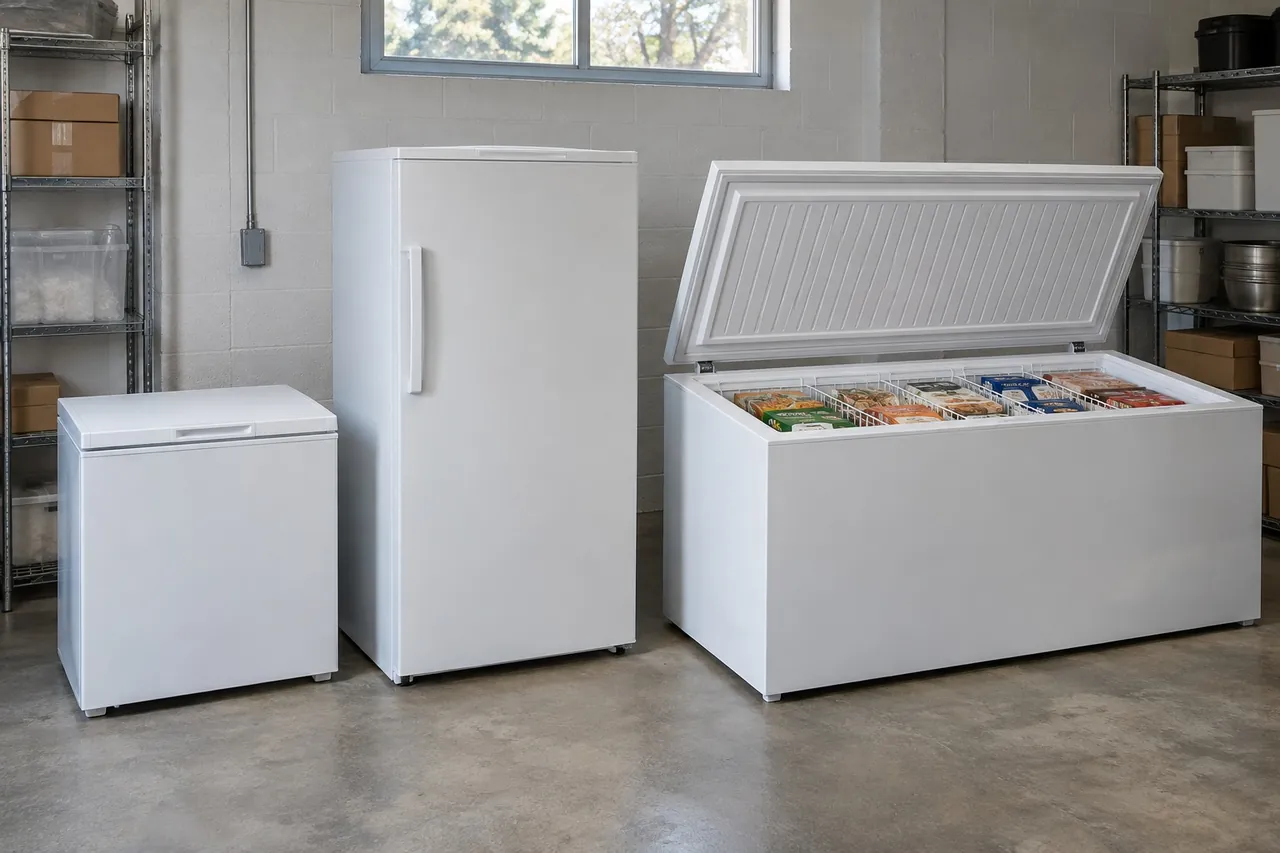
- Mini freezer – about 1–3 cu ft (28–85 L)
- Small freezer – about 4–7 cu ft (110–200 L)
- Medium – about 8–15 cu ft (225–425 L)
- Large freezer – about 16–30 cu ft (450–850 L)
Freezer size chart: cu ft, litres and food capacity
This chart shows common sizes with the approximate food each holds at 35 lb (16 kg) per cu ft and about 75% usable space.
| Size | Litres | Approx. food capacity | Typical format | Typical business use |
|---|---|---|---|---|
| 2–3 cu ft | 57–85 L | 50–80 lb (25–35 kg) | Mini chest or counter-height upright | Office, staff room, back bar |
| 5 cu ft | 142 L | 130 lb (60 kg) | Small chest or upright | Café, small kiosk |
| 7 cu ft | 198 L | 185 lb (85 kg) | Chest or compact upright | Café, food truck base, small shop |
| 10 cu ft | 283 L | 260 lb (120 kg) | Chest or upright | Small restaurant back-up |
| 14 cu ft | 396 L | 370 lb (170 kg) | Chest or upright | Restaurant, convenience store |
| 20 cu ft | 566 L | 525 lb (240 kg) | Chest or upright | Restaurant, butcher, caterer |
| 25–30 cu ft | 708–850 L | 650–790 lb (300–360 kg) | Large chest, commercial 1-door reach-in | Busy kitchen, retail stock |
| 45–50 cu ft | 1275–1415 L | 1,200–1,300 lb (540–600 kg) | Commercial 2-door upright | Restaurant main freezer |
The food figures above already allow for baskets and air gaps (the short answer uses the gross figure of 35 lb per cu ft). Above roughly 60–70 cu ft (1700–2000 L), a small walk-in freezer usually costs less per litre than several upright cabinets.
Chest freezer dimensions by cubic feet
Chest freezers grow mainly in width and depth; the height stays around counter height. These chest freezer dimensions are typical outside sizes; individual models vary by a few centimetres.
| Capacity | Width | Depth | Height |
|---|---|---|---|
| 3 cu ft chest freezer | 21–22 in (53–56 cm) | 20–22 in (51–56 cm) | 33–34 in (84–86 cm) |
| 5 cu ft | 28–31 in (71–79 cm) | 21–22 in (53–56 cm) | 33–34 in (84–86 cm) |
| 7 cu ft | 36–38 in (91–97 cm) | 21–23 in (53–58 cm) | 33–34 in (84–86 cm) |
| 10 cu ft | 40–44 in (102–112 cm) | 25–27 in (64–69 cm) | 33–35 in (84–89 cm) |
| 14 cu ft | 48–55 in (122–140 cm) | 27–30 in (69–76 cm) | 34–35 in (86–89 cm) |
| 20 cu ft | 62–68 in (157–173 cm) | 28–30 in (71–76 cm) | 34–35 in (86–89 cm) |
| 25 cu ft | 70–74 in (178–188 cm) | 29–31 in (74–79 cm) | 34–36 in (86–91 cm) |
How big is a 7 cubic foot freezer? A 7 cu ft chest freezer is roughly 37 in wide, 22 in deep and 34 in high (94 × 56 × 86 cm). It fits under a standard counter run and holds about 185–245 lb (85–110 kg) of food.
Allow about 50–100 mm (2–4 in) behind and beside a chest for airflow, and enough height to open the lid fully: add roughly the chest's depth again above the cabinet. A 10 cu ft chest freezer with its lid open needs about 1.5 m (59 in) of clear height.
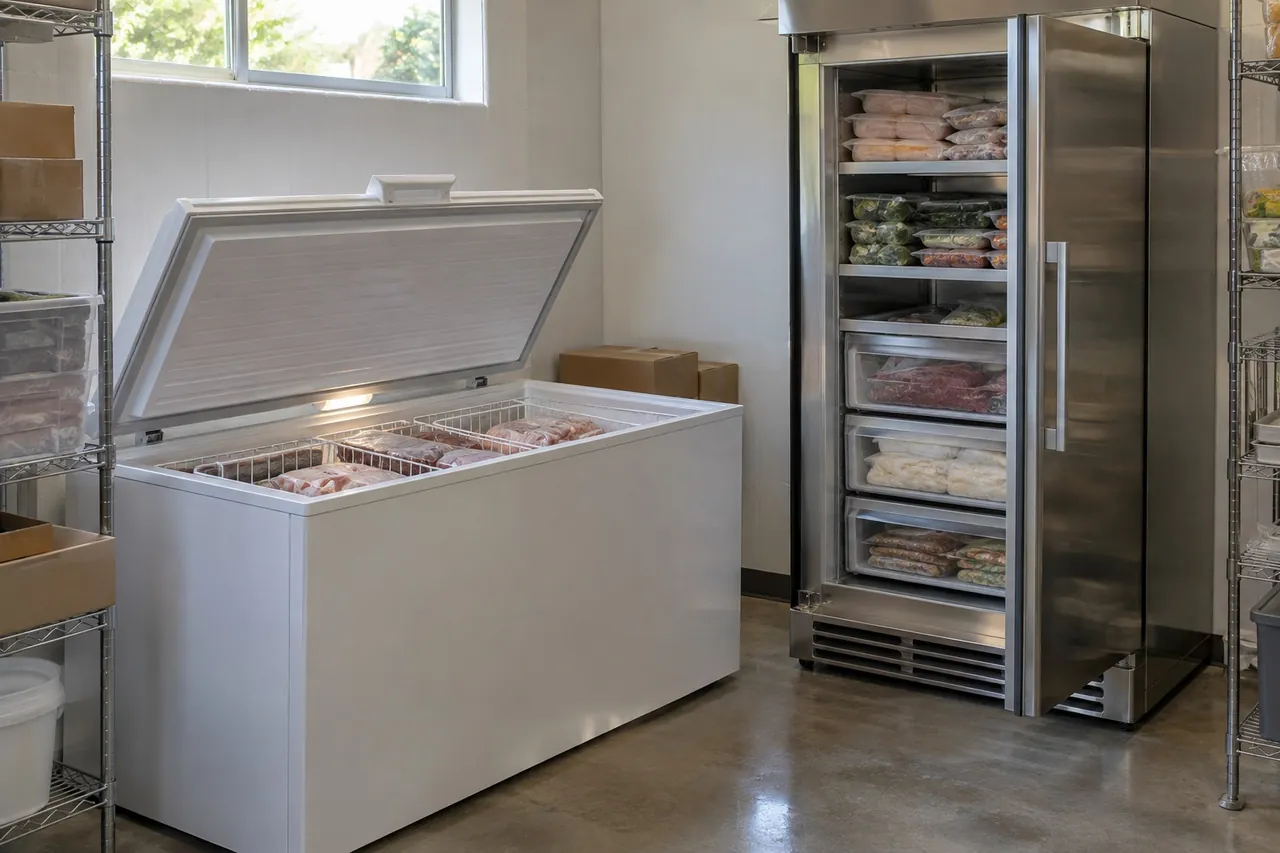
The largest chest freezers sold for home use are about 25 cu ft. Be There glass-top commercial chest freezers run from about 300 to 700 L (10.6–24.7 cu ft) for ice cream and frozen food display.
Upright freezer dimensions by cubic feet
Upright (stand up) freezers grow in height first, then width. These upright freezer dimensions are typical outside sizes:
| Capacity | Width | Depth | Height |
|---|---|---|---|
| 3 cu ft (counter height) | 19–21 in (48–53 cm) | 20–23 in (51–58 cm) | 32–34 in (81–86 cm) |
| 5–6 cu ft upright freezer | 21–24 in (53–61 cm) | 22–25 in (56–64 cm) | 50–58 in (127–147 cm) |
| 7–8 cu ft | 21–24 in (53–61 cm) | 23–26 in (58–66 cm) | 56–62 in (142–157 cm) |
| 10–11 cu ft upright freezer | 24–28 in (61–71 cm) | 25–29 in (64–74 cm) | 60–65 in (152–165 cm) |
| 13–14 cu ft | 28 in (71 cm) | 27–29 in (69–74 cm) | 61–67 in (155–170 cm) |
| 16–17 cu ft | 28–30 in (71–76 cm) | 28–30 in (71–76 cm) | 65–69 in (165–175 cm) |
| 20–21 cu ft upright freezer | 30–33 in (76–84 cm) | 29–31 in (74–79 cm) | 70–73 in (178–185 cm) |
| Commercial 1-door reach-in, about 23 cu ft | 27–29 in (69–74 cm) | 30–33 in (76–84 cm) | 78–84 in (198–213 cm) |
Remember the door swing: a 28 in (71 cm) door needs about the same distance of clear space in front to open past 90°, and a little more to pull out drawers or baskets.
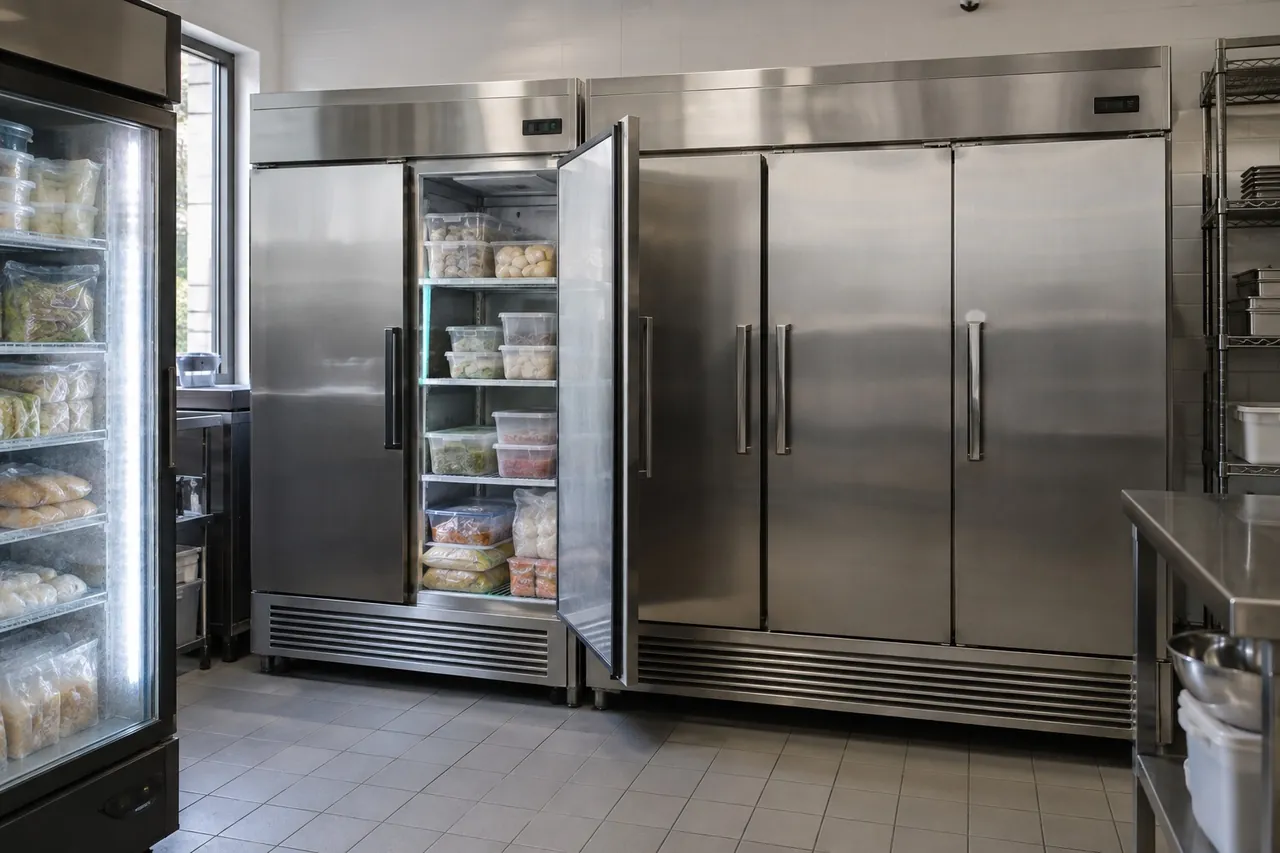
Commercial uprights are taller and deeper than home models because they sit on legs or castors and have bigger refrigeration systems. Be There upright glass-door display freezers run from about 400 L (14 cu ft) with one door to about 1600 L (56.5 cu ft) with four doors. For fridge and reach-in widths, see our commercial refrigerator sizes guide.
What size freezer do you need?
For a household, a common rule of thumb is about 1.5–2 cu ft (40–55 L) of freezer space per person, more if you buy in bulk or store game or harvests. A family of four is usually well served by 7–10 cu ft.
For a business, size from your stock, not from habit:
- Daily use – how many kilograms or pounds of frozen product you use or sell per day.
- Days of cover – days between deliveries, plus a safety day.
- Convert to volume – divide pounds by 35 (or kilograms by 16) to get net cu ft.
- Allow for access – divide by 0.75 for baskets, shelves and airflow.
- Add headroom – 10–20% for promotions, seasonal peaks or menu changes.
Example: A restaurant uses 40 kg (88 lb) of frozen product a day with deliveries every 3 days. 4 days × 88 lb = 352 lb. 352 ÷ 35 = 10 cu ft net. 10 ÷ 0.75 ≈ 13.4 cu ft, plus 15% = about 15.5 cu ft (440 L). A 14–17 cu ft upright or a 450–500 L chest fits.
If the result is above about 60 cu ft (1,700 L), price a small walk-in freezer as well; our cold room calculator estimates its refrigeration load.
Mini freezers and small freezers: when are they enough?
A mini freezer of 1–3 cu ft or a small upright freezer of 3–7 cu ft makes sense where space is tight and stock is small: offices, staff rooms, hotel rooms, back bars, small cafés and food trucks. A chest compact freezer of 3–5 cu ft gives the most food per euro or dollar at this size, while a mini freezer with a front door is easier to pick from.
Points to check before using small household freezers in a business:
- Climate class – household freezers are rated SN, N, ST or T. Class T is designed for rooms up to 43 °C (109 °F); SN and N units may not hold −18 °C (0 °F) in a hot kitchen.
- Commercial approval – many health inspectors expect NSF or equivalent equipment in food businesses; most household units are not certified.
- Warranty – some household warranties exclude commercial use.
- Recovery – small domestic compressors recover slowly when the door is opened often.
Searches for a refrigerator with large freezer or a mini freezer and refrigerator combo are common too. A combined unit works for staff areas, but for food service a dedicated fridge and a separate freezer give better control; see the chest vs upright freezer guide for which format to pair.
Be There does not supply domestic mini freezers. Our smallest standard commercial freezers start at about 300 L (10.6 cu ft).
Large freezers: 20 to 30 cu ft and beyond
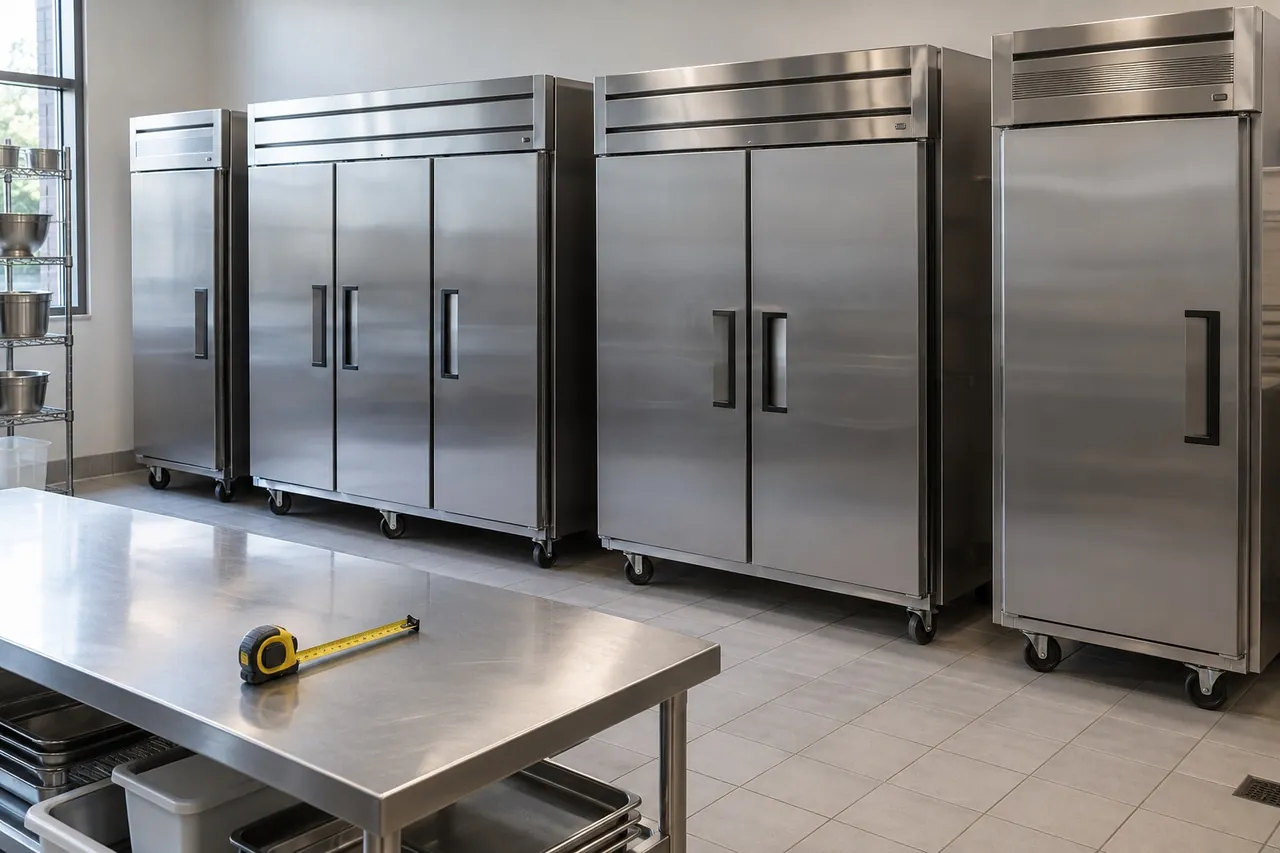
Large freezers of 20–30 cu ft (566–850 L) suit restaurants, butchers, caterers and shops. A 20 cu ft upright freezer is about 32 in wide and 71 in high (81 × 180 cm), so it fits a typical back-of-house wall. A 20 cu ft chest freezer holds the same but needs about 65 × 30 in (165 × 76 cm) of floor.
Beyond that, the options change:
| Need | Best format | Typical volume |
|---|---|---|
| Biggest freezer that fits a kitchen wall | Commercial 2-door reach-in | About 45–50 cu ft (1275–1415 L) |
| Retail frozen display | 2–4 door glass display freezer | About 800–1600 L (28–56.5 cu ft) |
| Bulk storage, more than about 60 cu ft | Walk-in freezer | A 2.4 × 2.4 × 2.2 m (8 × 8 × 7.2 ft) room is about 12.7 m³ (450 cu ft) |
Common walk in freezer dimensions are 6 × 8 ft, 8 × 8 ft, 8 × 10 ft and 10 × 12 ft, about 7–8 ft (2.1–2.4 m) high. Because walk-ins are built from modular panels, the size can be set to the room. Be There supplies complete walk-in freezer kits holding −18 °C to −25 °C (0 °F to −13 °F), with 120–150 mm panels, door, refrigeration and controller.
A walk-in also lets you stack cases on shelving to 2 m (6.5 ft) or more, which uses volume more efficiently than reaching into deep chests.
How to choose the right freezer size: checklist
- Work out net cu ft from daily use × days of cover ÷ 35 lb (or ÷ 16 kg).
- Allow for access: divide by 0.75 and add 10–20% headroom.
- Pick the format: chest for bulk storage and lowest energy, upright for daily picking and small floor space, glass door or glass top for selling.
- Measure the space: width, depth, height, door or lid swing and 50–100 mm (2–4 in) ventilation gaps. Check doorways and stairs for delivery.
- Check the room: hot or humid rooms need a higher climate class and a little more capacity.
- Choose defrost: see our frost-free vs manual defrost guide.
- Confirm power and certification: voltage, frequency, plug type and the mark your market requires.
Be There supplies commercial glass-top chest freezers of about 300–700 L (10.6–24.7 cu ft), upright glass-door display freezers of about 400–1600 L (14–56.5 cu ft) and walk-in freezers built to size. Send your required volume, temperature and site details through the inquiry form and we will recommend a size and quote FOB, CIF or DDP.