Short answer
Walk-in freezer repair starts with five checks: power and breakers, controller setpoint and alarms, door closing and gasket seal, ice on the evaporator coil, and condenser airflow. Most warm-box calls trace to a dirty condenser, failed defrost, air leaks at the door or low refrigerant. A freezer should hold −18 °C to −25 °C (0 °F to −13 °F).
Key takeaways
- Five first checks (power, controller, door, evaporator ice, condenser airflow) explain many walk-in breakdowns before a technician is needed.
- Walk-in freezers should hold −18 °C to −25 °C (0 °F to −13 °F); coolers 0 °C to +5 °C (32–41 °F).
- Freezer defrost typically runs 3–4 times a day for 20–40 minutes, ending at a coil temperature of about +10 °C to +15 °C.
- Ice on walls, ceiling or door means warm air is getting in: gasket, door closer, strip curtain, frame heater or relief port.
- Under the FDA Food Code, chilled TCS food held above 5 °C (41 °F) for more than 4 hours should be discarded.
- Have condensers cleaned monthly and a certified technician service the system every 6–12 months.
What should you check first when a walk-in freezer stops working?
Most walk-in freezer repair calls start with five checks anyone on site can make in 10 minutes: power and breakers, controller setpoint and display, the door and its gasket, ice on the evaporator coil, and airflow at the condensing unit. Those five explain a large share of "not cold" calls before a technician ever opens the refrigeration circuit.
- Power: Is the controller display lit? Are the breakers for both the condensing unit and the evaporator (fans and defrost heaters) on? Is any isolator switch off?
- Controller: Read the box temperature and setpoint. Check for alarm or error codes, and whether the unit is in defrost (many controllers show a "dEF" or snowflake symbol).
- Door: Does it close and latch by itself? Is the gasket torn, flattened or iced? Is the strip curtain in place?
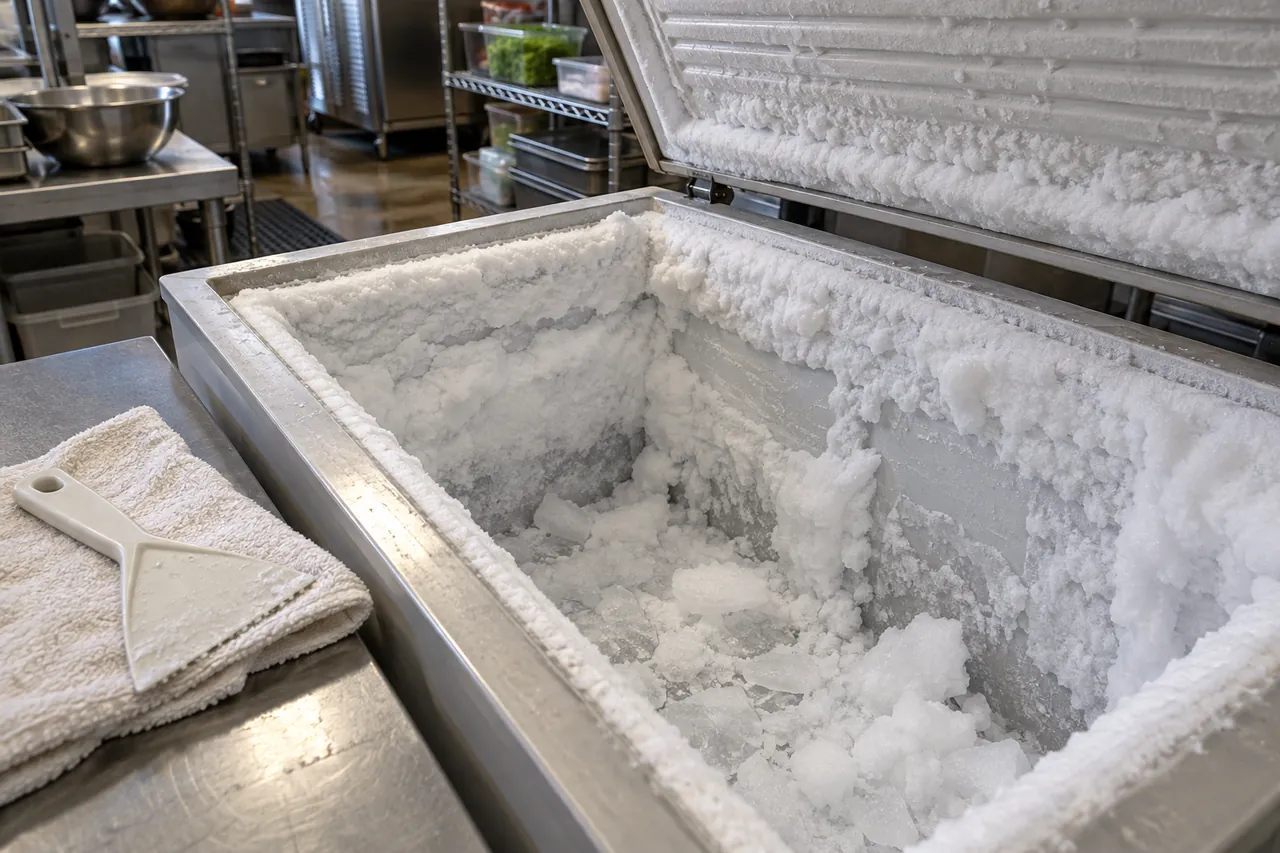
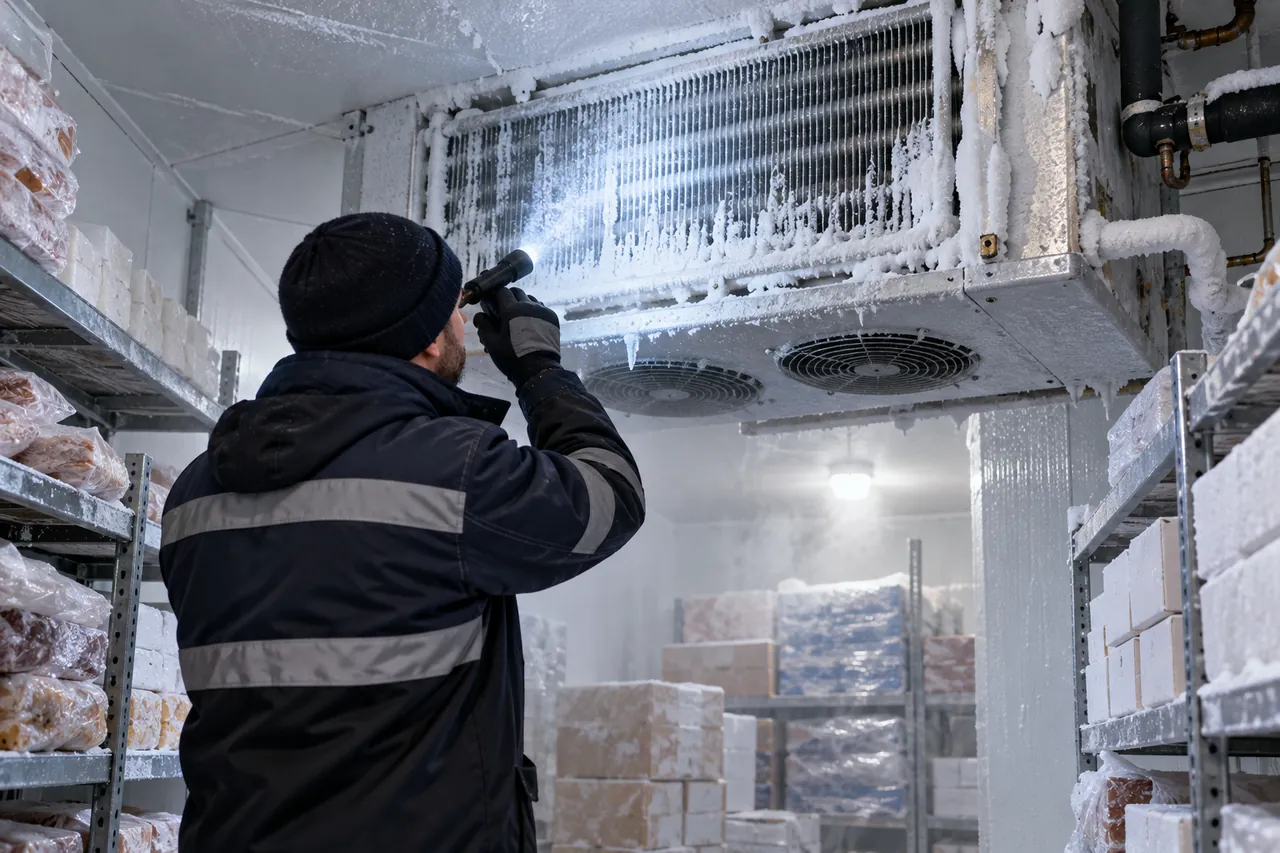
- Evaporator: Look at the coil behind the fan guard. Thin frost is normal; a solid block of ice is not.
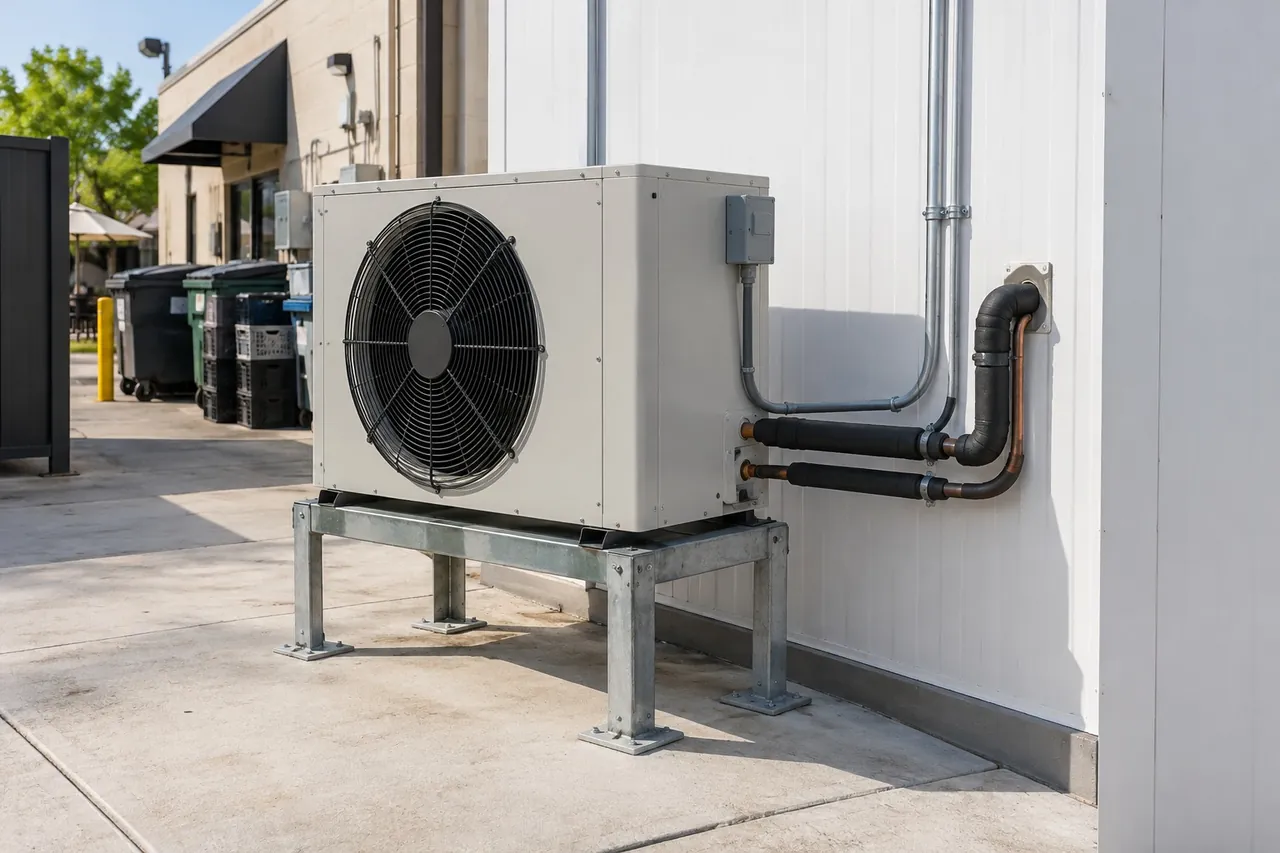
- Condensing unit: Is the fan turning? Is the condenser coil blocked by dust, grease, leaves or boxes? Is hot air recirculating in an enclosed space?
Write down what you find. A technician who is told "box at −8 °C, evaporator fans running, coil iced solid, last defrost unknown" can diagnose faster and bring the right parts.
Normal operating values for walk-in coolers and freezers
| Parameter | Walk-in cooler | Walk-in freezer |
|---|---|---|
| Box temperature | 0 °C to +5 °C (32–41 °F), typically +2 °C to +3 °C | −18 °C to −25 °C (0 °F to −13 °F) |
| Evaporator temperature difference (box minus coil) | About 5–8 K (9–14 °F) | About 5–7 K (9–13 °F) |
| Defrost | Off-cycle (air) defrost, often 2–4 per day | Electric or hot-gas, typically 3–4 per day, 20–40 minutes, ending at a coil temperature of about +10 °C to +15 °C |
| Fan delay after defrost | Usually none | Evaporator fans stay off for 2–5 minutes after defrost until the coil is cold |
| Door frame heater | Not usually fitted | On continuously or controlled; frame warm to the touch |
| Temperature rise during defrost | 1–3 K | Air may rise 3–6 K briefly; product barely changes |
If what you see matches the table, the system may be fine and the problem may be loading, door discipline or a sensor in the wrong place.
What are the most common walk-in freezer and cooler problems?
The 15 problems below cover the faults that most often lead to a walk in fridge repair or freezer repair call. Each lists the likely causes in order of probability, what site staff can safely check and what needs a qualified refrigeration technician.
| # | Symptom | Most likely causes | Staff can check | Technician fix |
|---|---|---|---|---|
| 1 | Unit completely off, box warming | Tripped breaker, isolator off, controller fault, high-pressure or thermal lockout | Breakers, isolators, display | Find why it tripped; test compressor, contactor, capacitor, controls |
| 2 | Runs all the time but box too warm | Dirty condenser, door left open or bad gasket, overload of warm product, low refrigerant charge | Condenser coil, door, recent deliveries | Clean coil, check pressures, superheat and subcooling, leak test |
| 3 | Evaporator coil iced solid | Defrost heater failed, defrost termination sensor or timer fault, fans not running, door air leaks | Ice pattern, whether defrost happens | Test heaters, sensor and controller; manual defrost; repair |
| 4 | Ice on ceiling, walls or floor near the door | Warm humid air entering: worn gasket, door not self-closing, missing strip curtain, failed pressure relief port | Gasket, closer, curtain | Replace gasket, adjust closer, fix heated port |
| 5 | Freezer door frozen shut or hard to open | Door frame heater failed; vacuum after door closes; blocked pressure relief port | Frame warm or cold? wait 1–2 minutes after closing | Replace heater wire or port heater |
| 6 | Water or ice on the floor under the evaporator | Blocked or frozen drain line, failed drain line heater, cracked drain pan | Drain pan, outlet outside box | Clear drain, replace heat tape, re-pitch drain |
| 7 | Evaporator fans not running | Normal fan delay after defrost; failed fan motor; ice jamming blades; fan thermostat fault | Time since defrost, ice on blades | Replace motor or fan control |
| 8 | Compressor short-cycling (on and off every few minutes) | Low charge tripping low-pressure switch, dirty condenser tripping high-pressure switch, controller differential set too small | Condenser coil, setpoint and differential | Gauges, leak search, adjust controls |
| 9 | Loud noise, rattling or scraping | Fan blade striking ice or guard, loose fan, compressor liquid floodback, loose panel or pipework | Where the noise comes from | Remove ice, re-fix fan, check superheat |
| 10 | Breaker trips when compressor starts | Failed start or run capacitor, shorted compressor winding, worn contactor, undersized supply | Do not keep resetting | Electrical tests; replace capacitor, contactor or compressor |
| 11 | Uneven temperatures, warm corners | Product stacked against evaporator or blocking airflow, stock on the floor, sensor near the door | Clearance around coil, stacking | Relocate sensor, add air throw or second coil |
| 12 | Freezer colder than setpoint | Wrong setpoint, failed sensor, stuck contactor keeping compressor on | Setpoint, compare with a probe thermometer | Replace sensor or contactor |
| 13 | Floor cracking, heaving or door binding on a freezer | Ground frozen under an uninsulated or unheated floor (frost heave) | Cracks, high spots, door alignment | Repair floor heating or ventilation; may need floor rebuild |
| 14 | Outside panels sweating, ice at panel joints | Failed joint sealant, damaged or wet panel core, gap at ceiling-to-wall joints | Where moisture appears | Reseal joints, replace damaged panels |
| 15 | Alarm or error code on the controller | Sensor open or short circuit, high-temperature alarm, door-open alarm, defrost timeout | Note code and look it up in the manual | Replace sensor, fix underlying fault |
Why is my walk-in freezer running but not cold enough?
A walk-in freezer that runs but cannot hold temperature usually has one of four problems: a dirty condenser that cannot reject heat, an iced evaporator that cannot absorb it, too much heat coming in through the door or new product, or a refrigerant leak. Work through them in that order, because the first three are cheap to fix.
Condenser
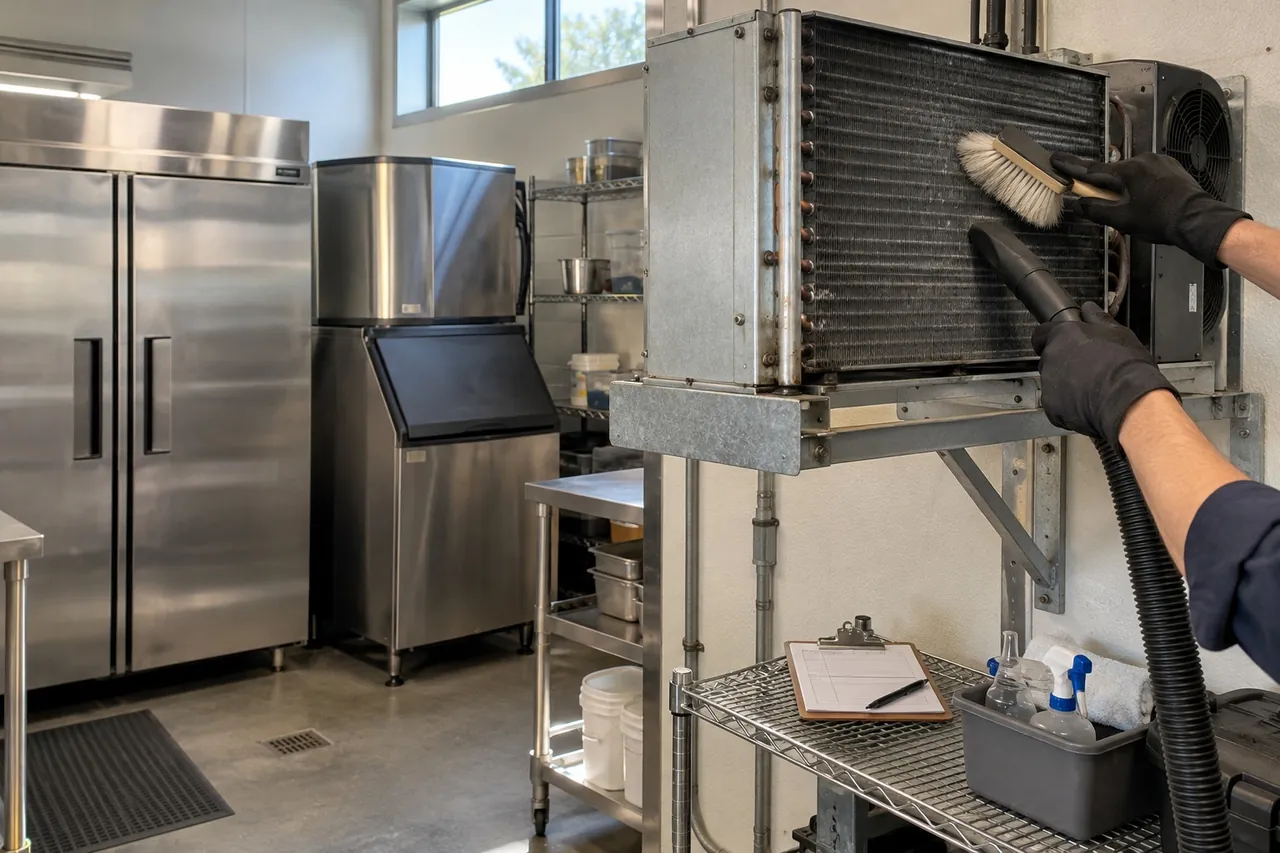
Dust and grease on the condenser raise condensing pressure, cut capacity and can trip the high-pressure switch. Turn off power, brush or vacuum the fins from the air-inlet side, and on outdoor units rinse gently with low-pressure water. Keep at least the clearance stated by the maker around the unit, typically 300–600 mm (1–2 ft), and do not let hot discharge air recirculate.
Evaporator and defrost
If the coil is a block of ice, air cannot pass and the box warms even though the compressor runs. Patchy ice on one side often points to low refrigerant charge; ice that builds evenly over a few days points to a defrost fault. For how frost builds and how defrost is controlled, see why freezers ice up. Never chip ice off a coil with a tool; fins and tubes puncture easily, turning a defrost fault into a refrigerant leak.
Heat load
Loading several hundred kilograms of warm product into a storage freezer can exceed the refrigeration system's capacity for hours. Walk-in freezers are sized for holding frozen stock, not freezing warm food; that is a blast freezer's job. A long door-open period during a delivery has a similar effect. Check the cold room refrigeration load calculator if your use has changed since the room was installed.
Refrigerant
Low charge shows up as long run times, short cycling on low pressure, bubbles in the sight glass on systems that have one, and partial icing of the coil. Topping up without finding the leak only delays the next failure. See our refrigerant leak guide for signs and detection methods.
Why is ice building up on the walls, ceiling or door?
Ice inside the box away from the evaporator is almost always caused by warm, humid outside air getting in and freezing on the coldest surface it meets. The usual entry points are the door gasket, a door that does not close fully, a missing or damaged strip curtain, a failed pressure relief port, and unsealed panel joints or penetrations.
- Run a sheet of paper around the closed door: if it slides out easily anywhere, the gasket is not sealing.
- Open the door 30–45° and let go: it should swing closed and latch without help. Adjust or replace the closer if not.
- Check the door frame heater on freezers: the frame should feel slightly warm. A cold frame lets the gasket freeze to it.
- Check the heated pressure relief port, usually on a wall near the ceiling; if it is iced over, the door will be hard to open and air will leak elsewhere.
- Look for ice lines along panel joints and around pipe and cable entries; these need resealing with suitable low-temperature sealant.
For door types, gaskets, heaters and strip curtains, see the walk-in cooler door guide. Frost heave and floor ice on freezers built on grade point to a failed underfloor heating or ventilation system and need a specialist.
What should you do in a walk-in cooler or freezer emergency?
In an emergency, protect the stock first: keep the door shut, record temperatures, call for repair, and move high-value or high-risk product to working cold storage if the box cannot be restored within a few hours. A full, closed walk-in loses temperature far more slowly than an empty one, so avoid opening it to "check".
- Note the time and the box and product temperatures, using a calibrated probe thermometer in the product, not just the air display.
- Keep the door closed. Put a sign on it.
- Do the five first checks above, then call an emergency walk in cooler repair or same-day service with your notes.
- If the controller shows a lockout, do not reset repeatedly; repeated restarts on a fault can destroy the compressor.
- Line up backup: another cold room, reach-in freezers, a reefer trailer or a rental container. See emergency cold storage options.
- Follow food safety limits. Under the FDA Food Code, chilled TCS food must be held at 5 °C (41 °F) or below; food that has been above that for more than 4 hours should be discarded. USDA guidance says frozen food that still contains ice crystals or is at 4 °C (40 °F) or below can be refrozen, though quality may suffer.
A remote temperature monitoring system with SMS or app alarms turns a lost night of stock into a morning service call.
How do you choose a commercial refrigeration repair service?
Choose a commercial refrigeration repair service that is certified to handle refrigerants in your country, has experience with walk-in systems and your refrigerant type, carries common parts, and offers a guaranteed response time. Price per visit matters less than first-time fix rate and how quickly they arrive at 2 a.m.
- Certification: in the US, technicians handling refrigerants need EPA Section 608 certification; in the EU and UK, F-gas certification is required.
- Response time: ask for written emergency and same-day response commitments, and whether nights and weekends cost extra.
- Parts: fan motors, defrost heaters, sensors, contactors, capacitors and gaskets should be on the van; compressors and coils may take days.
- Records: a good company logs pressures, temperatures, refrigerant added and parts replaced, which is essential for leak-check rules and for warranty.
- Service agreement: a planned maintenance contract usually costs less than two emergency call-outs a year.
Repair or replace?
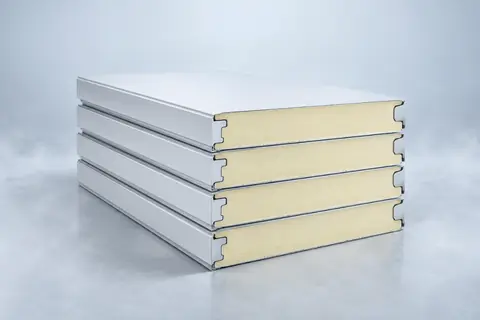
If the condensing unit is over about 10–15 years old, uses a phased-out or expensive refrigerant, or needs a compressor plus other major parts, replacing the refrigeration system can cost little more than the repair and use noticeably less energy. Panels themselves often last 20–30 years; a tired walk-in may only need a new refrigeration system, door gaskets and resealed joints. For component choices, see the walk-in cooler condensing unit and evaporator guide.
What walk-in cooler maintenance prevents breakdowns?
Regular walk in cooler maintenance prevents most of the failures in the table: daily temperature logging, weekly door and gasket checks, monthly condenser cleaning and drain checks, and a technician service every 6–12 months.
| Frequency | Task | Who |
|---|---|---|
| Daily | Log box temperature twice; check door closes and latches; keep coil and door clear of stock | Site staff |
| Weekly | Clean and inspect gaskets; check strip curtain; look for ice on walls, ceiling and coil | Site staff |
| Monthly | Brush condenser coil; check evaporator drain flows; check frame heater on freezer doors | Site staff or contractor |
| Quarterly | Clean evaporator coil and drain pan; check defrost heaters and termination; tighten electrical connections | Technician |
| Every 6–12 months | Pressures, superheat, subcooling, leak check, controls calibration, compressor amps | Certified technician |
The full checklist across fridges, freezers and cold rooms is in our commercial refrigeration maintenance checklist.
Troubleshooting checklist and when to call a technician
- Check power, controller, door, evaporator ice and condenser airflow before calling.
- Record box and product temperatures, alarm codes and what you saw.
- Staff can clean condensers, clear the coil area, fix stacking, replace strip curtains and check gaskets.
- Call a certified technician for anything involving refrigerant, compressors, electrical components, defrost heaters or repeated breaker trips.
- Protect stock: keep the door shut, follow FDA or local food safety limits and arrange backup storage early.
- After the repair, find the root cause, so the same fault does not return next month.
Be There supplies complete walk-in coolers and freezers with PU or PIR panels of 75–200 mm, heated insulated doors, matched condensing units and evaporators and digital controllers, as well as replacement PU/PIR cold room panels for damaged or wet sections. If your walk-in needs a new refrigeration system or panels rather than another repair, send the room size, temperature and voltage through the inquiry form and we will quote FOB, CIF or DDP.