Short answer
Commercial refrigeration maintenance means logging temperatures daily (chillers ≤ +5 °C / 41 °F, freezers ≤ −18 °C / 0 °F), cleaning gaskets weekly, cleaning condenser coils and drains monthly, inspecting evaporators and defrost quarterly, and booking a certified technician every 6–12 months for refrigerant, electrical and control checks. Ice machines need descaling at least every 6 months.
Key takeaways
- Log temperatures daily: chillers at +5 °C (41 °F) or below, freezers at −18 °C (0 °F) or below.
- Clean condenser coils at least monthly in kitchens; dirty coils are a leading cause of breakdowns.
- Book a full professional refrigeration service every 6–12 months, including leak testing.
- Descale and sanitise ice machines at least every 6 months and replace water filters on the same cycle.
- EU F-gas rules require leak checks every 12 months for systems from 5 t CO2e, more often for larger charges.
What is commercial refrigeration maintenance?
Commercial refrigeration maintenance is the routine cleaning, inspection and servicing that keeps fridges, freezers, cold rooms, ice machines and transport units cold, efficient and food-safe. It is split into daily and weekly checks your staff do, monthly cleaning, and an annual or twice-yearly professional refrigeration service.
Preventive maintenance is cheaper than repair. Most breakdowns start as small, visible problems: a dusty condenser that makes the compressor run hot, a torn door gasket that lets in moist air and ices the evaporator, a blocked drain that floods the floor. Catching them early avoids the emergency commercial refrigeration repair call on a Saturday night – and the stock you lose while you wait.
Commercial refrigeration preventive maintenance also:
- Cuts energy use – clean coils and good seals mean shorter compressor running times.
- Extends equipment life – compressors fail sooner when head pressure stays high.
- Protects food safety records – temperature logs and service reports support your HACCP plan.
- Keeps warranties valid – most manufacturers require documented cleaning and servicing.
The checklists below work for reach-in fridges, display cases, walk-in coolers and freezers, ice and ice cream machines, and truck refrigeration units. Adjust frequencies to your environment: a bakery or fryer kitchen needs coil cleaning far more often than a clean supermarket back room.
Refrigerator maintenance checklist: daily, weekly and monthly
Use this fridge maintenance checklist as a starting point for every reach-in, display and walk-in unit:
| Frequency | Task | Who |
|---|---|---|
| Daily | Check and log temperatures (chillers ≤ +5 °C / 41 °F, freezers ≤ −18 °C / 0 °F) | Staff |
| Daily | Check doors close and seal; nothing blocks the evaporator or air vents | Staff |
| Daily | Look for ice on the evaporator, water on the floor, unusual noise | Staff |
| Weekly | Clean door gaskets with warm soapy water; wipe interior and shelves | Staff |
| Weekly | Check door heaters on freezers and glass doors (no frost or sweating) | Staff |
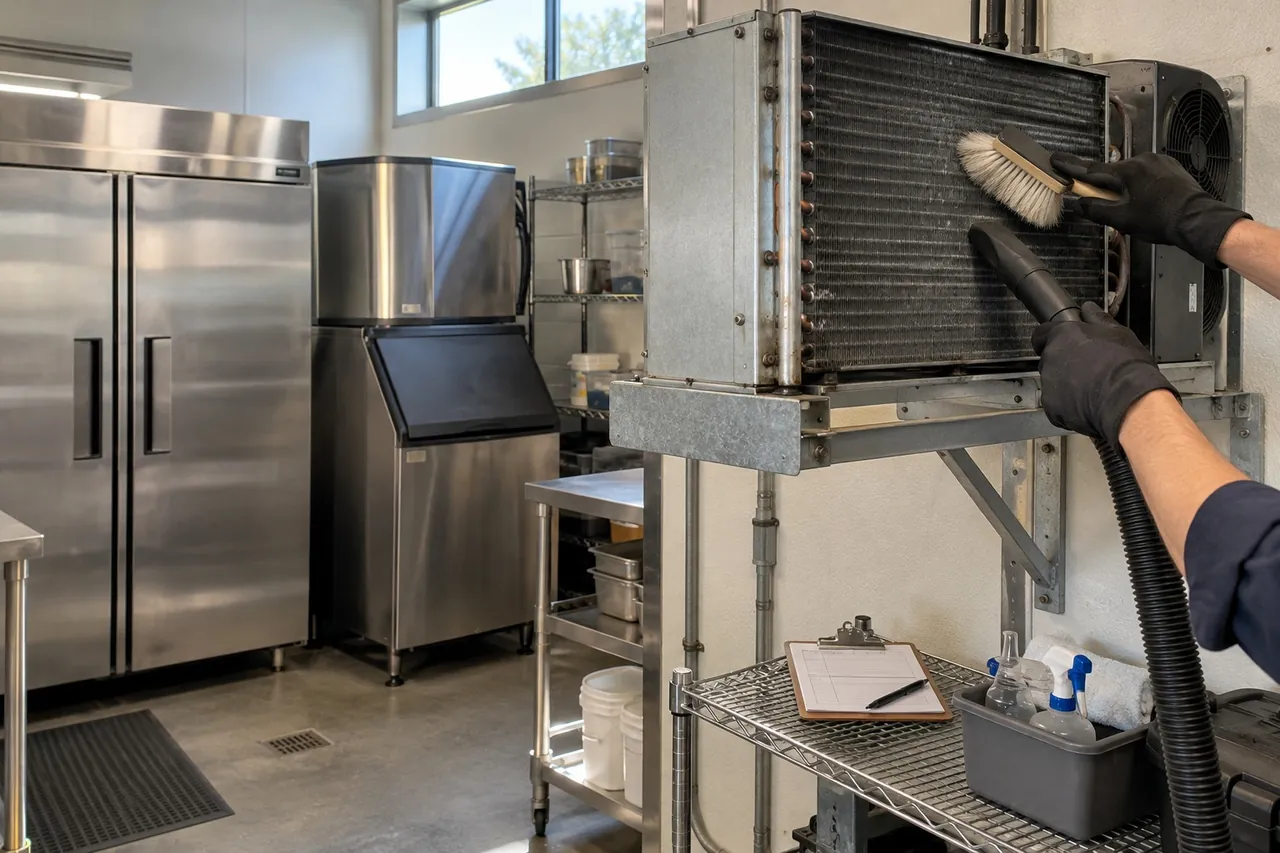
| Monthly | Clean condenser coils (more often in greasy or dusty areas) | Staff or technician |
| Monthly | Flush and check drain lines and drain pans | Staff or technician |
| Quarterly | Inspect evaporator coil, fans and defrost; check alarms | Technician |
| Every 6–12 months | Full refrigeration service: pressures, leaks, electrics, controls | Certified technician |
Keep the log next to the unit or in your temperature monitoring app. A record that shows a freezer creeping from −20 °C to −16 °C over two weeks gives a technician far more to work with than ‘it stopped working today’.
For continuous logs and phone alerts, see our cold room temperature monitoring guide.
Walk-in cooler maintenance: a monthly step-by-step check
Walk-in cooler maintenance follows the same pattern as a reach-in but with more to inspect: panels, door, floor, condensing unit and evaporator. This monthly check takes about an hour for one room:
- Check and log temperatures. Compare the controller display with a calibrated reference thermometer at product height and note any difference above 1 °C (2 °F).
- Switch off and isolate power. Turn off the condensing unit and evaporator at the isolator before touching coils or fans, and lock or tag the switch.
- Clean the condenser coil. Brush or vacuum dust from the fins on the air-inlet side and straighten bent fins; use a coil cleaner for greasy kitchen air.
- Inspect the evaporator. Look for uneven frost, ice on the fan blades or blocked fins, and check that the drain pan is clean and empty.
- Flush the drain line. Pour warm water into the drain pan and confirm it flows freely outside; check the drain line heater on freezers.
- Test door gaskets and heaters. Close the door on a sheet of paper at several points – it should resist being pulled out – and check that freezer frame heaters are warm.
- Check fans, lights and alarms. Restore power, confirm every fan runs, the door switch works and the high-temperature alarm sounds when tested.
- Record the check. Write the date, findings and actions in the maintenance log so trends and repeat faults are easy to spot.
Also check the room itself every few months. Look for frost or damp on panel joints (a sign of a failed seal), a door that drops or no longer closes by itself, and, on freezers, that the pressure relief valve is free of ice. Floor cracks or a rising floor in an older freezer can mean frost heave – call a specialist early.
What does a professional refrigeration service include?
Once or twice a year, a certified technician should carry out a full refrigeration service. A good commercial refrigeration service visit typically includes:
- Refrigerant checks – suction and discharge pressures, superheat and subcooling, and a leak test with an electronic detector.
- Compressor and electrics – running current against the nameplate, contactors, capacitors, terminals and overloads.
- Coils and fans – deep cleaning of condenser and evaporator, fan motor bearings and blades.
- Defrost – heaters, timers, termination sensors and drain heaters.
- Controls and safety – controller settings, sensor calibration, high- and low-pressure switches, alarms.
- A written report with readings and recommended repairs.
Refrigerant rules
Regulations govern who may handle refrigerant and how often leaks must be checked. In the EU, the F-gas Regulation sets leak-check frequencies by the system’s CO2-equivalent charge – for example every 12 months from 5 t CO2e, every 6 months from 50 t and every 3 months from 500 t. In the US, EPA Section 608 requires certified technicians, and leak-repair requirements apply to larger systems. Ask your service company to keep the records your market requires.
Systems on natural refrigerants such as R290 or CO2 need technicians trained for flammable or high-pressure work.
Ice machine and ice cream machine maintenance
Food-contact machines need cleaning as well as refrigeration servicing.
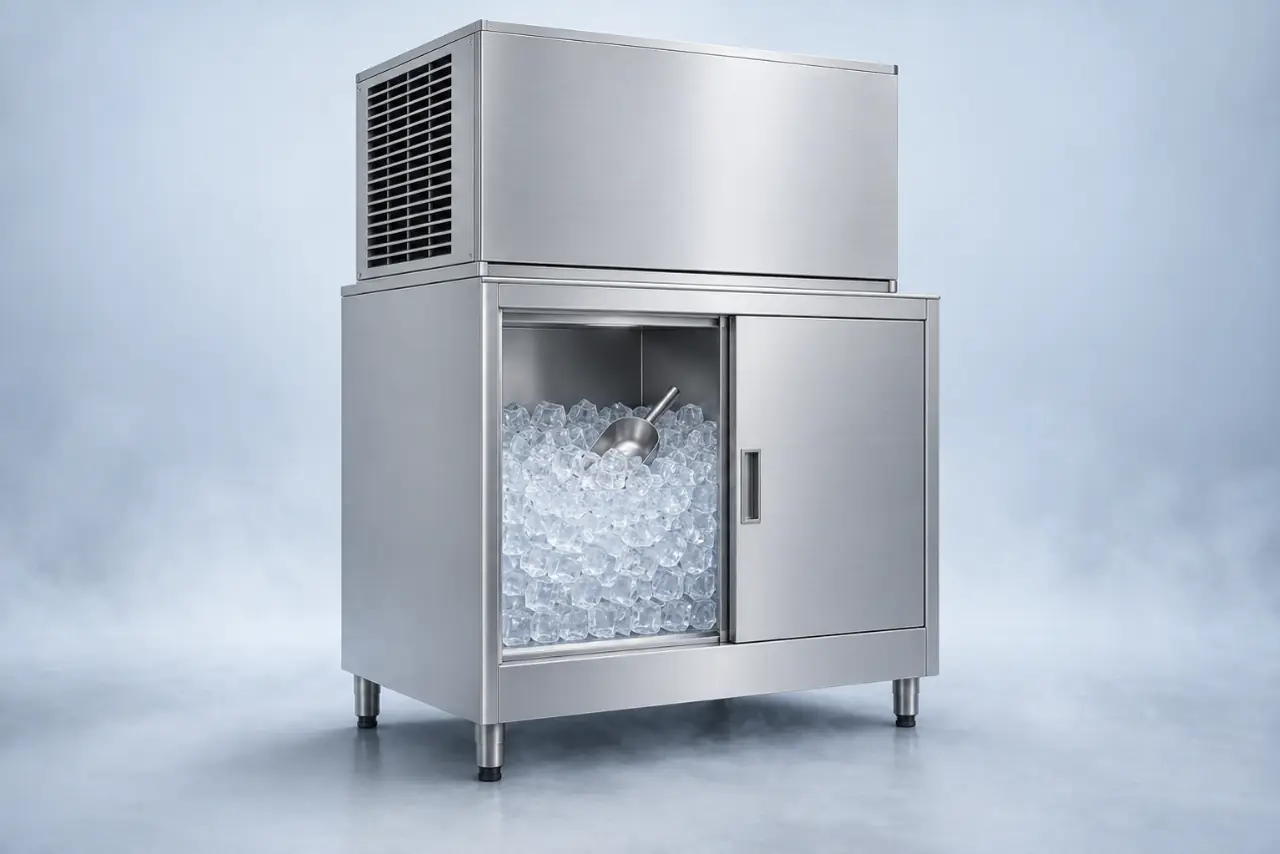
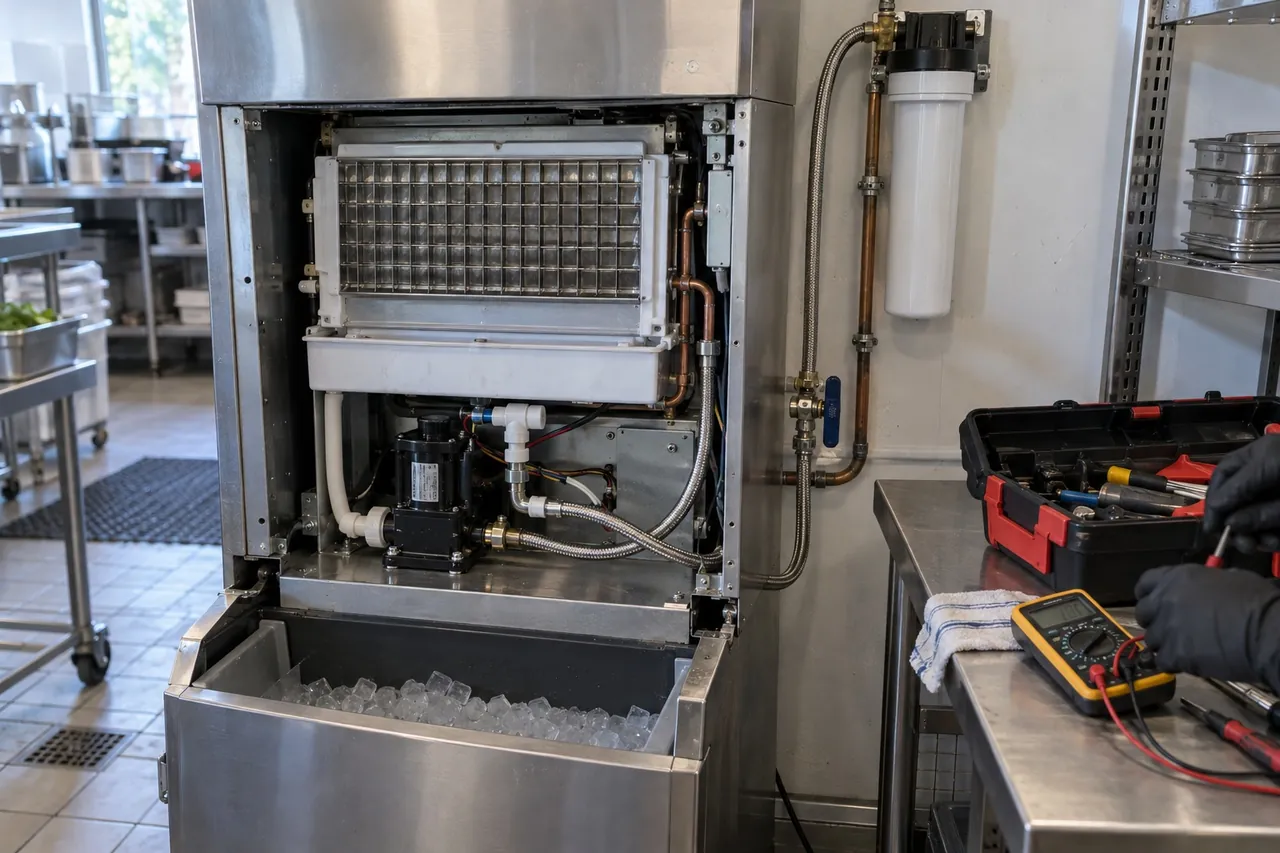
Ice machine maintenance
- Descale and sanitise at least every 6 months – every 3 months with hard water or in dusty kitchens.
- Replace the water filter every 6 months or at its rated gallons.
- Clean air-cooled condensers monthly; check water-cooled condensers for scale.
- Empty and sanitise the storage bin and scoop holder.
Our ice machine cleaning guide gives the full procedure and a log. Most ice machine service calls for low output or slow harvest come from scale and dirty condensers, which this routine prevents.
Soft serve and ice cream machines
- Disassemble, clean and sanitise all mix-contact parts as often as the manufacturer and your local health rules require – daily for standard machines; heat-treatment models allow longer intervals where permitted.
- Lubricate O-rings and seals with food-grade lubricant at every reassembly.
- Replace O-rings, seals and scraper blades every 3–6 months; worn blades reduce freezing and overload the motor.
- Keep hopper mix below +5 °C (41 °F) and check its temperature daily.
The same rules apply to batch freezers, slush and margarita machines. Many soft serve machine repair and ice cream machine repair calls are caused by worn seals or missed lubrication.
Truck refrigeration service and reefer repair
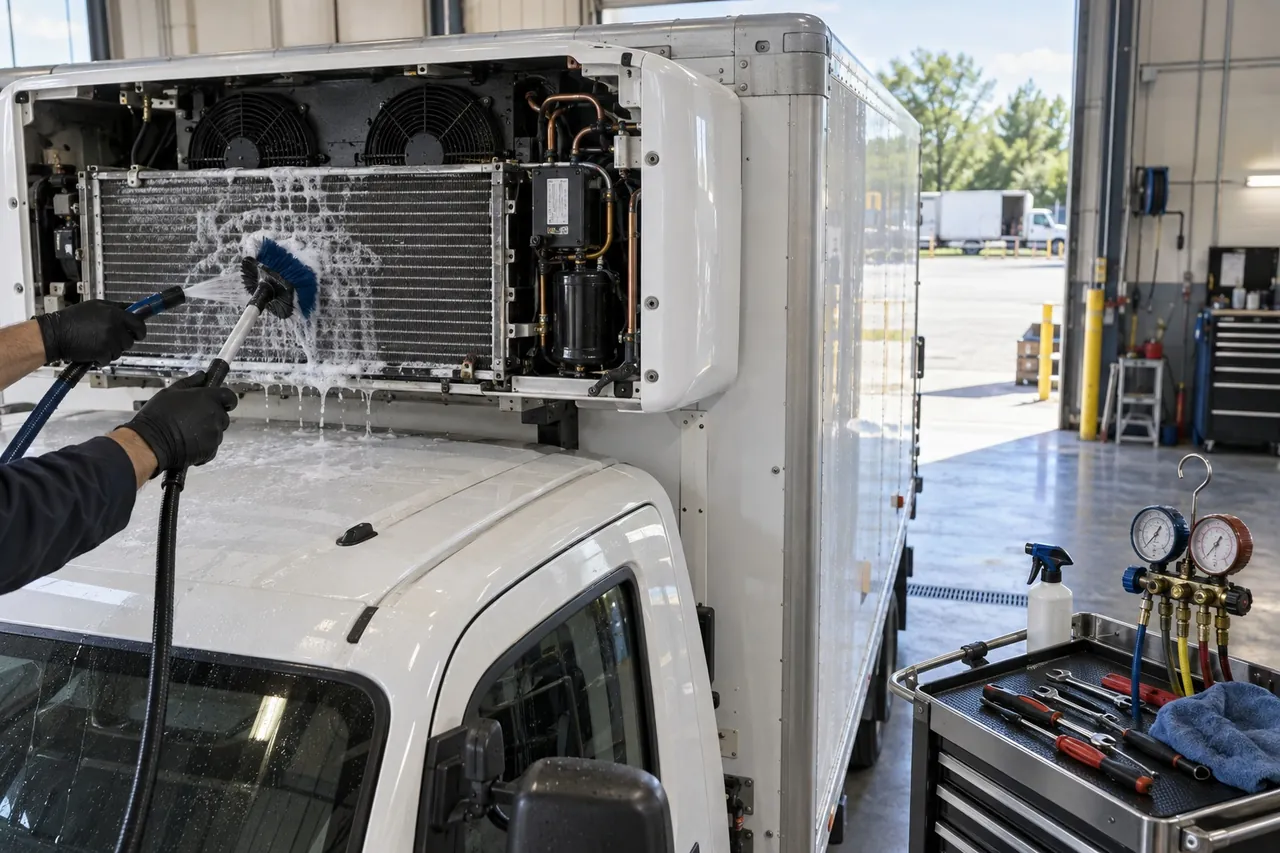
Transport units work harder than stationary equipment: vibration, road dirt, door openings every few minutes and outside temperatures from winter frost to summer heat. Plan truck refrigeration service around three levels:
- Daily pre-trip check by the driver: pre-cool the box, check the set point, look for damage, ice on the evaporator, loose belts and, on diesel units, fuel, oil and coolant.
- Scheduled service by engine or running hours: oil and filters on diesel units, belts, condenser and evaporator cleaning, defrost and door switch checks, at the interval in the unit manual.
- Annual inspection: refrigerant pressures and leaks, electrics, box insulation and door seals; in ATP countries, keep the certificate valid.
Most reefer repair jobs – units that will not hold temperature, alarms, iced evaporators – trace back to dirty coils, damaged door seals or skipped servicing. Mobile reefer repair services can visit depots or roadside; for reefer trailer repair on long routes, carry the service network’s number in the cab. Our truck refrigeration maintenance guide covers common faults in detail.
Looking at food service trucks for sale or a used food service trailer? Ask for the refrigeration service history, run every fridge and freezer down to temperature during the inspection and check gaskets and coils. Our food truck refrigeration guide explains what to look for.
Refrigeration troubleshooting chart: common problems and fixes
Use this refrigeration troubleshooting chart for first-line maintenance troubleshooting before you call for repair:
| Symptom | Likely causes | First action |
|---|---|---|
| Running but not cold enough | Dirty condenser, iced evaporator, failed fan, low refrigerant | Clean condenser, check fans, manual defrost; call a technician if no change |
| Compressor short-cycles | Dirty condenser, faulty pressure switch, low charge, bad sensor | Clean condenser; technician to check pressures and controls |
| Heavy ice on evaporator | Defrost heater or sensor fault, door left open, worn gasket | Check door and gasket; run manual defrost; check defrost settings |
| Water on the floor | Blocked or frozen drain, cracked drain pan | Flush drain; check drain line heater on freezers |
| Frost around door or panels | Worn gasket, failed frame heater, leaking panel joint | Replace gasket, check heater, reseal joint |
| Product freezing in chiller | Set point too low, sensor fault, stuck contactor | Check controller and sensor; technician for electrics |
| Glass doors sweating | High room humidity, failed door heater | Check heater; reduce room humidity |
| Ice machine low output | Scale, dirty condenser, hot room, clogged filter | Descale, clean condenser, replace filter |
See our ice machine troubleshooting guide for ice-specific faults. If the unit is still warm after these checks, protect the stock and call for troubleshooting and repair.
Emergency refrigeration repair: what to do and who to call
When a cooler or freezer fails, act in this order:
- Keep doors closed and note the time and temperature. A full, closed walk-in freezer warms slowly; a chiller does not.
- Check the simple things: power, breaker, controller display, door closed, condenser not blocked.
- Move high-risk stock – meat, dairy, cooked food – to another unit if temperature is rising.
- Call an emergency refrigeration service with the model, refrigerant, symptoms and photos of the data plate and controller.
- Follow your HACCP plan on what to discard. Many plans discard TCS food held above 5 °C (41 °F) for more than 4 hours in total.
Choosing a refrigeration repair company
Before you need emergency commercial refrigeration repair, agree a service contract with a company that offers 24 hour refrigeration service or same-day response, holds the refrigerant certifications your market requires, has experience with your equipment type – restaurant refrigeration repair, commercial walk-in cooler repair or coldroom repair – and keeps common parts in its van. Ask for written response times and an hourly or call-out rate.
A spare controller, evaporator fan motor and door gasket on site can turn a lost night into a 20-minute fix.
Best practices for commercial refrigeration maintenance: next steps
- Write a schedule for every unit: daily, weekly, monthly, quarterly and annual tasks, with names.
- Log temperatures automatically and review trends weekly.
- Keep the condenser clean – the single most effective task.
- Replace gaskets as soon as they tear or harden.
- Hold a small stock of spares for critical units.
- Use certified technicians for refrigerant and electrical work.
Safety first: staff should never work on electrics or refrigerant pipework unless qualified, and the inside door release must be tested before anyone works inside a freezer.
When equipment is beyond economical repair, replace it with a unit sized for today’s load. Be There supplies walk-in cold room kits, display fridges and freezers, ice machines, ice cream machines and truck refrigeration units, with spare parts lists on each quotation. Request a quotation or spare parts list – we reply within one working day.