

Short answer
A refrigerant leak is an escape of refrigerant gas from a sealed refrigeration or AC circuit, usually at joints, valves or corroded coils. Signs include long run times, rising cabinet temperature, partial frost on the evaporator and oily stains. Leaks are found with soap solution, electronic detectors sensitive to about 5 g (0.2 oz) a year or UV dye, and must be repaired by a certified technician.
Key takeaways
- Refrigerant does not get 'used up': if a system needs topping up, it has a leak that should be found and repaired, not just recharged.
- Oily residue at a joint is the most common visible sign, because escaping refrigerant carries compressor oil with it; the gas itself is colourless.
- Most HFC refrigerants are low-toxicity but heavier than air, so a large leak in a walk-in, basement or plant room can displace oxygen.
- Under the EU F-gas Regulation, systems holding 5 t CO2-equivalent or more need periodic leak checks; that is only about 1.3 kg (2.8 lb) of R404A.
- After repair, a technician should pressure-test with dry nitrogen, evacuate to below about 500 microns (67 Pa) and recharge by weight.
- In the US, only EPA Section 608 certified technicians may open systems and buy most refrigerants, and venting is prohibited.
What is a refrigerant leak?
A refrigerant leak is any escape of refrigerant from the sealed circuit of a fridge, freezer, cold room, ice machine or air conditioner. Because the circuit is closed, refrigerant is never consumed; a system that is low on charge has, by definition, leaked.
Many people call any refrigerant "freon". That is a trade name for a family of fluorocarbon refrigerants that became a generic word, so a freon leak and a refrigerant leak mean the same thing. Today's commercial systems mostly run on HFCs such as R404A, R134a and R448A/R449A, on lower-GWP blends, or on natural refrigerants: R290 (propane), R600a (isobutane), R744 (CO2) and R717 (ammonia).
Leaks matter for three reasons. An undercharged system cools less and uses more energy per kilogram of product. Lost refrigerant has to be bought and replaced. And most fluorinated refrigerants are powerful greenhouse gases, which is why leak checking and repair are regulated in the US, the EU, the UK and many other markets.
What are the signs of a refrigerant leak?
The main signs of a refrigerant leak are a system that runs longer but cools less, an evaporator that frosts only partly, oily marks on pipework and gauges that read low suction pressure with high superheat. Small leaks show up gradually over weeks; large ones within hours.
| Symptom | What you notice | Other possible causes to rule out |
|---|---|---|
| Rising temperature | Cabinet or cold room creeps above setpoint, especially in hot weather | Dirty condenser, door gaskets, overloading |
| Long or continuous running | Compressor rarely cycles off | Undersized unit, high ambient, door left open |
| Partial frost on evaporator | Frost or ice only on the first few rows or at the expansion valve | Restricted filter drier, faulty TXV |
| Oily residue | Dark, greasy, dust-covered patches at joints, valves or coils | Oil spill during service |
| Bubbles in sight glass | Continuous bubbling in the liquid-line sight glass | Flash gas from a restriction; normal briefly at start-up |
| Hissing sound | Audible hiss near pipework (larger leaks only) | Normal expansion-valve noise |
| Compressor tripping | Overheats or cuts out on low pressure | Electrical fault, failed fan |
| Higher energy bills | Same load, more kWh | Dirty coils, failed defrost |
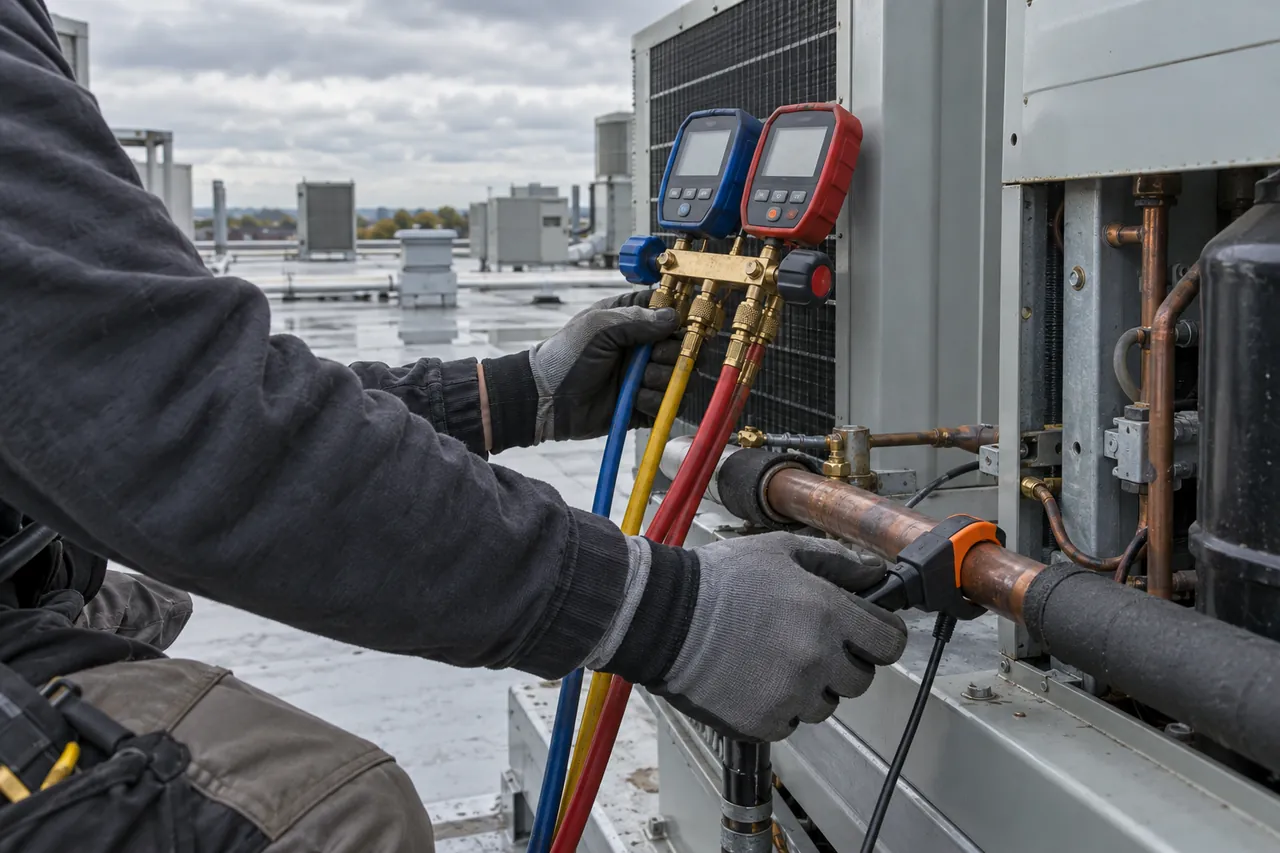
On gauges, a technician sees low suction pressure, high superheat at the evaporator outlet and low subcooling at the condenser outlet. Those three readings together point strongly to undercharge; our guide to superheat and subcooling explains the target values. An ice-blocked coil can also mean a defrost fault, so see the evaporator coil guide before blaming refrigerant.
What does a refrigerant leak look like?
The refrigerant itself is a colourless gas, so you cannot see it escaping, except as a puff of vapour or frost at a large leak. What you see is the oil that travels with it: a shiny or dark, dusty stain around a flare nut, valve, braze joint or coil bend. Some technicians add UV dye, which makes the leak glow yellow-green under a UV lamp.
Can you smell a freon leak?
Usually not. HFCs and HCFCs are almost odourless; at high concentration some people notice a faint sweet or ether-like smell. Refrigerant-grade propane and isobutane are not odorised like fuel gas, so a hydrocarbon leak may also be undetectable by smell. Ammonia is the exception: its sharp, pungent smell is noticeable at very low concentrations.
Are refrigerant leaks dangerous?
Small leaks from a fridge or air conditioner in a ventilated room are rarely a direct health risk, but large leaks in enclosed spaces can be. The hazards depend on the refrigerant's safety class under ISO 817 and ASHRAE Standard 34.
- A1 refrigerants (R134a, R404A, R448A, R744 CO2): low toxicity and non-flammable, but heavier than air. A large release in a walk-in, cellar or plant room can displace oxygen and cause dizziness, unconsciousness or asphyxiation. CO2 itself is also toxic at high concentration.
- A2L refrigerants (R32, R454C, R455A and similar): low toxicity, mildly flammable.
- A3 refrigerants (R290, R600a): flammable. Commercial cabinets are built to IEC 60335-2-89 charge limits, but ventilate and keep ignition sources away from a leak.
- B2L (R717 ammonia): toxic and mildly flammable; ammonia plants need gas detection, alarms and trained staff.
Liquid refrigerant can cause frostbite on skin or eyes, and fluorocarbons that contact flames or very hot surfaces decompose into toxic, acidic gases. So, can a freon leak make you sick? Breathing a high concentration can cause headache, nausea, dizziness and irregular heartbeat. If you suspect a large leak: leave the space, ventilate it, switch off the equipment if safe, avoid flames and call a technician. Seek medical help for symptoms.
Is a freon leak in a fridge dangerous?
A domestic fridge holds only a small charge, typically well under 150 g (5.3 oz) of R600a or R134a, so a leak in a normal kitchen is a low risk. Ventilate the room and avoid sparks with hydrocarbon models. Commercial cold rooms and rack systems hold kilograms to hundreds of kilograms, which is why plant rooms often need fixed leak detectors under EN 378 or ASHRAE Standard 15.
Where do refrigerant leaks usually occur?
Most leaks occur at mechanical joints, at points where vibration rubs pipes, and on thin-walled coils. Knowing the usual suspects is half of finding a leak.
- Flare joints and Schrader valve cores at service ports, especially after repeated gauge connections.
- Brazed joints that were made poorly or have cracked from vibration.
- Pipes rubbing on each other, on the casing or on unsupported runs near the compressor.
- Evaporator coils, which can suffer pinhole corrosion from cleaning chemicals, salt, fish or food acids.
- Condenser coils damaged by impact, hail or coastal corrosion.
- Service valve stems, pressure switches, sight glasses and filter drier connections.
- Ice machine evaporators and capillary tubes on small cabinets.
How do you find a refrigerant leak?
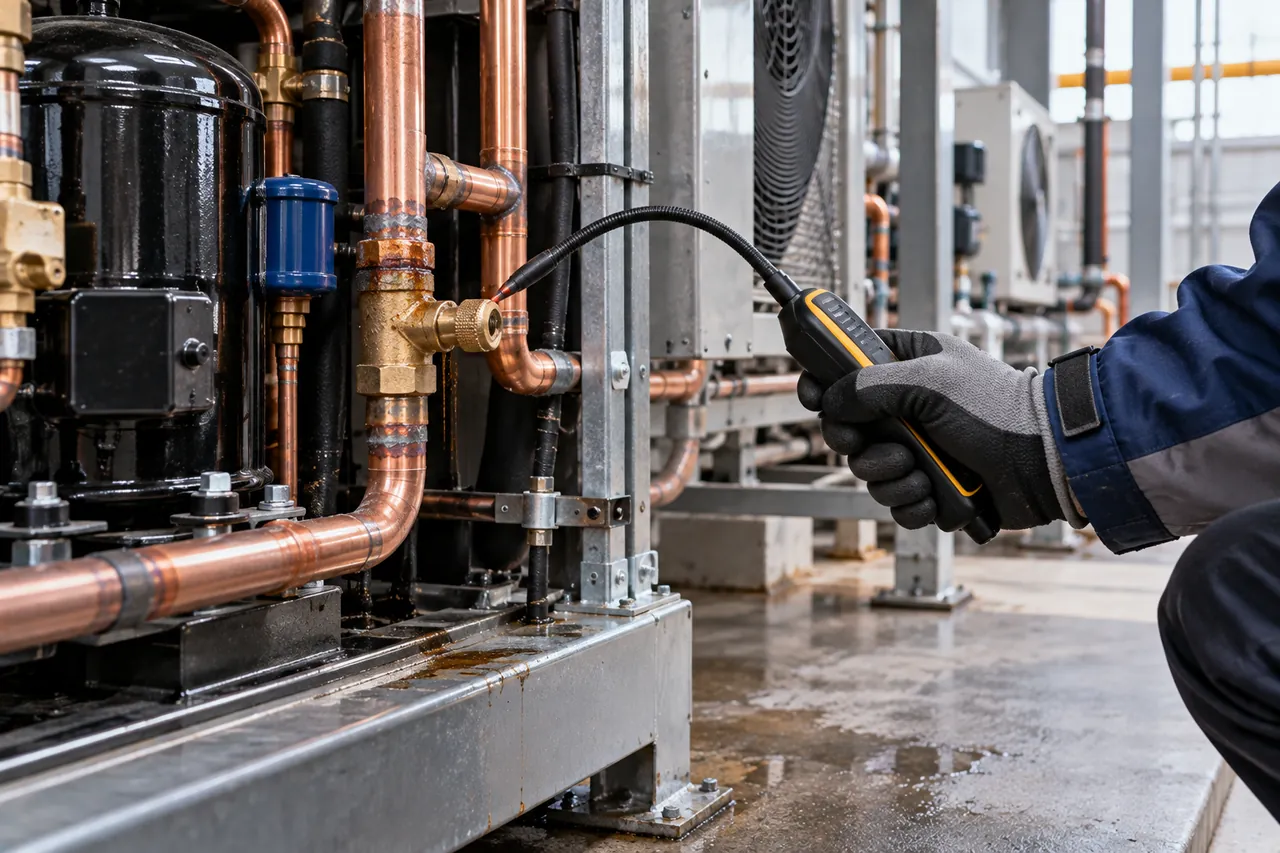
Technicians find refrigerant leaks by narrowing down with gauges and visual checks, then pinpointing with an electronic detector, bubble solution or UV dye, and finally confirming with a nitrogen pressure test. No single method catches every leak, so they are combined.
| Method | How it works | Best for | Limits |
|---|---|---|---|
| Visual and oil check | Look for oily stains at joints and coils | First check, any system | Only shows established leaks |
| Bubble solution | Leak solution brushed on joints forms bubbles | Pinpointing at a suspected joint | Slow on large systems; misses tiny leaks |
| Electronic leak detector | Heated-diode or infrared sensor samples air | Sweeping pipework; detects about 5 g (0.2 oz) a year | Drafts and wind dilute readings |
| UV dye | Dye added to oil glows under UV light | Intermittent leaks, ice machines, small systems | Dye must be compatible with the oil and approved |
| Ultrasonic detector | Listens for the high-frequency sound of escaping gas | Noisy plant, pressurised systems | Needs adequate pressure difference |
| Nitrogen pressure test | System charged with dry nitrogen; pressure drop watched over hours | Confirming repairs, new installations | System must be recovered first |
| Fixed gas detectors | Permanent sensors alarm at set ppm levels | Plant rooms, large cold stores, CO2 and ammonia systems | Detects room concentration, not location |
The usual sequence is: check gauges and history (how much refrigerant has been added and when), inspect for oil, sweep slowly with an electronic detector with fans off, confirm with bubble solution, and, if nothing is found, recover the charge and hold a nitrogen pressure test section by section. Temperature logs can also reveal slow leaks early; see cold room temperature monitoring.
How do you fix a refrigerant leak?
A refrigerant leak is fixed by recovering the remaining charge, repairing or replacing the leaking part, pressure-testing, evacuating and recharging by weight. "Top-up only" is not a repair, and sealant additives are not recommended by most compressor and equipment makers because they can block valves and capillaries.
- Recover the refrigerant into a certified recovery cylinder with a recovery machine. Venting is illegal in most markets.
- Repair the leak: rebraze the joint, replace the valve core or flare with a brazed joint, add vibration clamps, or replace the corroded coil or component.
- Replace the filter drier whenever the system has been opened.
- Pressure-test with dry, oxygen-free nitrogen to the test pressure specified for the system and check it holds.
- Evacuate with a vacuum pump to below about 500 microns (67 Pa) and confirm the vacuum holds, proving the system is dry and tight.
- Recharge with the correct refrigerant by weight on a charging scale; zeotropic blends such as R407C, R448A and R449A must be charged as liquid.
- Run the system, check superheat, subcooling and temperatures, leak-check the repair again and record the work.
This is the core of good refrigerant charging and service procedures. Typical refrigerant charging equipment includes a manifold gauge set or digital analyser, a charging scale, a vacuum pump with micron gauge, a recovery machine and recovery cylinders. Automatic refrigerant charging machines are used on production lines to charge new appliances by weight.
Who is allowed to repair refrigerant leaks?
Repairing refrigerant leaks must be done by certified technicians under local rules. In the US, EPA Section 608 requires certification to open refrigeration and AC systems and to buy most refrigerants, prohibits knowing venting, and sets leak repair rates for larger appliances (for commercial refrigeration, an annual leak rate above 20%). In the EU, the F-gas Regulation (EU) 2024/573 requires certified personnel and companies, and periodic leak checks based on the charge in tonnes of CO2-equivalent. The UK, Australia, Canada and many other countries have similar schemes.
| EU F-gas charge (CO2-equivalent) | Leak check frequency | With automatic leak detection | Example: R404A (GWP about 3,900) |
|---|---|---|---|
| 5 t to under 50 t | Every 12 months | Every 24 months | About 1.3–12.7 kg (2.8–28 lb) |
| 50 t to under 500 t | Every 6 months | Every 12 months | About 12.7–127 kg (28–280 lb) |
| 500 t and above | Every 3 months | Every 6 months; leak detection system required | Over about 127 kg (280 lb) |
Hermetically sealed equipment has a higher starting threshold; check the current text and your national rules. Low-GWP refrigerants reduce CO2-equivalent charge, which is one reason for the shift to R290 cabinets and CO2 rack systems; see R290 vs R404A and CO2 refrigeration systems.
A quick leak rate example
A walk-in freezer holds 6 kg (13.2 lb) of refrigerant. A technician adds 1.5 kg (3.3 lb) after 120 days since the last top-up. The annualised leak rate is 1.5 ÷ 6 × 365 ÷ 120 = about 76% a year. Whatever the legal threshold, a system leaking at that rate needs repair, not another recharge.
Should you repair a leak or replace the system?
Repair is usually right for a single accessible leak on a system in good condition; replacement makes sense when leaks keep recurring, a coil is corroded throughout, or the refrigerant is being phased out. Consider replacement when:
- The system uses R22 or another refrigerant that is no longer produced or is costly in your market.
- The evaporator or condenser has multiple pinhole leaks from corrosion.
- The equipment is past about half to two-thirds of its service life and also needs a compressor.
- Repeated repairs over 12–24 months have cost more than a large share of a new unit.
Home air conditioner refrigerant leak repair follows the same logic: a leaking indoor coil on an older R22 system is often better replaced with a complete matched system than recharged.
How to prevent refrigerant leaks: a checklist
Most leaks are preventable with good installation and routine checks. Use this list for new equipment and existing sites:
- Specify brazed joints rather than flares wherever possible, with nitrogen purging during brazing.
- Clamp and support pipework, and fit vibration eliminators near compressors.
- Pressure-test and evacuate properly at commissioning, and record the charge on a label.
- Log temperatures and run times, and investigate any gradual rise.
- Include a leak check in each service visit; see our commercial refrigeration maintenance checklist.
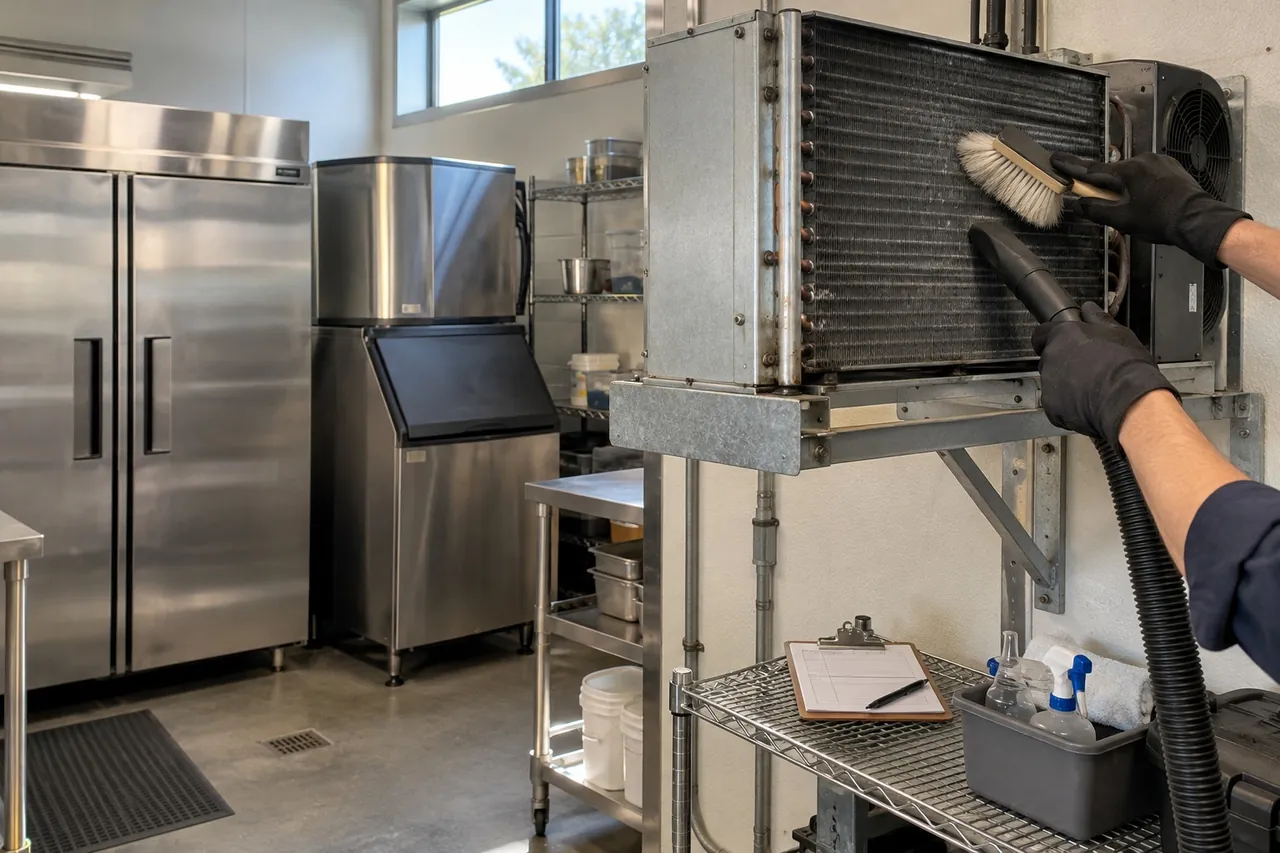
- Use coated coils for coastal, fish and chemical environments, and food-safe, non-acidic coil cleaners.
- Choose low-charge, factory-sealed or natural-refrigerant equipment where your market allows.
Be There supplies complete walk-in cold room kits with matched condensing units and evaporators, and glass door display fridges with an R290 natural-refrigerant option. Send your room size, temperature, refrigerant requirements and power supply through the inquiry form and we will quote FOB, CIF or DDP.