Short answer
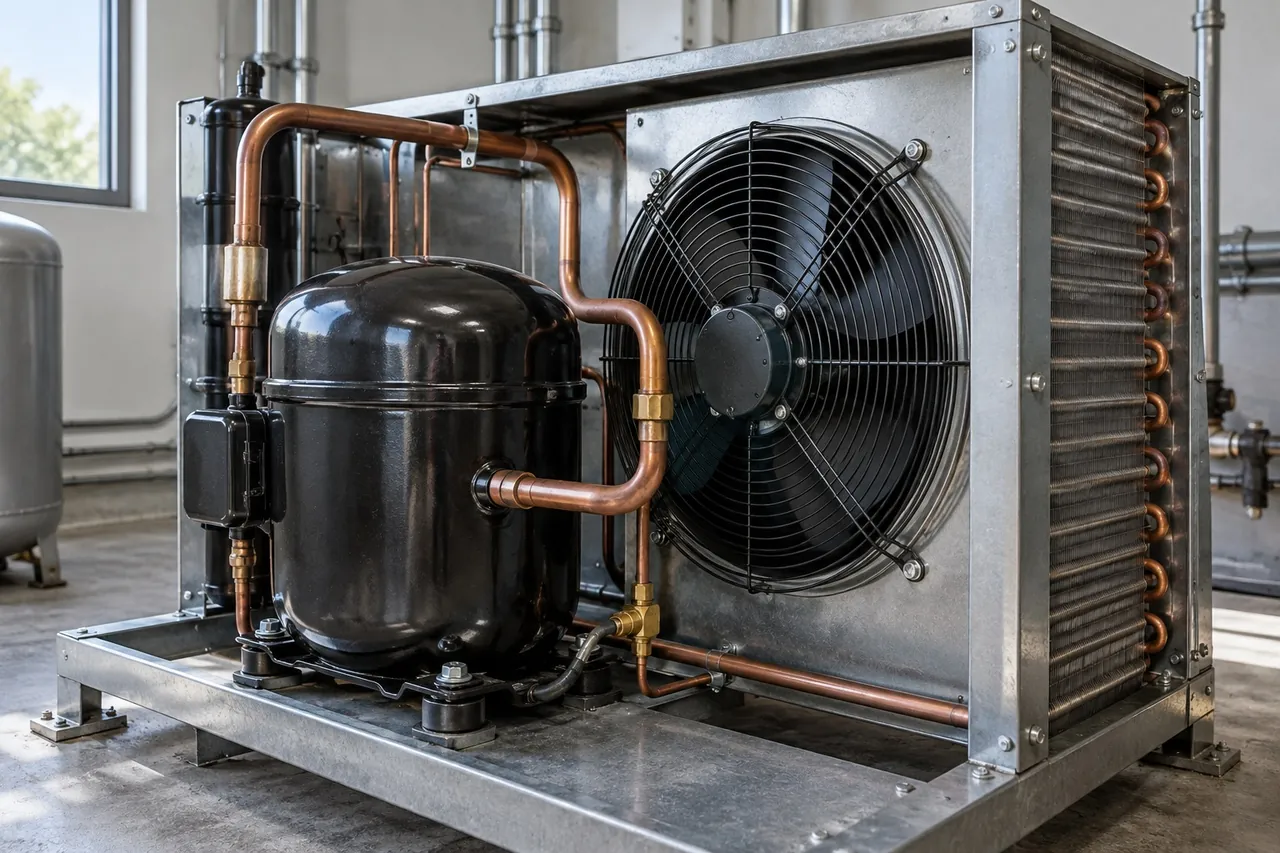
A walk-in cooler refrigeration system has a condensing unit (compressor, condenser coil and fan) outside or on top of the room, an evaporator coil with fans inside it, an expansion valve and a controller. Small rooms use a monoblock; most rooms use a split system with an outdoor condensing unit; supermarkets use rack refrigeration and large warehouses ammonia plants.
Key takeaways
- A condensing unit combines the compressor, condenser coil, fan and receiver; the evaporator coil inside the room absorbs the heat.
- A typical 8×10 ft (2.4 × 3.0 m) walk-in cooler needs roughly a 1 HP medium-temperature condensing unit; the same size freezer needs about 2 HP low-temperature.
- Refrigeration should be sized from the calculated load over 16 running hours a day for coolers and 18 hours for freezers.
- Evaporator coil TD of about 4–6 K keeps humidity high for produce; 6–8 K suits general walk-in cooler storage.
- Industrial ammonia refrigeration is used in large cold stores and processing plants; walk-ins use packaged HFC, HFO, CO2 or propane systems.
What is a walk-in cooler refrigeration system?
A walk-in cooler refrigeration system is the set of components that moves heat out of an insulated room. The core part is the condensing unit, which pumps and condenses refrigerant, matched to an evaporator coil inside the room. It works on the vapour-compression cycle used by almost all commercial refrigeration systems, from plug-in commercial appliances to warehouse plants.
Following the refrigerant round the loop, as a walk-in cooler parts diagram would show it:
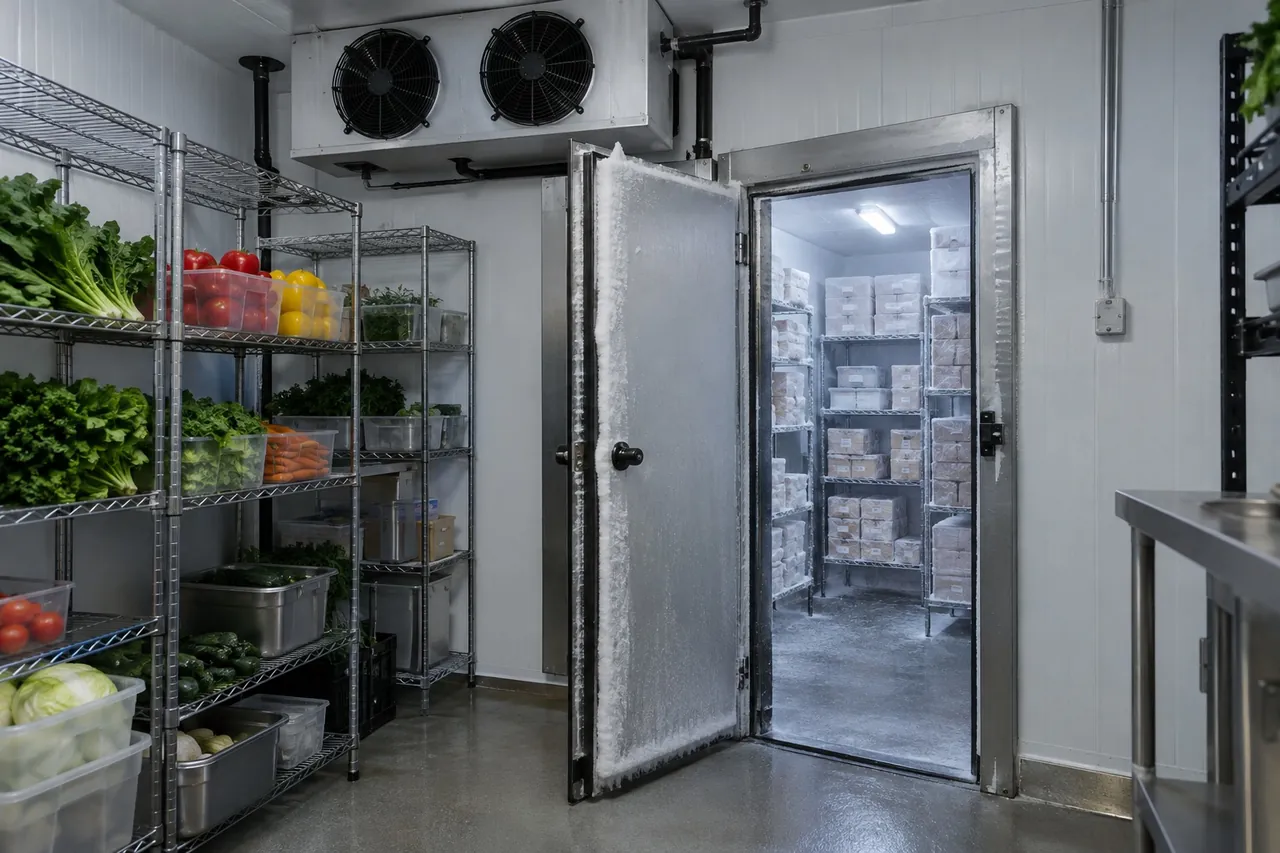
- Evaporator coil (inside the room): liquid refrigerant boils at about −10 °C to −5 °C in a cooler, absorbing heat from air blown through the coil by fans.
- Compressor (in the condensing unit): draws in the low-pressure vapour and compresses it to a high pressure and temperature.
- Condenser coil (in the condensing unit): a fan blows outdoor or room air over the coil, and the hot vapour gives up its heat and condenses to liquid.
- Receiver, filter drier and sight glass: store liquid, remove moisture and show charge condition.
- Expansion valve (at the evaporator): meters liquid into the coil and drops its pressure, closing the loop.
A controller, sensors and safety switches run the system. Every Be There walk-in cold room kit ships with a condensing unit and evaporator matched for its size and temperature.
What is a condensing unit? Outdoor vs indoor condensing units
A refrigeration condensing unit is a factory-assembled package of compressor, condenser coil, condenser fan, receiver and basic controls on one base. It is the part that rejects heat, so where you put it matters as much as what you buy.
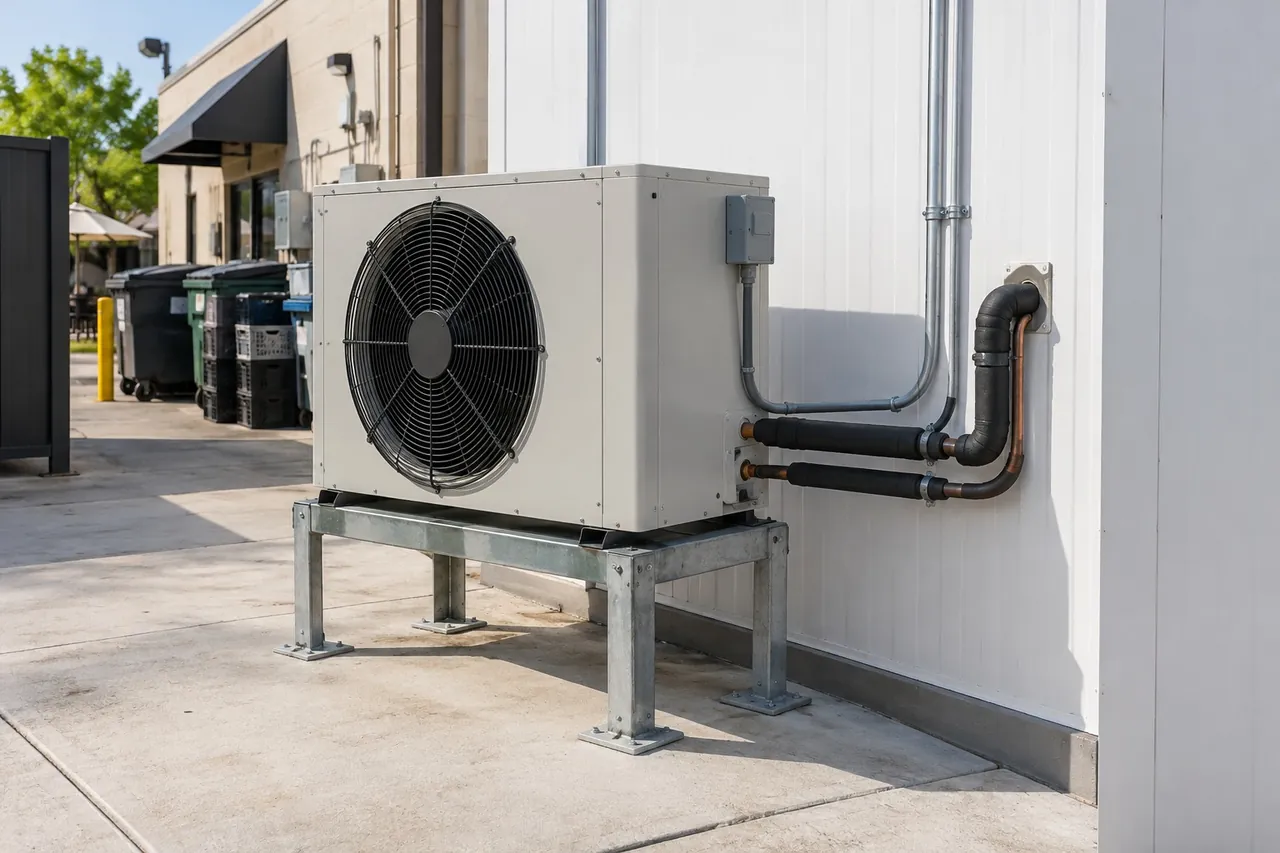
- Outdoor condensing unit: the most common choice for walk-in coolers. Heat goes outside, the kitchen or shop stays cooler and quieter. Units need a weather housing, free airflow, shade where possible and, in cold climates, low-ambient head-pressure control and a crankcase heater.
- Indoor condensing unit: used where piping outside is impractical. The room it stands in must be ventilated, because the unit releases the walk-in's heat plus the compressor's own heat. A hot plant room reduces capacity and shortens compressor life.
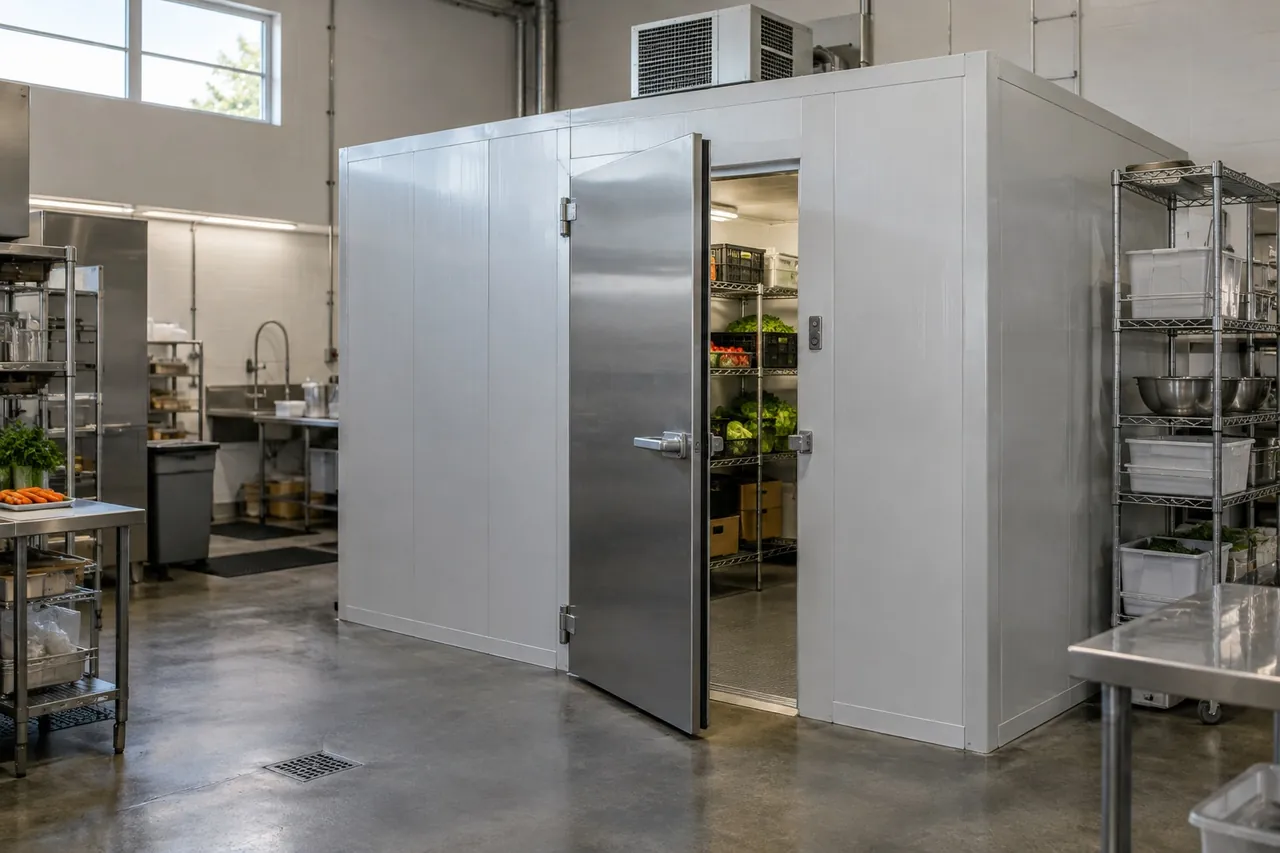
- Roof-mounted on the box: common on small walk-ins and in monoblocks. Convenient, but heat and noise stay in the room where the cooler stands.
Condensing units are rated for medium temperature (coolers, evaporating about −10 °C) or low temperature (freezers, about −30 °C to −35 °C). A low-temperature unit is not a bigger cooler unit: it uses compressors, oil and controls designed for low suction pressure. For how the compressor itself works, see our refrigeration compressor guide.
Walk-in cooler evaporator coil: what to look for
The walk-in cooler evaporator, also called a unit cooler or refrigeration coil, hangs from the ceiling and circulates air through a finned copper-and-aluminium coil. Its selection affects temperature evenness, humidity and how often it frosts.
- Profile: low-profile coils suit rooms with low ceilings; medium-profile units throw air further in deeper rooms.
- Fin spacing: about 4–6 mm for coolers; 6–7 mm or wider for freezers to tolerate frost.
- Temperature difference (TD): the gap between room air and evaporating temperature. A TD of about 4–6 K keeps relative humidity near 85–90% for produce and flowers; about 6–8 K suits general storage; a large TD dries product out.
- Air throw: the coil should reach the far wall without blowing directly on the door or on delicate product.
- Defrost: coolers above about +2 °C usually defrost off-cycle, with the compressor stopped and fans running; freezer coils use electric or hot-gas defrost.
- Coil coating: epoxy or hydrophilic coatings help in salty, humid or acidic rooms such as seafood or fruit storage.
A walk-in cooler condensing unit and evaporator must use the same refrigerant and be balanced in capacity at the design evaporating temperature. A coil too small for its condensing unit runs too cold and dries the room; one too large causes poor oil return and unstable control.
Monoblock, split system or rack refrigeration?
The right system type depends on room size, site layout and how many cold rooms you run.
| System type | How it is built | Typical use | Pros / cons |
|---|---|---|---|
| Monoblock (self-contained, top- or wall-mount, drop-in) | Condensing unit and evaporator in one pre-charged unit through the wall or roof | Small walk-ins, mobile and container rooms | Quick to install, no site piping; heat released next to the room |
| Split system | Outdoor or indoor condensing unit piped to an evaporator in the room | Most restaurant and shop walk-in cooler systems | Heat and noise outside; needs piping and a technician to charge |
| Multi-compressor condensing unit | Two or more compressors on one unit serving one or more rooms | Larger rooms, combined cooler/freezer sites | Capacity control and redundancy; higher cost |
| Rack refrigeration | Central compressor rack in a plant room serving many cases and rooms | Supermarkets, convenience store refrigeration equipment | Efficient at scale; design and installation by specialist contractors |
| Industrial plant (ammonia, CO2) | Engineered central system with large compressors and vessels | Cold storage warehouses, food processing | Highest efficiency; needs trained operators and safety systems |
A compact refrigeration unit or small monoblock is the simplest walk-in cooler unit for rooms up to about 10–15 m³. Beyond that, a split walk-in refrigeration unit is usually more efficient and easier to service.
Refrigeration controls and control panels
Refrigeration controls decide when the compressor runs, when the coil defrosts and what happens when something goes wrong. A typical walk-in cooler refrigeration control panel or digital controller handles:
- Temperature control: a room sensor switches a liquid-line solenoid valve or the compressor, with a differential of about 1–2 K.
- Pump-down: on many split systems the solenoid closes first and the compressor stops on its low-pressure switch, keeping liquid out of the compressor during off-cycles.
- Defrost: time-based or demand defrost, with a termination sensor on the coil and a fan delay afterwards so water is not blown off the fins.
- Safety switches: high- and low-pressure cut-outs, compressor overload protection, and phase protection on three-phase supplies.
- Alarms and monitoring: high/low temperature alarms, door-open alarms and, increasingly, remote monitoring by Wi-Fi or cellular modem.
Electronic expansion valves and variable-speed compressors or fans, once found mainly in larger plants, now appear on mid-size condensing units. They hold temperature more tightly and cut energy use at part load, which is most of the time in a walk-in cooler. Ask for a controller that logs temperatures; it supports HACCP records and makes refrigeration system repair diagnosis much faster.
How to size a walk-in cooler refrigeration unit
Size the walk-in cooler refrigeration unit from the heat load: heat through the panels, warm air at door openings, product pull-down, and heat from fans, lights and people, plus a safety margin, divided by the compressor's running time (about 16 hours a day for coolers and 18 hours for freezers). Our cold room refrigeration load calculator does this from your dimensions, temperature and daily intake.
For a first budget only, typical capacities for storage rooms with 100 mm (cooler) and 150 mm (freezer) panels in a 35 °C (95 °F) ambient are:
| Room size (ft / m) | Cooler, +2 °C (36 °F) | Freezer, −20 °C (−4 °F) |
|---|---|---|
| 6×8 / 1.8 × 2.4 | About 3/4 HP | About 1.5 HP |
| 8×10 / 2.4 × 3.0 | About 1 HP | About 2 HP |
| 10×12 / 3.0 × 3.6 | About 1.5 HP | About 3 HP |
| 12×20 / 3.6 × 6.0 | About 2.5–3 HP | About 4–5 HP |
Horsepower is a rough label; compare condensing units by cooling capacity in watts or BTU/h at your evaporating temperature and ambient. Increase capacity for frequent door openings, warm product deliveries or very hot sites, and do not oversize: an oversized unit short-cycles and controls humidity poorly.
Industrial ammonia refrigeration, rack systems and transport units
Industrial ammonia refrigeration uses ammonia (R717) as the refrigerant in large central plants for cold storage warehouses, meat and dairy processing and ice rinks. The ammonia refrigeration cycle is the same vapour-compression cycle, but on a larger scale: screw or reciprocating compressors feed an evaporative condenser on the roof, liquid is stored in a high-pressure receiver, and often pumped through evaporators in the cold rooms. Ammonia has zero GWP and excellent efficiency, but it is toxic, so industrial ammonia refrigeration systems are designed and maintained by specialist industrial refrigeration contractors under strict safety codes. Many new plants use CO2 or ammonia/CO2 cascade systems to keep the ammonia charge small.
Rack refrigeration is the supermarket version: a rack of compressors serves dozens of display cases and cold rooms from one plant room.
Be There supplies packaged condensing units and evaporators for walk-ins and cold rooms, not ammonia plants; for a cold storage warehouse we can supply the insulated panels, and packaged refrigeration for individual rooms within it. Transport refrigeration units for vans, box trucks and trailers are a separate product family: see our truck refrigeration units.
Commercial refrigeration installation, tools and maintenance
Commercial refrigeration installation of a split system is work for a licensed technician. Typical refrigeration tools on site include manifold gauges or a digital refrigeration analyser, a vacuum pump and micron gauge, a refrigerant recovery machine, a scale for charging, nitrogen for brazing and pressure testing, a tube cutter, flaring and swaging tools, and a clamp meter. Good practice is to braze under nitrogen, pressure-test, evacuate to about 500 microns and charge by weight.
A routine for maintenance of the refrigeration system:
- Monthly: clean the condenser coil (more often in kitchens), check that the evaporator is free of ice and the drain runs.
- Every 6 months: check refrigerant charge and pressures, superheat, electrical connections, contactors, fan motors, defrost operation and alarm settings.
- Yearly: leak-check the system, clean the evaporator coil and record results.
Troubleshooting refrigeration systems usually starts with three questions: is air flowing over both coils, is the defrost working, and is the charge correct? Most walk-in cooler compressor failures trace back to one of those. See our commercial refrigeration maintenance checklist for a full schedule. Spare walk-in cooler and freezer parts such as fan motors, defrost heaters, contactors and door gaskets are worth keeping on remote sites.
How to choose a walk-in cooler condensing unit and evaporator
- Calculate the heat load for the room temperature, size and daily product intake.
- Decide the system type: monoblock for small rooms; split system for most walk-ins; multi-compressor or rack for many rooms.
- Choose the condensing unit location and confirm the hottest ambient it will see.
- Select a medium- or low-temperature condensing unit with capacity at your design conditions, not just horsepower.
- Match the evaporator coil by capacity, TD, air throw and fin spacing.
- Confirm refrigerant allowed in your market, power supply (voltage, phase, frequency) and controller features such as alarms and data logging.
Be There supplies complete walk-in cooler and freezer systems with matched condensing units, evaporators and controllers, quoted FOB, CIF or DDP. Send your room size, temperature, site ambient and power supply through our inquiry form for a quotation.