


Short answer
An AC compressor pumps refrigerant vapour to high pressure, and the AC condenser in front of the radiator turns it back to liquid by releasing heat outside. When a car AC is not blowing cold, the usual causes are low refrigerant from a leak, a clutch that will not engage, a failed fan or blocked condenser. Healthy vents deliver about 3–8 °C (38–46 °F).
Key takeaways
- The AC compressor raises refrigerant to high pressure and about 60–90 °C (140–195 °F); the condenser in front of the radiator rejects that heat.
- A healthy car AC blows about 3–8 °C (38–46 °F) at the centre vents on maximum cooling on a warm day.
- Most AC faults are low charge from leaks, clutch or electrical faults, failed condenser fans and dirty condensers.
- The most common cause of compressor failure is oil starvation from low refrigerant charge.
- Replace the drier and expansion device and evacuate the system whenever a compressor is replaced.
- Refrigerant recovery and charging must be done by certified technicians, for example under US EPA Section 609 or EU F-gas rules.
What is an AC compressor and what does it do?
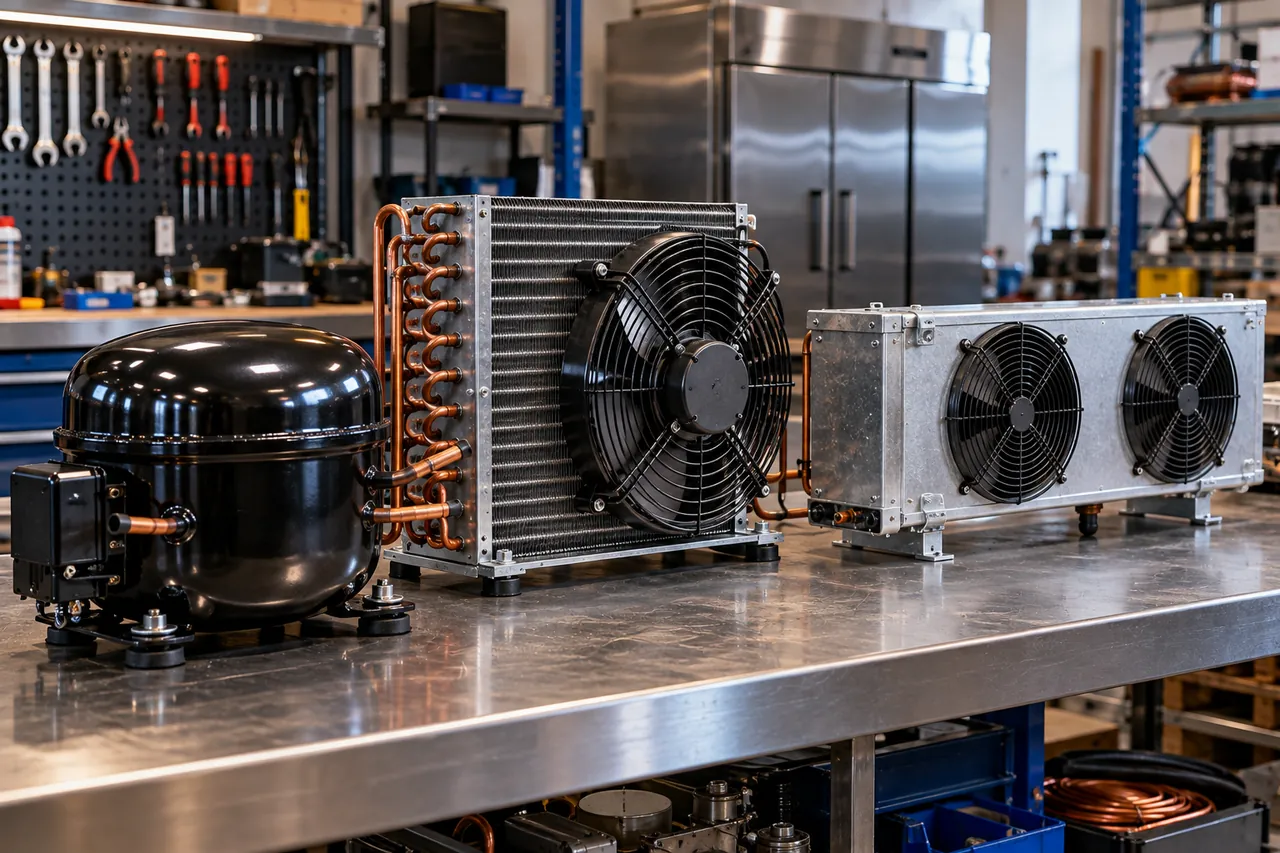
An AC compressor is the pump at the heart of an air conditioning system: it draws in low-pressure refrigerant vapour from the evaporator and compresses it to high pressure and temperature, typically 60–90 °C (140–195 °F) at the outlet, so the condenser can release the heat outside. Without the compressor, refrigerant does not circulate and nothing cools.
In a car or truck, the car AC compressor is mounted on the front of the engine and driven by the accessory belt through an electromagnetic clutch; many modern units use a variable-displacement design with an internal control valve instead of cycling the clutch. In hybrid and electric vehicles, the compressor is electric and powered from the high-voltage battery. In a truck refrigeration unit, the compressor is either belt-driven from the vehicle engine, driven by the unit's own diesel engine or electric. In a split air conditioner for a building, it sits in the outdoor unit.
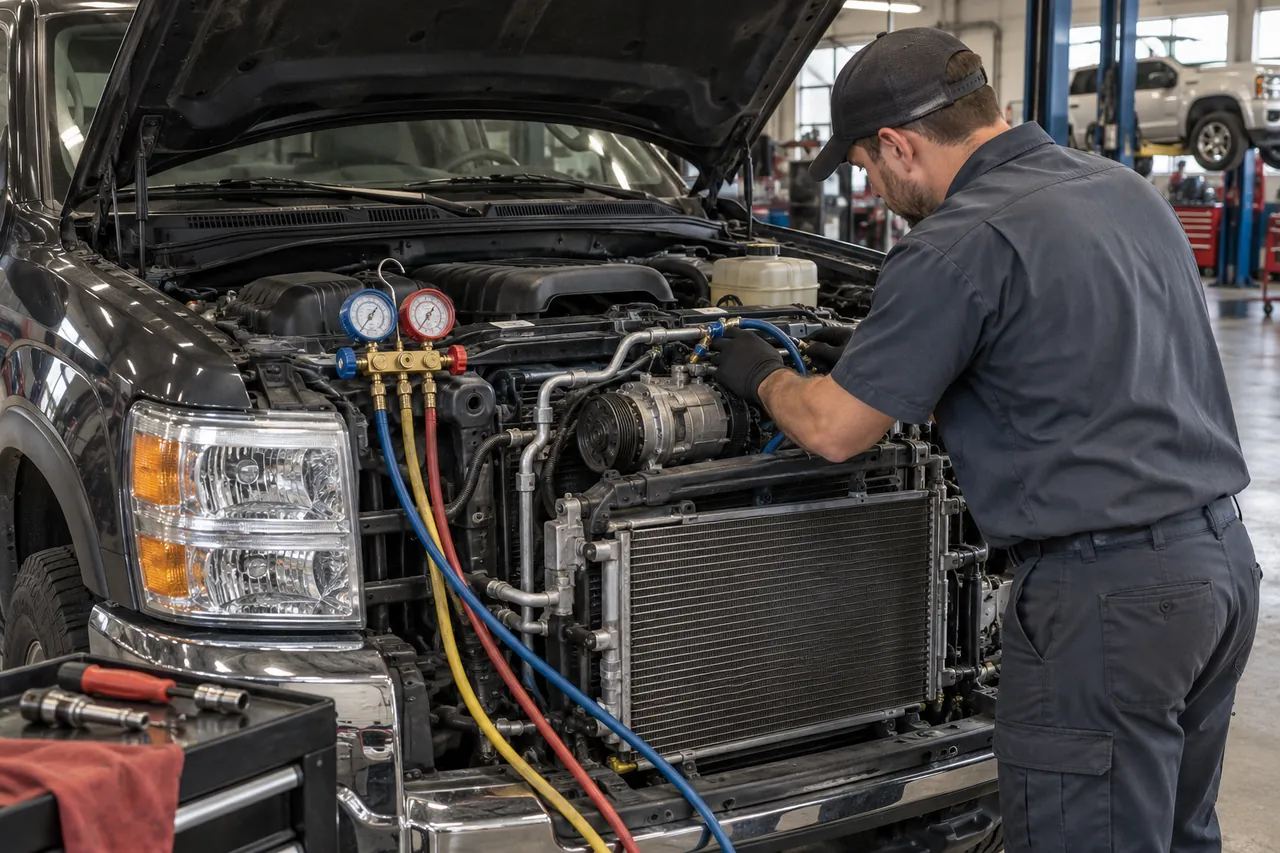
So where is the air conditioner compressor located? On most vehicles: low on the front of the engine, with two refrigerant hoses attached and a pulley on the belt. Our guide to condenser vs evaporator vs compressor explains how the parts work together, and the refrigeration compressor guide covers compressor types in fridges and cold rooms.
How does an AC condenser work, and where is it located?
An AC condenser is a finned heat exchanger that cools the hot, high-pressure refrigerant gas from the compressor until it condenses into liquid, releasing the heat absorbed from the cabin into outside air. On a car or truck, the condenser sits at the very front of the vehicle, in front of the engine radiator, where ram air and the electric cooling fan pass through it.
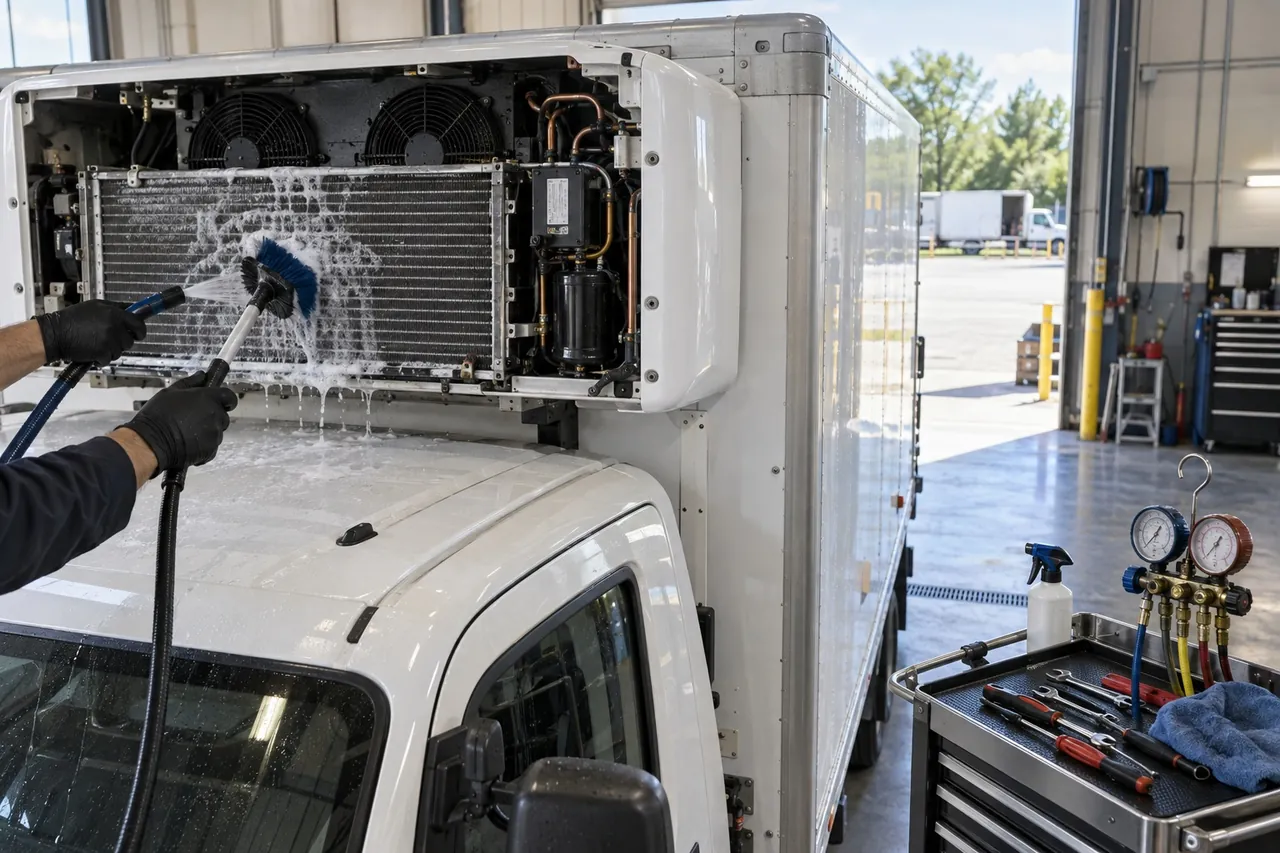
A typical automotive condenser is an aluminium parallel-flow or microchannel design: many flat tubes no thicker than a few millimetres, joined by thin fins. That makes it efficient and light but vulnerable to stones, road salt and corrosion, and impossible to flush clean after a compressor failure. If the condenser cannot reject heat, because it is blocked with insects and dirt, its fan has failed or air recirculates from the radiator, head pressure rises, cooling falls and the compressor works harder and hotter.
In a truck refrigeration unit the condenser is on the front of the box or the unit housing; in a bus rooftop AC it is in the roof unit; on a building split system it is the outdoor coil. The physics and the failure modes are the same.
Why is my car AC not blowing cold air?
The most common reasons a car AC is not blowing cold are low refrigerant from a leak, a compressor clutch that does not engage, a blown fuse or failed relay, a failed condenser fan, a blocked condenser, a clogged cabin filter, or a blend door stuck on heat. Most are diagnosed in a few minutes with simple checks before anyone connects gauges.
| Symptom | Most likely causes | What to check first |
|---|---|---|
| Air blows but is warm, compressor clutch not engaging | Low refrigerant (pressure switch stops compressor), fuse, relay, clutch coil, sensor | Fuses and relay, clutch connector; then pressure check by a technician |
| Compressor runs, air only slightly cool | Low charge from a slow leak, blocked condenser, expansion valve or orifice tube fault | Clean condenser, check fan, leak test |
| Cold when driving, warm at idle or in traffic | Condenser fan not running, dirty condenser, slight overcharge | Fan operation with AC on, condenser fins |
| Cold at first, then warm after 10–30 minutes | Evaporator freezing (moisture, low charge, faulty sensor) or clutch overheating | Airflow drops as it warms? Suspect icing |
| Weak airflow at all settings | Clogged cabin filter, failed blower or resistor, leaves in intake | Replace cabin filter, test blower speeds |
| Cold on one side, warm on the other | Blend door actuator, low charge on dual-zone systems | Listen for actuator clicking, check settings |
| AC stops working suddenly | Fuse, relay, clutch failure, sudden leak (hose, condenser hit by stone) | Fuses, visible oily residue at fittings |
A healthy system on a warm day typically delivers air of about 3–8 °C (38–46 °F) at the centre vents on maximum cooling with recirculation, after a few minutes of running. Measuring vent temperature with a probe thermometer is the quickest objective check before and after any repair.
How do you diagnose car AC problems step by step?
Diagnose an AC system from the simple and safe checks to the specialist ones: controls and airflow first, then electrical supply and compressor engagement, then condenser and fans, and only then refrigerant pressures and leak testing by a certified technician.
- Set maximum cold, recirculation and highest fan speed. Check that air comes out of the correct vents at every speed.
- Replace a dirty cabin filter and clear leaves from the intake below the windscreen.
- With the engine running and AC on, look at the compressor: the clutch plate at the front should spin with the pulley. If not, check fuses and the AC relay.
- Check that the condenser or radiator fan runs when AC is switched on, and inspect the condenser for dirt, insects, bent fins and oily stains, which signal a leak.
- Look along hoses and fittings for oil residue; refrigerant oil escapes with the refrigerant and leaves a dirty, damp patch.
- Measure vent temperature and note ambient temperature and humidity.
- A certified technician then connects gauges or a service station to read low- and high-side pressures and compare them with the vehicle's chart. As an indication only, an R134a system at about 27–30 °C (80–86 °F) ambient often runs around 1.7–3.1 bar (25–45 psi) low side and 10–15 bar (150–220 psi) high side.
- If the charge is low, the technician finds the leak with UV dye, an electronic detector or a nitrogen pressure test, repairs it, evacuates the system with a vacuum pump to remove air and moisture, and recharges by weight to the label specification.
Two rules apply everywhere. First, do not top up with DIY cans and walk away: without a leak repair, the charge escapes again, and an overcharge raises pressures and can damage the compressor. Second, refrigerant work requires certified technicians and recovery equipment under rules such as US EPA Section 609 for motor vehicle air conditioning and the EU F-gas regulations; venting refrigerant is illegal in many countries. Read our refrigerant leak guide for detection methods.
What are the signs of a bad AC compressor?
The main bad AC compressor symptoms are warm air with correct refrigerant charge, loud grinding, knocking or squealing when the AC engages, a clutch that will not engage or slips, refrigerant oil leaking from the compressor body or shaft seal, and pressures that stay nearly equal on the high and low sides while the compressor runs.
- Noise: grinding or rumbling that changes with AC on and off points to compressor or clutch bearing wear; a squeal at engagement is often a slipping belt or clutch.
- Clutch problems: a clutch that does not pull in, or engages and slips, may have an open coil, an excessive air gap or a burnt friction face. The clutch can sometimes be replaced without opening the refrigerant circuit.
- Leaks: oily residue around the front shaft seal or body seams.
- Poor pumping: with a correct charge, low side stays high and high side stays low, meaning valves or internal parts are worn.
- Overheating or seizure: the belt squeals or stalls, the clutch smokes, or the engine stumbles at idle when AC is switched on.
Many "bad compressor" diagnoses turn out to be low charge, an electrical fault or a blocked condenser. Confirm with pressure readings and electrical checks before replacing it. The same principles apply to stationary units, covered in our guide to refrigerator compressor problems.
What is the most common cause of AC compressor failure?
The most common cause of AC compressor failure is loss of lubrication, usually because a leak has reduced the refrigerant charge and with it the oil carried back to the compressor. Other leading causes are liquid refrigerant flooding back to the compressor, contamination by moisture or debris, and overheating from high head pressure caused by a blocked condenser or failed fan.
| Failure cause | How it damages the compressor | Prevention |
|---|---|---|
| Low charge and oil starvation | Oil travels with refrigerant; low charge means poor lubrication and overheating | Fix leaks early; recharge by weight with the correct oil |
| Liquid floodback (slugging) | Liquid refrigerant or oil cannot be compressed and breaks valves | Correct charge, working expansion device, no overcharge |
| Moisture and air | Forms acids and sludge, attacks windings and bearings | Evacuate properly; replace receiver-drier or accumulator after opening |
| Debris from a previous failure | Metal particles circulate and wreck the new compressor | Flush lines, replace condenser if parallel-flow, fit new expansion valve and drier |
| High head pressure | Dirty condenser, failed fan or overcharge raise discharge temperature | Clean condenser, check fans |
| Wrong oil or refrigerant | Incompatible oil fails to lubricate; electric compressors need insulating oil | Use only the oil and refrigerant specified on the label |
When a compressor is replaced, good practice is to also replace the receiver-drier or accumulator and the expansion valve or orifice tube, flush or replace contaminated lines and condenser, add the correct oil quantity, and evacuate deeply before charging. Skipping these steps is why replacement compressors sometimes fail within months.
How much does AC compressor or condenser replacement cost?
As an indicative guide only, in the US market a car AC condenser replacement typically costs several hundred to around one thousand US dollars installed, and an AC compressor replacement often costs roughly twice that or more once the drier, expansion valve, flushing, oil and recharge are included. Prices vary widely by vehicle, region and whether parts are new, remanufactured or rebuilt.
Points that change the bill:
- Labour time: some condensers come out in an hour; others need the bumper and radiator support removed.
- Collateral parts: a compressor job should include drier and expansion device, and sometimes a condenser.
- Refrigerant: R1234yf, used in most newer cars, costs considerably more than R134a, and the charge is weighed in by a dedicated machine.
- Remanufactured AC compressor units cost less than new and are fine from a reputable source with a warranty, provided the system is cleaned properly.
For trucks and commercial vehicles, ask for a written quote listing every part and the refrigerant quantity. For building systems, condenser size is described in tons of cooling: 1 ton = 12,000 BTU/h = 3.52 kW, so a 3 ton condenser is about 10.5 kW and a 5 ton about 17.6 kW. Size and price those through a licensed HVAC contractor.
Do the same faults affect truck refrigeration units?
Yes. A truck refrigeration unit is a vapour-compression system like a vehicle AC, so the same compressor and condenser faults, especially dirty condensers, low charge from leaks and worn belts, cause most failures to cool. The differences are a wider temperature range, down to −20 °C (−4 °F) or lower, defrost cycles and box temperature control.
For reefers, add these checks: is the evaporator iced and is defrost working; are the box door seals and curtains intact; is the box loaded so air can return to the evaporator; and are the box temperature sensors reading correctly. A unit that cools a box slowly in summer often has a blocked condenser on the front of the box. Our guide to truck refrigeration unit maintenance gives a full schedule, and superheat and subcooling explains how technicians confirm charge on systems with service valves.
Repair or replace? A checklist for vehicle and unit AC
Repair rather than replace when the fault is electrical, a single leaking part or a dirty condenser; consider replacing the compressor, condenser or whole unit when the compressor has failed internally, the system is contaminated, or the equipment is old and uses a refrigerant that is being phased out in your market.
- Record symptoms, vent temperature, ambient temperature and when the fault occurs.
- Do the safe checks: filters, fuses, fans, clutch engagement, condenser cleanliness.
- Have a certified technician measure pressures, find leaks and give a written diagnosis.
- If the compressor is replaced, insist on drier, expansion device, flushing and evacuation.
- Compare repair cost with the remaining life of the vehicle or unit.
- For refrigerated cargo, check unit capacity is still right for the box and route.
Be There does not make car, truck cab or building air conditioners. We supply truck refrigeration units for vans and trucks with 4–45 m³ boxes, holding −20 °C to +15 °C, in engine-driven, independent diesel and fully electric versions, with install kits matched to your vehicle. If your reefer unit is old or undersized, tell our engineers about your vehicle, box size and cargo temperature through the inquiry form and we will quote a replacement FOB, CIF or DDP. For cab comfort, see our guide to 12V and 24V truck air conditioners.