Short answer
A condenser, evaporator and compressor are the three main parts of a refrigeration system. The evaporator absorbs heat inside the cold space as refrigerant boils at about −5 °C to −30 °C (23 °F to −22 °F); the compressor pumps that vapour to high pressure; the condenser releases the heat outside, typically condensing 10–15 K above ambient air temperature.
Key takeaways
- The evaporator is the cold coil inside the fridge or cold room; the condenser is the hot coil outside; the compressor is the pump between them.
- A condenser must reject about 1.2–1.4 times the evaporator's cooling capacity for a cooler and 1.4–1.6 times for a freezer, because it also dumps the compressor's motor heat.
- An air-cooled condenser typically condenses 10–15 K above ambient, so in 32 °C (90 °F) air it runs at about 45 °C (113 °F).
- Walk-in cooler evaporators run about 6–10 K below room temperature; a +2 °C (36 °F) room usually evaporates at about −6 °C to −8 °C (21–18 °F).
- Dirty condenser coils are the most common cause of high energy use and compressor overheating; clean them at least monthly in kitchens.
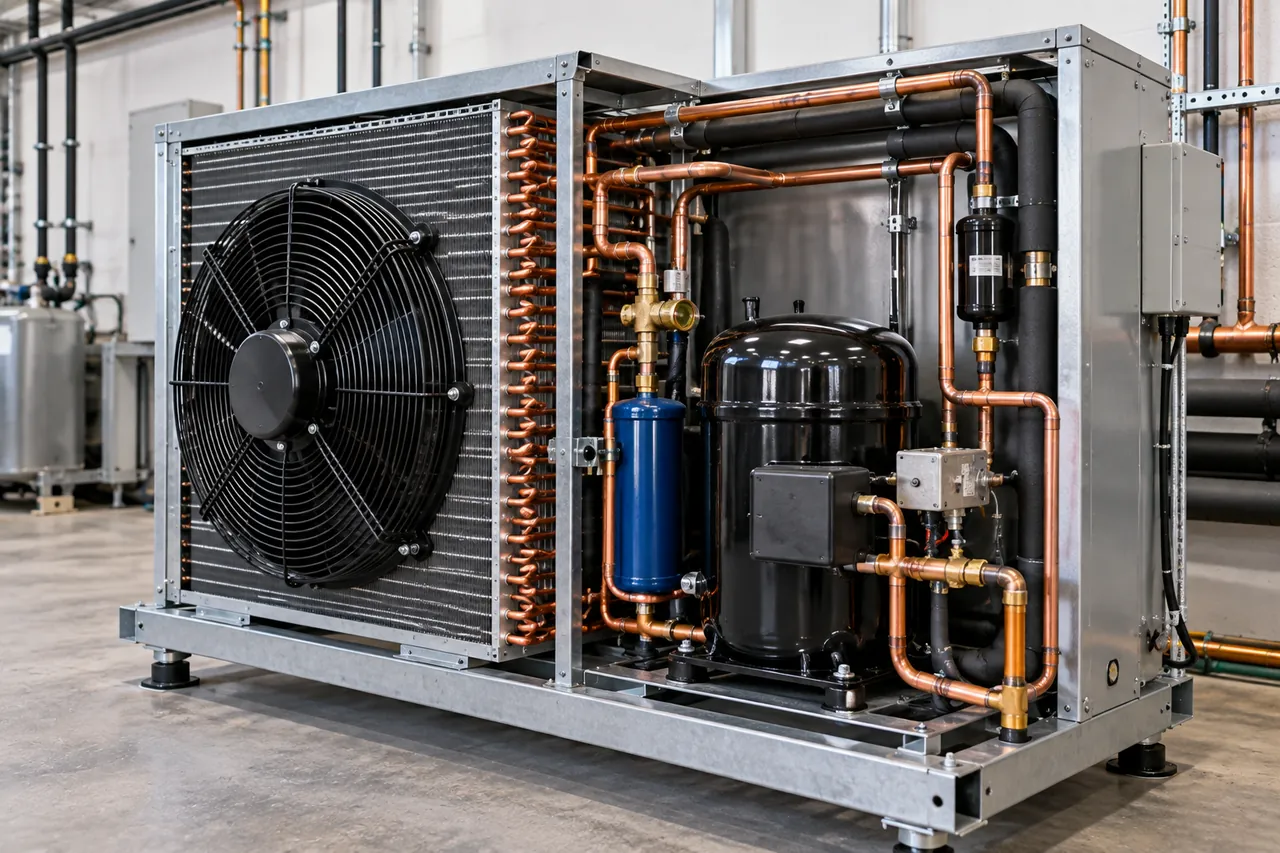
- In a split air conditioner or cold room, the outdoor 'condenser unit' actually houses both the compressor and the condenser coil.
What is the difference between a condenser, evaporator and compressor?
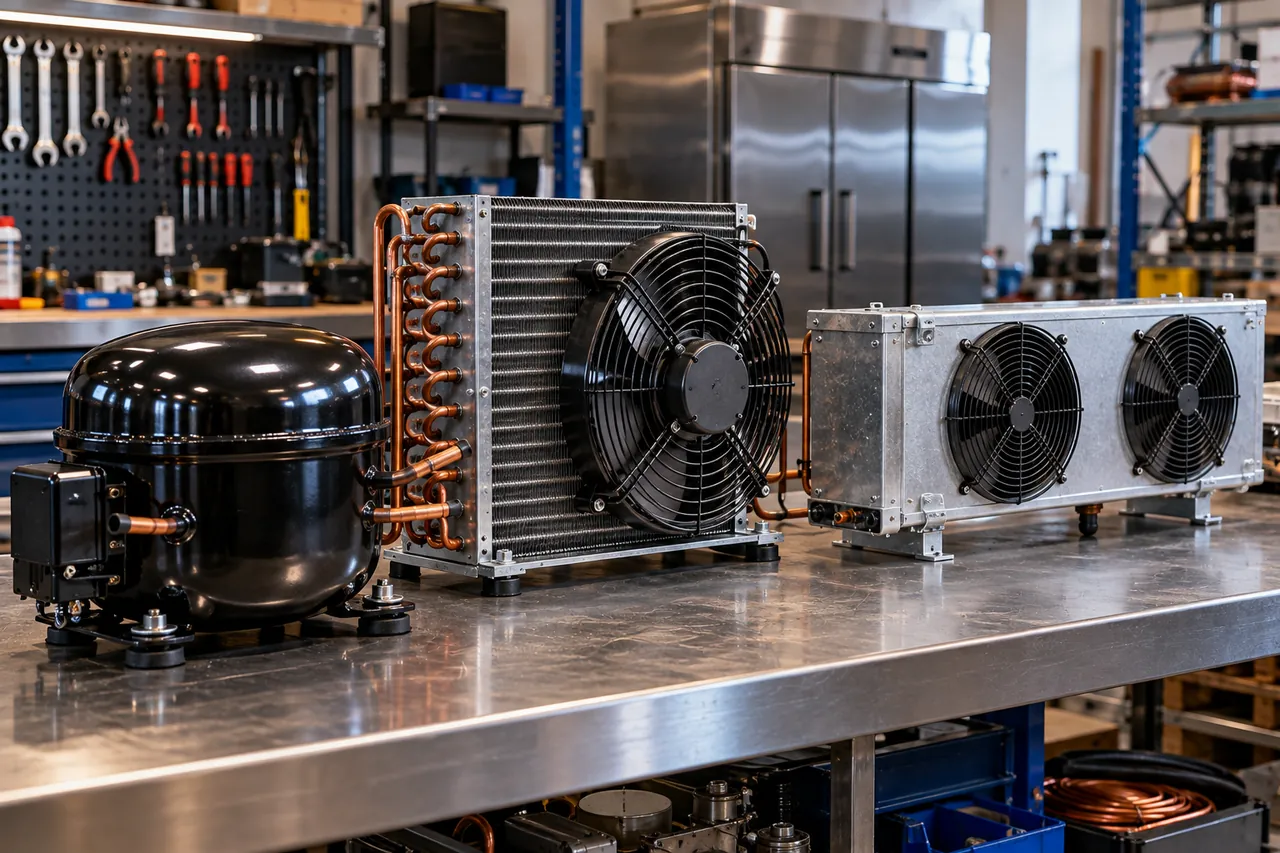
The evaporator takes heat out of the cold space, the compressor raises the refrigerant's pressure and temperature, and the condenser throws the heat away outside. Comparing condenser vs evaporator vs compressor is really comparing three stages of one loop: absorb, pump, reject.
All three are connected by copper pipe in a sealed circuit with a fourth part, the expansion device, which drops the pressure again before the refrigerant re-enters the evaporator. The same vapour-compression cycle runs in a domestic fridge, a supermarket display case, a walk-in cold room, a truck reefer and a home air conditioner. Only the size, refrigerant and operating temperatures change. If you want the full cycle step by step, read how refrigeration works; this guide focuses on telling the three main components apart.
| Part | What it does | Where it sits | Refrigerant state | Typical temperature (walk-in cooler at +2 °C) |
|---|---|---|---|---|
| Evaporator | Absorbs heat from the air in the cold space | Inside the fridge, cold room or indoor AC unit | Low-pressure liquid boiling to vapour | Coil at about −6 °C to −8 °C (21–18 °F) |
| Compressor | Pumps vapour from low to high pressure | Outside, in the condensing unit or machine compartment | Vapour in, hot high-pressure vapour out | Discharge 60–90 °C (140–195 °F) |
| Condenser | Releases heat to outdoor air or water | Outside, next to the compressor | Hot vapour condensing to liquid | About 10–15 K above ambient, e.g. 45 °C (113 °F) in 32 °C air |
| Expansion valve | Drops pressure and meters liquid into the evaporator | At the evaporator inlet | High-pressure liquid to low-pressure mix | Outlet at evaporating temperature |
What does an evaporator do?
An evaporator is the heat exchanger that makes the cold: liquid refrigerant boils inside its tubes at low pressure, and boiling absorbs heat from the air blown across its fins. That is why the coil inside a fridge or cold room is the coldest part of the system.
Refrigerant arrives from the expansion valve as a cold mix of liquid and a little flash gas. As it travels through the coil it absorbs heat and turns completely into vapour, leaving a few degrees warmer than its boiling point. That extra warmth is called superheat, normally 4–8 K at the coil outlet. A fan pulls warm room air through the fins and pushes cold air back into the space.
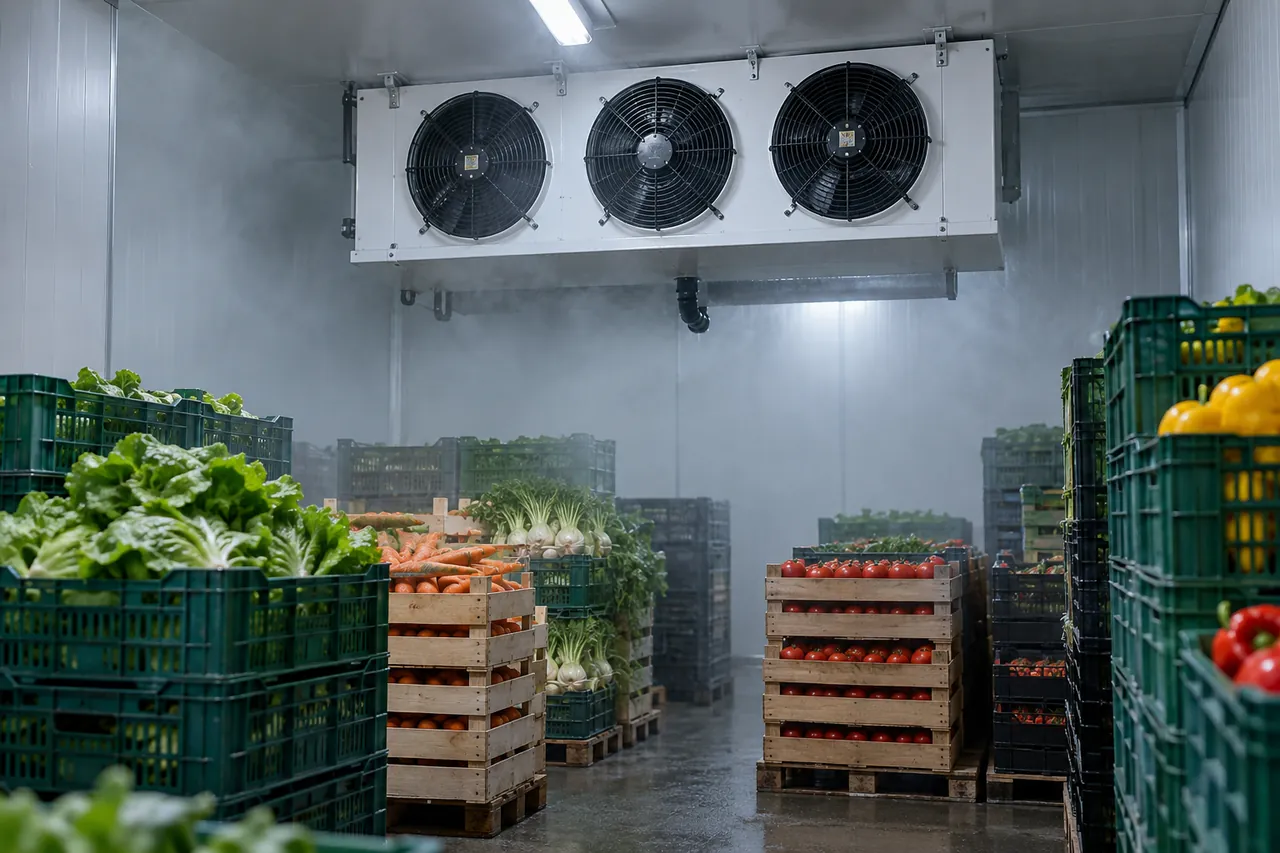
In a commercial cold room the evaporator is called a unit cooler: a coil, fans, a drain pan and, for freezers, electric defrost heaters in one housing hung from the ceiling. For coil types, fin spacing and defrost, see our evaporator coil and unit cooler guide.
What does an AC evaporator do?
In an air conditioner the evaporator coil sits in the indoor unit or air handler. It does exactly the same job, cooling and dehumidifying room air, but runs warmer, at about +5 °C to +10 °C (41–50 °F), because it only needs to bring a room to about 24 °C (75 °F). Water condensing on the coil drains away through the condensate line.
What does a compressor do?
A compressor is the pump of the system: it sucks low-pressure vapour out of the evaporator and squeezes it to high pressure, which also makes it hot enough to give its heat away outside. Without the compressor, the refrigerant would have no way to move heat "uphill" from a cold room to warm outdoor air.
Compression raises the vapour's temperature well above the outdoor air, typically to 60–90 °C (140–195 °F) at the discharge port. The compressor is also where most of the system's electricity goes, which matters later because all of that electrical energy ends up as extra heat in the condenser. Small cabinets use hermetic reciprocating or rotary compressors; cold rooms use hermetic, scroll or semi-hermetic types. Our refrigeration compressor guide explains how each type works, and the hermetic vs semi-hermetic vs scroll comparison helps you choose between them.
What is a condenser and what does it do?
A condenser is the heat exchanger that rejects heat from the refrigerant to the outside air or to water, cooling the hot vapour from the compressor until it condenses back into a liquid. It is the "hot coil" you feel blowing warm air at the back or bottom of a fridge or from an outdoor unit.
The condenser works in three zones. First the superheated discharge gas cools to its condensing temperature (desuperheating); then it condenses to liquid, which is where most heat leaves; finally the liquid cools a few degrees further below condensing temperature, called subcooling, typically 3–8 K. Subcooled liquid then flows through the liquid line to the expansion valve. Technicians measure superheat and subcooling to judge whether the charge is correct.
Types of condenser
- Air cooled condenser: a finned coil and fan. Used on almost all fridges, display cases, ice makers and cold room condensing units. Simple and water-free, but loses capacity as ambient air gets hotter.
- Water-cooled condenser: a shell-and-tube, coaxial or plate heat exchanger cooled by tower or chilled water. Stable condensing pressure in hot plant rooms; common on ice machines in hot kitchens and on larger industrial systems.
- Evaporative condenser: water sprayed over a coil while a fan blows air through it. Used on large ammonia and industrial refrigeration plants because it condenses close to the wet-bulb temperature.
- Static (wire-and-tube) condenser: the black grid on the back of a domestic fridge, cooled by natural convection, with no fan.
The phrase "air cooled condenser power plant" (ACC) refers to something different: very large steam condensers that cool turbine exhaust at power stations. The principle of rejecting heat to air is the same, but they are not refrigeration equipment.
What does a fridge condenser look like?
On a household fridge, the fridge condenser is a black wire-and-tube grid on the back or a fan-cooled coil under the cabinet behind the kick plate. On commercial reach-ins and display fridges, it is a small finned coil with a fan in the machine compartment, usually at the bottom or top. On a cold room or air conditioner, it is the outdoor box with a large fan and a coil on one, two or four sides.
Condenser vs evaporator coils: how do they compare?
Condenser and evaporator coils look similar, both being copper tubes with aluminium fins, but the condenser runs hot and high-pressure and rejects heat, while the evaporator runs cold and low-pressure and absorbs it. The condenser always carries the larger heat duty, because it removes the evaporator's heat plus the compressor's work.
| Feature | Condensing coil | Evaporator coil |
|---|---|---|
| Job | Reject heat outside | Absorb heat inside |
| Pressure (R404A cold room, gauge) | About 17–21 bar (250–300 psig) | About 3–5 bar (45–75 psig) for a cooler; 0.8–2 bar (12–30 psig) for a freezer |
| Coil temperature | About 40–55 °C (104–131 °F) | About −30 °C to −5 °C (−22 °F to 23 °F) |
| Fin spacing | Close, about 2 mm (12 fins per inch) | Wider, 4–6 mm (6–4 fins per inch), to tolerate frost |
| Heat duty | 1.2–1.6 × evaporator capacity | Rated cooling capacity |
| Main enemy | Dust, grease, leaves, hot recirculated air | Frost and ice, blocked drains |
| Defrost needed? | No | Yes in freezers and in coolers below about +2 °C |
The heat rejection factor in the table is the useful rule of thumb. For a medium-temperature cooler, a condenser rejects about 1.2–1.4 times the cooling capacity; for a low-temperature freezer it is 1.4–1.6 times, because the compressor works harder per kilowatt of cooling. A 5 kW (17,000 BTU/h) freezer evaporator therefore needs a condenser able to dump about 7–8 kW (24,000–27,000 BTU/h).
Condenser vs compressor: what is the difference?
The compressor is a motor-driven pump that moves refrigerant and raises its pressure; the condenser is a passive coil that only removes heat. One uses electricity to do work, the other just exchanges heat with air or water using a fan.
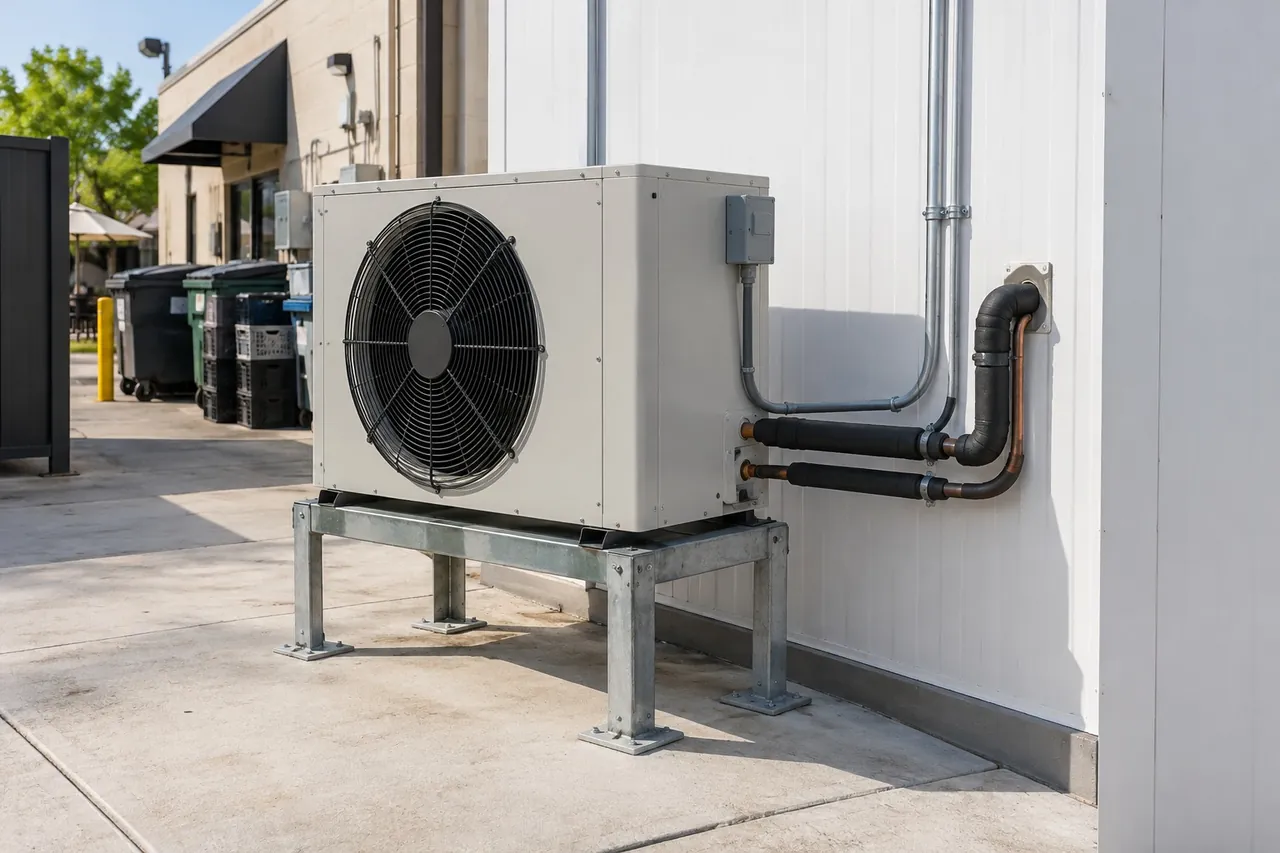
The confusion comes from naming. On a split cold room or air conditioner, the outdoor box is often called "the condenser", but it is properly a condensing unit: the compressor, condenser coil, fan, receiver, controls and service valves on one base. When someone says "my AC condenser is not working", the fault is just as likely to be the compressor, a capacitor or the fan motor inside that box.
AC compressor vs condenser in a home or HVAC system
For HVAC compressor vs condenser questions the logic is identical to commercial refrigeration. In a split air conditioner the outdoor unit contains the compressor and the condenser coil; the indoor unit contains the evaporator coil. A "3 ton condenser and coil" set is a matched outdoor condensing unit and indoor evaporator coil rated at about 10.5 kW (36,000 BTU/h); a 2 ton set is about 7 kW (24,000 BTU/h). One ton of refrigeration equals 3.517 kW (12,000 BTU/h). Be There does not sell home air conditioning, but the same sizing logic applies to cold room condensing units.
Where are the condenser, evaporator and compressor located?
The evaporator is always inside the space being cooled, and the compressor and condenser are almost always outside it, close together, so the heat leaves the room. How far "outside" depends on the system type.
| Equipment | Evaporator | Compressor and condenser |
|---|---|---|
| Domestic fridge | Behind the rear inner wall or freezer panel | Compressor at bottom rear; condenser on the back or under the cabinet |
| Commercial reach-in or display fridge | Behind a fan panel at the top or back of the cabinet | Machine compartment at top or bottom |
| Walk-in cooler or freezer (split) | Unit cooler hung from the ceiling inside | Condensing unit outdoors or on the roof, often 15–30 m (50–100 ft) away |
| Walk-in (monoblock) | Inside part of a through-wall unit | Outside part of the same unit |
| Supermarket rack system | In each display case and cold room | Compressor rack in a plant room; remote condenser or gas cooler on the roof |
| Split air conditioner | Indoor wall unit or air handler | Outdoor unit |
For walk-ins, choosing between monoblock and split arrangements, and where to put the condensing unit, is covered in our walk-in cooler condensing unit and evaporator guide. For supermarkets with dozens of cases, see rack and CO2 refrigeration systems.
What goes wrong with each part?
Each component has its own typical failure: condensers clog, evaporators ice up, and compressors overheat or wear out, usually because one of the other two parts was neglected. Knowing which symptoms belong to which part speeds up diagnosis.
Condenser problems
- Dirty condenser coil: dust and kitchen grease insulate the fins. Head pressure rises, the compressor draws more current, runs hotter and uses more energy; in hot weather the unit trips on high pressure.
- Failed condenser fan motor: very high head pressure within minutes; the compressor short-cycles on its overload.
- Hot air recirculation: an outdoor unit boxed into a corner breathes its own exhaust. Keep at least 300–600 mm (12–24 in) clearance on the intake side.
- Corroded or damaged fins near coastlines; specify coated coils for marine sites.
Evaporator problems
- Ice build-up from failed defrost, a door left open, low refrigerant or a stopped fan.
- Blocked or frozen drain lines causing water or ice on the floor.
- Product stacked against the coil, blocking air flow.
Compressor problems
- Overheating and tripping because of a dirty condenser or low charge.
- Failed start capacitor or relay: the compressor hums but does not start.
- Liquid flood-back from an iced evaporator, which damages valves, or burnt windings after long overheating.
Cleaning condenser coils monthly and checking evaporator defrost quarterly prevents most compressor failures. Our commercial refrigeration maintenance checklist sets out the full schedule.
Condenser coil replacement cost
Condenser coil replacement cost varies widely with size, refrigerant and labour rates. As an indicative guide only, a small commercial cabinet coil is a relatively cheap part, but labour, brazing, a new filter drier, evacuation and recharge usually cost more than the coil itself. For a cold room or a 2–3 ton condensing unit, a coil replacement often runs into the low thousands of US dollars in markets such as the US; at that point, compare the quote with a complete new condensing unit, especially if the existing one uses a refrigerant that is being phased down. Any work that opens the circuit must be done by a certified technician under local rules, such as EPA Section 608 in the US or the F-gas regulation in the EU.
How to match a condenser, evaporator and compressor
The three parts must be selected as a balanced set at the same evaporating and condensing temperatures, or the system will either short-cycle or never reach temperature. Use this checklist when specifying or replacing equipment:
- Calculate the room or cabinet heat load first, for example with the cold room refrigeration load calculator, including running-time allowance (16 h for chillers, 18 h for freezers).
- Choose the evaporating temperature from the room temperature and the humidity the product needs: about 6–10 K below room air for most coolers, about 8 K for freezers.
- Select the evaporator at that evaporating temperature and temperature difference, not at a catalogue "nominal" rating.
- Select the compressor or condensing unit for the same capacity at the same evaporating temperature and at your real summer ambient, for example 35 °C or 43 °C (95 °F or 110 °F), not 25 °C (77 °F).
- Check the condenser can reject 1.2–1.6 times the cooling capacity at that ambient, with clear air flow and room for cleaning.
- Match the expansion valve orifice and refrigerant to the evaporator capacity.
- Confirm voltage, phase and frequency, and the refrigerant permitted in your market.
Be There supplies complete walk-in cooler and freezer kits with a condensing unit and evaporator already matched to the room size, panel thickness and your local ambient, from chillers at 0 °C to +10 °C to freezers at −18 °C to −25 °C and blast rooms to −35 °C. Our truck refrigeration units come as matched condenser, compressor and evaporator sets for 4–45 m³ boxes. Send your room dimensions, temperature, product and power supply through the inquiry form and we will quote FOB, CIF or DDP.