



Short answer
A 12V air conditioner or 24 V truck parking cooler is a battery-powered AC with its own electric compressor that cools a cab with the engine off. Typical units deliver 2–3 kW (7,000–10,000 BTU/h) and average 400–700 W, about 17–30 A at 24 V or 35–60 A at 12 V, so 8 hours needs roughly 3–6 kWh of battery.
Key takeaways
- Truck parking coolers typically deliver 2–3 kW (7,000–10,000 BTU/h) and draw 500–1,000 W at full speed.
- Current = power ÷ voltage: 720 W is 30 A at 24 V but 60 A at 12 V, so 24 V systems need lighter cable.
- Running 500 W for 8 hours uses 4 kWh: about 333 Ah of lead-acid or 196 Ah of LiFePO₄ at 24 V.
- Set a low-voltage cut-off around 22.5–23.5 V (24 V) or 11.3–11.8 V (12 V) to protect starting batteries.
- Evaporative 12 V car air coolers only cool dry air, by about 5–10 °C, and add humidity; they are not air conditioners.
- Refrigerant leak repair and recharging must be done by a certified AC technician.
What is a 12V or 24V truck air conditioner?
A 12V air conditioner or 24 V truck air conditioner is a DC-powered cooling unit with its own electric compressor that runs from the vehicle's batteries, so it can cool a sleeper cab or van with the engine switched off. In trucking these units are usually called parking coolers or no-idle air conditioners, and typical models deliver about 2–3 kW (7,000–10,000 BTU/h) of cooling.
A vehicle's factory AC uses a compressor driven by the engine belt, so it stops when the engine stops. For a driver taking a 10-hour rest break in summer, the choices are to idle the engine all night, which burns roughly 2–4 L (0.5–1 US gal) of diesel per hour and is restricted by anti-idling rules in many places, or fit a battery-powered unit. That is the job a semi truck air conditioner of the parking type does.
The same technology appears in campervans, ambulances, construction cabs, boats and off-grid cabins. Heavy trucks mostly run 24 V electrics (two 12 V batteries in series, common in Europe, Asia and Australia), while North American trucks and most vans and cars run 12 V. Buy the unit to match the vehicle's system voltage; 24 V units draw half the current for the same power.
What types of 12V and 24V air conditioners are there?
There are four common types: rooftop parking coolers that fit a roof hatch, split back-wall units with an external condenser, portable compressor units that sit in the cab, and evaporative air coolers that use water and a fan rather than refrigerant. Only the first three are true air conditioners.
| Type | Cooling capacity | Typical power draw | Install | Best for |
|---|---|---|---|---|
| Rooftop parking cooler | 2.0–3.0 kW (7,000–10,000 BTU/h) | 500–1,000 W; about 20–40 A at 24 V or 40–80 A at 12 V | Replaces roof hatch, about 400 × 400 mm (16 × 16 in) opening | Sleeper cabs, vans, ambulances |
| Split back-wall or under-bunk unit | 2.0–3.0 kW | 500–1,000 W | Condenser on cab back or chassis, evaporator inside | Cabs with no roof hatch or tall fairings |
| Portable 12 V compressor unit | 0.6–1.5 kW (2,000–5,000 BTU/h) | 250–600 W | Freestanding, hoses or vent through window | Small cabs, temporary use |
| Evaporative "12V car air cooler" | Air cooled 5–10 °C below ambient in dry air only | 30–100 W | Freestanding, needs water | Dry climates; little effect in humid weather |
| Engine-driven factory AC | 4–8 kW | Engine shaft power | Factory fitted | Driving; stops when engine stops |
Most good units now use an inverter (variable-speed) DC compressor. It starts softly with no current surge, slows down once the cab is cool and can cut average current draw by a third or more compared with an on-off compressor. Our wider guide to DC and battery-powered air conditioners covers off-grid and solar applications beyond vehicles.
Is a portable automotive air conditioner a real AC?
A portable automotive air conditioner with a compressor, refrigerant and a hot-air exhaust hose is a real air conditioner, just a small one. Many products sold as a "mini AC for car" or "12V car air cooler", however, are evaporative coolers: a fan blows air through a wet pad. They can cool very dry air noticeably, but in humid weather they barely lower the temperature and add moisture to the cab. Check the specification: a true AC lists refrigerant type, compressor and cooling capacity in watts or BTU/h; an evaporative cooler lists water tank size.
How much power does a 12V or 24V air conditioner use?
A parking cooler rated about 2.5 kW (8,500 BTU/h) typically draws 700–1,000 W at full speed and averages about 400–700 W once the cab is cool. That is roughly 17–30 A average on a 24 V truck or 35–60 A average on a 12 V system, with full-speed peaks of about 40 A and 80 A respectively.
The current follows from power divided by voltage: 720 W ÷ 24 V = 30 A; 720 W ÷ 12 V = 60 A. Actual draw depends on outside temperature, sun on the cab, insulation, curtains and the thermostat setting. A unit cooling a well-insulated sleeper with curtains drawn at night may average under 400 W; the same unit in full afternoon sun can run flat out.
| Average power | Current at 12 V | Current at 24 V | Energy over 8 hours | Energy over 10 hours |
|---|---|---|---|---|
| 300 W | 25 A | 12.5 A | 2.4 kWh | 3.0 kWh |
| 500 W | 42 A | 21 A | 4.0 kWh | 5.0 kWh |
| 700 W | 58 A | 29 A | 5.6 kWh | 7.0 kWh |
| 900 W | 75 A | 38 A | 7.2 kWh | 9.0 kWh |
How big a battery do you need to run a 12V AC overnight? (worked example)
Multiply average power by hours of use to get energy, divide by system voltage to get amp-hours, then divide by the usable fraction of the battery: about 50% for lead-acid or AGM and about 80–90% for lithium iron phosphate (LiFePO₄). For 8 hours at 500 W on 24 V, that is about 333 Ah of lead-acid or about 190–210 Ah of LiFePO₄.
- Energy needed: 500 W × 8 h = 4,000 Wh (4 kWh).
- Amp-hours at system voltage: 4,000 Wh ÷ 24 V = 167 Ah (or 4,000 ÷ 12 = 333 Ah on a 12 V system).
- Lead-acid or AGM, using no more than 50% depth of discharge: 167 ÷ 0.5 = about 333 Ah at 24 V (667 Ah at 12 V).
- LiFePO₄, using about 80–90%: 167 ÷ 0.85 = about 196 Ah at 24 V (about 392 Ah at 12 V).
- Add 10–20% for inverter, cable and cold-weather losses, and to leave reserve for the cab's other loads.
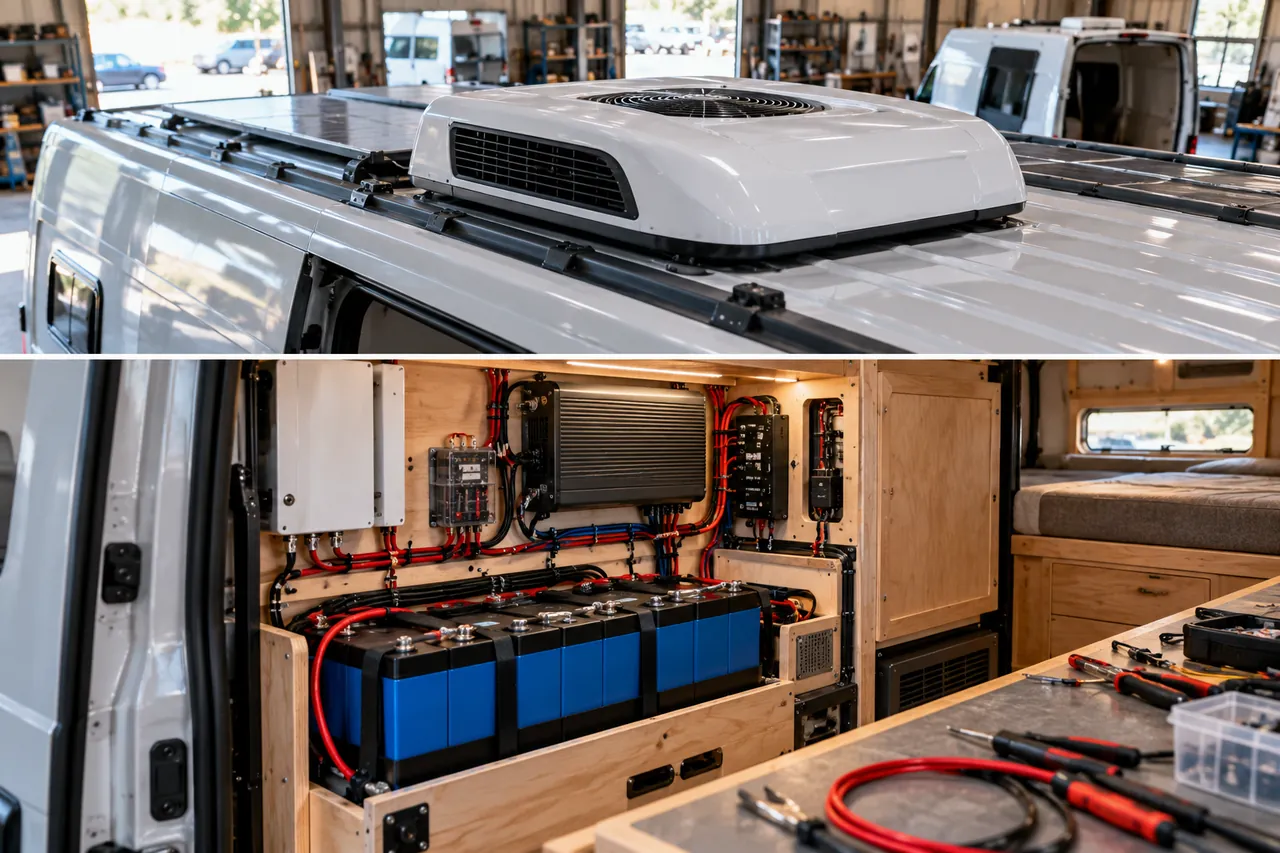
Two points follow. First, a typical truck's two starting batteries of 180–225 Ah at 24 V cannot run a parking cooler all night and still reliably start a large diesel engine, which is why most installers add a separate house battery bank. Second, the bank must be recharged during the next drive: 4–6 kWh needs a strong alternator and a DC-DC charger, or several hours of driving. Solar helps but does not replace this: a 200 W roof panel yields roughly 0.6–0.9 kWh on a good summer day.
Every parking cooler should have a low-voltage cut-off, typically set around 22.5–23.5 V on 24 V systems or 11.3–11.8 V on 12 V systems, so it shuts down before the starting batteries are drained. Use the battery-type setting if the unit offers one, because lithium batteries hold a higher voltage for most of their discharge.
Cable size and fusing
High DC currents need heavy cable. A 12 V unit drawing up to 80 A over a 4 m (13 ft) one-way run needs about 25–35 mm² (AWG 4–2) cable to keep voltage drop to around 3%; at 24 V the same power needs roughly half the current and a smaller cable. Fit a fuse or circuit breaker rated for the cable within about 30 cm (12 in) of the battery. Undersized cable is the most common cause of units cutting out on low voltage when the batteries are actually fine.
How much cooling does a truck cab or sleeper need?
Most sleeper cabs of 5–10 m³ (175–350 cu ft) need about 1.5–2.5 kW (5,000–8,500 BTU/h) of cooling to stay comfortable at night, and 2.5–3.5 kW (8,500–12,000 BTU/h) to pull down a cab parked in afternoon sun. Day cabs with curtains closed need less; high-roof sleepers with large windscreens need more.
| Vehicle space | Approx. volume | Suggested cooling | Typical unit |
|---|---|---|---|
| Car or small van cab | 2–3 m³ (70–105 cu ft) | 0.6–1.2 kW (2,000–4,000 BTU/h) | Portable 12 V compressor unit |
| Day cab, curtained bunk area | 4–6 m³ (140–210 cu ft) | 1.2–2.0 kW (4,000–7,000 BTU/h) | Compact rooftop or back-wall unit |
| Mid-roof sleeper cab | 6–8 m³ (210–280 cu ft) | 2.0–2.5 kW (7,000–8,500 BTU/h) | Rooftop parking cooler |
| High-roof sleeper cab | 8–11 m³ (280–390 cu ft) | 2.5–3.5 kW (8,500–12,000 BTU/h) | Larger rooftop or split unit |
| Camper van living area | 8–12 m³ (280–420 cu ft) | 2.0–3.5 kW, depending on insulation | Rooftop 12 V or 230/120 V unit |
Insulation, window shades and parking in shade cut energy use more than any change of unit. Insulating a cab roof and back wall, fitting reflective windscreen covers and closing bunk curtains so only the sleeper is cooled can roughly halve the battery capacity needed. For larger camper and specialty vehicles, see our guide to rooftop air conditioners for RVs and vans.
How is a truck parking air conditioner installed?
A rooftop parking cooler replaces the cab's roof hatch: the unit sits on a gasket over the opening, is clamped from inside with a frame, and the power cable runs through fused protection to the battery bank. A split unit mounts the condenser on the cab back wall or chassis and the evaporator inside, joined by pre-charged refrigerant lines.
- Check roof strength, hatch size and height clearance; a rooftop unit adds about 60–120 mm (2.5–5 in) and 25–40 kg (55–90 lb).
- Plan battery capacity, charging (alternator, DC-DC charger, solar) and the low-voltage cut-off.
- Run correctly sized cable with a fuse near the battery and secure, abrasion-protected routing.
- Seal the roof gasket carefully; leaks into the cab are the most common installation complaint.
- Route the condensate drain so water runs off the cab rather than into it.
- Test cooling, airflow and the cut-off voltage before the first long trip.
Split systems with pre-charged quick couplings can be installed by competent fitters, but any work that opens the refrigerant circuit, such as shortening lines, adding charge or replacing components, must be done by a technician certified to handle refrigerants under local rules.
Why is my truck or car air conditioning not cold?
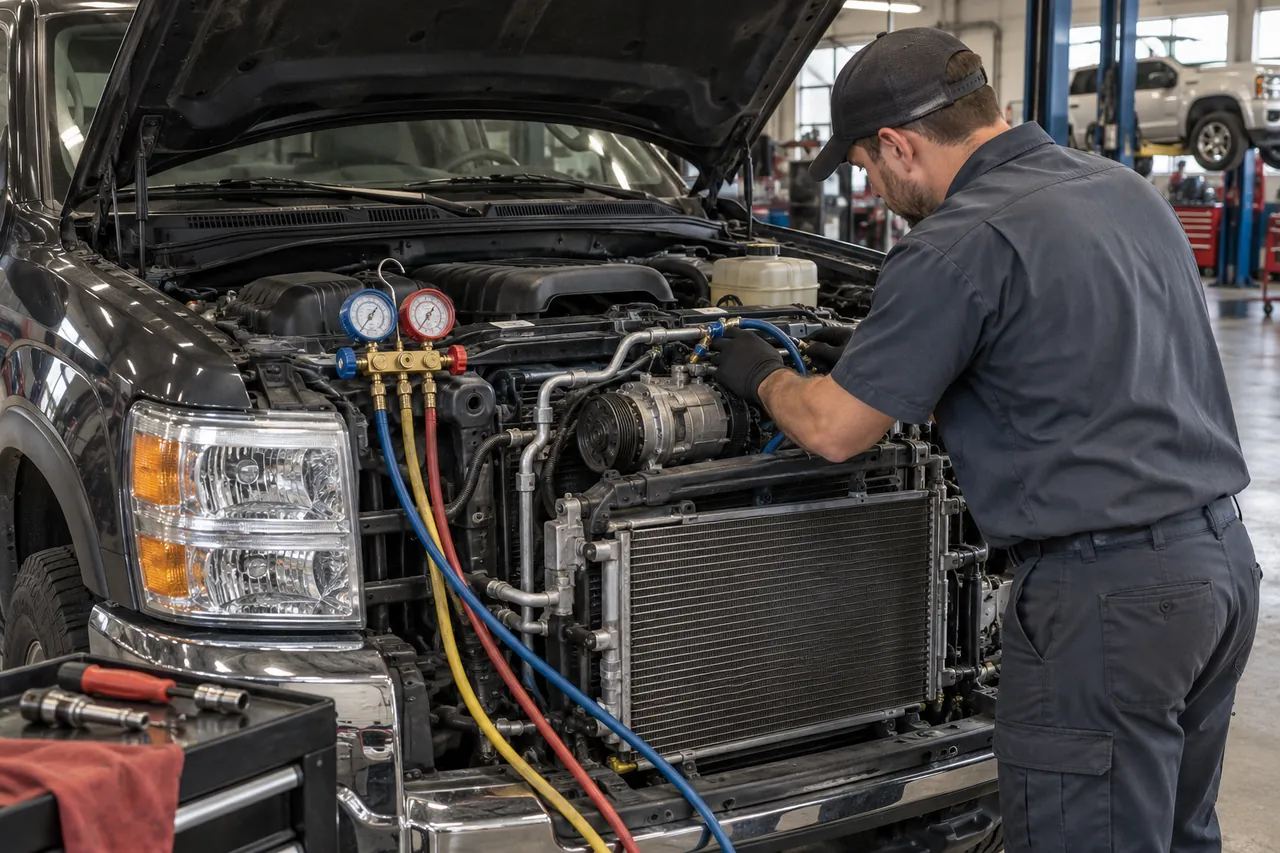
When factory truck air conditioning or car air conditioning stops blowing cold, the usual causes are low refrigerant from a leak, a compressor clutch that is not engaging, a blown fuse or relay, a failed condenser fan, a blocked condenser or cabin filter, or a blend door stuck on heat. For parking coolers, low battery voltage, a tripped cut-off and dirty condenser fins are the most common causes.
- Check the basics: settings, fuses and relays, cabin air filter and whether the blower moves air at every speed.
- With the engine running and AC on, see whether the compressor clutch engages and the condenser fan runs.
- Look at the condenser in front of the radiator for bugs, dirt and bent fins; clean gently with water.
- For DC units, measure battery voltage at the unit while it runs; a large drop points to cable or connection problems.
- If the compressor runs but air is warm, the system probably needs a leak test and recharge.
DIY recharge cans can overcharge a system or mask a leak, and venting refrigerant is illegal in many countries. Diagnosis of pressures, leak repair and recharging should be done by a certified AC technician, for example under US EPA Section 609 or the EU F-gas rules. For a fuller diagnostic sequence, read our guide to AC compressor and condenser problems.
How to choose a 12V or 24V air conditioning unit: checklist
Choose a 12V air conditioning unit or 24 V parking cooler by sizing cooling to the space, then sizing batteries and charging to the cooler.
- Match the unit to the vehicle's system voltage: 12 V or 24 V.
- Size cooling to the cab: about 2–2.5 kW for most sleepers, more for high roofs in hot climates.
- Prefer a true compressor AC with an inverter DC compressor over an evaporative cooler unless the climate is very dry.
- Calculate battery capacity for your longest stop and choose lithium or a separate house bank where weight allows.
- Confirm charging: alternator size, DC-DC charger and optional solar.
- Check roof hatch size, height limits, noise level and condensate drainage.
- Ask about local service, spare parts and who can do refrigerant work if needed.
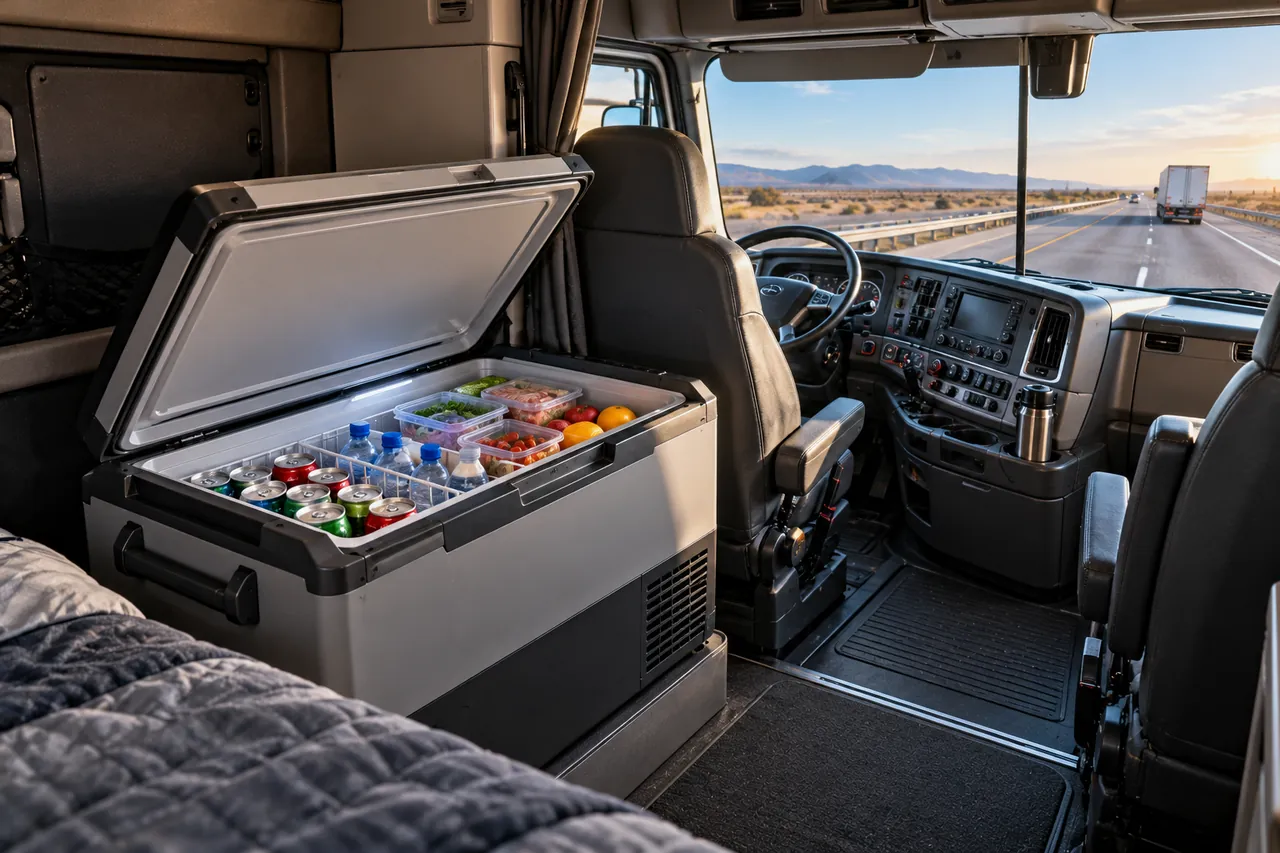
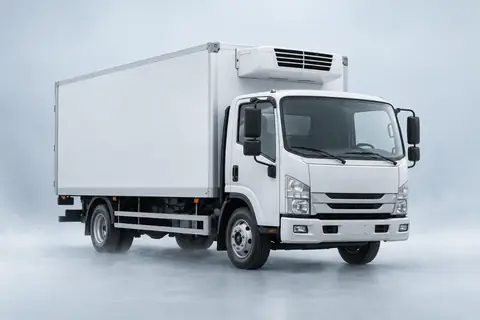
Be There does not make cab air conditioners. We make cargo cooling: truck refrigeration units for vans and trucks with 4–45 m³ insulated boxes, holding −20 °C to +15 °C, in engine-driven, independent diesel and fully electric versions. Our guide to how truck refrigeration units work explains the differences, and for small loads a 12V fridge freezer may be enough. Estimate your box load with the truck refrigeration calculator, then tell our engineers about your vehicle, cargo and temperature through the inquiry form and we will quote FOB, CIF or DDP.