
Short answer
A refrigerator compressor that is not working usually shows one of three signs: it clicks and hums every 2–5 minutes without starting, it is silent while fans and lights run, or it runs nonstop while the cabinet warms. Check voltage, controller, condenser, fans and start relay first; a running compressor shell at 50–90 °C (120–195 °F) is normal.
Key takeaways
- Most 'dead compressor' calls are a failed start relay, capacitor, contactor, fan, defrost control or dirty condenser, not the compressor itself.
- On a single-phase compressor, C–R reads lowest, C–S higher and R–S equals the sum; an open reading may be a tripped overload, so retest after cooling for an hour.
- A running compressor shell is normally about 50–90 °C (120–195 °F); keep the discharge line below about 107 °C (225 °F).
- Click–hum–click every 2–5 minutes points to start components, low voltage or an overheated or locked compressor.
- Indicatively in the US, a domestic compressor replacement costs about US$400–1,200 and a commercial reach-in US$800–2,500 installed.
- Replace the unit rather than the compressor if repair exceeds about half the price of new or the unit is past half its service life.
What are the signs of a bad refrigerator compressor?
The classic signs of a refrigerator compressor not working are a unit that hums or clicks every few minutes but never starts, a compressor that runs constantly while the cabinet stays warm, a tripping breaker, or a shell that is silent and cold while the fans and lights work. In practice, most "dead compressors" turn out to be a failed start relay, capacitor, fan, thermostat or dirty condenser, so test before you replace.
This guide is for owners and maintenance staff of commercial fridges, freezers and cold rooms, and covers what you can check safely and what needs a certified refrigeration technician. For how compressors work and the main types, see our refrigerator compressor guide.
| Symptom | Most likely causes | First check |
|---|---|---|
| Nothing runs, no lights | Power, plug, breaker, fuse, door switch, controller | Supply voltage at the socket or isolator |
| Lights and fans on, compressor silent | Thermostat or controller not calling, defrost timer stuck in defrost, failed relay or contactor, open overload | Controller display and mode; listen for a relay click |
| Click–hum–click every 2–5 minutes | Failed start relay or PTC, start capacitor, low voltage, overheated or locked compressor | Voltage under load; start components |
| Compressor runs, cabinet warm | Dirty condenser, failed condenser or evaporator fan, iced coil, refrigerant leak, restriction, worn compressor valves | Condenser and fans; frost on the evaporator |
| Compressor runs constantly, cabinet cold | Heavy load, door gasket leak, set point too low, high ambient | Gaskets, door closure, set point, room temperature |
| Breaker trips at start | Shorted winding, winding to earth fault, wiring fault | Technician: insulation resistance test |
| Loud knocking, rattling or squeal | Broken internal mount or valve, liquid slugging, loose mounting | Technician: pressures and superheat |
Why is my refrigerator compressor not running?
When a refrigerator compressor is not running, the cause is more often in the supply or controls than in the compressor itself: no call for cooling from the thermostat, a defrost cycle that has not ended, a failed contactor or start relay, or a thermal overload that has tripped because the compressor overheated. Work from the outside in.
- Check the controller. Is it showing a set point above the actual temperature? Is it in defrost (often shown as "dEF")? A defrost timer or controller stuck in defrost will stop the compressor for hours.
- Measure voltage at the unit while it tries to start. Single-phase compressors need roughly ±10% of nameplate voltage; a long extension lead or undersized cable can drop it far below that at start-up.
- Feel the compressor shell, carefully. If it is very hot and silent, the internal or external overload has probably tripped. Switch off, clean the condenser, and allow 30–60 minutes for it to cool and reset.
- Listen for the start relay or contactor. On commercial condensing units, a contactor that pulls in but has burned contacts may not pass power to the compressor.
- Check safety switches on cold rooms: high-pressure and low-pressure cut-outs, and phase-failure or phase-sequence relays on three-phase units. A tripped high-pressure switch usually points to a condenser fan or dirty coil.
A refrigerator compressor not working but the light is on usually means the cabinet has power but the compressor circuit does not: thermostat, defrost control, relay, overload or an inverter control board on variable-speed models.
How do you check a refrigerator compressor?
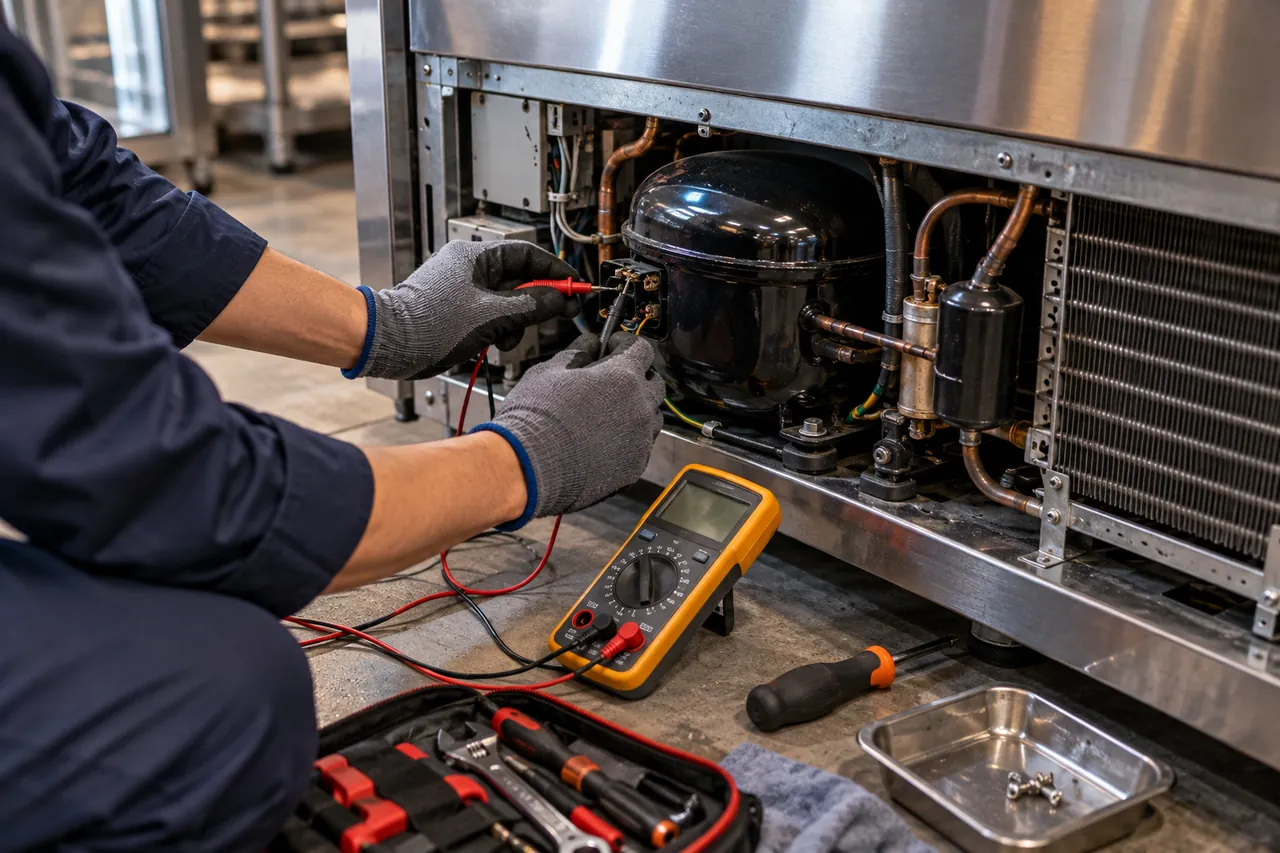
To check a refrigerator compressor, isolate the power, remove the terminal cover, and measure the motor windings and their insulation to earth with a meter; then, with power restored, measure running current and system pressures. Electrical tests on live equipment and any work on the refrigerant circuit should be done by a qualified technician.
1. Winding resistance test
A single-phase hermetic compressor has three terminals: common (C), start (S) and run (R). With power off and wires removed, measure resistance between each pair:
- C to R gives the lowest reading (run winding).
- C to S is higher (start winding).
- R to S should equal the sum of the other two.
Small fridge compressors typically read from a few ohms to a few tens of ohms; compare with the maker's data. An open circuit (infinite reading) on any pair means a broken winding or a tripped internal overload: let the compressor cool for an hour and test again before condemning it. Three-phase compressors should show three nearly equal readings between terminals.
2. Insulation (earth) test
Measure from each terminal to a clean, bare spot on the copper or steel shell. A multimeter should read open circuit. Technicians use an insulation tester (megohmmeter), usually at 500 V DC; a healthy compressor reads high, typically well into the hundreds of megohms, and a low reading means the winding insulation has broken down. Liquid refrigerant in the shell can lower the reading temporarily, so a cold compressor is often re-tested after running its crankcase heater.
3. Start components
Domestic and small commercial compressors use a PTC relay or a current relay, sometimes with a start capacitor and a run capacitor. A PTC relay that rattles or reads open when cold, or a capacitor that is bulging or out of its microfarad tolerance, is a cheap fix that restores many "dead" compressors.
4. Running current and pressures
With the compressor running, compare its current with the rated load amps (RLA) on the nameplate. Current well below RLA with low discharge pressure and high suction pressure suggests worn valves; current at or above RLA with high discharge pressure suggests a condenser problem or overcharge. A technician reads suction and discharge pressures and calculates superheat and subcooling to separate compressor faults from charge and flow faults; see how to calculate superheat and subcooling.
How hot should a refrigerator compressor get?
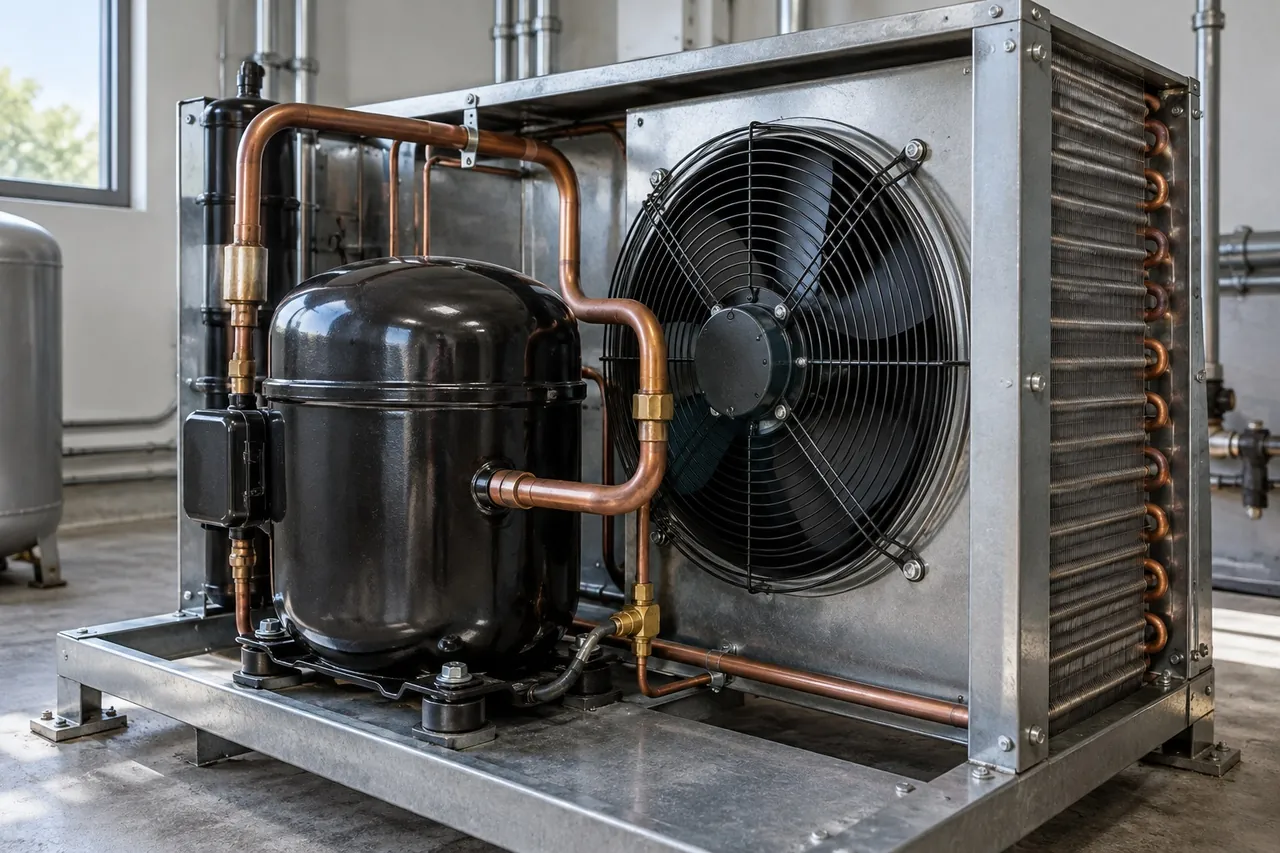
A running refrigerator compressor is normally hot: the shell commonly sits around 50–90 °C (120–195 °F), too hot to hold a hand on for more than a moment. That is not a fault. It becomes a problem when the discharge line close to the compressor exceeds about 107 °C (225 °F), the overload keeps tripping, or the suction line is warm instead of cool.
| Point | Normal (typical) | Warning sign |
|---|---|---|
| Compressor shell, top | About 50–90 °C (120–195 °F) | Over 100 °C (212 °F), overload cycling |
| Discharge line, 150 mm (6 in) from compressor | About 60–95 °C (140–203 °F) | Above about 107 °C (225 °F): oil breakdown risk |
| Suction line at compressor | Cool to cold; may sweat or frost slightly on freezers | Warm (high superheat, starved evaporator) or heavily frosted to the shell (liquid flood-back) |
| Condenser air outlet | About 8–15 K above room air | Very hot air with high pressure (dirty coil, fan fault) |
A refrigerator compressor that is hot to the touch but not running has usually tripped on its overload. Common causes are a blocked or dirty condenser, a failed condenser fan, low voltage, a hot room, low refrigerant charge (less cool suction gas returning to cool the motor) or a failing start relay keeping the start winding energised. Fix the cause before resetting, or the compressor will burn out. A mini fridge compressor running hot is often simply boxed into a cabinet without ventilation.
Why is the compressor running but the fridge is not cooling?
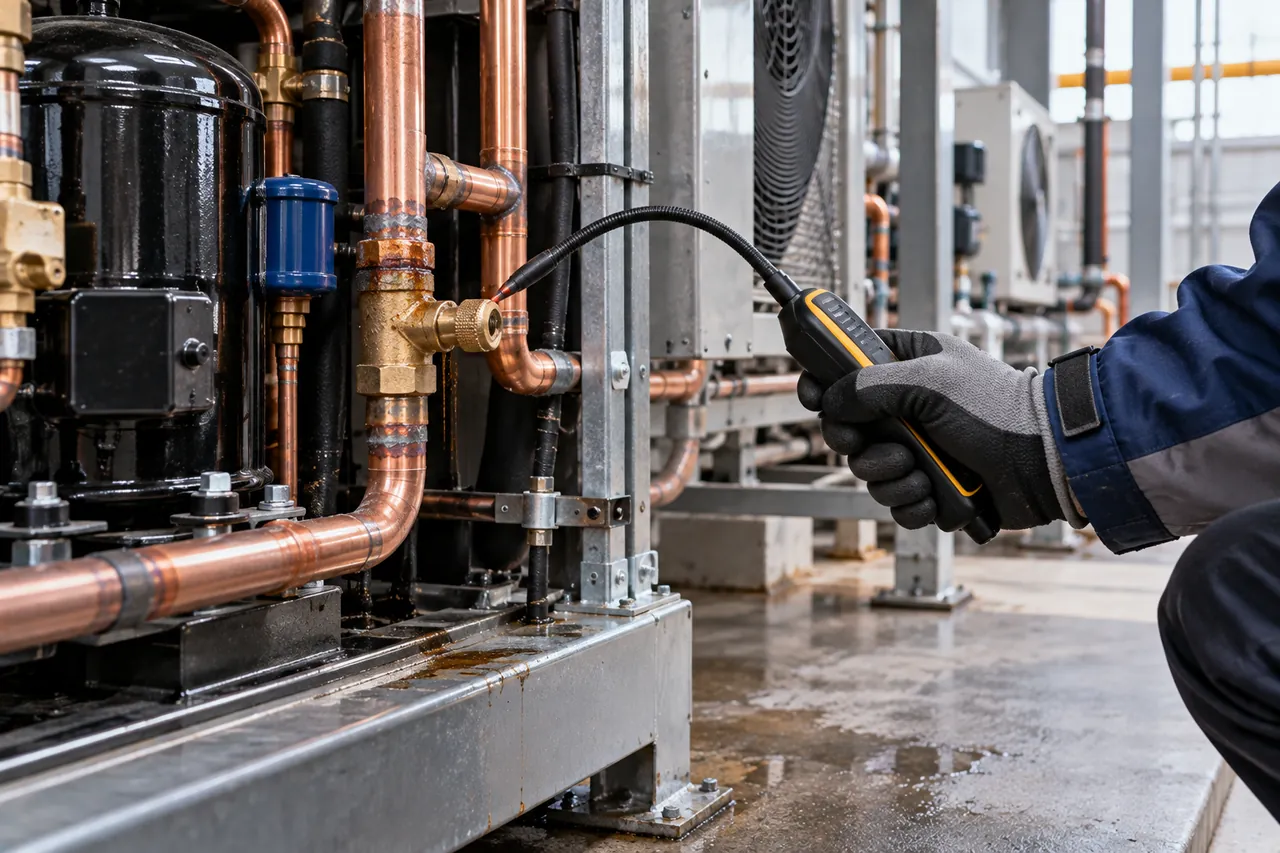
If the compressor is running but not cooling, heat is either not being moved (low refrigerant, a restriction or worn compressor valves) or not reaching the coils (failed fans, iced evaporator, dirty condenser). The fan and coil checks are quick and free; refrigerant faults need a technician with gauges and a leak detector.
- Evaporator iced solid: defrost has failed (heater, termination sensor, timer). Defrost manually, then find the fault; see walk-in freezer and cooler troubleshooting.
- Evaporator fan stopped: the coil frosts and the box warms although the compressor runs.
- Condenser dirty or its fan stopped: head pressure rises, capacity falls and the overload may trip.
- Partial frost on the evaporator, warm suction line, bubbles in the sight glass: likely low charge from a leak. Recharging without fixing the leak is a short-term fix; see the refrigerant leak guide.
- Frost or sweating at a filter drier or capillary inlet: a restriction from moisture or debris.
- Normal fans and charge but low pressure difference between suction and discharge: worn valves or a scroll running backwards on a three-phase unit with reversed phases.
How much does it cost to replace a refrigerator compressor?
As an indicative guide in the US market, refrigerator compressor replacement on a domestic fridge typically costs about US$400–1,200 including the part, a new filter drier, refrigerant and 2–5 hours of labour. Commercial reach-in compressors commonly cost about US$800–2,500 installed, and a walk-in cold room compressor or condensing unit US$1,500–5,000 or more. Prices vary widely by country, refrigerant and access.
| Equipment | Compressor part (indicative) | Total replacement (indicative) | Usually worth it? |
|---|---|---|---|
| Mini fridge or bar fridge | US$100–250 | Often more than the fridge | Rarely: replace the unit |
| Home fridge-freezer | US$150–450 | US$400–1,200 | Only if under about 5–7 years old |
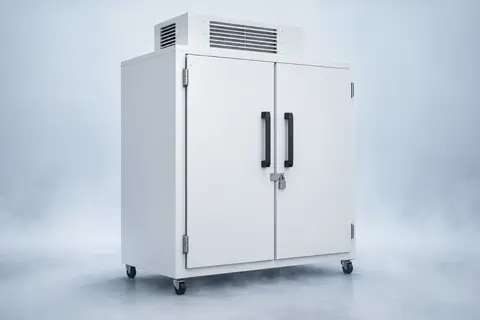
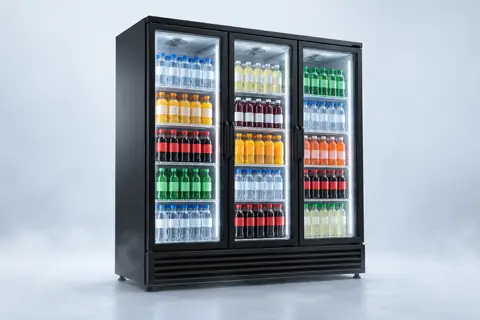
| Commercial reach-in or glass door fridge | US$300–1,000 | US$800–2,500 | If cabinet, gaskets and insulation are sound |
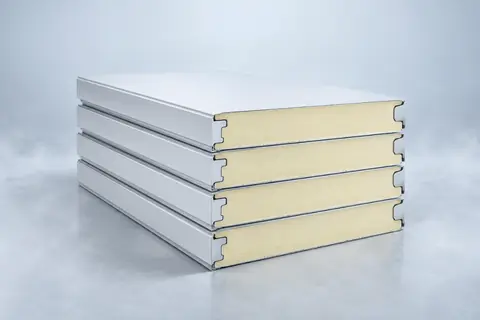
| Walk-in cooler or freezer condensing unit | US$800–3,000+ | US$1,500–5,000+ | Usually yes; the panels last 20+ years |
The labour is more than swapping a part: the technician recovers the refrigerant, brazes in the new compressor and drier, pressure-tests, evacuates to a deep vacuum, recharges by weight and checks superheat. After a burnout the system also needs an acid test and a suction-line filter drier to clean it, otherwise the new compressor can fail within months. In the US this work requires EPA Section 608 certification; in the EU and UK, F-gas certification.
Repair or replace?
A common rule of thumb is to replace the whole unit if the repair costs more than about half the price of new equipment, or if the unit is past about half its service life (reach-ins typically last 10–15 years). Also consider the refrigerant: if a plug-in unit uses an HFC that is being phased down in your market, a new R290 unit may cost less to run and service. Our used vs new commercial refrigeration guide gives service-life figures. Walk-in cold rooms are different: the insulated box usually outlives several condensing units, so replacing the refrigeration alone is normally the right call.
How do you prevent compressor failure?
Most compressor failures are caused by heat, poor lubrication, liquid refrigerant reaching the compressor, or electrical problems, not by age alone. Preventive maintenance targets each of these:
- Clean condenser coils monthly in kitchens and every 3 months elsewhere, and keep ventilation clearances clear.
- Check that condenser and evaporator fans run and that the evaporator defrosts fully.
- Keep supply voltage within about ±10% of nameplate; fit phase-failure protection on three-phase units.
- Have superheat and subcooling checked during annual service; low superheat floods the compressor with liquid, high superheat overheats it.
- Make sure crankcase heaters work on outdoor condensing units in cold climates.
- Fix refrigerant leaks rather than topping up.
The full routine is in our commercial refrigeration maintenance checklist.
Checklist: before you call a technician
- Note the symptoms: silent, clicking, running constantly, tripping, noisy; and the cabinet temperature.
- Check power, breaker, plug and controller set point and mode.
- Look at the condenser: dusty or blocked? Is its fan running?
- Look at the evaporator: iced solid? Is its fan running?
- Feel the compressor and lines carefully: very hot and silent suggests an overload trip.
- Write down the model, serial number, refrigerant type and age from the data plate.
- Move product to backup storage if the cabinet is above +5 °C (41 °F) or the freezer above −15 °C (5 °F).
- Ask the technician for a written diagnosis, the cost of repair versus replacement and the refrigerant to be used.
When repair is not worth it, Be There supplies replacement glass door display refrigerators with an R290 option and complete walk-in cold room kits with matched condensing units, evaporators and controllers. Send the size, temperature and voltage you need through the inquiry form and we will quote FOB, CIF or DDP.