Short answer
Truck refrigeration unit maintenance means a daily pre-trip check, cleaning condenser and evaporator coils every 1–3 months, servicing diesel reefer engines typically every 1,500–3,000 engine hours, and a full annual inspection with refrigerant leak check. Most failures to cool trace back to dirty coils, iced evaporators, refrigerant leaks, worn belts or faulty sensors.
Key takeaways
- A 10-minute pre-trip check of alarms, belts, fluids, coils and door seals prevents most roadside reefer failures.
- Dirty condenser coils raise head pressure and can cut cooling capacity noticeably; clean them every 1–3 months, more often in dusty or coastal areas.
- Diesel reefer engines are typically serviced every 1,500–3,000 engine hours; check the unit manual for the exact interval.
- In the EU, units containing 5 t CO₂e or more of fluorinated refrigerant need regular leak checks, typically at least every 12 months.
- Under the ATP agreement, a new insulated body is typically certified for 6 years and then re-tested for renewals of up to 3 years.
What does truck refrigeration unit maintenance involve?
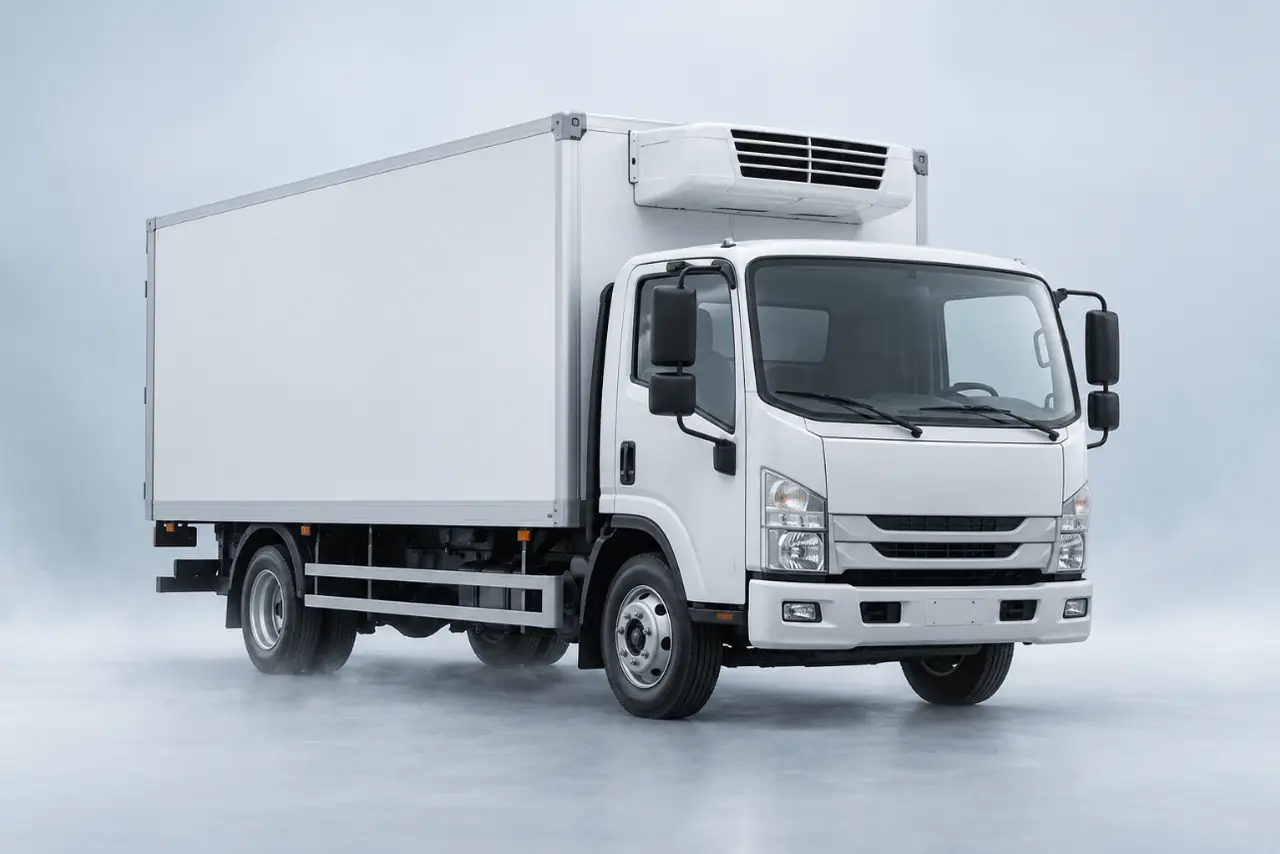
Truck refrigeration unit maintenance is the routine inspection, cleaning and servicing of a reefer unit and its insulated box so it holds temperature reliably and efficiently. It covers four systems: the refrigeration circuit (compressor, coils, fans, refrigerant), the power source (vehicle engine drive, the unit's own diesel engine, or electric and battery components), the controller and sensors, and the insulated body with its doors and seals.
The stakes are higher than for a fixed fridge. A reefer works in vibration, road dust, salt, rain, heat and constant door openings, often far from a workshop. A unit that stops cooling for two hours on a summer route can spoil a full load of chilled or frozen product, trigger a customer claim and break the temperature records that food safety and pharmaceutical customers require.
Good maintenance also saves money every day. Clean coils and tight seals shorten run time, which cuts fuel use on diesel units, extends battery range on electric units and reduces compressor wear. Most of the work is simple and can be done by drivers and in-house technicians; refrigerant work and major repairs need a qualified reefer mechanic.
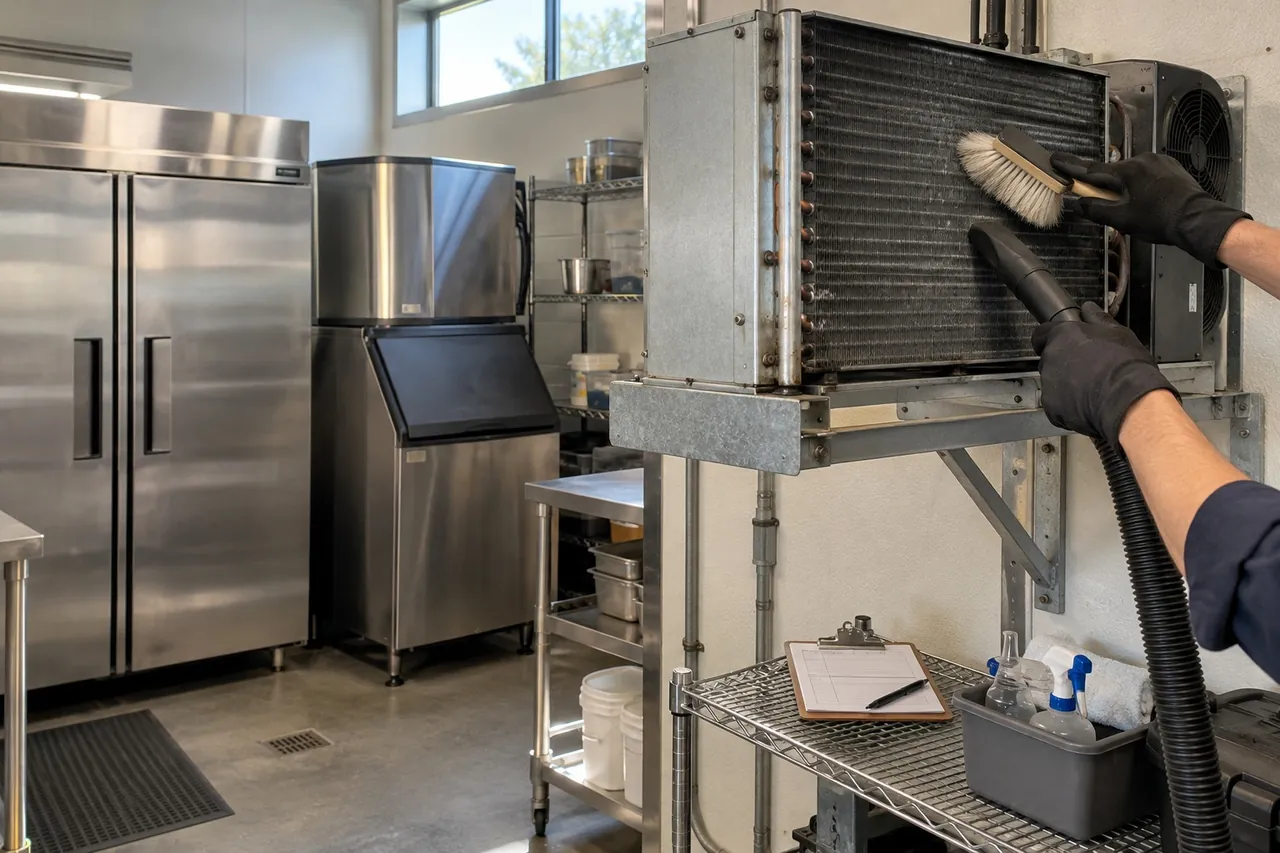
The principles are the same as for cold rooms and display cabinets, covered in our commercial refrigeration maintenance checklist, but transport units add engines, belts and road damage to the list.
Reefer maintenance schedule: daily to annual
Always follow the unit manufacturer's manual first. Where it is silent, this schedule reflects common industry practice:
| Interval | Task | Who |
|---|---|---|
| Every trip | Pre-trip check: alarms, set point, belts, fluids, visible leaks, door seals, pre-cool | Driver |
| Weekly | Clean debris from condenser grille, check drain hoses, check strip curtains and air chute | Driver or yard staff |
| Every 1–3 months | Wash condenser and evaporator coils, check fan blades and motors, inspect belts and mounts | Technician |
| Every 1,500–3,000 engine hours (diesel units) | Engine oil and filter, fuel filters, air filter, coolant check, belts | Technician |
| Every 6 months | Check sensor accuracy against a reference thermometer, test defrost and alarms, inspect electric standby plugs and cables | Technician |
| Every 12 months | Full inspection: refrigerant leak check, pressures, compressor oil (where applicable), electrical connections, mounting bolts, body and insulation | Certified reefer mechanic |
| Every 6 years, then up to every 3 years | ATP inspection or re-test of the insulated body and unit, where ATP applies | Approved test station |
Shorten the coil-cleaning and filter intervals for dusty roads, construction sites, farms and coastal routes, and for units that run around the clock. Keep every service in a log; it supports warranty claims and raises resale value.
How to do a reefer pre-trip check
A daily pre-trip check takes about 10 minutes and catches most problems before the truck leaves the yard:
- Check the controller – Switch on, clear or note any stored alarm codes, confirm the set point and mode (continuous or start-stop) match the load paperwork.
- Walk round the unit – Look for oil or refrigerant stains, loose panels, damaged hoses and cables, and debris blocking the condenser coil or grille.
- Check fluids and fuel – On diesel units check engine oil, coolant and fuel level; on direct-drive units check the compressor belt for cracks and tension.
- Inspect the box – Check door seals, strip curtains, the air chute, the floor and drains, and make sure the return-air opening and front bulkhead are clear.
- Pre-cool and verify – Run the unit to set point before loading, then check the reading against a calibrated hand probe or data logger.
- Record it – Note date, vehicle, set point, alarms found and actions taken in the vehicle log or telematics system.
Never load warm product to "let the reefer cool it down". Transport units are designed to hold temperature, not to pull down warm cargo; product should be loaded at its carrying temperature. Pre-cooling the empty box with the doors closed, ideally on electric standby at the depot, also reduces condensation and frost on the evaporator once doors start opening.
Servicing the refrigeration system: coils, fans, refrigerant and sensors
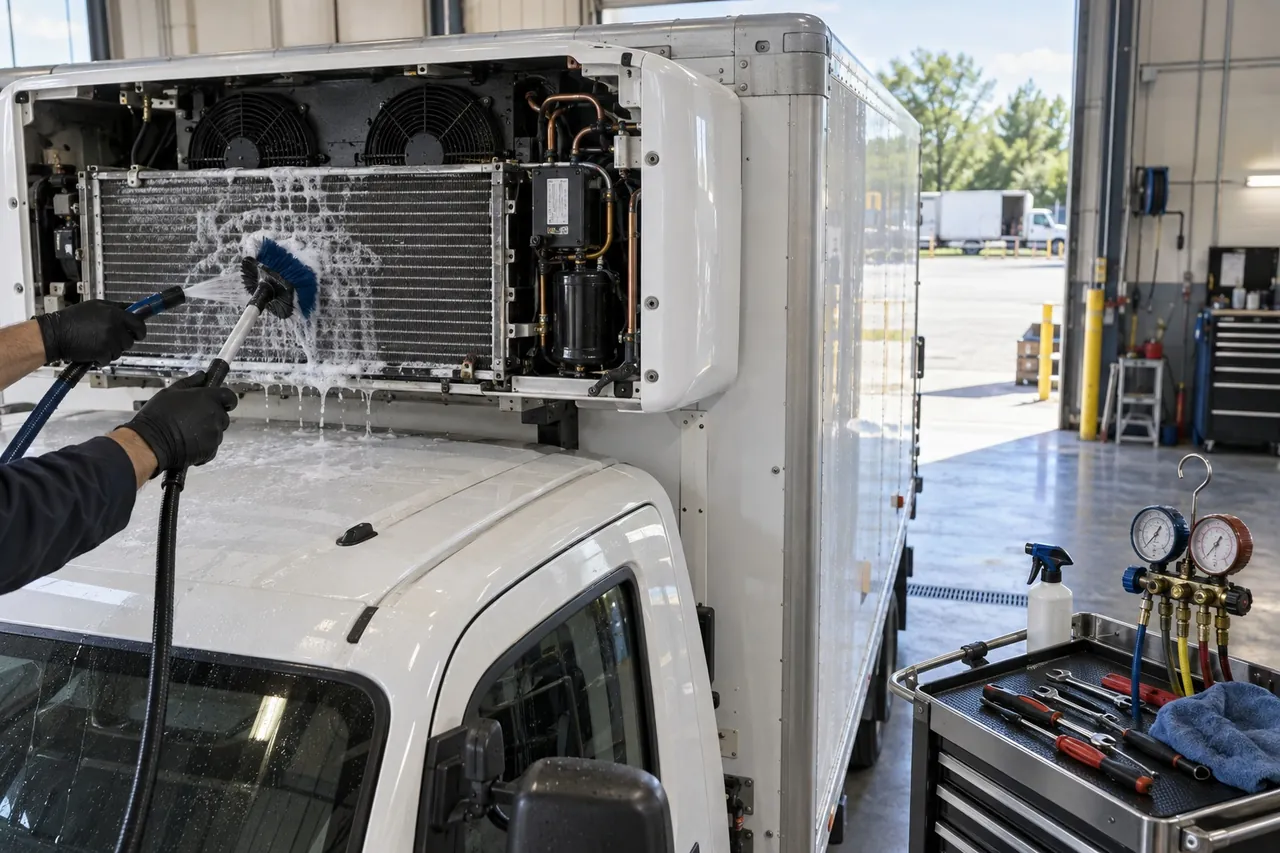
Condenser coil – the outdoor coil rejects heat. Road dust, insects, leaves and salt block the fins, raising condensing pressure, power draw and run time. Clean with low-pressure water or approved coil cleaner from the inside out, straighten bent fins with a fin comb, and never use a high-pressure jet close to the fins.
Evaporator coil and drains – the indoor coil collects frost from moist air entering at each door opening. Check that defrost cycles clear it completely and that drain hoses and heaters are working; a blocked drain freezes and then floods the box.
Fans – check blades for cracks and imbalance, motors for noise and bearings, and that air flows freely. A failed evaporator fan is a common cause of a warm box even when the compressor is running.
Refrigerant – only certified technicians should open the circuit. A slow fall in cooling performance, oily stains at joints or bubbles in a sight glass point to a leak. In the EU, fluorinated-gas rules require periodic leak checks on transport units above 5 t CO₂e of refrigerant, typically at least every 12 months; keep the records with the vehicle.
Sensors and controller – return-air, supply-air and defrost sensors drift or get damaged. Check them against a calibrated probe, and update controller software when the supplier issues fixes. If you need a refresher on how the cycle works, read how truck refrigeration units work.
Servicing diesel, direct-drive and electric reefer units
Independent diesel units
The unit's own small diesel engine needs the same care as any engine: oil and filter changes, fuel and air filters, coolant strength and level, glow plugs and battery. Intervals are typically 1,500–3,000 engine hours; some newer units allow longer with approved oils. Use winter-grade fuel in cold climates and drain water from the fuel filter.
Engine-driven (direct-drive) units
The compressor runs from the vehicle engine via a belt and electromagnetic clutch. Check belt tension, wear and alignment at every service, listen for clutch noise, and inspect hoses where they pass through the engine bay and chassis. Many issues blamed on the reefer are actually low engine idle speed, which reduces compressor speed and cooling during deliveries.
Electric standby and fully electric units
- Inspect plugs, sockets and cables for damage and water ingress; replace, do not tape, damaged cables.
- Confirm the depot supply matches the unit's voltage, frequency and, for three-phase, phase rotation.
- On battery units, monitor state of charge and battery health, keep connections clean and tight, and follow the charging schedule.
Be There truck refrigeration units come in engine-driven, independent diesel and fully electric versions; each ships with its own service schedule and wiring diagram, which should stay with the vehicle.
Common reefer unit problems and how to fix them
Use this table to narrow down a fault before calling a technician. Anything involving refrigerant, high-voltage electrics or the compressor needs a qualified mechanic.
| Symptom | Likely causes | What to do |
|---|---|---|
| Unit runs but box stays warm | Dirty condenser, iced evaporator, failed fan, low refrigerant, blocked airflow | Clean coils, run manual defrost, check fans, clear load from return air, then leak test |
| Evaporator iced solid | Defrost heater or sensor fault, doors left open, drain blocked | Manual defrost, test heaters and termination sensor, clear drain |
| High-pressure alarm | Dirty condenser, condenser fan failure, overcharge, very high ambient | Clean coil, check fan, have charge checked |
| Low-pressure alarm | Refrigerant leak, blocked filter drier or expansion valve, iced coil | Defrost, then technician leak check and repair |
| Short cycling | Faulty sensor, low charge, wrong differential setting | Check sensor reading and controller settings |
| Diesel unit will not start | Flat battery, no fuel, water or gelled fuel, glow plugs, filters | Check battery, fuel and filters, then glow plugs and starter |
| Belt squeal or slip (direct-drive) | Worn or loose belt, failing clutch | Adjust or replace belt, test clutch |
| Standby will not run | Wrong supply, damaged plug or cable, tripped breaker, contactor fault | Check supply and cable, reset, then test contactor |
| Display temperature disagrees with load | Sensor drift or damage, sensor in wrong position | Compare with calibrated probe, replace sensor |
| Water on floor | Blocked or frozen defrost drain | Clear drain, check drain heater |
| High fuel use | Continuous mode, poor seals, damaged insulation, dirty coils | Use start-stop where allowed, repair seals and coils |
Looking after the insulated body and ATP certification
The best unit cannot hold temperature in a leaking box. Check the body at every service:
- Door seals and hinges – replace cracked, flattened or torn gaskets; adjust doors that no longer close evenly. Shut a torch inside in the dark and look for light around the doors.
- Strip curtains – replace missing or stiff strips; they cut warm air entry at each stop.
- Skins and panels – repair punctures promptly. Water that enters the foam reduces its insulation value and adds weight.
- Floor and drains – keep drains clear; repair cracks before water reaches the core.
- Air chute and bulkhead – replace torn chutes; keep the return-air opening clear of cargo.
Insulation loses some performance every year through ageing and moisture. Where the ATP agreement applies, a new body is typically certified for 6 years and then renewed after inspection or testing for periods of up to 3 years. If an older body struggles in summer, check its insulation before buying a bigger unit; re-sizing may still be needed, and our reefer unit sizing guide shows how to recalculate the load.
Spare parts, finding a reefer mechanic and next steps
Keep downtime short by planning ahead:
- Carry a small spares kit – compressor or alternator belts, fuses, a fan motor for older units, fuel and oil filters, and a spare temperature sensor.
- Find a reefer mechanic on your routes – ask for refrigerant certification, experience with your unit type and access to diagnostic software.
- Use telematics – remote alarms and temperature logs show a falling performance trend before a failure.
- Log everything – pre-trip checks, services, leak checks, repairs and calibrations.
- Replace, don't keep patching – when an old unit needs a compressor and coils, a new unit with lower fuel or power use may pay back quickly.
Be There supplies replacement and new-build reefer units for vans and trucks with boxes of 4–45 m³, holding −20 °C to +15 °C (−4 °F to 59 °F), with install kits matched to your vehicle. Send your vehicle, box size and set point through the inquiry form to get a quotation and the recommended spare parts list.