Short answer
A frost free freezer hides its evaporator coil behind a panel, circulates air with a fan and melts frost automatically with a heater, typically 1–4 times a day for 15–30 minutes. A manual defrost freezer has cold walls with no heater, so frost builds up and must be melted by hand when it reaches about 6 mm (1/4 in). Manual models typically use 35–40% less energy.
Key takeaways
- Frost free, auto defrost, self defrosting and no frost usually describe the same thing: a fan-cooled freezer with an automatic defrost heater.
- A defrost cycle typically lasts 15–30 minutes and runs 1–4 times every 24 hours, ending when the coil warms to a set point around +10 °C (50 °F).
- Manual defrost freezers typically use 35–40% less energy and hold temperature longer in a power cut, but need defrosting when frost reaches about 6 mm (1/4 in).
- Most upright freezers are frost free; most chest freezers are manual defrost.
- Commercial glass-door display freezers and ice merchandisers use automatic defrost because doors open many times a day.
What is a frost free freezer and what does manual defrost mean?
A frost free freezer is a freezer that removes its own frost automatically. Its cooling coil (the evaporator) sits behind a panel, a fan blows cold air through the cabinet, and a timed heater melts any frost on the coil several times a day. The water drains out and evaporates, so you never see ice build up on the walls or shelves.
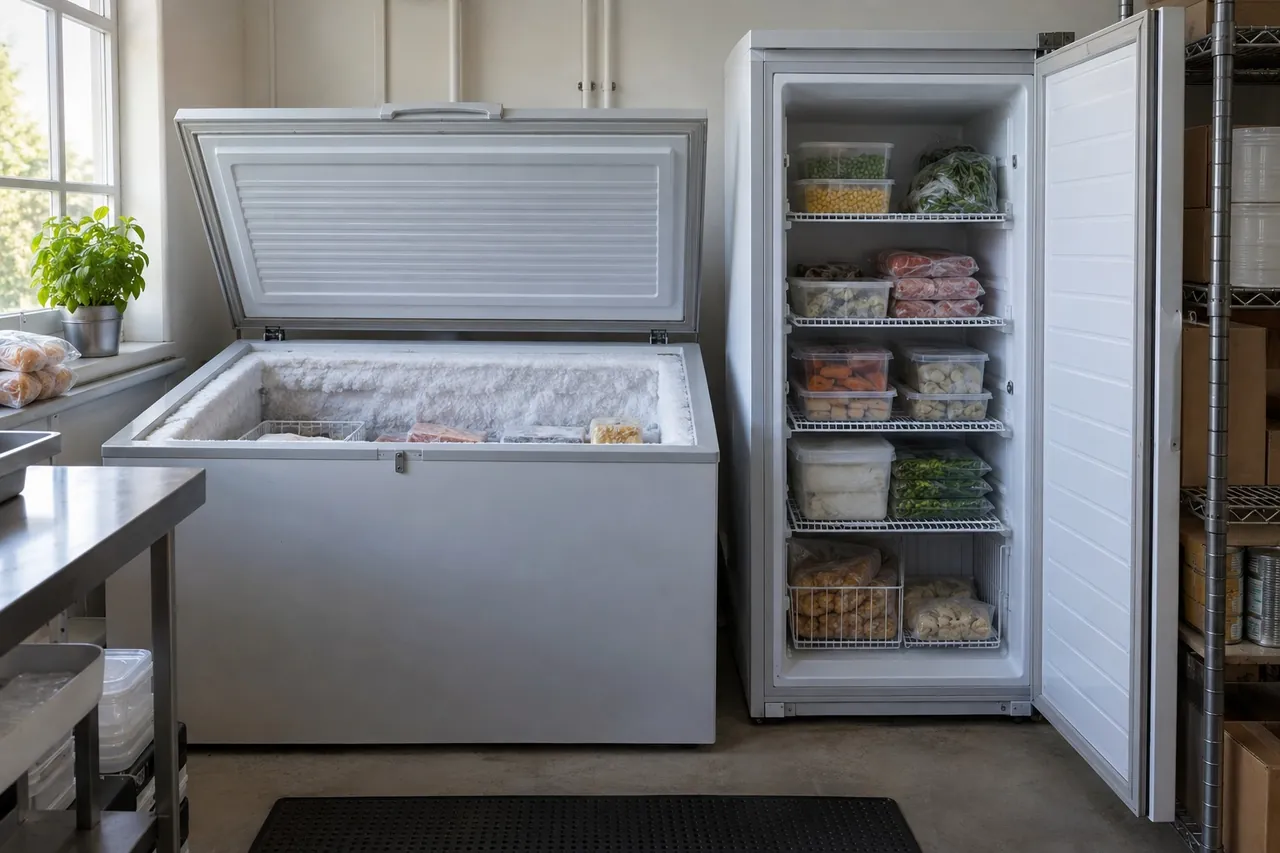
A manual defrost freezer works differently. The refrigerant tubes run inside the walls (in a chest) or through the shelves (in an upright), and there is no fan or heater. Moisture from the air freezes onto the coldest surfaces as frost. What does manual defrost mean in practice? It means that every few months you switch the freezer off, let the frost melt and clean it out.
Frost forms in any freezer because every time the door or lid opens, warm, moist air enters. Its water vapour freezes on the coldest surface it meets. Frost matters because:
- It insulates the coil, so the compressor runs longer and uses more energy.
- It takes up storage space and can stop lids and doors sealing.
- On a fan coil it blocks airflow, so the cabinet warms up.
So the real question is not whether a freezer frosts, but whether it clears the frost itself (frost free) or you do (manual defrost).
How does a frost free freezer work? The defrost cycle explained
A frost-free freezer runs two alternating modes: cooling and defrost.
Cooling mode
The compressor pumps refrigerant through the evaporator coil, which may run at −25 °C to −30 °C (−13 °F to −22 °F). A fan pulls cabinet air across the coil and back through ducts, so frost collects on the hidden coil instead of on your food.
Defrost mode
At set intervals, the controller stops the compressor and fan and switches on a defrost heater fixed to the coil. Typical values:
- Frequency – about 1–4 times every 24 hours. Older freezers use a fixed timer (often every 6–12 hours); newer "adaptive" controls defrost only when run time or door openings suggest frost.
- Duration – about 15–30 minutes.
- Termination – a sensor or thermostat ends defrost when the coil reaches roughly +10 °C (50 °F), or after a maximum time.
- Drainage – meltwater runs through a heated drain to a tray over the compressor, where it evaporates.
After defrost a short pause lets water drip off, then the fan restarts. Food temperature rises only slightly, but repeated small rises are why frost-free freezers can dry out unwrapped food faster.
Fridge defrost cycle
A refrigerator defrost cycle is simpler. Because the fridge runs above 0 °C (32 °F), most fridges use "off-cycle" or air defrost: the coil warms up naturally while the compressor rests. A defrost system with a heater is needed wherever a coil runs well below freezing, which means freezers, ice cream cabinets, ice merchandisers and walk-in freezers.
Frost free vs manual defrost: side-by-side comparison
This table compares a typical frost free vs manual defrost freezer of similar size.
| Factor | Frost free / auto defrost | Manual defrost |
|---|---|---|
| Frost on walls and shelves | None visible | Builds up; defrost at about 6 mm (1/4 in) |
| Energy use | Higher: fan and heater add load | Typically 35–40% lower |
| Temperature evenness | Very even, fast recovery after opening | Warmer near the lid or top, slower recovery |
| Freezer burn on unwrapped food | More likely (air circulation dries food) | Less likely |
| Usable space | Slightly less (fan, duct, coil) | More, until frost builds |
| Power-cut holdover | Shorter | Longer, especially chest models |
| Noise | Fan noise | Quieter |
| Purchase price | Higher | Lower |
| Maintenance | Clean condenser and drain | Defrost by hand, often 1–2 times a year at home, more often in busy use |
The energy figure comes from university extension guidance comparing similar residential freezers; actual savings depend on size, insulation and how often the freezer is opened. A manual model that is never defrosted loses much of its advantage, because thick frost insulates the walls.
For long-term bulk storage that is opened rarely, manual defrost wins on cost. For daily-access storage and anything customers open, frost free wins on labour and temperature stability.
Frost free vs auto defrost vs self defrosting: are they the same?
Mostly, yes. In upright freezers, frost free, auto defrost, automatic defrost, self defrosting and no frost all describe a fan-cooled freezer with a heater that melts frost automatically. Differences are in how makers use the terms:
- Frost free / no frost – fan-cooled, hidden coil, automatic heater defrost. No visible frost.
- Auto defrost or automatic defrost – in freezers, usually the same as frost free. In fridges, "auto defrost refrigerator" often means the fridge section defrosts itself while a small freezer compartment still needs manual defrosting.
- Self defrosting chest freezer – some chest models use a heater on cold-wall tubes to remove most frost; they are sometimes sold as "low frost" rather than fully frost free. Check whether there is a fan and whether the manual still asks you to defrost.
- Manual defrost / non frost free – no heater; you defrost by hand.
So when comparing frost free vs auto defrost listings, ask three questions: Is there a fan? Is there a defrost heater or hot-gas defrost? Does the manual say you never need to defrost? If all three answers are yes, it is frost free.
Commercial cabinets use clearer language: "automatic electric defrost", "hot-gas defrost" or "off-cycle defrost", with the number of cycles per day set on the controller.
Frost free upright freezers vs frost free chest freezers
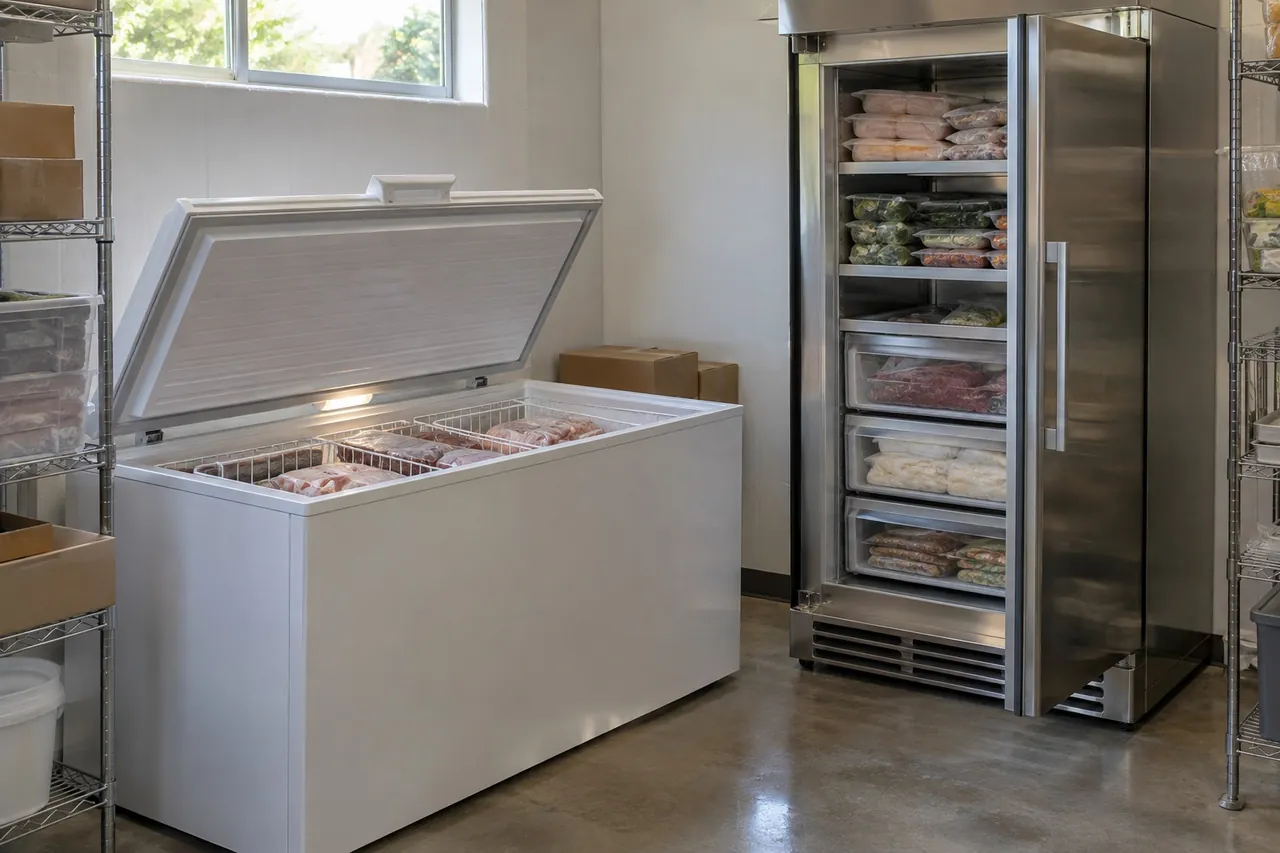
Format and defrost type are linked. Most frost free upright freezers are fan-cooled, because uprights lose cold air every time the door opens and benefit most from fast, even recovery. Most chest freezers are manual defrost, because cold air stays in the chest and frost builds slowly.
| Type | Typical defrost | Typical sizes | Best for |
|---|---|---|---|
| Upright freezer frost free | Automatic | About 3–30 cu ft (85–850 L) | Daily access, kitchens, easy rotation |
| Manual defrost upright freezers | Manual (coil shelves) | About 3–20 cu ft | Budget storage, low energy |
| Manual defrost chest freezer | Manual (cold walls) | About 3–25 cu ft | Bulk storage, power-cut resilience |
| Frost free chest freezer / auto defrost chest freezer | Automatic or low-frost | Fewer models, mostly 5–15 cu ft | Busy chests where defrost labour is costly |
Small upright freezers frost free are made down to about 3–5 cu ft (85–140 L), though the choice is narrower than for manual units. A 20 cu ft (570 L) frost free upright is a common size for a small restaurant's back-up storage. If you are deciding between formats, our chest freezer vs upright freezer guide covers floor space and access in depth.
How defrost works in commercial display freezers and walk-ins
Commercial equipment is opened far more often than a home freezer, so the defrost choice is usually made for you.
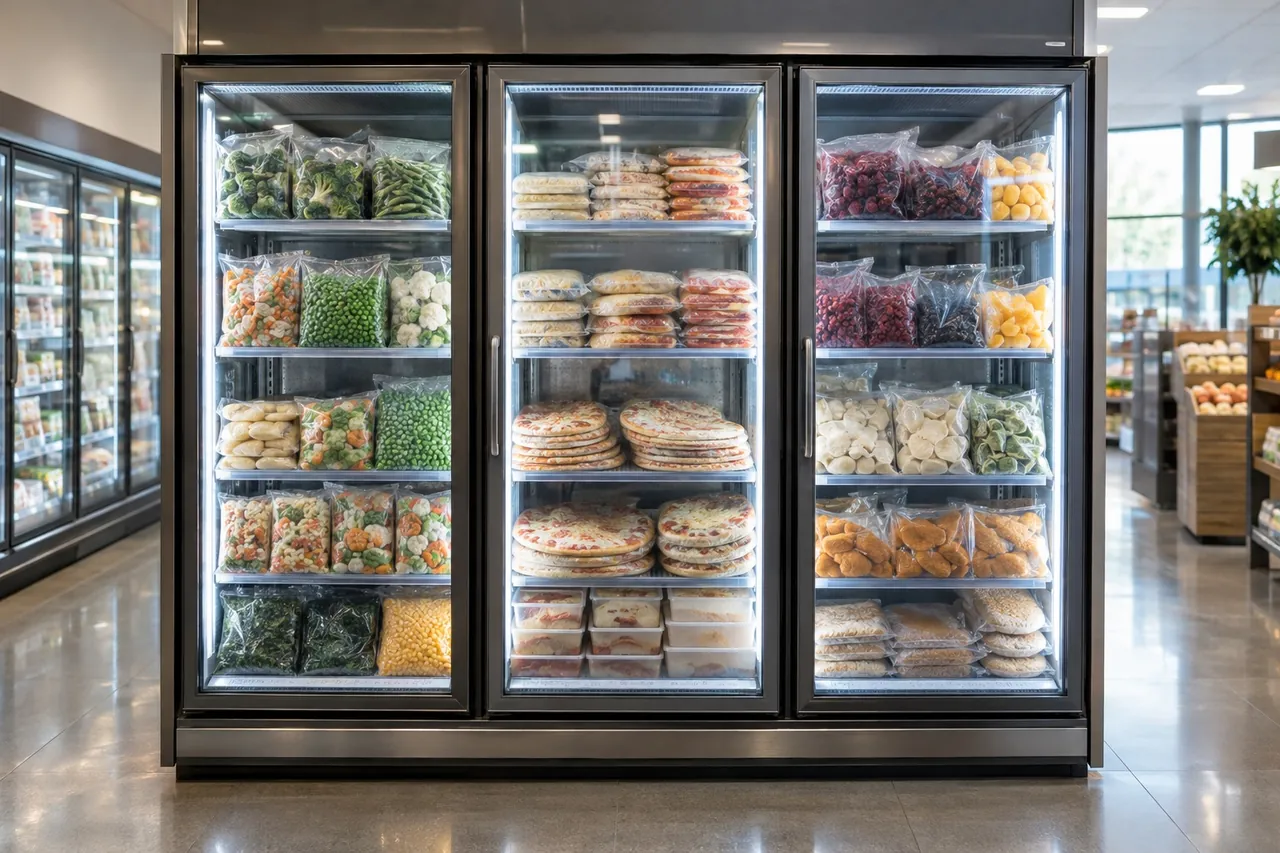
- Upright glass-door display freezers are always fan-cooled with automatic defrost, typically 2–4 cycles a day. Door and frame heaters stop frost forming on gaskets. See our glass door freezer guide.
- Glass-top chest ice cream freezers are often static (cold-wall) with manual defrost, which keeps ice cream temperature very stable. Fan-cooled auto-defrost versions suit humid shops.
- Bagged ice merchandisers should have automatic defrost so bags do not freeze together; Be There ice merchandisers hold −12 °C to −6 °C (10–21 °F).
- Walk-in freezers use electric or hot-gas defrost on the evaporator, a heated drain line and a door frame heater. The controller schedules defrosts, often 3–4 a day. Each Be There walk-in cold room kit includes the evaporator and digital controller matched to the room.
Be There upright and glass-top display freezers hold −18 °C to −24 °C (0 °F to −11 °F). When you order, confirm the defrost type and the number of defrost cycles on the specification, especially for hot, humid stores where frost forms fastest.
How to defrost a manual defrost freezer safely
Defrost a manual freezer when frost reaches about 6 mm (1/4 in) thick, or sooner if the lid stops sealing. Plan it for a quiet period, when stock is low.
- Move the food. Transfer frozen stock to another freezer or to insulated coolers with ice packs, keeping it at or below −18 °C (0 °F) where possible.
- Switch off and unplug. Turn the freezer off at the controller and unplug it so no heater or fan can run while you work.
- Open the drain and protect the floor. Remove the drain plug, place a tray or hose under the outlet and lay towels around the base.
- Let the frost melt. Leave the lid or door open and put bowls of hot (not boiling) water inside to speed melting. Do not use knives, ice picks or heat guns.
- Remove loose ice and water. Lift out softened sheets of frost by hand or with a plastic scraper and sponge up meltwater.
- Clean and dry. Wash the interior with a mild detergent or baking-soda solution, rinse, then dry every surface completely.
- Restart and pull down. Refit the drain plug, switch on and wait until the cabinet reaches −18 °C (0 °F) or colder before reloading, usually a few hours.
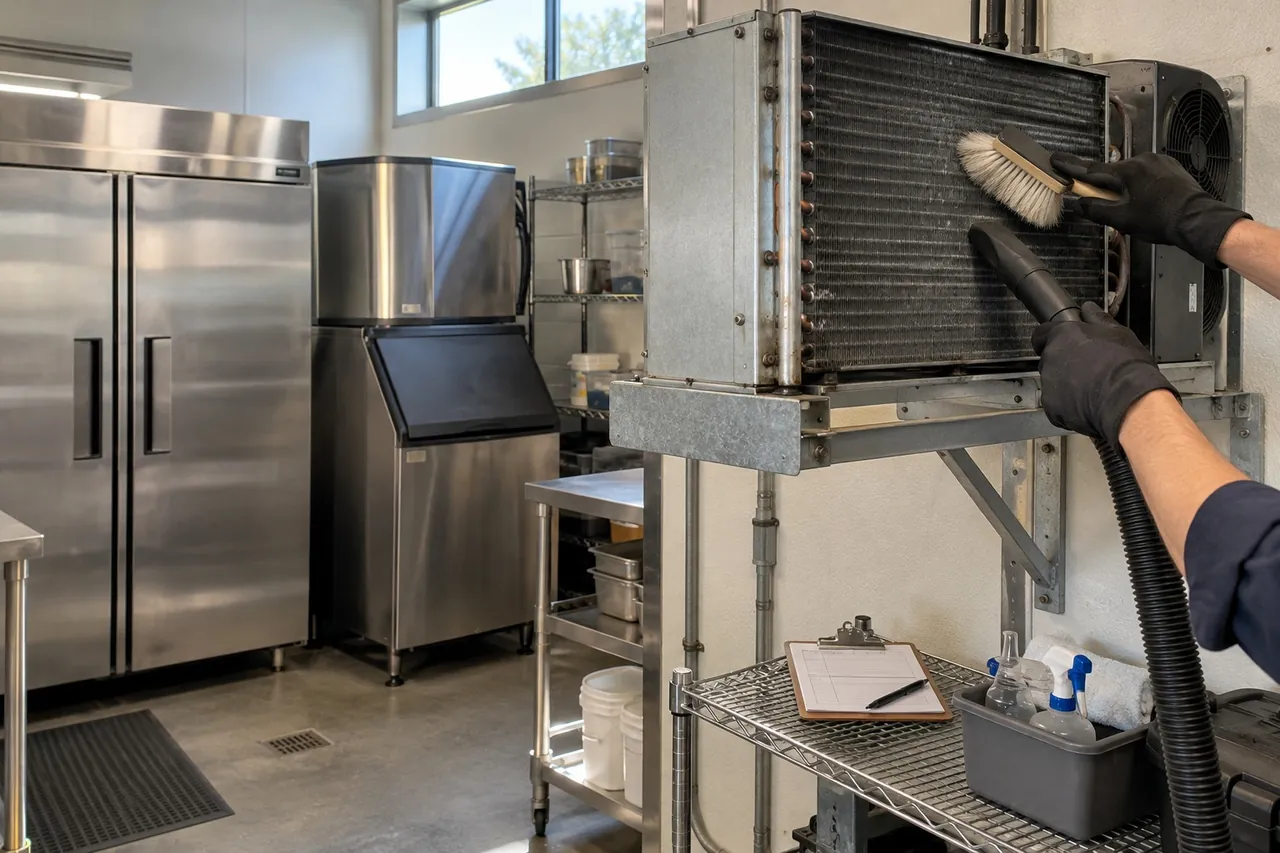
Most chest freezers defrost in 1–3 hours this way. Do not chip at ice with metal tools: a punctured cold-wall tube means a refrigerant leak and usually a scrapped freezer. Log the date so you can see how fast frost builds; if it returns within weeks, check the lid gasket. Our refrigeration maintenance checklist covers gaskets and condensers.
Which should you choose: frost free or manual defrost?
Use these rules of thumb:
- Choose frost free if the freezer is opened many times a day, staff do not have time to defrost, products must stay evenly cold on every shelf, or customers open it.
- Choose manual defrost if the freezer is mainly for long-term bulk storage, energy cost matters most, power cuts are common or food is stored unwrapped for long periods.
- Choose automatic defrost in commercial display wherever doors are glass and customers shop.
Before you buy, check:
- Defrost type (fan + heater, hot gas, cold-wall manual or low-frost).
- Annual energy use in kWh on the label or datasheet.
- Number of defrost cycles and whether they are adjustable.
- Drain arrangement and evaporation tray.
- Climate class for your room temperature and humidity.
Be There supplies commercial display freezers, ice merchandisers and walk-in freezers with the defrost system specified per order. Send your product, temperature and site conditions through the inquiry form for a quote.