

Short answer
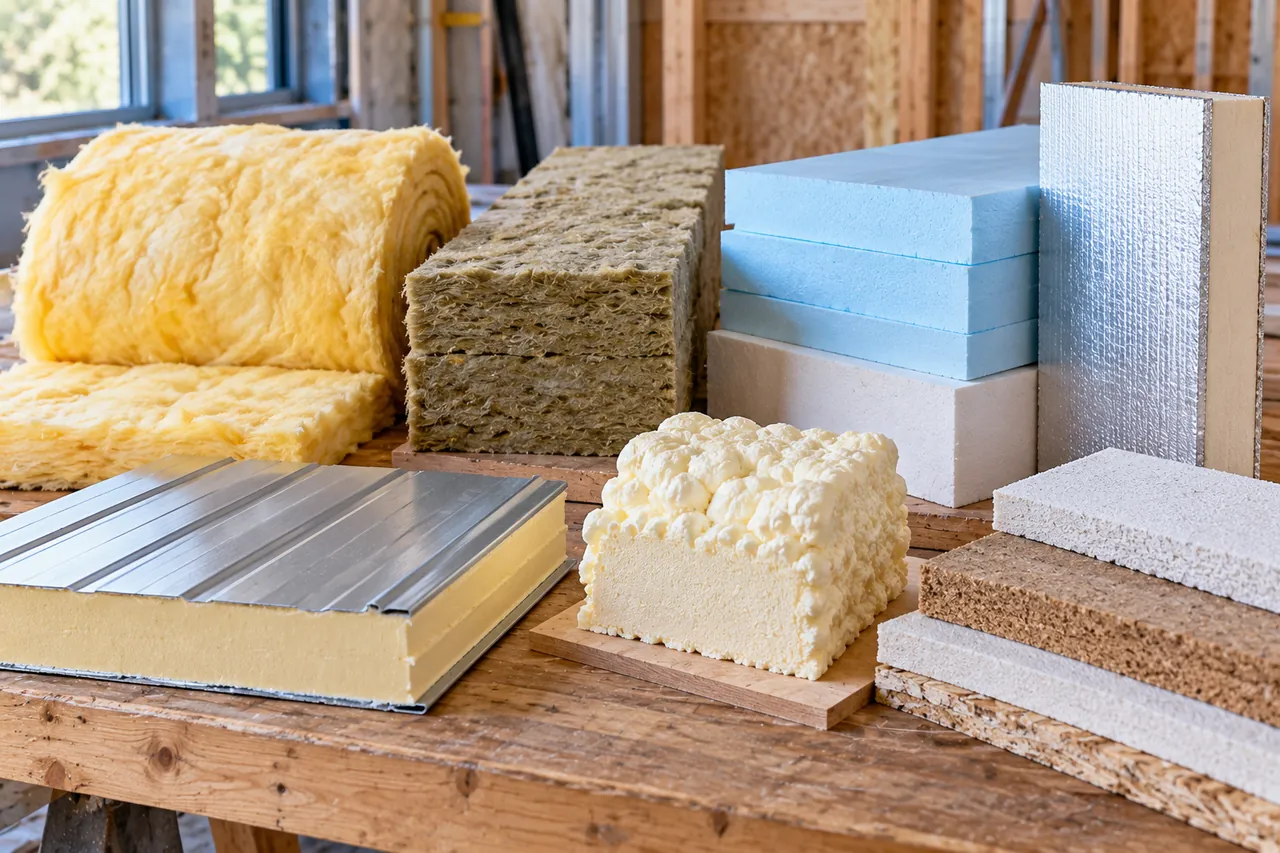
The different types of insulation are fibreglass and mineral wool batts (R-2.9 to R-4.3 per inch), blown cellulose (R-3.2 to R-3.8), spray foam (R-3.5 open-cell to R-7 closed-cell) and rigid foam board: EPS R-3.6 to R-4.2, XPS about R-5 and PIR R-6 to R-6.5. Fibreglass is cheapest; foam board is thinner, air-tight and moisture-tolerant.
Key takeaways
- Fibreglass batts give about R-2.9 to R-3.8 per inch and are the cheapest insulation for open stud cavities and attics.
- Mineral wool gives R-3.7 to R-4.3 per inch, is non-combustible above 1,000 °C and is denser, so it blocks sound better.
- Rigid foam board gives R-3.6 to R-6.5 per inch; XPS absorbs under 1% water by volume, making it the choice below ground.
- Standard batts: R-13 or R-15 for 2×4 walls, R-19 to R-21 for 2×6 walls, R-30 to R-38 for attics; widths 15 in and 23 in.
- Kraft-faced batts are a Class II vapour retarder (about 1 perm); foil-faced batts are a Class I vapour barrier.
- Studs reduce a 2×4 wall with R-13 batts to about R-10 to R-11 effective; 25 mm of exterior XPS lifts it to about R-15.
What are the different types of insulation?
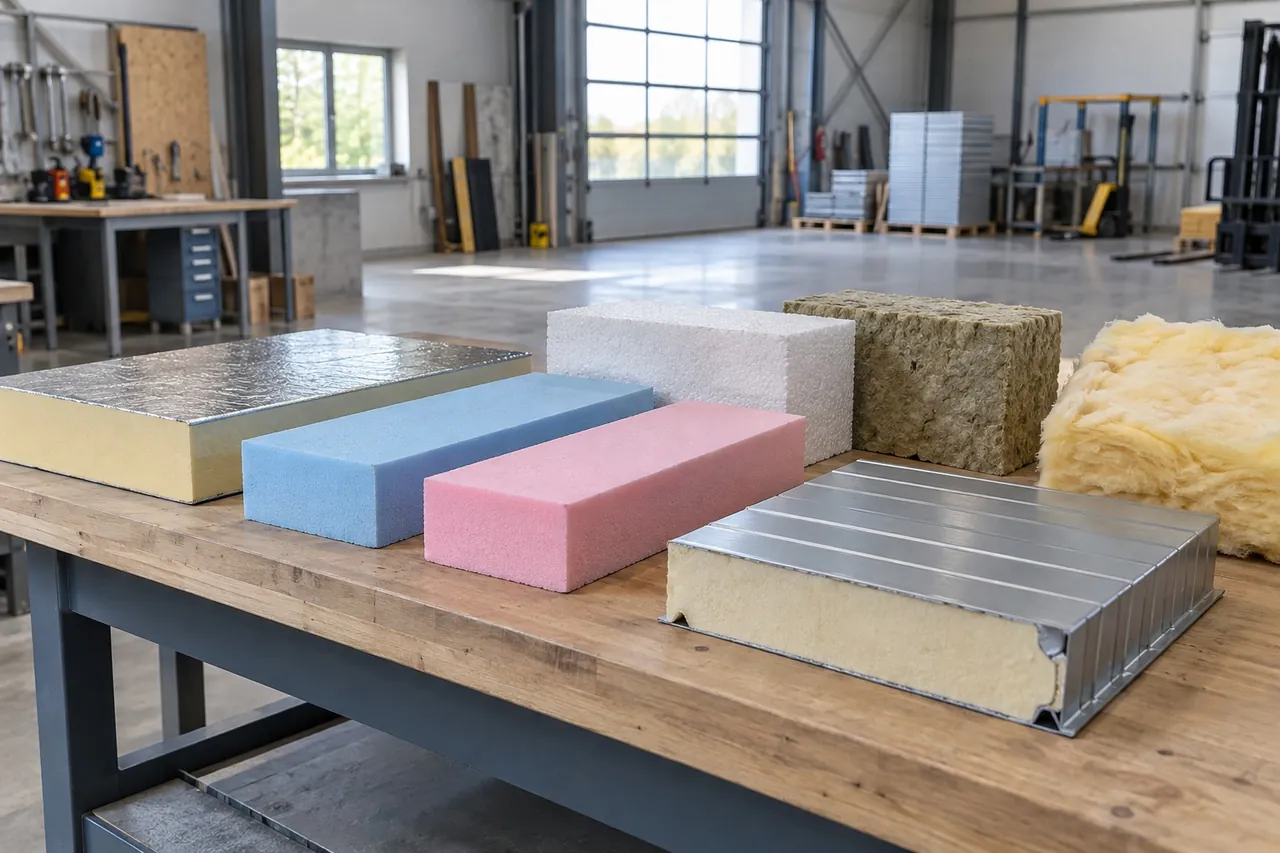
The main different types of insulation are fibrous batts and rolls (fibreglass and mineral wool), loose-fill (blown fibreglass and cellulose), spray foam (open-cell and closed-cell), rigid foam board (EPS, XPS and PIR/polyiso) and factory-made insulated panels. They all work the same way, by trapping still air or gas, but they differ in R-value per inch, moisture tolerance, fire behaviour, strength and cost.
Choosing well means matching the material to the place it goes: a stud cavity, an attic floor, a concrete basement wall, under a slab, outside the sheathing or inside a cold room. No single type is best everywhere. The comparison below gives typical values; check the declared R-value or thermal conductivity on the product you buy.
| Insulation type | R per inch (US) | λ, W/(m·K) | Moisture tolerance | Fire behaviour | Relative installed cost | Best uses |
|---|---|---|---|---|---|---|
| Fibreglass batts and rolls | R-2.9 to R-3.8 | 0.038–0.050 | Poor when wet; dries out | Glass non-combustible; facings combustible | Lowest | Stud walls, attics, floors over crawl spaces |
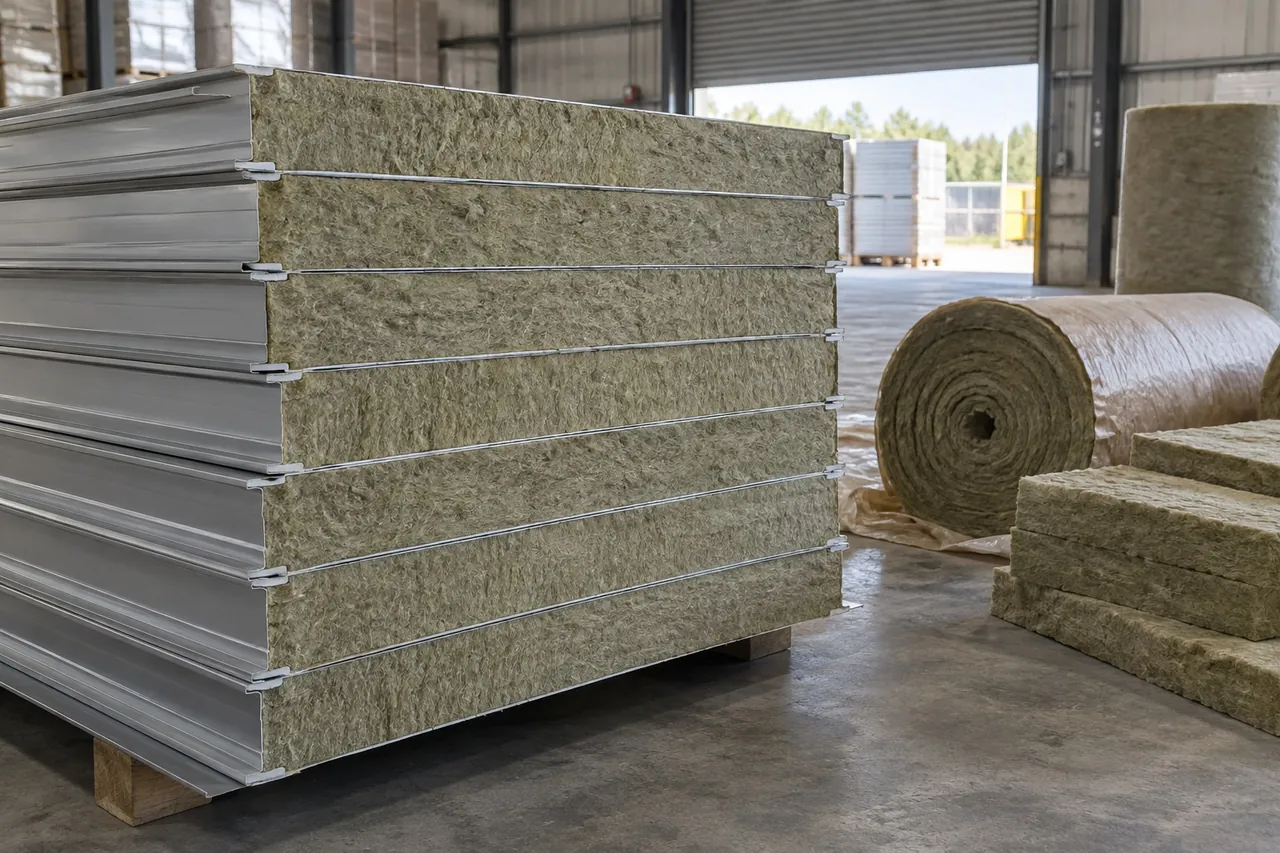
| Mineral wool (rock wool) batts and boards | R-3.7 to R-4.3 | 0.034–0.040 | Water-repellent, drains | Non-combustible, above 1,000 °C | Low–medium | Fire and sound walls, exterior continuous insulation |
| Blown cellulose | R-3.2 to R-3.8 | 0.038–0.045 | Poor; can settle if wet | Treated with fire retardant | Low | Attic floors, dense-pack retrofit walls |
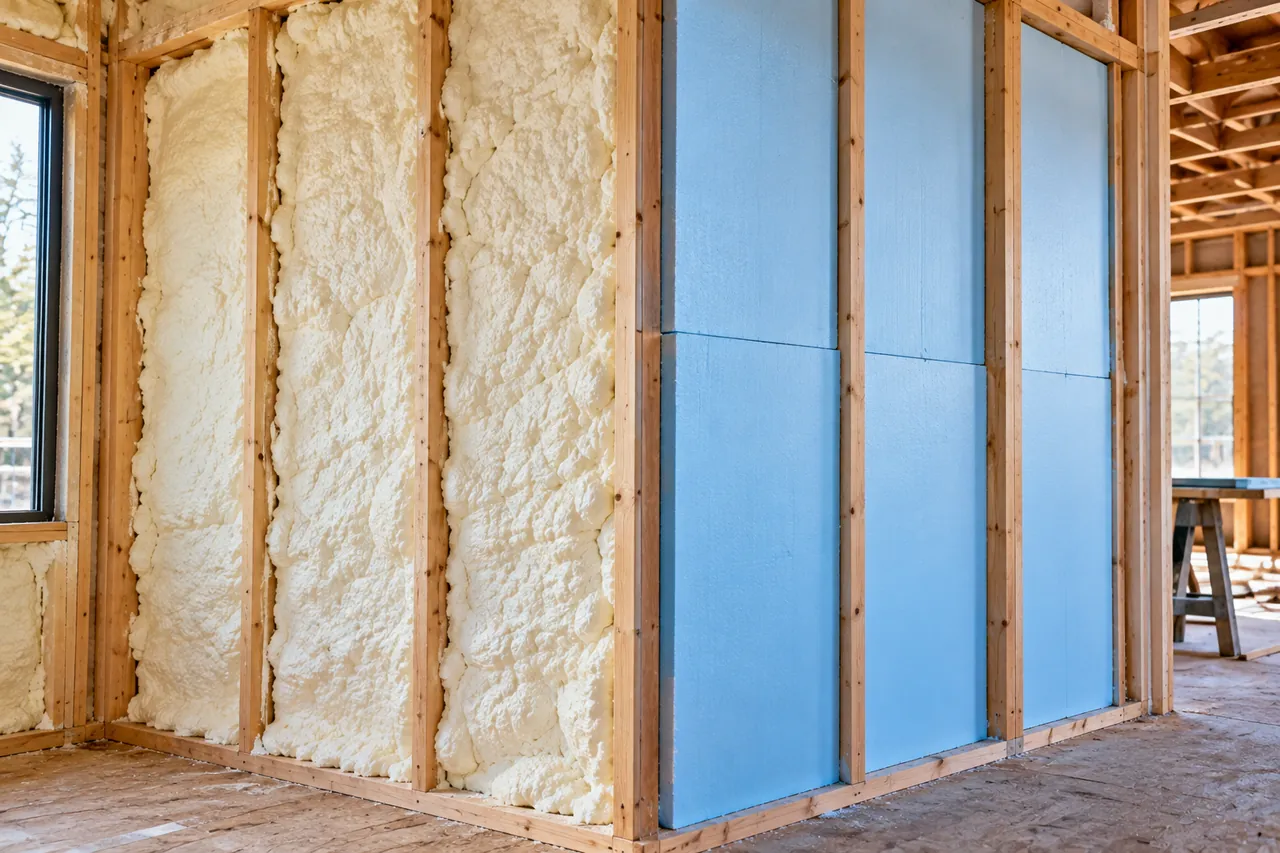
| Open-cell spray foam | R-3.5 to R-3.8 | 0.037–0.040 | Absorbs water; vapour open | Needs thermal barrier | Medium–high | Air sealing roof decks and walls |
| Closed-cell spray foam | R-6 to R-7 | 0.021–0.024 | Good; low absorption | Needs thermal barrier | High | Rim joists, metal buildings, irregular surfaces |
| EPS foam board | R-3.6 to R-4.2 | 0.035–0.038 | Moderate | Combustible, needs protection | Low–medium | Walls, roofs, external insulation systems |
| XPS foam board | about R-5 | 0.028–0.030 | Excellent, under 1% by volume | Combustible, needs protection | Medium | Foundations, under slabs, freezer floors |
| PIR / polyiso board | R-6 to R-6.5 | 0.020–0.024 | Good with facings | Best of the foams; chars | Medium | Roofs, walls, thin build-ups, cold rooms |
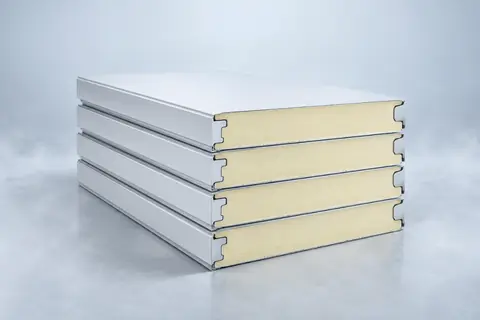
| PU/PIR sandwich panel, 100 mm (4 in) | R-24 to R-26 total | about 0.022 | Sealed by steel skins | Panel-tested systems | Higher material, fast install | Cold rooms, freezers, industrial buildings |
The full table of R-values, including thickness-by-thickness figures, is in our insulation R-value chart. This guide focuses on how the types compare in practice and when to choose each.
What is fiberglass insulation made of?
Fiberglass insulation is made of fine glass fibres spun from molten glass and bound together with a resin binder into soft, springy blankets. The glass comes from sand, limestone and soda ash plus a large share of recycled glass, melted at about 1,400 °C (2,550 °F) and spun through tiny holes in a rotating spinner.
The fibres themselves are not the insulator; the still air between them is. That is why fiberglass batt insulation loses R-value when compressed, when it gets wet, or when it is fitted loosely so that air can move around it. Fibreglass is naturally white or yellow; pink, brown and other colours are dyes or bio-based binders used to identify a maker's product line. Pink insulation does contain fibreglass. Colour says nothing about R-value.
Batt insulation vs rolls vs boards
- Batt insulation is pre-cut lengths, usually 1.2 m (4 ft) or 2.4 m (8 ft) long, sized to fit between studs or joists.
- Fiberglass insulation rolls are the same blanket in long continuous lengths for attics and long joist runs, cut to length on site.
- Rigid fiberglass insulation board is compressed to about 48–96 kg/m³ (3–6 lb/ft³), gives roughly R-4 to R-4.4 per inch and is used for duct wrap, acoustic panels and curtain wall spandrels.
Fiberglass batt insulation R-value and sizes
Batts are sold by R-value and width. Widths of 15 in (381 mm) and 23 in (584 mm) suit framing at 16 in and 24 in centres.
| Batt | Thickness | Fits | RSI (m²·K/W) | Typical use |
|---|---|---|---|---|
| R-11 | 3.5 in (89 mm) | 2×4 wall, interior | 1.9 | Interior sound walls, floors |
| R-13 | 3.5 in (89 mm) | 2×4 wall | 2.3 | Exterior 2×4 walls in warm climates |
| R-15 high density | 3.5 in (89 mm) | 2×4 wall | 2.6 | 2×4 walls needing more R |
| R-19 | 6.25 in (159 mm) | 2×6 wall (compressed to about R-18) or floor | 3.3 | 2×6 walls, floors |
| R-21 high density | 5.5 in (140 mm) | 2×6 wall | 3.7 | 2×6 walls in cold climates |
| R-30 | 9.5–10 in (240–255 mm) | 2×10 or 2×12 joists, attic | 5.3 | Attics and cathedral ceilings |
| R-38 | 12 in (305 mm) | Attic | 6.7 | Attics in cold climates |
So the fiberglass insulation r value works out at about R-3.1 to R-3.8 per inch: standard batts are at the low end, high-density batts at the top. The batt insulation r value per inch is lower than any rigid foam, which is why foam board is used where thickness is limited.
What is faced insulation and when do you need it?
Faced insulation is a batt with a paper or foil layer bonded to one side that acts as a vapour retarder and gives a stapling flange. Unfaced batts have no facing and rely on a separate vapour control layer, or none, depending on climate.
- Kraft faced insulation (paper faced insulation) has an asphalt-coated kraft paper facing, a Class II vapour retarder of about 1 perm. It goes towards the warm-in-winter side in cold and mixed climates.
- Foil faced fiberglass insulation has an aluminium facing, a Class I vapour barrier. It is used in basements, crawl spaces and metal buildings, and can add a radiant benefit only if it faces an air gap.
- Unfaced batts are used where a separate membrane is installed, in interior walls, for sound, or when adding layers over existing insulation.
Kraft and foil facings are combustible and most codes do not allow them to be left exposed in occupied spaces. In hot, humid climates an interior vapour barrier can trap moisture, so follow local practice. Our vapor barrier guide explains which side the barrier goes on and why it matters even more in cold rooms.
Fiberglass vs mineral wool insulation: which is better?
Mineral wool is denser, slightly higher in R-value per inch, non-combustible, water-repellent and better at blocking sound; fibreglass is lighter, easier to compress into awkward spaces and cheaper. For ordinary walls and attics fibreglass is adequate; for fire separations, sound walls, and exterior continuous insulation mineral wool is usually the better choice.
| Property | Fibreglass batt | Mineral wool batt |
|---|---|---|
| Raw material | Glass (sand, recycled glass) | Basalt rock or steel slag |
| Density | About 10–16 kg/m³ (0.6–1.0 lb/ft³) | About 30–45 kg/m³ (1.9–2.8 lb/ft³) |
| R-value, 2×4 cavity | R-13 to R-15 | R-15 |
| R-value, 2×6 cavity | R-19 to R-21 | R-23 |
| Fire | Glass melts around 700 °C; facings burn | Withstands above 1,000 °C (1,830 °F), Euroclass A1 |
| Sound | Good | Better, due to higher density |
| Water | Holds water, slumps | Sheds water, keeps shape |
| Fitting | Soft, compressible | Stiff, friction-fit, cut with a bread knife |
| Cost | Lower | Typically 25–50% higher |
Mineral wool batt insulation, also sold as rock wool batt insulation or mineral fiber batt insulation, is the same family of material used in rock wool sandwich panels for fire-rated industrial walls. See mineral wool insulation and rock wool sandwich panels for fire ratings. Sheep's wool batts are a separate natural product with similar R-value to fibreglass at a higher price.
Fiberglass insulation for soundproofing
Both fibrous types absorb sound in a cavity. Filling a single-stud interior wall with batts typically adds a few points of sound transmission class (STC); bigger gains come from decoupled framing, resilient channels and extra layers of plasterboard. Rigid foam is a poor sound absorber.
Is foam insulation better than fiberglass?
Foam insulation gives more R-value per inch, stops air movement and tolerates moisture far better than fibreglass, but costs more per square metre. Whether it is "better" depends on where it goes: foam board wins on foundations, under slabs, outside sheathing and anywhere thin or wet; fibreglass wins on cost in open stud cavities and attic floors.
Foam board vs fiberglass insulation
- R per inch: PIR R-6 to R-6.5, XPS about R-5, EPS R-3.6 to R-4.2, against R-2.9 to R-3.8 for fibreglass.
- Air: taped foam board is an air barrier; fibreglass is not and needs separate air sealing.
- Moisture: XPS absorbs under 1% water by volume and keeps its R-value below ground; wet fibreglass loses most of its value.
- Thermal bridging: foam board fixed over studs as continuous insulation stops heat flowing through the framing, which can cut a 2×4 wall's effective R-value by 15–25% when ignored.
- Fire: foam boards are combustible and must be covered, typically with 12.7 mm (½ in) gypsum inside buildings.
Many good walls use both: fibreglass or mineral wool in the cavity and rigid foam outside. That approach is covered in our guide to continuous exterior insulation with rigid foam board. For spray foam versus board, see spray foam vs rigid foam board insulation.
Non fiberglass insulation options
If you want non fiberglass insulation for allergies, handling or performance, the choices are mineral wool (still a fibre, but rock rather than glass), cellulose, sheep's wool, spray foam and rigid foam board. Not all insulation has fibreglass: foam boards and spray foams contain none.
What R-value insulation do you need for walls?
For walls, energy codes in the US typically require about R-13 in hot climates up to R-20 cavity plus R-5 to R-10 of continuous insulation in cold climates; most other countries set a maximum U-value instead. Cold rooms need far more: a chiller wall is typically R-17 to R-26 and a freezer wall R-26 to R-39.
- Under the 2021 International Energy Conservation Code (IECC), wood-frame walls need roughly R-13 in the warmest zones, R-20 or R-13 plus R-5 continuous in mixed zones, and R-20 plus R-5 continuous or R-13 plus R-10 continuous in cold zones. Check the edition your jurisdiction has adopted.
- A 2×4 wall with R-13 batts has an effective whole-wall value of only about R-10 to R-11 once studs are counted; adding 25 mm (1 in) of XPS outside raises it to about R-15.
- To figure the R-value of insulation layers, add the R-values of each layer in series; for metric, divide thickness in metres by λ to get RSI and multiply by 5.68 for US R.
What is the best insulation for walls? For new exterior walls: cavity batts or mineral wool plus continuous rigid board outside. For existing walls without opening them: dense-pack cellulose or injected foam. For basement and foundation walls: XPS or PIR board against the concrete, as described in our basement and foundation insulation guide. For a cold room: insulated PU/PIR panels.
How much does insulation cost per square foot?
Indicatively, fibreglass batts are the cheapest insulation per square foot, blown cellulose and fibreglass are similar, mineral wool and foam board cost more, and closed-cell spray foam is usually the most expensive per unit of R-value. Actual prices depend heavily on country, labour rates, thickness and project size.
| Type | Indicative cost per R-value (fibreglass batt = 1.0) | Labour | Notes |
|---|---|---|---|
| Fibreglass batts and rolls | 1.0 | DIY-friendly | Cheapest insulation for open cavities |
| Blown fibreglass or cellulose | 0.9–1.3 | Blowing machine | Cheapest for deep attic floors |
| Mineral wool batts | 1.3–1.6 | DIY-friendly | Fire and sound benefits |
| EPS foam board | 1.3–2.0 | Moderate | Lowest-cost rigid board |
| XPS and PIR foam board | 1.8–3.0 | Moderate | Higher R per inch, moisture or fire benefits |
| Closed-cell spray foam | 2.5–4.0 | Specialist contractor | Insulates and air-seals in one step |
These ratios are rough guides for comparing options, not quotes. Because rigid board doubles as air barrier, drainage plane or load-bearing layer, the cheapest insulation per R is not always the cheapest finished wall. Buying board by the container from a manufacturer is typically much cheaper per cubic metre than retail.
What is the most waterproof and the thinnest insulation?
The most water-resistant common insulation is XPS foam board, followed by closed-cell spray foam and PIR with foil facings; the thinnest for a given R-value are PIR boards among everyday materials, and vacuum insulated panels or aerogel blankets for specialist use.
- Waterproof insulation below ground and under freezer floors: XPS at 250–700 kPa compressive strength. See our article on under-slab insulation for cold room floors.
- Thinnest insulation for walls and roofs: PIR at λ about 0.022 W/(m·K), so 50 mm gives roughly RSI 2.3 (R-13).
- Aerogel blankets reach about λ 0.015 W/(m·K), roughly R-9 to R-10 per inch, at many times the price.
- Vacuum insulated panels reach about λ 0.004–0.008 W/(m·K), roughly R-20 to R-35 per inch, but cannot be cut or pierced and are used mainly in appliances and specialist shipping boxes.
How to choose insulation: a quick checklist
Work from the location to the material:
- Open stud cavity or attic floor: fibreglass or mineral wool batts, or blown loose-fill. Lowest cost per R.
- Fire or sound wall: mineral wool batts or rock wool panels.
- Outside the sheathing: continuous XPS, PIR or mineral wool board, taped or lapped as a drainage plane.
- Below ground, under slabs, freezer floors: XPS foam board.
- Roofs and thin build-ups: PIR/polyiso board.
- Garages and metal buildings: foil-faced board or insulated metal panels.
- Cold rooms and freezers: PU/PIR sandwich panels of 75–200 mm, never batts, because fibres soak up condensation at low temperature.
Be There does not sell fibreglass or mineral wool batts. We supply the rigid side of the comparison: XPS foam board with 150–700 kPa compressive strength for floors and foundations, PIR and PU insulation boards from 20 to 200 mm in 1200 × 2400 mm and 1200 × 600 mm sizes, and PU/PIR sandwich panels for cold rooms and insulated buildings. Send your build-up, thickness and quantity through the inquiry form and we will quote FOB, CIF or DDP.