





Short answer
An RV air conditioner is a packaged rooftop AC that fits a standard 14 × 14 in (356 × 356 mm) roof opening. Common sizes are 13,500 BTU/h (4.0 kW) for RVs up to about 7.5 m (25 ft) and 15,000 BTU/h (4.4 kW) or two units for longer vehicles. On 120 V a 13,500 BTU/h unit draws about 11–13 A running.
Key takeaways
- Standard RV rooftop AC units are 13,500 BTU/h (4.0 kW) and 15,000 BTU/h (4.4 kW), fitting a 14 × 14 in (356 × 356 mm) opening.
- One 13,500 BTU/h unit suits RVs up to about 7.5 m (25 ft); vehicles over 10.5 m (35 ft) usually need two or three units.
- A 13,500 BTU/h unit draws about 11–13 A at 120 V; it needs a 3,000–3,500 W generator, or about 2,000–2,500 W with a soft start.
- Wash the return air filter every 2–4 weeks of use and clean the coils at least once a season.
- A healthy RV AC blows air about 10–12 °C (18–22 °F) cooler than the return air.
What is an RV rooftop air conditioner?
An RV air conditioner is a self-contained packaged air conditioner that mounts in a roof opening of a camper, motorhome, van or specialty vehicle, with the compressor and condenser on top of the roof and the evaporator blowing cool air down into the living space. The most common North American sizes are 13,500 BTU/h (about 4.0 kW) and 15,000 BTU/h (about 4.4 kW), fitted to a standard 14 × 14 in (356 × 356 mm) roof opening.
The rooftop location makes sense on a vehicle: it uses no floor space, the condenser gets free air, and condensate drains off the roof. The roof unit (the shroud, compressor, condenser and evaporator) connects to an interior ceiling assembly with the return air filter, controls and either direct air outlets or connections to ceiling ducts. Units run on mains power: 120 V 60 Hz in North America or 220–240 V 50 Hz in most other markets, supplied by a shore connection, a generator or, increasingly, an inverter and lithium battery bank. DC rooftop units for 12, 24 and 48 V systems also exist.
The same packaged rooftop principle is used on ambulances, mobile clinics, mobile shops, food trucks, broadcast and command vehicles, and site cabins. Full-size buses use much larger rooftop units, covered in our guide to bus air conditioning systems.
What types of rooftop AC units are there for vehicles?
Vehicle rooftop air conditioners come as standard-profile and low-profile AC units, cooling-only or with a heat pump, ducted or non-ducted, and powered by AC mains or by a DC battery system. Below-bench (basement) units and split mini-split systems are alternatives when roof height or weight is limited.
| Type | Typical cooling | Power supply | Strengths | Limitations |
|---|---|---|---|---|
| Standard-profile rooftop | 13,500–15,000 BTU/h (4.0–4.4 kW) | 120 V or 230 V AC | High capacity, wide parts availability | Adds about 330–360 mm (13–14 in) height |
| Low-profile rooftop | 9,000–15,000 BTU/h (2.6–4.4 kW) | 120 V or 230 V AC | Lower height and drag, quieter designs | Higher price |
| Inverter rooftop | 9,000–15,000 BTU/h | 120 V or 230 V AC, variable speed | Soft start, lower average power, quiet | Higher price, electronic boards |
| Rooftop with heat pump | Cooling plus heating | AC mains | Efficient heating above about 5 °C (40 °F) | Heating falls off in cold weather |
| 12 V / 24 V / 48 V DC rooftop | 6,000–10,000 BTU/h (1.8–3.0 kW) | Battery bank | Runs off-grid without an inverter | Needs a large battery bank and charging |
| Under-bench or split unit | 5,000–12,000 BTU/h | AC mains or DC | Keeps roof clear, low centre of gravity | Takes interior storage space, ducting |
Ducted systems feed outlets along the ceiling and give more even cooling in long motorhomes; non-ducted (direct discharge) units blow from a single ceiling assembly below the unit and suit smaller campers and vans. The rooftop unit must match the ceiling assembly type, so check before ordering a replacement.
RV rooftop AC vs commercial rooftop HVAC units (RTU)
"RTU" in building services means a rooftop unit: a packaged air conditioner for a building roof, typically 3–25 tons (10.5–88 kW, 36,000–300,000 BTU/h), with gas or electric heat and ductwork into the space below. Commercial rooftop HVAC units share the packaged principle with RV units but are many times larger, run on three-phase power and are designed and installed by HVAC contractors. This guide covers vehicle units.
What size RV air conditioner do I need?
As a rule of thumb, an RV up to about 7.5 m (25 ft) needs one 13,500 BTU/h (4.0 kW) unit, an RV of 7.5–10.5 m (25–35 ft) needs one 15,000 BTU/h unit or two 13,500 BTU/h units, and a motorhome over 10.5 m (35 ft) usually needs two or three units. Hot, sunny climates and poorly insulated vehicles need more.
| Vehicle | Length | Suggested cooling | Typical setup |
|---|---|---|---|
| Camper van, small van conversion | 5–6.5 m (16–21 ft) | 6,000–9,500 BTU/h (1.8–2.8 kW) | Low-profile or DC rooftop |
| Small travel trailer or camper | 5–7.5 m (16–25 ft) | 11,000–13,500 BTU/h (3.2–4.0 kW) | One rooftop, non-ducted |
| Mid-size trailer or Class C motorhome | 7.5–10.5 m (25–35 ft) | 15,000 BTU/h or 2 × 13,500 BTU/h (4.4–7.9 kW) | One large or two units, ducted |
| Large fifth wheel or Class A motorhome | Over 10.5 m (35 ft) | 27,000–45,000 BTU/h (7.9–13.2 kW) | Two or three ducted units, 50 A service |
| Ambulance or mobile clinic body | 4–6 m box | 9,000–15,000 BTU/h plus cab AC | Rooftop on patient module |
| Food truck kitchen | 4–7 m (14–24 ft) | 13,500–15,000 BTU/h, often two | Rooftop, sized for cooking heat |
These figures assume normal RV wall insulation and reasonable shading. A food truck needs more than its length suggests because fryers, griddles and refrigeration condensers add heat inside the kitchen; see our food truck refrigeration guide for how cooking and refrigeration heat interact. For van conversions, insulating with 25–50 mm (1–2 in) of rigid foam board on walls and roof does more for comfort than an extra few thousand BTU; our rigid foam insulation guide compares PIR, XPS and EPS.
How much power does an RV air conditioner use?
A 13,500 BTU/h rooftop unit on 120 V typically draws about 11–13 A (1,300–1,600 W) when running and a brief start-up surge of roughly 3–5 times that while the compressor starts; a 15,000 BTU/h unit draws about 13–16 A. On 230 V supplies, the running current is about half. That is why a 30 A RV hook-up runs one AC comfortably and a 50 A service is needed for two or three.
- Generator size: one 13,500 BTU/h unit usually needs a 3,000–3,500 W generator, or about 2,000–2,500 W if a soft-start device is fitted to reduce the compressor start surge.
- Low voltage: running a compressor on long or undersized extension leads, below about 105 V on a 120 V supply, overheats it and shortens its life. A surge protector or energy management system that disconnects on low voltage is cheap insurance.
- Battery and inverter: running a 1,400 W AC unit for 4 hours uses about 5.6 kWh, or about 470 Ah at 12 V before losses. That is a large lithium bank plus an inverter of at least 3,000 W.
For 12V RV air conditioner units, the current at 12 V is high: a DC rooftop unit using 600–900 W draws 50–75 A. The battery maths, cable sizing and charging options are worked through in our guide to 12V and 24V truck air conditioners, and our DC and battery-powered air conditioner guide covers solar and off-grid setups.
How do you install a rooftop air conditioner on a camper or van?
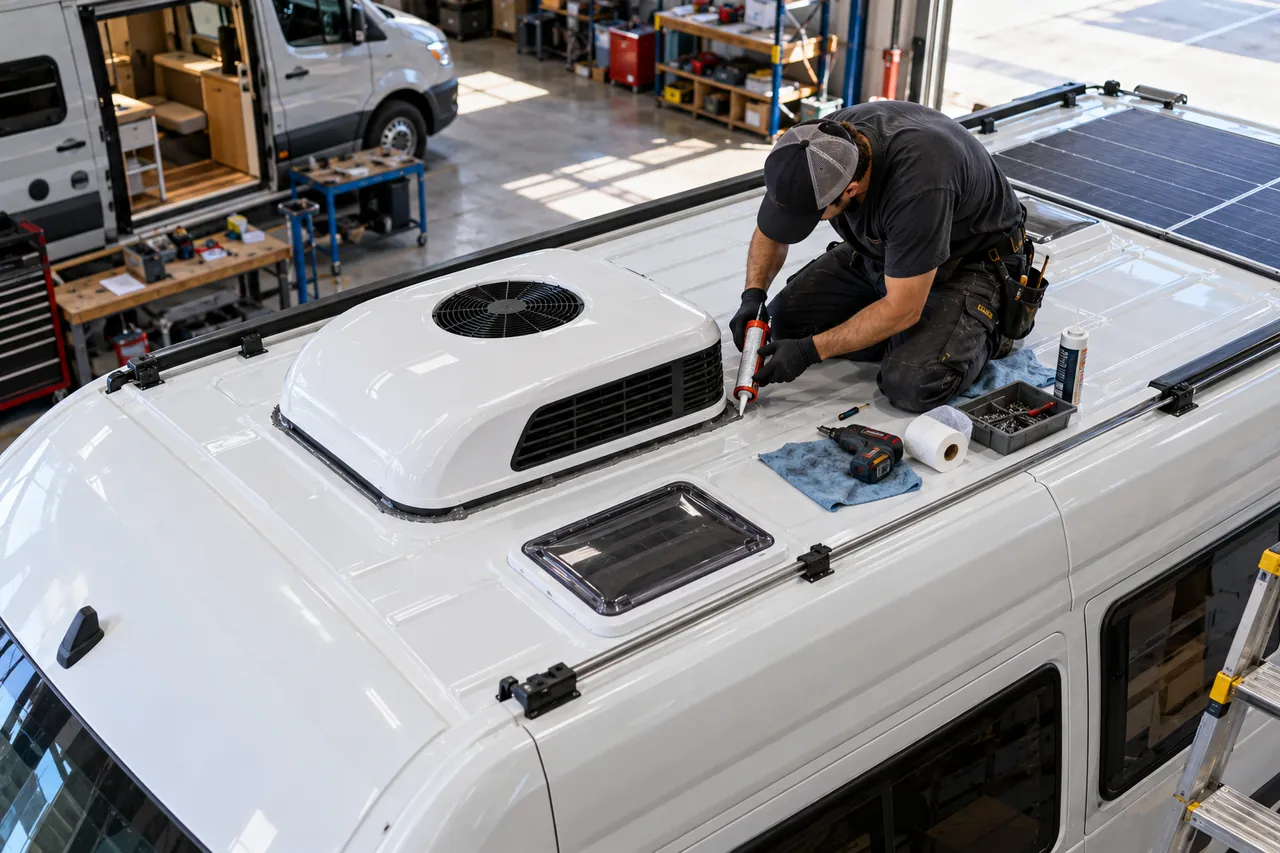
To install a rooftop AC, prepare a square, framed roof opening (usually 14 × 14 in / 356 × 356 mm), seat the unit on its roof gasket, clamp it from inside with the ceiling assembly bolts tightened evenly, then connect power on a dedicated circuit and fit the ceiling assembly and thermostat. Each manufacturer gives a bolt torque or gasket compression figure; follow it exactly.
- Check that the roof structure can carry the unit: rooftop units weigh about 35–50 kg (75–110 lb), and the roof framing around the opening must be solid and level.
- Check the roof thickness range the mounting kit accepts, often roughly 50–140 mm (2–5.5 in), and confirm the slope is within the unit's limits.
- Cut and frame the opening, sealing exposed wood or foam against moisture.
- Lower the unit onto the gasket, aligned with the opening and the front of the vehicle.
- Fit the mounting frame from inside and tighten the bolts gradually in a cross pattern until the gasket is evenly compressed.
- Run supply cable of the correct gauge on its own breaker (typically 20 A at 120 V), with an earth or ground connection.
- Fit the ceiling assembly, filter and thermostat; route any ducting; check that condensate runs off the roof.
- Test cooling, check for water leaks after rain or a hose test, and recheck bolt tension after the first few hundred kilometres.
Most failures after installation are water leaks from unevenly compressed gaskets and electrical faults from undersized cable. Rooftop units are sealed systems charged at the factory, so installation should not involve opening the refrigerant circuit; any refrigerant work needs a certified technician.
How do you clean and service an RV air conditioner?
Routine maintenance on an RV air conditioner means washing the return air filter every 2–4 weeks of use, cleaning the condenser and evaporator coils at least once a season, checking the shroud, gasket and drains, and keeping the electrical supply healthy. These steps prevent most loss of cooling.
How to clean an RV air conditioner
- Switch off the unit and disconnect shore power and the generator.
- Remove the ceiling grille, wash the foam or mesh filter in warm soapy water, rinse and let it dry.
- On the roof, remove the shroud screws and lift off the shroud; check it for cracks that let in water or sunlight damage.
- Vacuum or gently brush the condenser and evaporator fins, or use a non-acid coil cleaner and low-pressure rinse. Do not use a pressure washer.
- Straighten bent fins with a fin comb, clear leaves from the base pan and make sure drain holes are open.
- Check the roof gasket for leaks, refit the shroud and grille, and run the unit to confirm cool air and normal noise.
A healthy unit typically blows air about 10–12 °C (18–22 °F) cooler than the return air at the ceiling grille. Much less than that suggests dirty coils, low airflow or a refrigerant problem. Our guide to AC compressor and condenser troubleshooting covers diagnosis, and anything inside the sealed refrigerant circuit must be handled by a certified technician.
What are the most common RV AC problems?
The most common RV AC problems are poor cooling from dirty filters and coils, a frozen evaporator, breakers tripping on start-up, water leaking into the vehicle and failed start capacitors. The table lists likely causes and first checks.
| Problem | Likely causes | First checks |
|---|---|---|
| Blows air but not cold | Dirty coils, failed capacitor, compressor not starting, refrigerant leak | Clean filter and coils; listen for compressor; technician for capacitor and refrigerant |
| Ice on evaporator, weak airflow | Dirty filter, fan on low in humid weather, thermostat set very low | Clean filter, run fan on high, defrost by running fan only |
| Breaker trips or generator stalls on start | Start surge, low voltage, weak capacitor | Check voltage, fit soft start, replace capacitor |
| Water dripping inside | Loose or compressed-out gasket, blocked drain pan | Retighten bolts evenly, replace gasket, clear drains |
| Loud rattle or hum | Loose shroud, fan blade hitting, failing motor bearing | Inspect fan and mounting |
How to choose the best rooftop air conditioner for your vehicle
The best RV rooftop air conditioner for you is the one that matches your roof opening, ceiling assembly, power supply and climate, not simply the largest capacity.
- Measure the vehicle and choose capacity from the sizing table, adding margin for hot climates and food truck kitchens.
- Match supply voltage and frequency (120 V 60 Hz, 230 V 50 Hz or DC) and check the start surge against your generator or inverter.
- Confirm the roof opening, roof thickness, height limits and whether you need a ducted or non-ducted ceiling assembly.
- Decide on heat pump, heat strip or cooling only.
- Prefer inverter or soft-start units for generator and battery use, and compare noise levels.
- Check local parts and service, and the refrigerant used in your market.
Be There does not make RV or rooftop air conditioners. We supply cargo and product cooling for vehicles: truck refrigeration units for refrigerated vans and trucks with 4–45 m³ boxes holding −20 °C to +15 °C, plus XPS foam board for insulating vehicle bodies and floors. For refrigerated vans, read our refrigerated van conversion guide. Tell our engineers about your vehicle, box size and cargo temperature through the inquiry form and we will quote FOB, CIF or DDP.