

Short answer
A bus air conditioning system is a vapour-compression unit, usually roof-mounted, that cools and dehumidifies the passenger saloon through ducts. Size it at about 2.5–3.5 kW of cooling per metre of bus (8,500–12,000 BTU/h per metre), so a 12 m (40 ft) city bus or school bus typically needs 30–40 kW (100,000–135,000 BTU/h).
Key takeaways
- Bus AC rule of thumb: 2.5–3.5 kW per metre of length (8,500–12,000 BTU/h per metre), up to about 4 kW per metre in hot city service.
- A 12 m (40 ft) city bus or coach usually needs 30–40 kW; a 6–9 m shuttle or minibus 8–24 kW.
- Passengers (about 0.12 kW each), solar gain and fresh air make up most of a bus heat load, not body insulation.
- Electric buses use high-voltage electric compressors, often as heat pumps; 30 kW of cooling at COP 2 draws about 15 kW.
- A full-size engine-driven system can draw 100–200 A at 12 V for fans and blowers, so check alternator capacity on retrofits.
- Refrigerant recovery, charging and compressor work on bus AC must be done by certified technicians.
How does a bus air conditioning system work?
A bus air conditioning system uses the same vapour-compression cycle as any refrigerator: a compressor pumps refrigerant to a condenser that rejects heat outside, the liquid passes an expansion valve, and an evaporator inside the air-handling section absorbs heat from the passenger saloon. Fans push the cooled, dried air through roof ducts and diffusers along the length of the bus.
What makes bus HVAC different from a car system is scale and duty. A full-size city bus needs roughly ten times the cooling of a large car, carries up to 80–100 people, opens its doors every few hundred metres and has large single-glazed windows facing the sun. The system must also supply fresh air, remove moisture so windows do not fog, and on most buses provide heat in winter, which is why the industry tends to speak of bus climate control rather than just AC.
The main components are the compressor (engine-driven or electric), the condenser coil and fans, the evaporator coil and blowers, an expansion valve, a receiver-drier, the duct system, return air filters and a controller with cabin and ambient sensors. If you want a refresher on the cycle itself, our explainer on how refrigeration works covers it step by step.
What types of bus AC systems are there?
Buses use four main layouts: rooftop packaged units with an engine-driven compressor, fully electric rooftop units, split systems with separate condenser and evaporator sections for smaller buses, and rear or skirt-mounted systems common on school buses. The choice depends on bus length, powertrain and where space and weight can be found.
| System type | Typical vehicles | Compressor drive | Typical capacity | Notes |
|---|---|---|---|---|
| Rooftop packaged unit, engine-driven compressor | City buses, coaches 10–13 m | Open compressor belt-driven from the engine | 20–45 kW (68,000–154,000 BTU/h) | Most common on diesel buses; hoses run from engine bay to roof |
| Fully electric rooftop unit | Battery-electric, hybrid and fuel-cell buses | Hermetic electric compressor on high-voltage DC | 20–40 kW | Sealed refrigerant circuit, runs with engine off; often heat pump |
| Split or ceiling-mounted system | Minibuses, shuttle buses 6–9 m, vans | Engine-driven, sometimes auxiliary electric | 8–20 kW (27,000–68,000 BTU/h) | Condenser on roof or side, evaporators in ceiling or rear |
| Rear or skirt-mounted system | School buses, some shuttles | Engine-driven | 15–40 kW in one or two circuits | Condensers on the side skirt or rear, evaporators in ceiling or rear |
| Driver-only or front unit | Any bus | Shared or separate circuit | 3–8 kW | Keeps the driver comfortable and the windscreen clear |
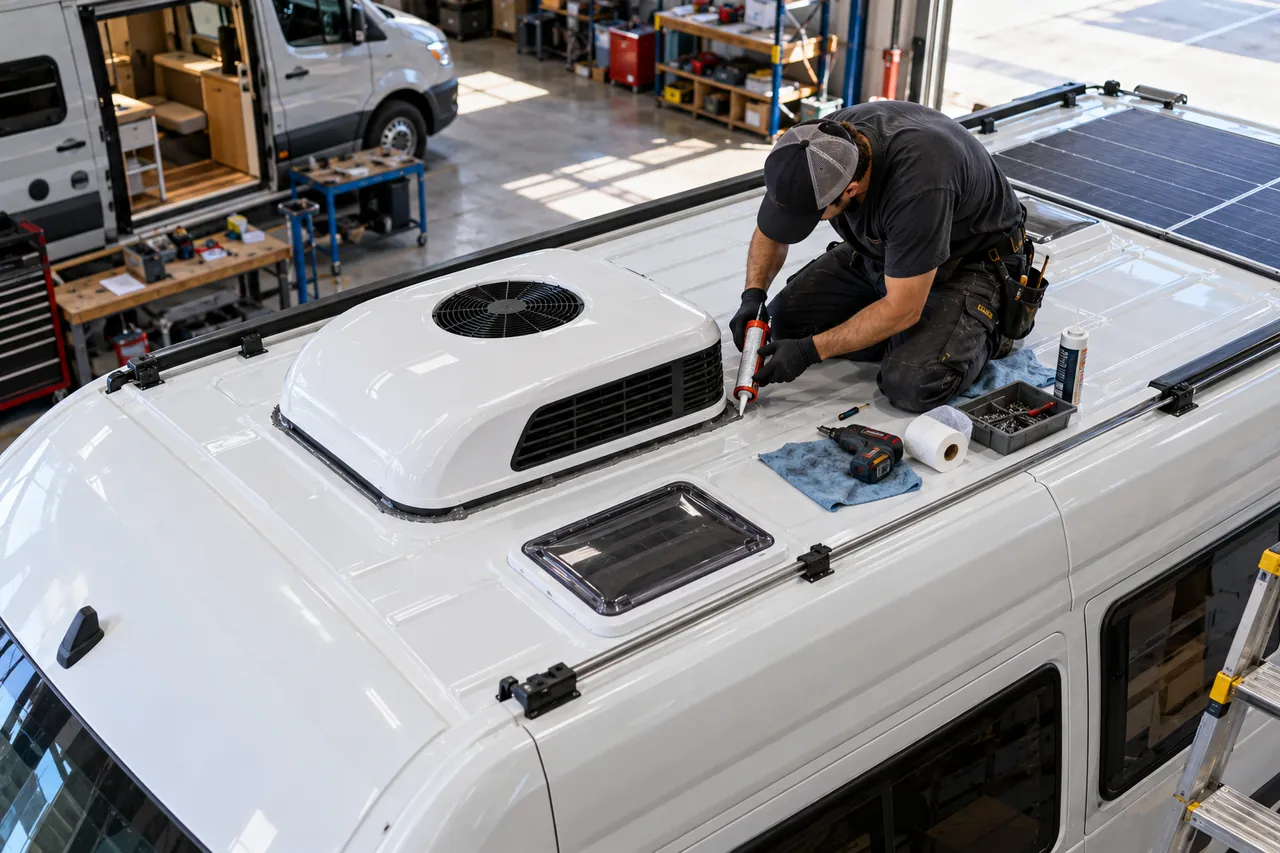
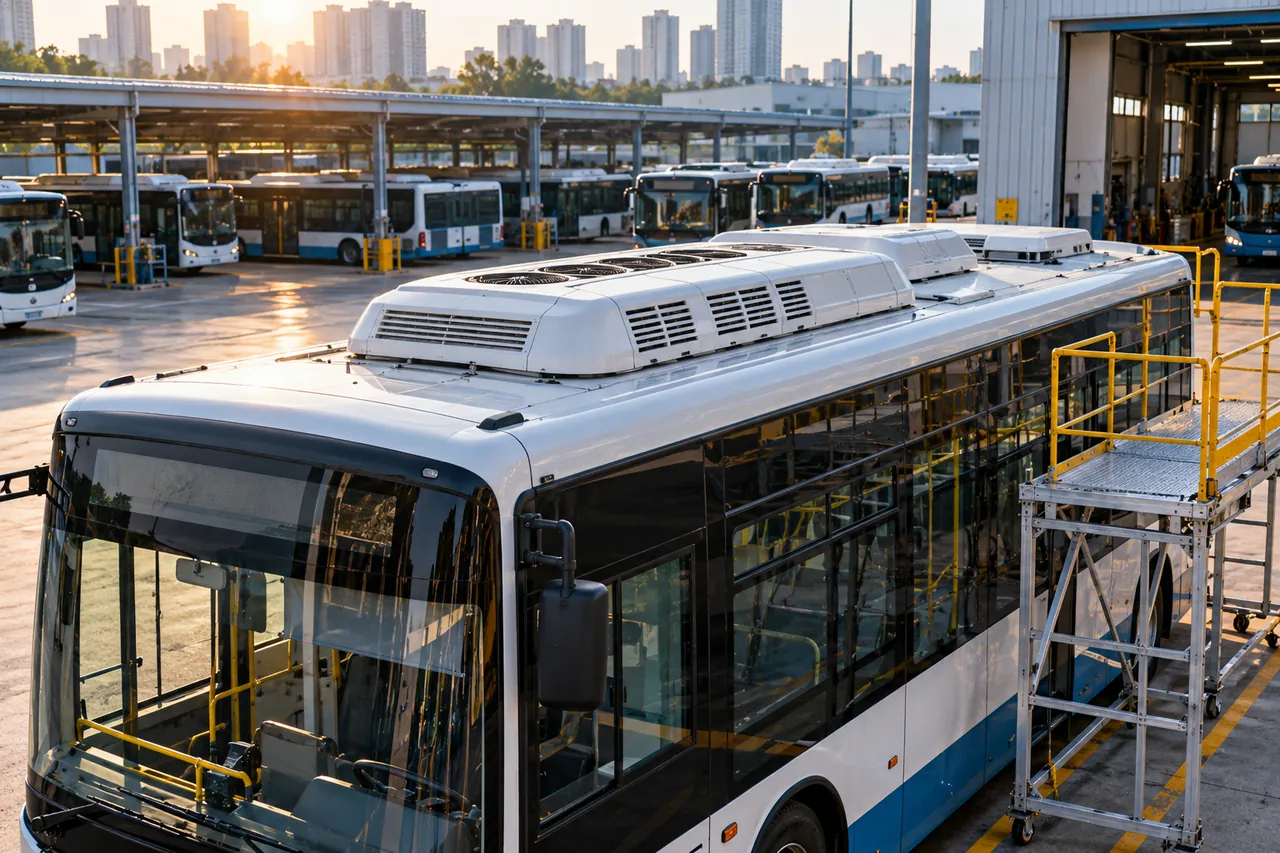
A rooftop bus air conditioning unit puts the condenser and evaporator in one aerodynamic housing, typically 3–4.5 m (10–15 ft) long, 1.8–2.0 m wide and 150–250 kg (330–550 lb) installed. The roof must be reinforced for that weight and the unit sealed to the roof skin to keep water out. For smaller vehicles and specialty conversions, our guide to rooftop air conditioners for RVs, vans and specialty vehicles covers lighter units.
How much AC capacity does a bus need?
A typical rule of thumb for a bus AC system is about 2.5–3.5 kW of cooling per metre of bus length (roughly 8,500–12,000 BTU/h per metre, or 2,600–3,600 BTU/h per foot), rising to about 4 kW per metre for city buses in very hot, sunny climates. A 12 m (40 ft) city bus therefore usually needs 30–40 kW (100,000–135,000 BTU/h).
| Bus type | Length | Typical cooling capacity | BTU/h (approx.) |
|---|---|---|---|
| Van-based minibus | 5–7 m (16–23 ft) | 7–14 kW | 24,000–48,000 |
| Shuttle or midi bus | 7–9 m (23–30 ft) | 14–24 kW | 48,000–82,000 |
| Full-size school bus | 10–12 m (33–40 ft) | 24–38 kW | 82,000–130,000 |
| Coach or tour bus | 12–13.5 m (40–44 ft) | 28–40 kW | 95,000–137,000 |
| City bus, hot climate | 12 m (40 ft) | 32–45 kW | 110,000–154,000 |
| Articulated city bus | 18 m (60 ft) | 50–70 kW, often two units | 170,000–240,000 |
Coaches usually need a little less capacity per metre than city buses for the same climate, because they open their doors rarely, carry seated passengers and often have tinted, double-glazed windows. City buses need more because of door openings and standing passengers. Treat these figures as starting points: the manufacturer of the AC unit should confirm capacity at your design ambient, for example +35 °C (95 °F) or +45 °C (113 °F), not at the gentler conditions often printed on brochures.
How do you calculate the heat load on a bus? (worked example)
The heat load on a bus is the sum of heat from passengers, sun through glass, conduction through the body, outside air brought in for ventilation, door openings and equipment such as lights and the engine bay. Here is an indicative calculation for a 12 m city bus in a hot climate.
- Passengers: 80 people × about 0.12 kW each (sensible plus latent heat) = 9.6 kW.
- Solar gain through glass: about 20 m² (215 ft²) of side and rear windows with roughly 0.3 kW/m² entering on a sunny day = 6 kW.
- Conduction through roof, walls and floor: about 90 m² of body at an overall U-value of around 2.5 W/(m²·K) with 12 K between +38 °C outside and +26 °C inside ≈ 2.7 kW.
- Fresh air ventilation: about 0.2 kg/s (roughly 600 m³/h) of hot, humid outside air cooled from +38 °C to +26 °C, removing about 25 kJ/kg including moisture ≈ 5 kW.
- Door openings, engine bay and electrics: allow about 3–5 kW for a city route.
The total is roughly 26–28 kW. Adding a margin of 15–20% for pull-down after the bus has stood in the sun and for coil fouling between services gives a rooftop unit of about 32 kW (110,000 BTU/h), which matches the rule of thumb above. In practice the bus maker or AC supplier runs this calculation with real glazing data and route profiles, but working it through shows why passengers and outside air, not the body insulation, dominate the load.
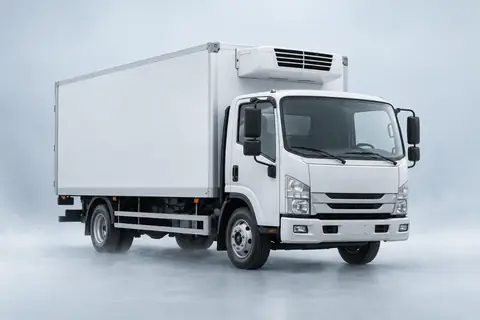
Unlike cargo refrigeration, where the insulated box is the main factor, bus AC is sized mainly for people and sun. If you are cooling goods rather than passengers, use the cargo method in our truck refrigeration unit sizing guide instead.
What should you know about school bus air conditioning?
School bus air conditioning usually uses one or two engine-driven systems with condensers on the side skirt, rear or roof and ducted ceiling evaporators, giving about 24–38 kW (82,000–130,000 BTU/h) on a full-size bus. Many fleets now specify AC on new buses, and school bus AC units can also be retrofitted.
School buses have long bodies, many windows and little insulation, and they often sit in the sun between routes. Points to plan for when specifying or retrofitting school bus HVAC systems:
- Engine power and idle: a 30 kW system absorbs roughly 8–12 kW of shaft power at full load, which matters on small engines and on long hill climbs; idling rules may limit pre-cooling.
- Alternator capacity: evaporator blowers and condenser fans on a full-size system can draw 100–200 A at 12 V, or half that at 24 V, so the charging system often needs upgrading.
- Air distribution: ducts along both sides with adjustable outlets avoid hot rear seats.
- Weight and roof strength for rooftop units, or ground clearance for skirt-mounted condensers.
- Service access: condensers near the road collect dirt and need frequent cleaning.
Retrofit cost varies widely by market and system, so get quotes for the complete installation, including alternator, wiring, ducting and refrigerant charge, rather than the AC kit price alone.
How does AC work on an electric bus?
On an electric bus, the AC compressor is driven by its own electric motor powered from the high-voltage traction battery, usually through an inverter, so cooling works whether the bus is moving or not. Most new electric bus units are heat pumps that also provide efficient heating in winter.
Because every kilowatt-hour used for climate control is taken from the driving range, efficiency matters. A worked example: a unit delivering 30 kW of cooling at a coefficient of performance (COP) of 2 draws about 15 kW of electricity; over a 10-hour hot shift at an average 50% load, that is around 75 kWh, a meaningful share of a typical 300–450 kWh bus battery. Variable-speed compressors, heat pumps, pre-conditioning while the bus is on charge, and good glazing all reduce this.
Refrigerants in use include R134a and R407C, and increasingly lower-GWP options such as R1234yf and natural CO₂ (R744), which works well as a heat pump in cold climates but runs at much higher pressures. Electric units have a hermetically sealed circuit with no shaft seal and no long hoses to the engine bay, which reduces leaks. For small all-electric vehicles and parking coolers running on 12 or 24 V, see our guide to DC and battery-powered air conditioners.
What are common bus AC problems and repairs?
Most bus AC repair calls come from dirty condenser coils, blocked return air filters, slipping or worn compressor belts, failed fan motors and refrigerant leaks. The first three are routine maintenance items; refrigerant and compressor work must be done by certified technicians.
| Symptom | Likely causes | First checks |
|---|---|---|
| Weak cooling, high head pressure, trips on high pressure | Dirty condenser, failed condenser fan, overcharge, very high ambient | Clean condenser, check every fan runs |
| Weak airflow from vents | Clogged return air filter, iced evaporator, failed blower, blocked ducts | Replace filters, check blowers and ducts |
| Cooling fades on hot afternoons | Low refrigerant charge, undersized system, condenser recirculating hot air | Leak check by a technician, check airflow around unit |
| Squeal or burning smell at start | Slipping belt, failing clutch or compressor bearing | Belt tension and condition, clutch air gap |
| Water dripping into the saloon | Blocked condensate drain, failed roof seal | Clear drains, inspect roof gasket |
| Front of bus cool, rear hot | Duct damage, closed dampers, poor air balance | Inspect ducts and outlets end to end |
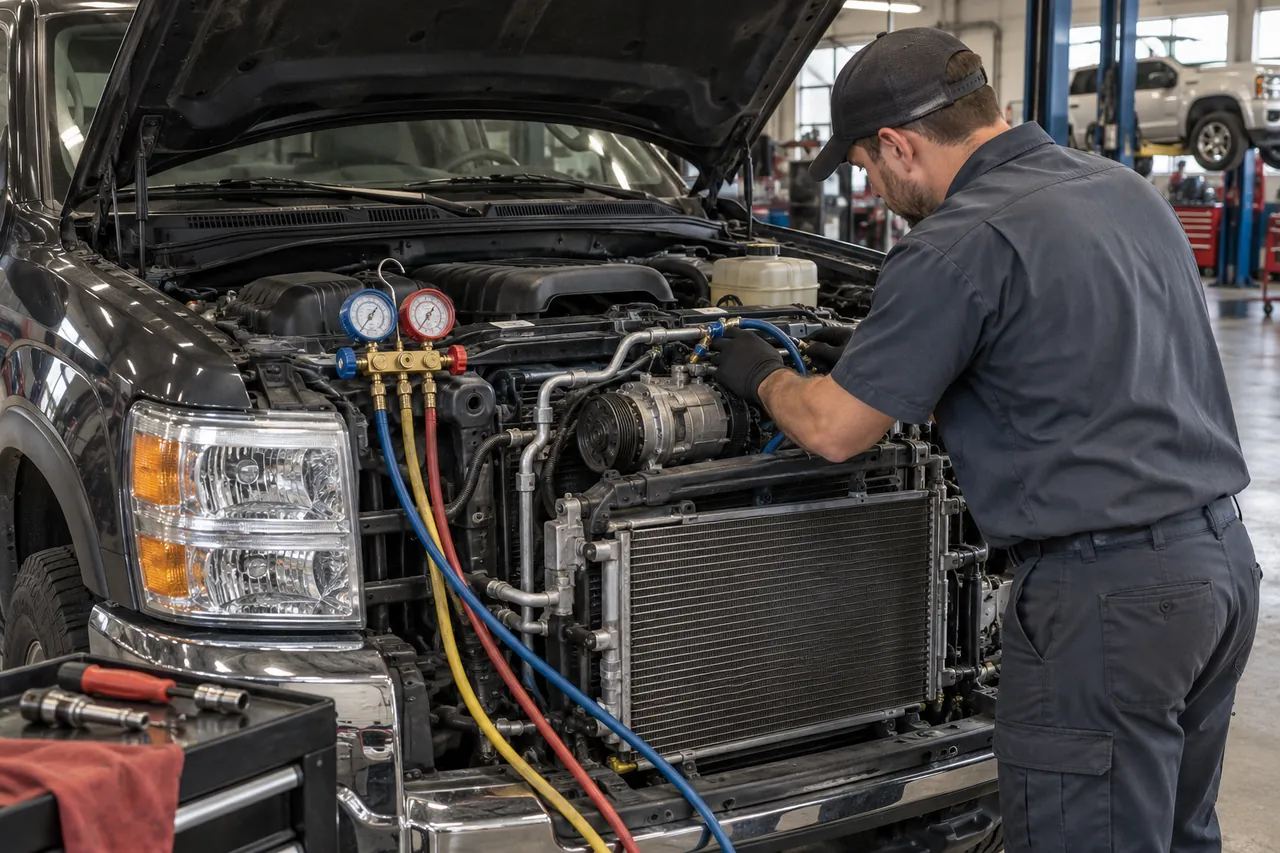
A preventive schedule usually includes return air filter cleaning or replacement every 2–6 weeks depending on dust, condenser and evaporator coil cleaning every 3–6 months, belt and electrical checks at each service, and a full pre-season inspection with leak test. Refrigerant recovery, recharging and compressor replacement must be done by technicians certified under local rules, such as US EPA Section 609 for motor vehicle air conditioning or the EU F-gas regulation. Our guide to AC compressor and condenser troubleshooting explains the diagnostic steps in more detail.
How to choose a bus air conditioning system: checklist
Choose an AC unit for a bus by matching capacity at your real design conditions to the bus's power supply, roof structure and service network.
- Bus length, passenger count (seated and standing) and route type: city, intercity or school.
- Design ambient and humidity, for example +40 °C (104 °F) and 50% RH, and the capacity the unit delivers at those conditions.
- Powertrain: diesel with engine-driven compressor, hybrid, or battery-electric with high-voltage electric compressor and heat pump.
- Electrical supply: 12 V or 24 V fan and blower load versus alternator capacity.
- Roof load and mounting, or space for skirt-mounted condensers, plus driver and windscreen circuit.
- Refrigerant permitted in your market and availability of certified service technicians and parts.
- Heating and ventilation requirements for winter and for fresh air.
Be There does not manufacture bus air conditioners; buses and their AC units come from specialist vehicle suppliers. Where Be There helps is when a vehicle carries cargo that must stay cold. We supply truck refrigeration units for vans and trucks with 4–45 m³ insulated boxes, holding −20 °C to +15 °C, which also suit cargo boxes on converted vehicles, as covered in our food truck refrigeration guide. You can estimate cargo cooling with the truck refrigeration calculator, then tell our engineers about your vehicle, box size and temperature through the inquiry form for an FOB, CIF or DDP quote.