

Short answer
A battery powered air conditioner is a compressor air conditioner that runs directly on 12 V, 24 V or 48 V DC using a variable-speed brushless compressor. Typical units cool 1.5–3.5 kW (5,000–12,000 BTU/h) on 300–1,100 W. A 450 W average draw for 10 hours needs about 5.3 kWh of lithium battery, roughly 220 Ah at 24 V.
Key takeaways
- A DC air conditioner runs a brushless variable-speed compressor directly from a 12 V, 24 V or 48 V battery, with no mains inverter.
- Current equals power divided by voltage: a 600 W unit draws about 50 A at 12 V, 25 A at 24 V and 12.5 A at 48 V.
- Battery size = average draw × hours ÷ usable fraction; a 450 W average for 10 hours needs about 5.3 kWh of LiFePO4 (about 220 Ah at 24 V).
- Lead-acid or AGM banks need roughly 1.8 times the capacity of lithium for the same run time because only about 50% is usable.
- 1 kWp of solar typically yields 4–6 kWh a day in sunny regions; a van roof fits only 400–800 W of panels.
- Adding 25–50 mm of PIR insulation can cut wall heat gain by 70–90%, often extending run time more cheaply than a bigger battery.
What is a DC or battery-powered air conditioner?
A battery powered air conditioner is a vapour-compression air conditioner whose compressor, fans and controls run directly from a 12 V, 24 V or 48 V DC battery instead of mains power. It uses a brushless DC, variable-speed compressor and a built-in drive board, so it can cool a truck cab, van, boat, cabin or equipment shelter with the engine off and no generator.
The refrigeration cycle is the same as in any split or window air conditioner: a compressor pumps refrigerant to a condenser that rejects heat outside, the liquid passes an expansion device and boils in an evaporator inside, absorbing heat from the air. If you want the cycle explained step by step, see how refrigeration works. What changes in a DC powered air conditioner is the power side: the compressor motor is a permanent-magnet brushless motor driven by an electronic controller that converts battery voltage to variable-frequency three-phase current, so the unit can slow down rather than switch on and off.
DC air conditioner vs "inverter air conditioner"
The words get mixed up. A dc inverter air conditioner in a home is usually a mains-powered split system (for example 230 V or 120 V AC) that rectifies the supply to DC internally and drives a variable-speed DC compressor. A true DC unit skips the mains entirely and connects to a battery. An rv inverter air conditioner is a mains-voltage rooftop unit with a variable-speed compressor, often run from a battery through a separate DC-to-AC power inverter. All three can be efficient; only the true DC unit avoids inverter losses of about 5–15%.
What a battery-powered "AC fan" is not
A battery powered ac fan, "personal air cooler" or many products sold as a portable battery air conditioner are evaporative coolers: a fan blowing through a wet pad. They draw 5–30 W and can make dry air feel 3–8 °C cooler, but they add humidity, do nothing in humid climates and remove no heat from the space. If it has no compressor and no hot-air exhaust or outdoor coil, it is not an air conditioner.
What types of DC air conditioning units are there?
DC ac units fall into five common formats, each matched to a voltage and a typical cooling load. Ratings below are typical for the category, not specific products; always compare cooling capacity at a stated outdoor temperature.
| Type | Typical voltage | Cooling capacity | Electrical input | Typical use |
|---|---|---|---|---|
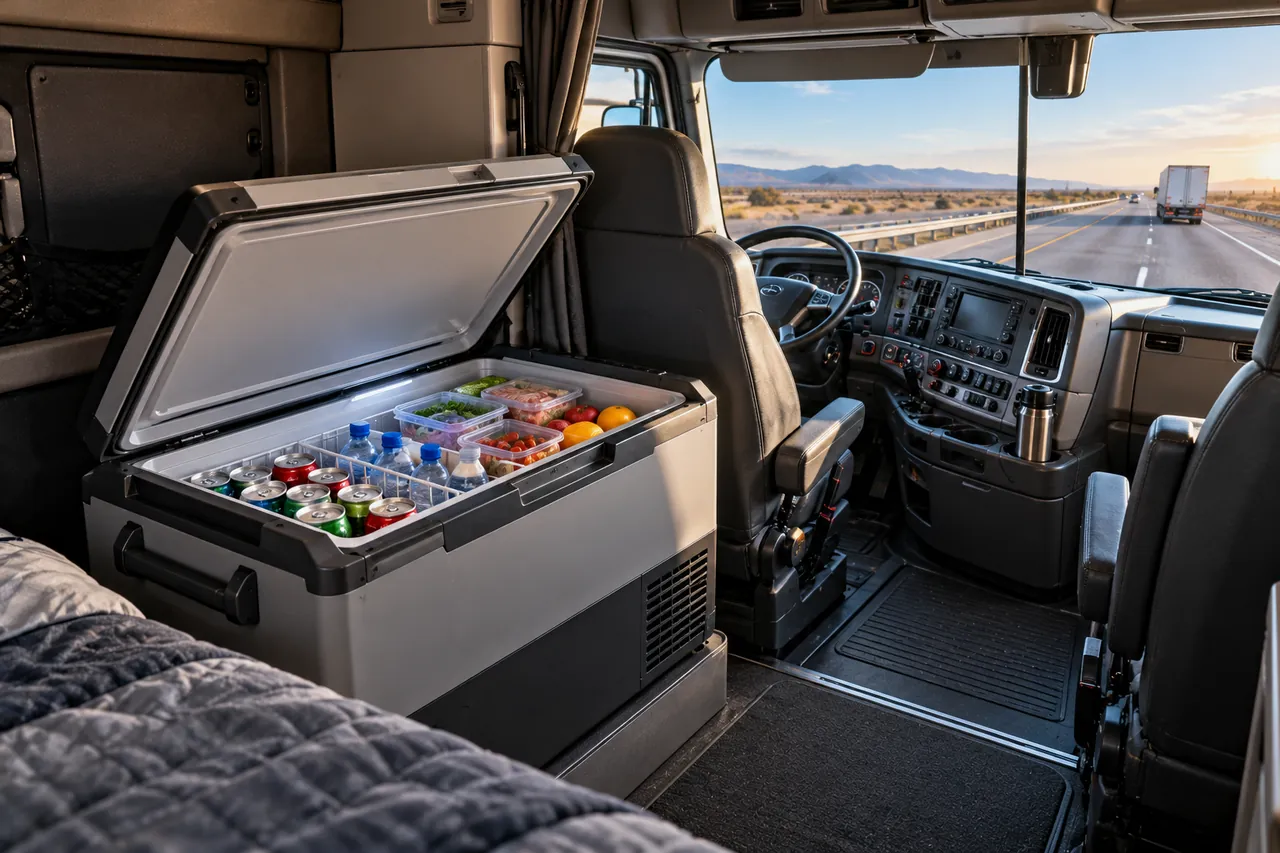
| Truck parking cooler (rooftop or back-wall split) | 12 V or 24 V | 1.5–3 kW (5,000–10,000 BTU/h) | 300–900 W | Sleeper cabs, machinery cabs, engine-off rest periods |
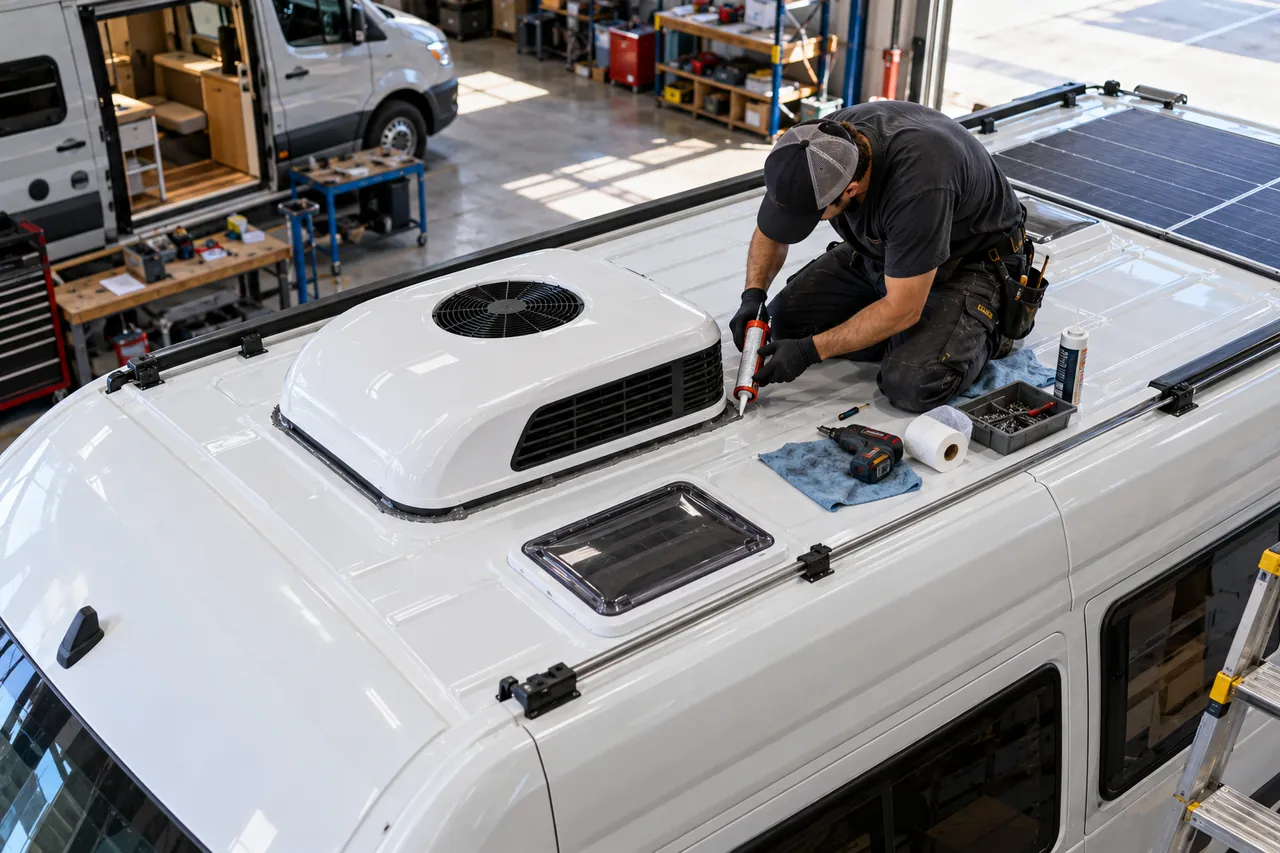
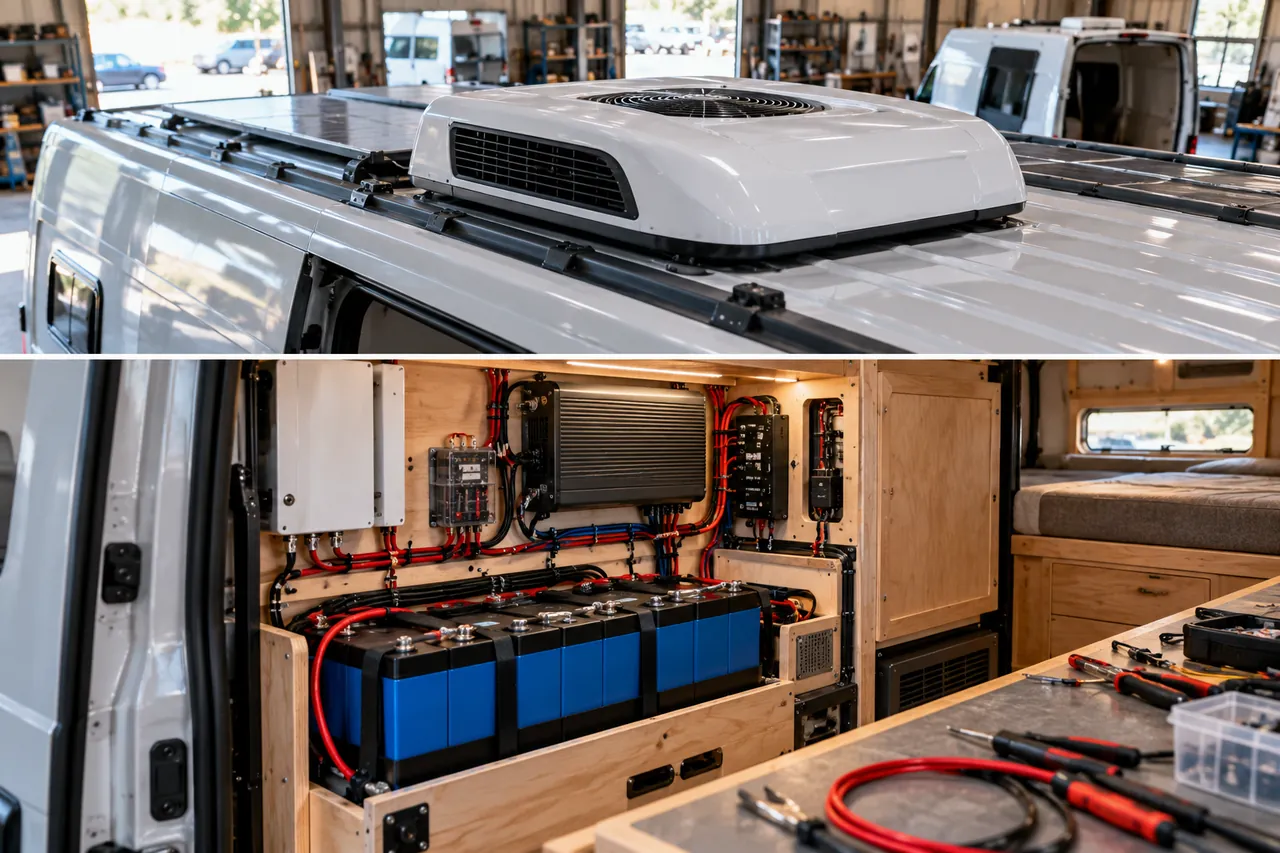
| Van or RV rooftop DC unit | 12 V, 24 V or 48 V | 1.5–3.5 kW (5,000–12,000 BTU/h) | 400–1,100 W | Campervans, mobile workshops, ambulances, food trucks |
| Small or micro air conditioner (portable or under-bunk) | 12 V or 24 V | 0.4–1.2 kW (1,500–4,000 BTU/h) | 100–400 W | Spot cooling in a bunk, tent, small cabin or electronics box |
| 48v dc air conditioner (wall split) | 48 V | 2.5–7 kW (9,000–24,000 BTU/h) | 600–2,200 W | Off-grid cabins, telecom shelters, solar home systems |
| Hybrid solar AC/DC split | Mains plus direct PV input | 2.5–7 kW (9,000–24,000 BTU/h) | Varies with sun | Grid-tied homes and shops wanting daytime solar offset |
Truck cab units are covered in detail in our guide to 12V and 24V truck air conditioners, and roof-mounted vehicle units in rooftop air conditioners for RVs and vans. This article concentrates on the power maths that applies to all of them.
How much current does a 12 V, 24 V or 48 V air conditioner draw?
Current equals power divided by voltage, so the same 600 W air conditioner draws about 50 A at 12 V, 25 A at 24 V and 12.5 A at 48 V. Higher voltage means thinner cables, smaller fuses, less heat in connections and less voltage drop, which is why larger systems move to 24 V or 48 V.
| System voltage | Current at 600 W input | Current at 1,000 W input | Typical copper cable for 600 W over 3 m one way (≤3% drop) |
|---|---|---|---|
| 12 V | 50 A | 83 A | 16–25 mm² (6–4 AWG) |
| 24 V | 25 A | 42 A | 4–6 mm² (12–10 AWG) |
| 48 V | 12.5 A | 21 A | 2.5 mm² (14 AWG), sized up for ampacity |
The cable column assumes a 6 m round trip of copper and a 3% voltage-drop target; check against the cable's current rating and your local wiring rules. A 12 volt dc ac unit is practical up to roughly 600–800 W input. Above that, currents of 60–100 A make wiring, fusing and battery discharge rates hard to manage. Most heavy trucks already have a 24 V system, which is one reason a 24v dc air conditioner is the default for long-haul cabs, while a 12 volt dc air conditioner for semi truck use is mainly a North American option because many US trucks run 12 V electrics.
Start-up current
Brushless DC compressors soft-start, ramping speed over several seconds, so inrush is typically only slightly above running current. This is a big advantage over a fixed-speed mains air conditioner on a power inverter, where locked-rotor start current can be 3–6 times running current and trips undersized inverters.
How big a battery does a battery-powered AC need?
Battery capacity needed equals the air conditioner's average power draw multiplied by the hours of use, divided by the usable fraction of the battery. Average power matters, not nameplate power: a variable-speed DC compressor usually runs at 40–70% of its maximum once the space has pulled down.
The formula:
- Energy needed (Wh) = average input power (W) × running hours (h)
- Battery size (Wh) = energy needed ÷ usable depth of discharge ÷ wiring and controller efficiency
- Battery size (Ah) = battery Wh ÷ system voltage
Use about 80–90% usable depth of discharge for lithium iron phosphate (LiFePO4) and about 50% for lead-acid or AGM if you want reasonable cycle life. Allow 0.95 for wiring and controller losses on a direct DC unit, or about 0.85–0.90 if the air conditioner runs through a DC-to-AC inverter.
Worked example: sleeper cab overnight
- A 24 V parking cooler has 800 W maximum input. After pull-down on a 32 °C (90 °F) night it averages about 450 W.
- Rest period of 10 hours: 450 W × 10 h = 4,500 Wh.
- LiFePO4 at 90% usable and 0.95 efficiency: 4,500 ÷ 0.9 ÷ 0.95 ≈ 5,260 Wh.
- At 24 V: 5,260 ÷ 24 ≈ 220 Ah. A 24 V 200–230 Ah lithium bank is the right size.
- The same job on AGM at 50% usable needs about 9,500 Wh, roughly 395 Ah at 24 V and three to four times the weight.
| Scenario | Average AC draw | Hours | Energy used | LiFePO4 bank needed | Lead-acid / AGM bank needed |
|---|---|---|---|---|---|
| Van, micro AC in bunk area | 200 W | 8 h | 1.6 kWh | about 1.9 kWh (155 Ah at 12 V) | about 3.4 kWh (280 Ah at 12 V) |
| Sleeper cab parking cooler | 450 W | 10 h | 4.5 kWh | about 5.3 kWh (220 Ah at 24 V) | about 9.5 kWh (395 Ah at 24 V) |
| Campervan rooftop DC unit, evening and night | 600 W | 6 h | 3.6 kWh | about 4.2 kWh (88 Ah at 48 V) | about 7.6 kWh (158 Ah at 48 V) |
| Off-grid cabin, 48 V split, 24 h hot climate | 900 W | 24 h | 21.6 kWh | about 25 kWh (530 Ah at 48 V) | Rarely practical |
The last row shows the limit of battery-only cooling: round-the-clock air conditioning of a building needs a large battery and a solar array to refill it every day. Battery prices vary widely by market; as an indicative guide, LiFePO4 packs for vehicles and cabins have typically cost from a few hundred US dollars per kWh upwards, so the battery often costs more than the air conditioner.
Can solar panels run an air conditioner off grid?
Yes. Off grid solar air conditioning works well because the cooling load peaks when the sun is strongest, but the array must cover the daily energy, not just the instantaneous power. As a rule of thumb, 1 kWp of solar panels yields about 4–6 kWh a day in sunny regions, less in winter, under cloud or with shading.
Sizing an off grid solar air conditioner
- Estimate daily AC energy: for example a 48 V split averaging 700 W for 10 hours = 7 kWh.
- Add other daily loads (lights, fridge, pumps), say 2 kWh, for a total of 9 kWh.
- Divide by local peak sun hours and system efficiency: 9 kWh ÷ 5 h ÷ 0.8 ≈ 2.25 kWp of panels.
- Size the battery for the hours without sun: if 4 kWh of the load falls after dark, choose about 5 kWh of LiFePO4.
- Add margin for cloudy days: one to two days of autonomy, or a backup generator or grid connection.
A dc solar powered air conditioner with a built-in MPPT input can take panels directly and prioritise solar during the day, falling back to battery or mains. An rv solar air conditioner setup is usually limited by roof area: a van roof holds about 400–800 W of panels, which yields only 2–4 kWh on a good day, enough to cover part of a day's cooling but rarely a whole night as well. Plan on charging from the alternator through a DC-DC charger and from shore power when available.
Why does insulation decide how long the battery lasts?
An air conditioner only removes the heat that gets in, so halving the heat gain roughly halves the battery and solar needed. In vehicles and small cabins, insulation, sealing and shading usually give more run time per dollar than a bigger battery.
Heat gain through walls is U-value × area × temperature difference. Take a 10 m² van body or cab envelope with 35 °C (95 °F) outside and 25 °C (77 °F) inside, a 10 K difference:
- Bare steel with trim panels, U ≈ 3–5 W/(m²·K): about 300–500 W of conduction gain, before solar heat on the roof.
- With 25 mm (1 in) of PIR board, U ≈ 0.8 W/(m²·K): about 80 W.
- With 50 mm (2 in) of PIR board, U ≈ 0.4 W/(m²·K): about 40 W.
Sun on a dark roof can add several hundred watts more, so reflective roof paint, window shades and stopping air leaks around doors also matter. Rigid boards are the most space-efficient way to insulate a van or cabin; see the insulation R-value chart for how PIR, XPS and other materials compare.
DC air conditioning vs electric truck refrigeration: what is the difference?
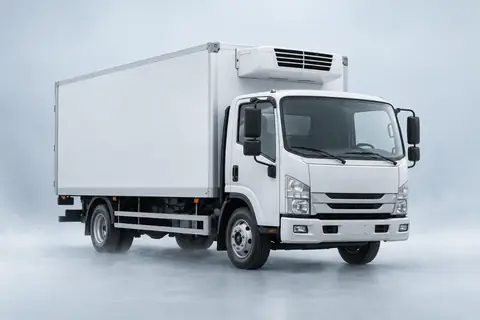
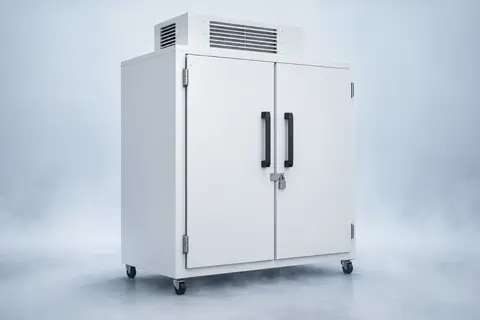
A DC air conditioner cools people to about 20–27 °C (68–81 °F); a transport refrigeration unit keeps cargo at −20 °C to +15 °C (−4 °F to 59 °F) inside an insulated box. Both use DC-driven compressors on electric vehicles, but the duty, temperatures and standards are different, and a cab air conditioner cannot replace a reefer.
- Temperature: comfort air conditioners run evaporators near +5 to +10 °C; frozen-cargo units run evaporators below −25 °C and need defrost.
- Load: a box truck's door openings, warm product and wall heat gain set the size, calculated with the K-value method used for ATP testing. See truck refrigeration unit sizing.
- Body: a refrigerated box needs 50–100 mm (2–4 in) of PU insulation, as described in our refrigerated van conversion guide.
- Food rules: chilled and frozen food transport must hold temperatures that comfort cooling is not designed or certified to hold.
Fully electric reefer units for vans and small trucks run from the vehicle's traction battery or a dedicated battery pack, using the same battery-sizing logic as above with the cargo heat load in place of the cab load. For small mobile cooling of goods rather than people, a compressor box fridge may be enough; see the 12V fridge freezer guide.
Can you run a battery-powered AC in a car from the car battery?
Not for long. A car starter battery of 50–70 Ah at 12 V stores roughly 0.6–0.8 kWh, but only about half is usable without damage, and a 400–600 W battery powered air conditioner for car use would flatten it in under an hour and leave the engine unable to start.
The safe arrangement for any vehicle is:
- A separate auxiliary battery, ideally LiFePO4, sized with the formula above.
- A DC-DC charger or battery isolator so the alternator charges the auxiliary battery while driving, but the air conditioner can never drain the starter battery.
- A low-voltage disconnect set to the battery maker's cut-off voltage.
- A main fuse or circuit breaker within about 150–300 mm (6–12 in) of the battery positive terminal, sized to the cable.
- Cables sized for both current and voltage drop, with crimped and heat-shrunk lugs; loose or undersized lugs are the most common cause of DC system overheating.
Running the engine to power a standard belt-driven AC is often what idling rules in many cities and countries are trying to stop, which is why engine-off battery systems have grown in trucking.
How to choose a DC air conditioner: checklist
Choose a battery-powered AC by heat load first, then voltage, then battery and charging. Use this checklist:
- Heat load: estimate the space volume, insulation, glazing and sun exposure; for a well-insulated sleeper cab 1.5–2.5 kW of cooling is typical, for an uninsulated van it can be double.
- Voltage: match the vehicle or battery bank (12 V, 24 V or 48 V). Prefer 24 V or 48 V above about 600 W input.
- Rated capacity at real conditions: ask for cooling capacity and input power at a stated outdoor temperature, such as 35 °C (95 °F), not just a "BTU" number.
- Efficiency: compare COP (cooling watts ÷ input watts); variable-speed DC units commonly reach about 2.5–3.5 at moderate conditions.
- Battery and charging: size the bank for average draw × hours ÷ usable fraction, and plan alternator, solar and shore charging.
- Installation: roof load and sealing, condensate drain, fusing, low-voltage protection and service access.
- Insulate first: 25–50 mm of PIR board in walls and roof often cuts conduction gain by 70–90%.
Be There does not sell air conditioners, but we supply the cold-side equipment around them: engine-driven, independent diesel and fully electric truck refrigeration units for 4–45 m³ boxes holding −20 °C to +15 °C, and PIR and PU insulation boards from 20 to 200 mm for vehicle bodies, cabins and shelters. Use the truck refrigeration calculator to size a reefer, then send your vehicle, box size and power source through the inquiry form and we will quote FOB, CIF or DDP.