

Short answer
Humidity in cold storage should match the product: most fresh fruit and vegetables need 90–95% relative humidity, leafy greens and root vegetables 95–100%, fresh meat 85–90%, and onions, garlic and dry goods 50–70%. Measure it with a digital hygrometer accurate to ±2–3% RH and control it mainly by evaporator temperature difference: 4.5–6.5 K gives about 91–95% RH.
Key takeaways
- Most fresh fruit and vegetables keep best at 90–95% RH; leafy greens and root vegetables at 95–100%.
- Fresh meat is held at about 85–90% RH; onions and garlic at 65–70%; dry stores at 50–60%.
- Digital capacitive hygrometers are typically accurate to ±2–3% RH between 10% and 90% RH.
- An evaporator TD of 4.5–6.5 K (8–12 °F) gives about 91–95% RH; 9–12 K gives about 76–80%.
- Air at 25 °C (77 °F) and 60% RH condenses on any surface colder than about 17 °C (62 °F).
- Check hygrometers every 6–12 months; saturated salt gives about 75% RH for a quick test.
Why does humidity matter in cold storage?
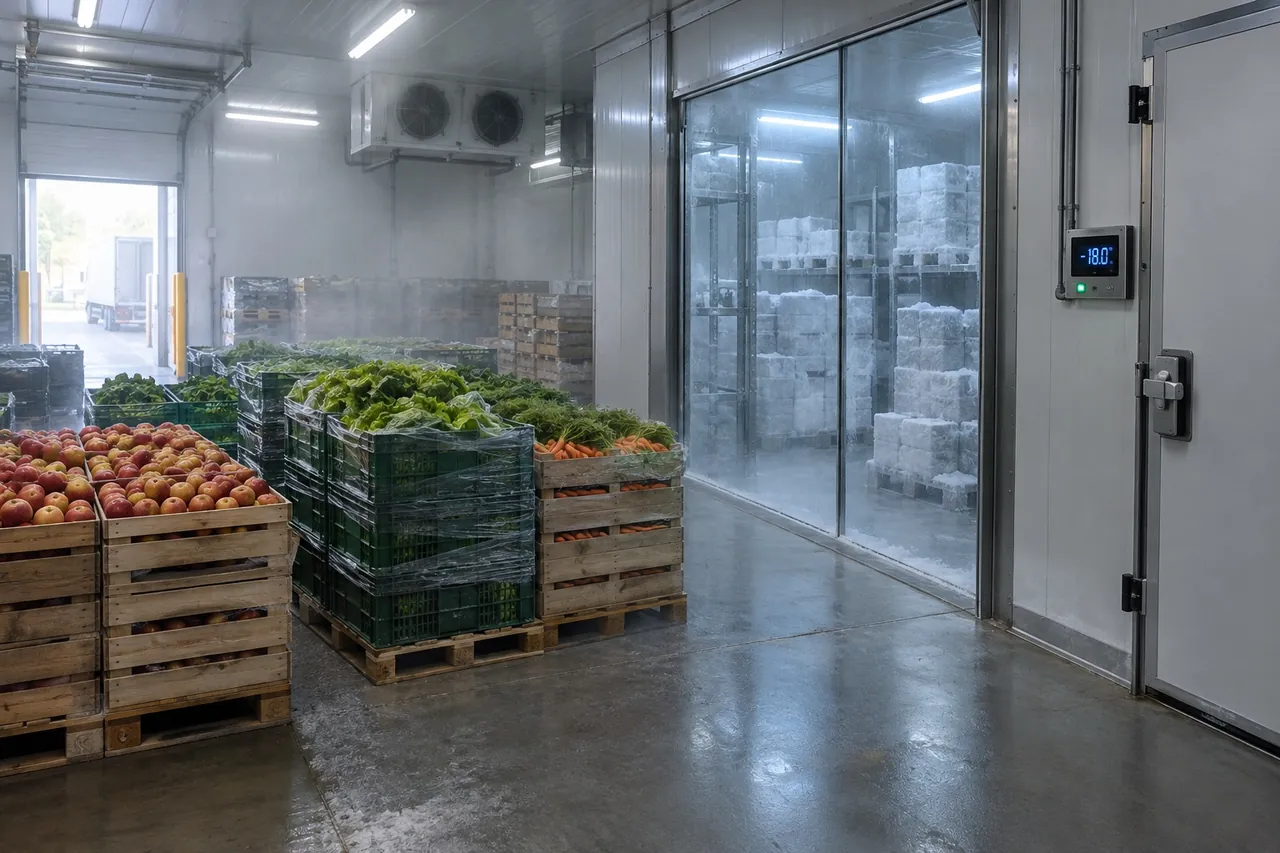
Humidity matters in cold storage because the moisture content of the air decides whether stored food loses water, grows mould or stays fresh. Relative humidity (RH) that is too low dries out produce, meat and cheese and causes weight loss and freezer burn; RH that is too high causes condensation, mould, slime, soggy cartons and ice build-up.
Weight loss is money. Leafy greens can lose enough water in a few days at low humidity to wilt and become unsaleable, and unwrapped meat in a dry cooler loses weight and darkens on the surface. In a cold room, humidity is not a separate setting: it is largely the result of how the refrigeration is designed, how often doors open and what is stored. This guide covers how to measure RH, the targets by product and how to control it. Temperatures by product are in our cold storage temperature chart.
How do you measure humidity in a room or cold room?
Humidity is measured with a hygrometer, the standard instrument to measure humidity, which reads relative humidity as a percentage. For cold rooms, a digital hygrometer with a capacitive sensor, often combined with a thermometer as a temperature humidity monitor, is the practical choice; for records and alarms, use a temperature and humidity data logger.
| Instrument | How it works | Typical accuracy | Best for |
|---|---|---|---|
| Digital capacitive hygrometer | Polymer film changes capacitance with moisture | ±2–3% RH (10–90% RH) | Cold rooms, stores, general use |
| Hygrometer with probe | Capacitive sensor on a cable or wand | ±1.5–3% RH | Reading inside rooms from outside, duct checks |
| Temperature and humidity data logger / wireless sensor | Capacitive sensor plus memory or radio | ±2–3% RH | Continuous records, alarms, pharma warehouses |
| Psychrometer (wet and dry bulb) | Evaporative cooling of a wetted thermometer | ±2–5% RH; poor below 0 °C | Field reference checks above freezing |
| Mechanical dial (hair or coil) | Material expands with moisture | ±5–10% RH | Rough indication only |
| Chilled-mirror dew point meter | Measures the dew point directly | ±0.2 °C dew point | Laboratory reference, calibration |
Tips for accurate readings
- Let a humidity meter stabilise for 15–30 minutes when it is carried from a warm room into a cold room; readings change as the sensor cools.
- Do not breathe on the sensor or hold it close to your body.
- Avoid the evaporator discharge, which is drier, and the door, where warm moist air enters.
- Above 90% RH most sensors are less accurate and can saturate; check them more often in produce coolers.
- Check calibration every 6–12 months, either against a reference instrument or with saturated salt solutions: sodium chloride gives about 75% RH and magnesium chloride about 33% RH at room temperature.
Using a hygrometer in a fridge or display case
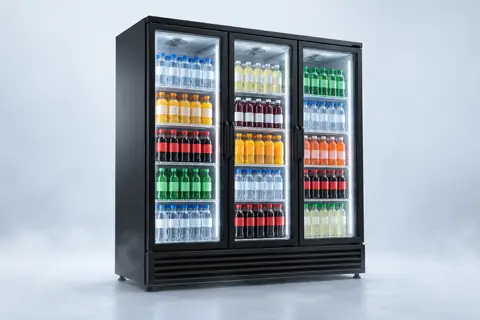
A small fridge hygrometer placed on a middle shelf shows whether a reach-in, prep fridge or display case is drying out food. Fan-cooled cabinets usually run at about 40–70% RH depending on load and door openings, which is why uncovered food dries and skins over quickly. Cover, wrap or lid all stored food, keep fresh produce in crisper drawers or lidded containers, and keep a relative humidity meter reading as a trend rather than a target: a sudden rise often means a blocked drain or failed defrost, while frost on the back wall means humid air is leaking in through a gasket.
For continuous recording, see our temperature and humidity data logger guide; for connected sensors with alarms, see wireless temperature and humidity sensors.
What is the ideal humidity for cold storage?
The ideal humidity depends on the product: most fresh fruit and vegetables want 90–95% RH, leafy greens and root vegetables 95–100%, fresh meat about 85–90%, while onions, garlic, dried foods and chocolate need dry air, 50–70% RH or less.
| Product | Temperature | Relative humidity |
|---|---|---|
| Leafy greens, lettuce, spinach | 0 °C (32 °F) | 95–100% |
| Carrots, beets, celery | 0 °C (32 °F) | 95–100% |
| Apples | −1 °C to +4 °C (30–39 °F), by variety | 90–95% |
| Citrus | +3 °C to +9 °C (37–48 °F), by type | 85–90% |
| Bananas (ripening and holding) | +13 °C to +14 °C (55–57 °F) | 90–95% |
| Potatoes (table) | +7 °C to +10 °C (45–50 °F) | 90–95% |
| Onions, garlic (dry) | 0 °C (32 °F) | 65–70% |
| Pumpkins and winter squash | +10 °C to +13 °C (50–55 °F) | 50–70% |
| Fresh meat, carcasses | −1 °C to +2 °C (30–36 °F) | 85–90% |
| Fresh fish (on ice) | 0 °C to +2 °C (32–36 °F) | 95–100% |
| Cut flowers | +1 °C to +4 °C (34–39 °F) | 90–95% |
| Chocolate and confectionery | +15 °C to +18 °C (59–64 °F) | Below 50–55% |
| Dry stores (flour, rice, packaged goods) | +10 °C to +21 °C (50–70 °F) | 50–60% |
| Frozen food | −18 °C to −25 °C (0 °F to −13 °F) | High RH is fine; it reduces freezer burn |
These values follow common postharvest and cold storage practice; check your product specification or supplier guidance for exact targets. Fresh produce and meat rooms are designed in detail in our guide to produce and meat coolers.
Why do cold rooms lose humidity?
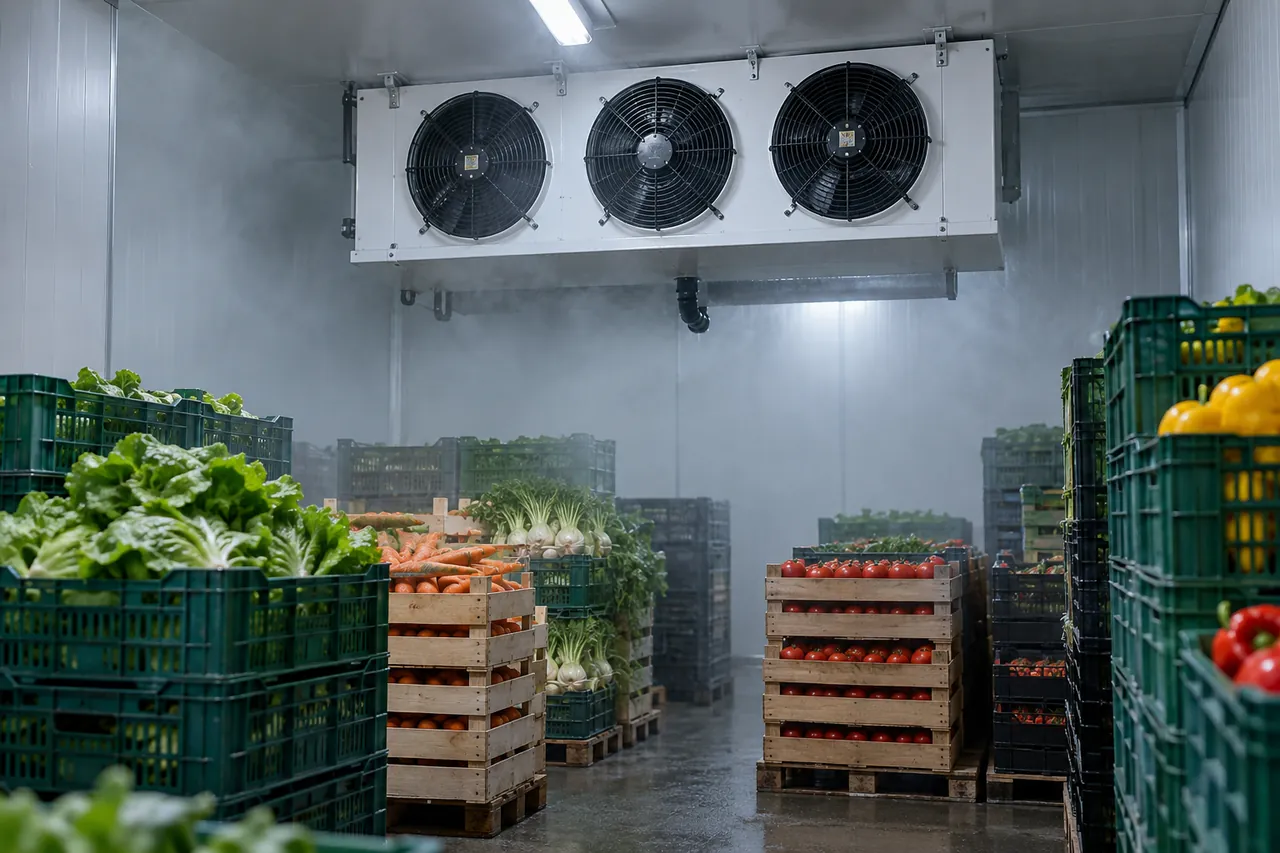
Cold rooms lose humidity because the evaporator coil runs colder than the room air, and moisture in the air condenses or freezes on the coil and is drained away at defrost. The bigger the temperature difference (TD) between the room air and the coil, the more water is removed and the drier the room.
This is why evaporator selection is the main humidity control in a cooler. A coil sized generously, so it can work with a small TD, removes less moisture. The table shows the usual design rule of thumb for coolers.
| Design TD (room air minus evaporating temperature) | Approximate room RH | Suits |
|---|---|---|
| 4.5–6.5 K (8–12 °F) | 91–95% | Leafy greens, root vegetables, flowers |
| 6.5–8 K (12–14 °F) | 86–90% | Most fruit, fresh meat |
| 8–9 K (14–16 °F) | 81–85% | Packaged produce, dairy, general chilled |
| 9–12 K (16–22 °F) | 76–80% | Packaged goods, drinks, beer coolers |
A worked example: a produce room held at +2 °C (36 °F) for leafy greens needs about 95% RH. With a 5 K TD the coil runs at about −3 °C (27 °F) evaporating temperature. If the same room were fitted with a smaller, cheaper coil running at −8 °C (18 °F), a 10 K TD, the room would settle near 80% RH and the greens would wilt. Evaporator choice is covered in our guide to evaporator coils and unit coolers.
How do you increase humidity in a cold room?
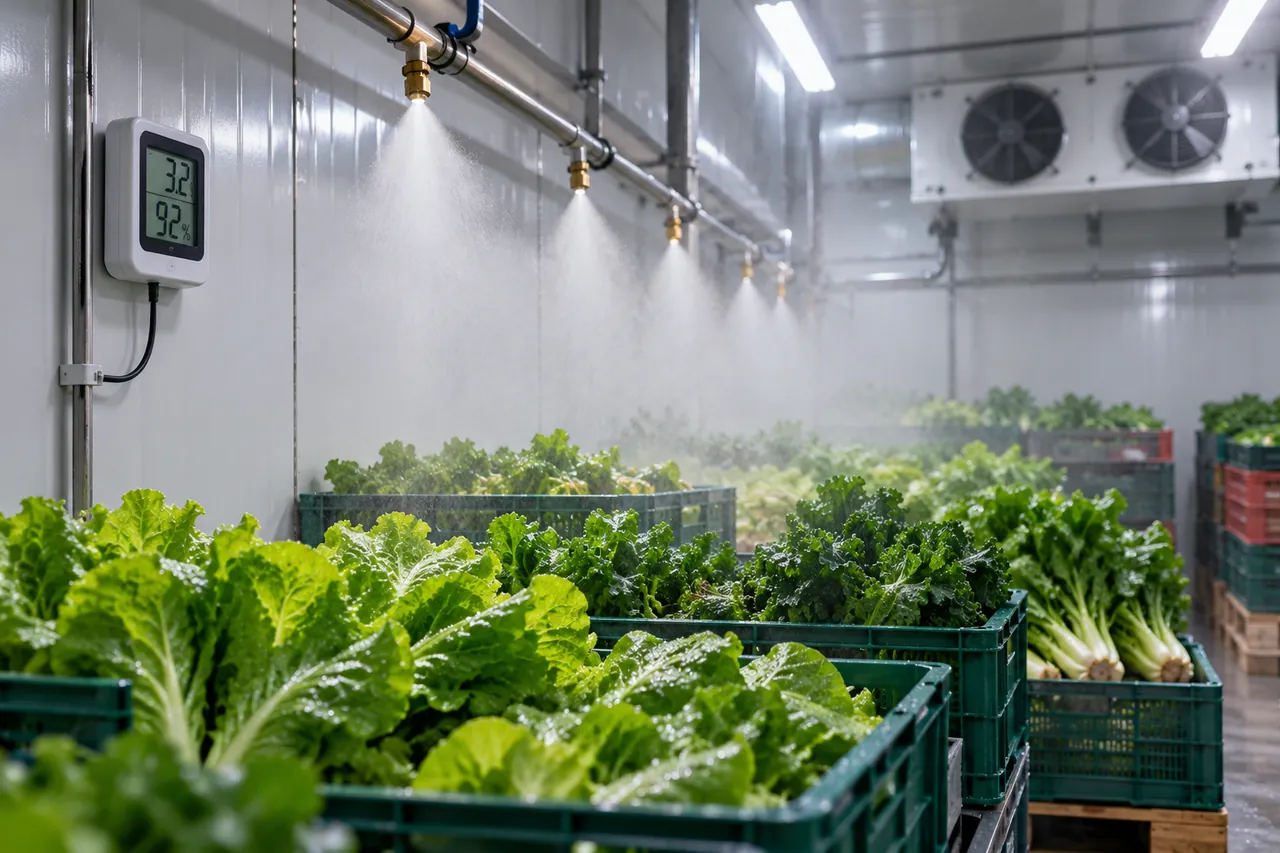
To increase humidity in a cold room, reduce the evaporator TD, reduce air speed over the product, keep doors shut, and if that is not enough, add a humidifier designed for cold rooms.
- Specify a larger evaporator with a low TD, about 4.5–6.5 K, for high-humidity rooms.
- Use low-velocity or two-speed evaporator fans so air does not strip moisture off the product; aim for gentle, even airflow.
- Cover or pack produce in perforated liners, or use humidity-retaining crates.
- Add an ultrasonic, high-pressure fog or centrifugal humidifier controlled by an RH sensor; use treated water to avoid mineral dust and bacteria.
- Avoid wetting the floor or product by hand, which encourages mould and slip hazards.
- Keep door openings short and fit strip curtains so warm dry winter air or warm moist summer air does not swing the room.
How do you reduce humidity and stop condensation?
To reduce humidity and stop condensation in cold storage, stop warm moist air getting in, remove moisture at the source and keep all surfaces above the dew point of the surrounding air.
- Seal panel joints, cable and pipe penetrations so outside air cannot leak in; moisture entering the panel core also ruins insulation. See our vapor barrier guide.
- Fit door heaters and check gaskets; door frames are the most common place for condensation and ice on freezers.
- Keep doors closed; use strip curtains or rapid doors and an air-tight anteroom for busy freezers.
- Do not store hot or wet product in the room; chill cooked food in a blast chiller first.
- For dry stores or chocolate rooms, use a dehumidifier or design the refrigeration with a larger TD and reheat.
Condensation happens when a surface is colder than the dew point of the air. Air at 25 °C (77 °F) and 60% RH has a dew point of about 17 °C (62 °F), so any surface colder than that, such as the outside of a cold room door frame, an uninsulated pipe or the floor near a freezer, will sweat. This is why the outside of a cold room should be kept in a ventilated, ideally air-conditioned space.
How are temperature and humidity controlled in the pharmaceutical industry?
In the pharmaceutical industry, temperature and humidity are controlled according to the storage conditions on each product's label, with continuous monitoring by calibrated loggers and alarms under EU GDP (2013/C 343/01) or equivalent national rules. Room-temperature warehouses typically hold +15 °C to +25 °C (59–77 °F), often with humidity limits such as 60–65% RH or below, while +2 °C to +8 °C cold rooms are controlled mainly on temperature.
Pharmaceutical stores need temperature and humidity mapping before use, calibrated sensors at the mapped worst-case points, alarms with documented response and records kept for the required period. Our guides to pharmaceutical cold chain and vaccine storage and warehouse mapping explain the process.
Humidity control checklist for cold storage
Good humidity control starts at design: decide the RH the product needs before the refrigeration is selected, then measure it once the room is running.
- List the products and their target temperature and RH; separate dry-loving and moisture-loving products into different rooms.
- Select the evaporator by TD for that RH: about 4.5–6.5 K for 90–95% RH, 8–12 K for general storage.
- Specify fan speed and air throw to avoid drying product near the coil.
- Seal all penetrations and fit door heaters, gaskets and strip curtains.
- Install a calibrated temperature and humidity logger or wireless sensor at product level, away from the coil and door.
- Check hygrometers every 6–12 months against a reference or salt test.
- Add humidifiers or dehumidifiers only after design measures are in place.
Be There supplies walk-in cold rooms with PU or PIR panels, matched condensing units and evaporators, and we select the evaporator TD for your product's humidity, from high-RH produce rooms to general chillers and freezers. Rooms can be specified with a controller and sensor for temperature and humidity display. Send your products, room size, target temperature and RH and voltage through the inquiry form and we will quote FOB, CIF or DDP.