Short answer
Refrigeration works by moving heat, not making cold. A refrigerant boils in the evaporator at low pressure, for example −8 °C (18 °F) in a +2 °C cold room, absorbing heat; the compressor raises its pressure and temperature; the condenser releases the heat outside at about +40 °C (104 °F); and an expansion valve drops the pressure to restart the cycle.
Key takeaways
- The vapour compression cycle has four stages: evaporation, compression, condensation and expansion.
- A refrigerant's boiling point depends on pressure, so it boils cold in the evaporator and condenses hot in the condenser.
- A +2 °C (36 °F) cold room typically evaporates at −10 °C to −5 °C and condenses at +40 °C to +45 °C on an air-cooled system.
- With R134a, −8 °C evaporating is about 2.2 bar abs and +40 °C condensing about 10.2 bar abs; other refrigerants run at different pressures.
- About a quarter to a third of the liquid flashes to vapour across the expansion device.
- Real commercial cold rooms achieve a COP of about 2–3.5 as chillers and 1.2–2 as freezers.
How does a refrigerator work?
A refrigerator works by pumping heat out of an insulated box rather than "making cold". A refrigerant boils inside the evaporator coil at low pressure, absorbing heat from the food and air; a compressor then squeezes that vapour to high pressure and temperature, and a condenser coil outside the box releases the heat to the room. An expansion device drops the pressure again and the loop repeats.
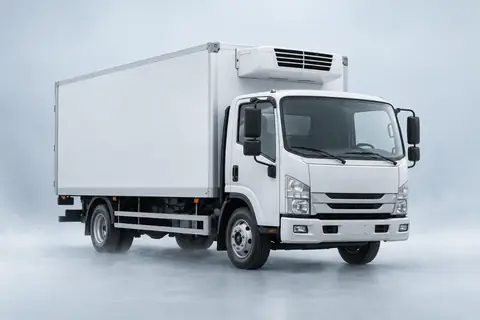
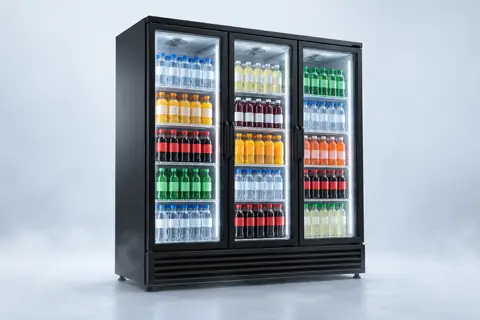
This loop is the vapor compression refrigeration cycle, and the same four steps run in a domestic fridge, a supermarket display case, a walk-in cold room, a truck reefer unit and an air conditioner. What changes between them is size, refrigerant, the type of compressor and how the heat is finally rejected.
The trick that makes it work is simple physics: the temperature at which a liquid boils depends on pressure. Water boils at 100 °C (212 °F) at sea level but at about 70 °C (158 °F) high on a mountain. A refrigerant is chosen so that, at the low pressure in the evaporator, it boils well below the box temperature, for example −8 °C (18 °F) in a +2 °C (36 °F) cold room, and at the high pressure in the condenser it condenses well above the outside air, for example +40 °C (104 °F) on a 28 °C (82 °F) day.
What are the four stages of the refrigeration cycle?
The four stages of the basic refrigeration cycle are evaporation, compression, condensation and expansion. Each happens in one main component, and the refrigerant changes state between liquid and vapour twice on every lap of the circuit.
- Evaporation (heat absorbed): A cold mix of liquid and vapour enters the evaporator at low pressure. Fans blow box air across the fins; the liquid boils, absorbing latent heat, and leaves as vapour a few degrees warmer than its boiling point. That small extra warming is called superheat.
- Compression (energy added): The compressor draws in the low-pressure vapour and compresses it. Pressure rises several times over and the vapour leaves hot, typically 60–90 °C (140–195 °F) in commercial systems.
- Condensation (heat rejected): In the condenser the hot gas first cools, then condenses to liquid at its high-pressure saturation temperature, giving up both the heat taken from the box and the energy added by the compressor. The liquid is then cooled a few degrees more; this is subcooling.
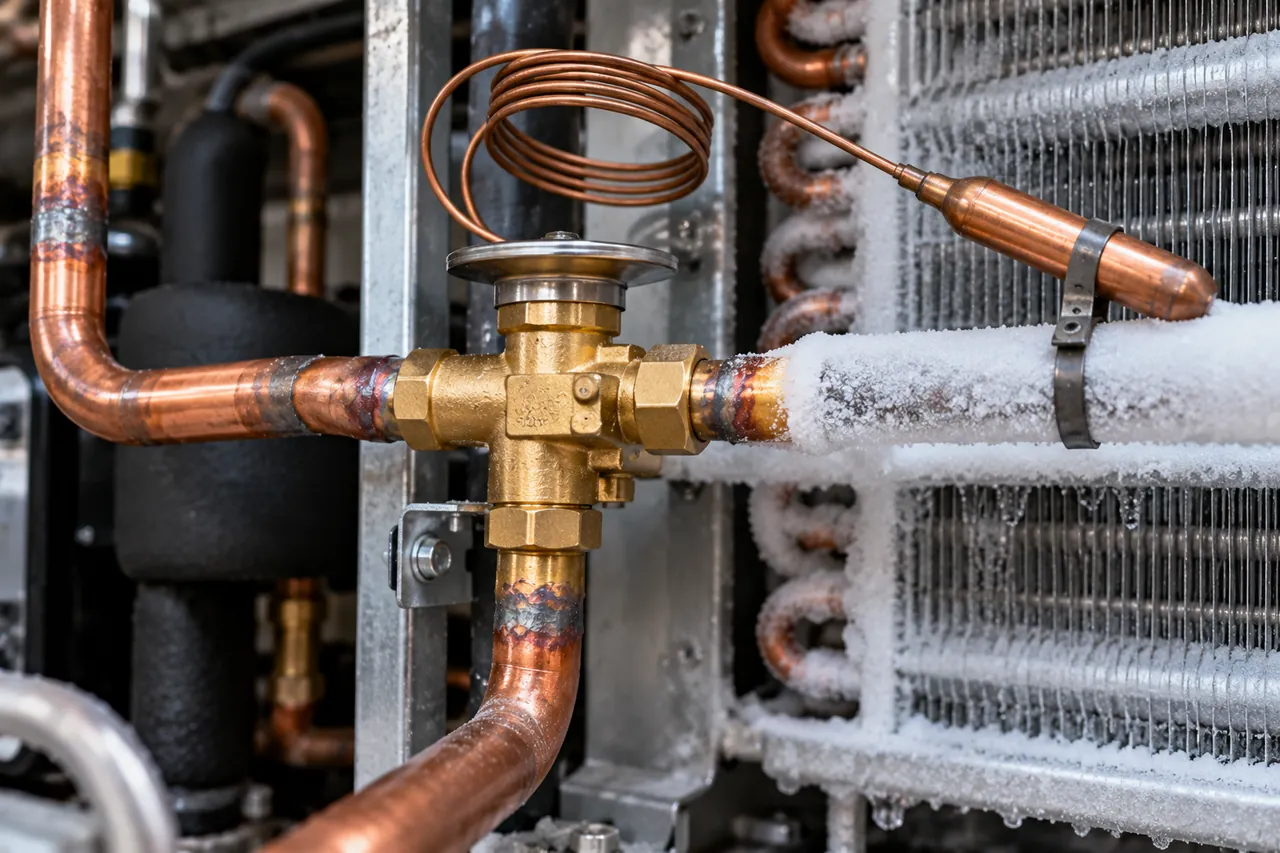
- Expansion (pressure dropped): The warm, high-pressure liquid passes through a metering device: a capillary tube, a thermostatic expansion valve (TXV) or an electronic expansion valve. Its pressure falls suddenly, roughly a quarter to a third of the liquid flashes to vapour, and the remainder is chilled to the evaporating temperature, ready to start again.
For a closer look at each component see condenser vs evaporator vs compressor; for the metering device, our TXV expansion valve guide.
Refrigeration cycle diagram with pressure and temperature
A refrigeration cycle diagram traces the refrigerant around the loop, and the most useful version labels the pressure, temperature and state at each point. The table below does this for a typical +2 °C (36 °F) walk-in cooler with R134a, an air-cooled condenser and 28 °C (82 °F) outside air.
| Point in the circuit | State | Pressure (approx.) | Temperature (approx.) |
|---|---|---|---|
| 1. Evaporator outlet / suction line | Low-pressure vapour, slightly superheated | 2.2 bar abs (1.2 bar g / 17 psig) | −8 °C boiling, about −2 °C to −3 °C after 5–6 K superheat |
| 2. Compressor discharge | High-pressure, hot superheated gas | 10.2 bar abs (9.2 bar g / 133 psig) | About 60–75 °C (140–167 °F) |
| 3. Condenser outlet / liquid line | High-pressure liquid, subcooled | 10.2 bar abs | +40 °C condensing, about +34 °C to +36 °C after 4–6 K subcooling |
| 4. After expansion device | Low-pressure liquid–vapour mix | 2.2 bar abs | −8 °C (18 °F) |
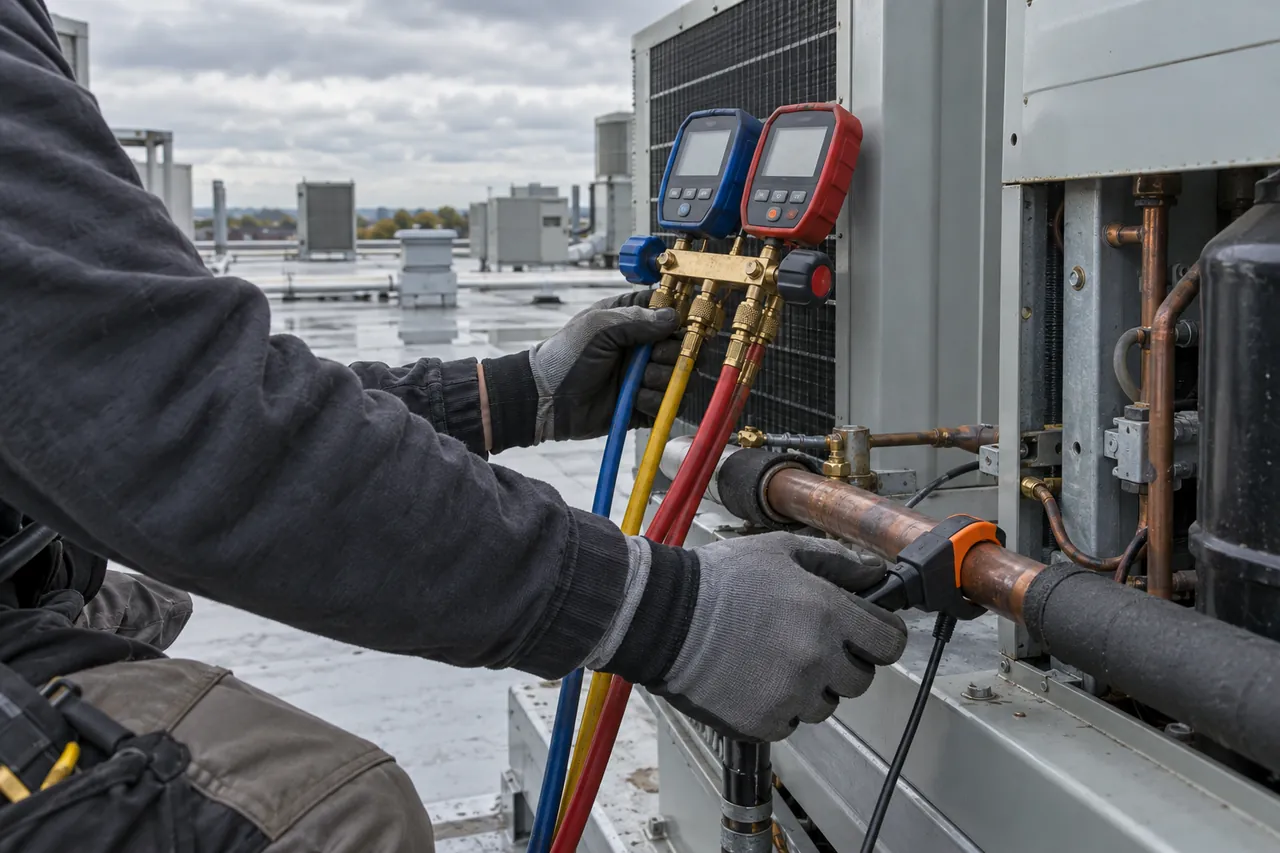
Pressures are R134a saturation values; other refrigerants run at different pressures for the same temperatures. R290 (propane) at the same −8 °C and +40 °C conditions runs at roughly 3.7 and 13.7 bar abs, and R404A at roughly 4.6 and 18.2 bar abs. That is why technicians read a gauge pressure and convert it to a saturation temperature for the refrigerant in the system; see how to calculate superheat and subcooling.
Design temperature differences
| Application | Room temperature | Typical evaporating temperature | Typical condensing temperature (air-cooled, 30 °C day) |
|---|---|---|---|
| Display fridge / walk-in cooler | +2 °C to +5 °C (36–41 °F) | −10 °C to −5 °C (14–23 °F) | +40 °C to +45 °C (104–113 °F) |
| Meat or produce cooler, high humidity | 0 °C to +2 °C (32–36 °F) | −6 °C to −3 °C (21–27 °F) | +40 °C to +45 °C |
| Walk-in freezer | −18 °C to −22 °C (0 °F to −8 °F) | −30 °C to −26 °C (−22 °F to −15 °F) | +40 °C to +45 °C |
| Blast freezer | −35 °C (−31 °F) air | −42 °C to −40 °C (−44 °F to −40 °F) | +40 °C to +45 °C |
The gap between room air and evaporating temperature is the evaporator TD. A small TD (4–6 K) keeps humidity high for produce and meat; a larger TD (8–10 K) dries the air and builds frost faster.
What is the ideal vapor compression refrigeration cycle?
The ideal vapor compression refrigeration cycle is the textbook model of the four stages: compression at constant entropy, heat rejection at constant pressure, expansion at constant enthalpy and heat absorption at constant pressure. Real systems differ because of pressure drops in pipes, heat gain in the suction line, superheat, subcooling and compressor losses.
Engineers draw the cycle on two charts. On a pressure–enthalpy (p-h) diagram, used in the trade, the refrigerant's saturation dome sits in the middle; the cycle is a four-sided shape with the evaporator as a horizontal line under the dome at low pressure, the compressor as a steep line up and to the right, the condenser as a horizontal line at high pressure, and the expansion as a vertical drop. The width of the evaporator line is the refrigerating effect per kilogram; the width of the compressor line is the work added. On a temperature–entropy (T-s) diagram, used in thermodynamics courses, the areas under the lines represent heat flows, which makes it easy to compare the real cycle with the ideal Carnot cycle.
Efficiency: what COP means
The coefficient of performance (COP) is cooling output divided by electrical input. The theoretical maximum depends only on the absolute evaporating and condensing temperatures: for −8 °C and +40 °C it is 265 K ÷ 48 K ≈ 5.5. Real commercial cold rooms typically achieve a COP of about 2–3.5 at chiller conditions and 1.2–2 for freezers. Every degree you raise the evaporating temperature or lower the condensing temperature improves COP, which is why clean condensers and correctly sized evaporators save energy.
What are the main parts of a refrigeration system?
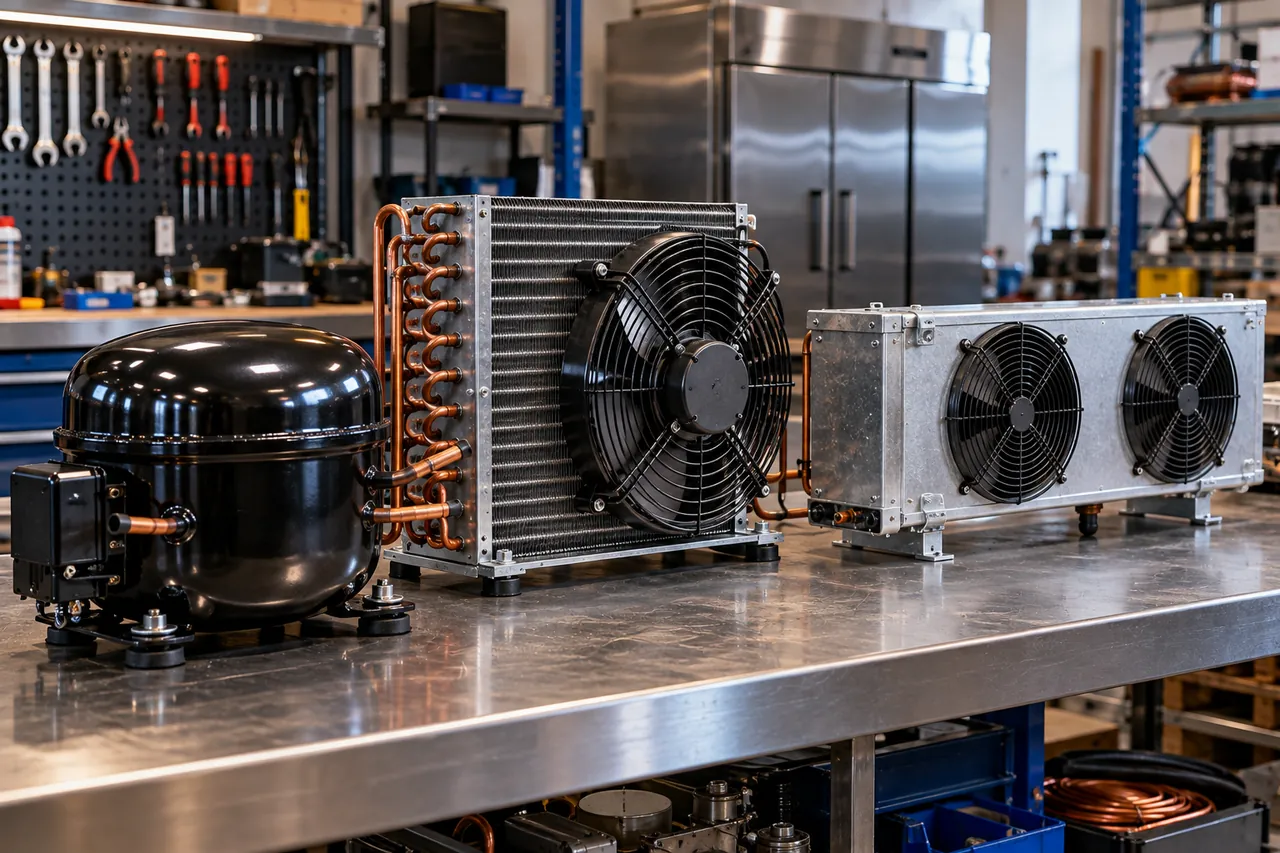
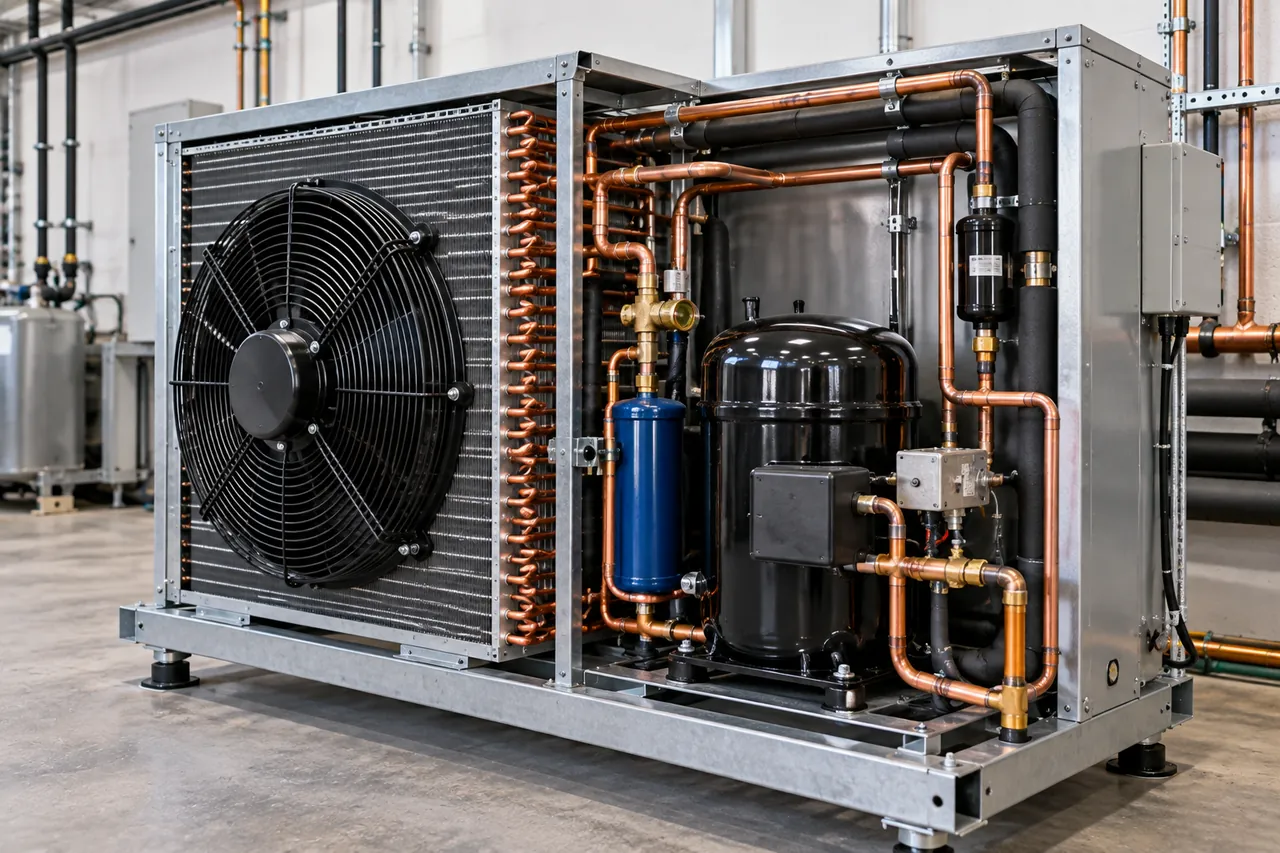
The main parts of a refrigeration system are the compressor, condenser, metering device and evaporator, connected by suction, discharge and liquid lines and controlled by a thermostat or controller. Commercial systems add components for protection, service and defrost.
| Part | What it does | Typical commercial form |
|---|---|---|
| Compressor | Raises refrigerant pressure and moves it round the circuit | Hermetic reciprocating or rotary, scroll, semi-hermetic |
| Condenser | Rejects heat to air or water | Finned copper–aluminium coil with fan, or water-cooled plate heat exchanger |
| Receiver | Stores liquid refrigerant so charge can vary with load | Steel vessel after the condenser on split systems |
| Filter drier and sight glass | Removes moisture and debris; shows liquid flow | In the liquid line before the metering device |
| Metering device | Drops pressure and controls flow to the evaporator | Capillary tube, TXV or electronic expansion valve |
| Evaporator | Absorbs heat from the box | Fan-coil unit cooler on the ceiling or wall |
| Controls | Start, stop, defrost, alarm and protect | Digital controller, pressure switches, solenoid valve |
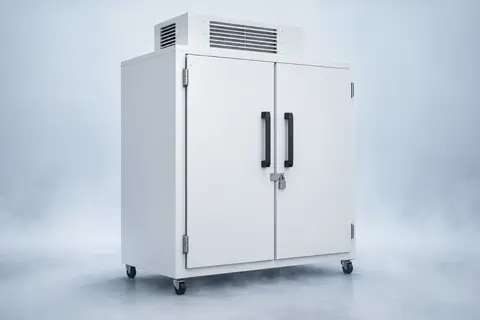
In a plug-in fridge all of these sit in the cabinet. In a walk-in cold room the compressor, condenser and receiver form the condensing unit outside, and the evaporator hangs inside; see the walk-in cooler refrigeration system guide and how a refrigerator compressor works.
Why do refrigeration coils need defrosting?
Coils need defrosting because the evaporator runs below 0 °C (32 °F) in most commercial systems, so moisture from the air freezes on the fins and gradually blocks air flow. Coolers at +2 °C or warmer can defrost "off cycle" by stopping the compressor and running the fans; freezers need electric heaters or hot gas several times a day.
Defrost is part of the cycle design: refrigeration for a cold room is usually sized to meet the daily load in about 16 hours of running for chillers and 18 hours for freezers, leaving time for defrost and peaks. Our cold room refrigeration load calculator uses the same running hours.
What other refrigeration cycles are used?
Besides standard vapour compression with HFC, HFO or hydrocarbon refrigerants, commercial and industrial cooling uses ammonia systems, CO2 systems, absorption cycles and, for small loads, thermoelectric cooling. All except thermoelectric still move heat by boiling and condensing a working fluid.
- Ammonia refrigeration cycle (R717): the same vapour compression cycle with ammonia, which is very efficient and has zero GWP but is toxic, so it is used in large industrial plants, cold stores and food factories with trained operators and machinery rooms.
- CO2 (R744): very high pressures; in warm climates it runs transcritical, rejecting heat in a gas cooler rather than condensing. Common in supermarket racks; see rack refrigeration and CO2 systems.
- Absorption: heat (gas, steam or hot water) drives an ammonia–water or water–lithium bromide cycle instead of a compressor. Used in gas fridges, hotel minibars and large chillers with waste heat.
- Thermoelectric: electric current through a semiconductor moves heat with no refrigerant; only practical for small coolers.
An air conditioner and a heat pump use the same cycle as a fridge. A heat pump simply reverses the flow with a four-way valve so the indoor coil becomes the condenser and heats the room.
What does this mean when buying refrigeration?
Understanding the cycle helps you compare quotes on the numbers that matter. Use this checklist when specifying a fridge, freezer or cold room:
- Ask for cooling capacity at stated evaporating and condensing (or ambient) temperatures, not just horsepower.
- Check that the evaporating temperature suits the product: small TD for fresh produce and meat, larger for frozen goods.
- Confirm the refrigerant and that it is allowed and serviceable in your market; compare R290 and R404A in our refrigerant guide.
- Check the maximum ambient the condensing unit is rated for, and plan shade and air flow around it.
- Look at the metering device: capillary for small plug-ins, TXV or electronic valve for cold rooms with varying loads.
- Confirm the defrost method and controller, and ask for commissioning values (superheat, subcooling, pressures) to be recorded.
Be There supplies complete walk-in cooler and freezer kits with matched condensing units, evaporators, expansion valves and digital controllers, holding 0 °C to +10 °C for chillers, −18 °C to −25 °C for freezers and down to −35 °C for blast rooms, plus glass door display refrigerators with an R290 option. Send your room size, temperature and climate through the inquiry form and we will quote FOB, CIF or DDP.