
Short answer
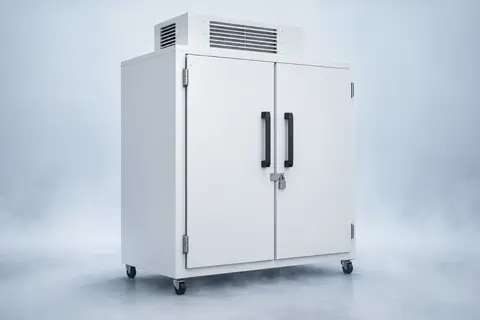
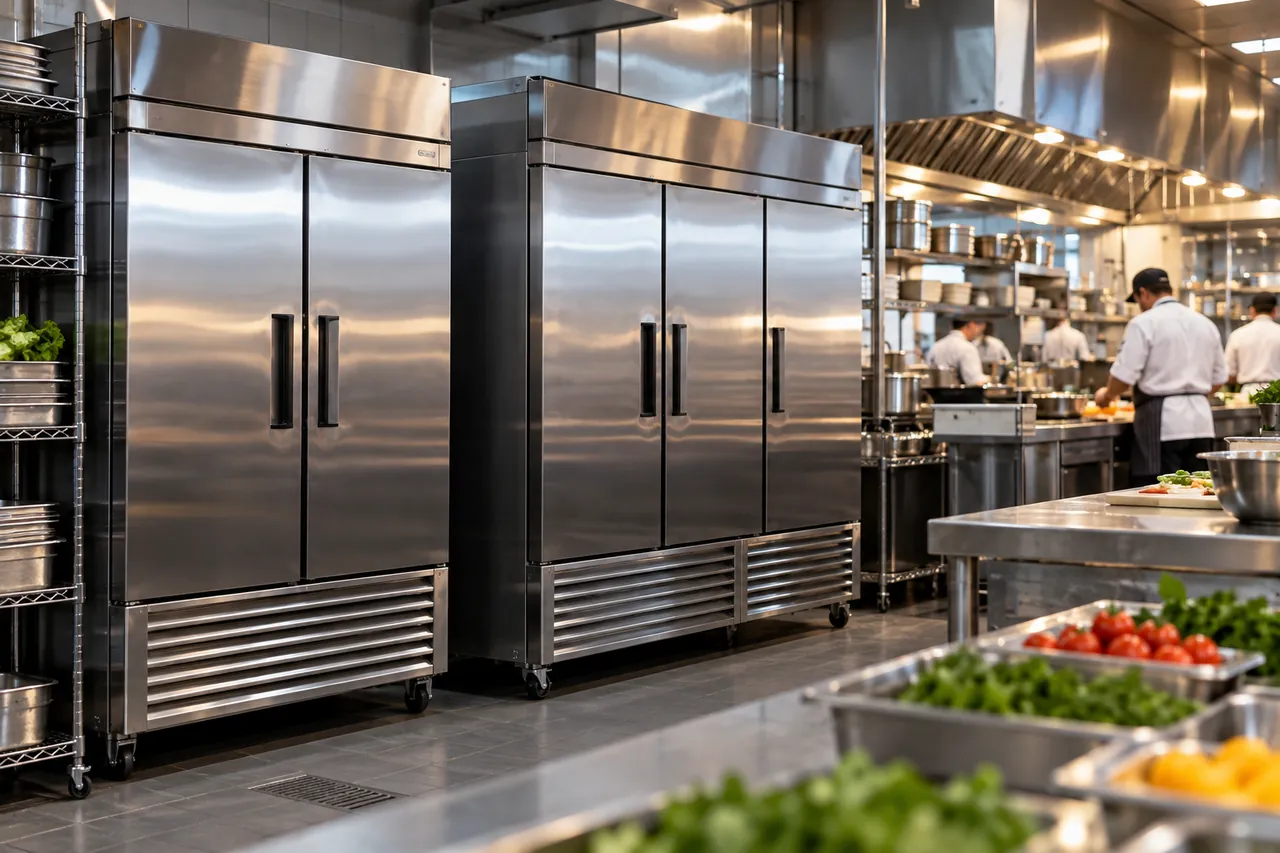
A commercial reach-in fridge is an upright, fan-cooled refrigerator that holds food at +1 °C to +4 °C (33–40 °F). A 1-door model is about 27–29 in (690–740 mm) wide with 19–25 cu ft; a 2-door about 52–55 in with 43–49 cu ft; a 3-door about 77–83 in with 69–74 cu ft. All stand roughly 78–84 in (1,980–2,130 mm) tall.
Key takeaways
- 1-door reach-ins are about 27–29 in (690–740 mm) wide with 19–25 cu ft (540–700 L) of storage.
- 2-door reach-ins are about 52–55 in (1,320–1,400 mm) wide with 43–49 cu ft; 3-door about 77–83 in with 69–74 cu ft.
- Asian-style 4-door kitchen uprights are about 1.2 m (47 in) wide and hold roughly 900–1,000 L, often split fridge and freezer.
- Kitchen reach-ins should be rated for 38–43 °C (100–110 °F) ambient and hold food at 5 °C (41 °F) or below.
- Freezer versions of the same door count typically cost 15–30% more than refrigerators.
What is a commercial reach-in refrigerator?
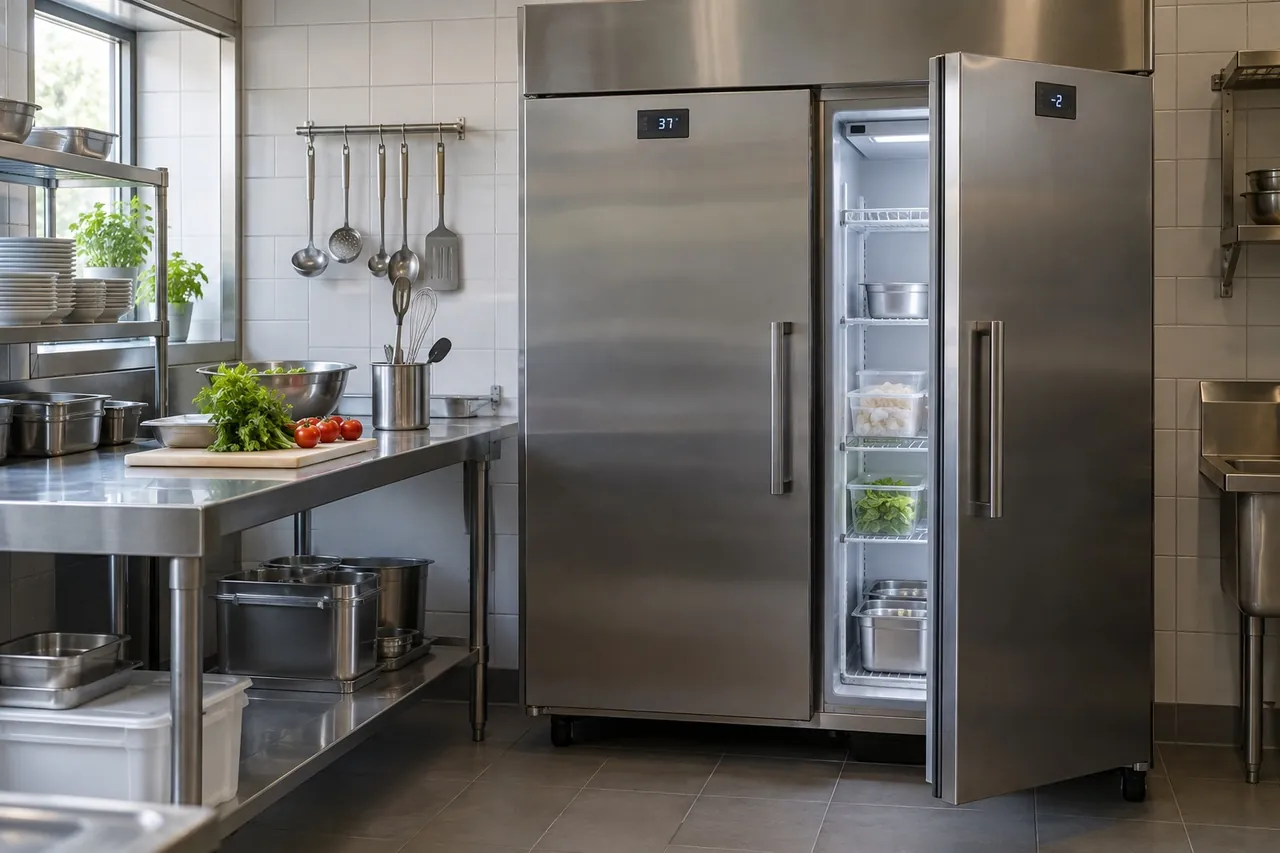
A commercial reach-in refrigerator is an upright, fan-cooled commercial fridge with one to four doors that holds food at +1 °C to +4 °C (33–40 °F), never above 5 °C (41 °F), in a hot, busy kitchen. Staff reach in to pick ingredients, unlike a walk-in that they step into.
Reach-ins are the workhorse of restaurant refrigeration. They are sold by door count, and the door count largely decides width, capacity, compressor size and price. This guide compares single door commercial refrigerators, 2 door commercial refrigerators, 3 door commercial refrigerators and four-door kitchen uprights side by side, with typical dimensions, specs and indicative costs. For the wider decision between reach-in, undercounter, prep and display formats, start with our commercial refrigerator buying guide; for every standard dimension, see refrigerator sizes and dimensions.
What sizes are 1, 2 and 3 door commercial refrigerators?
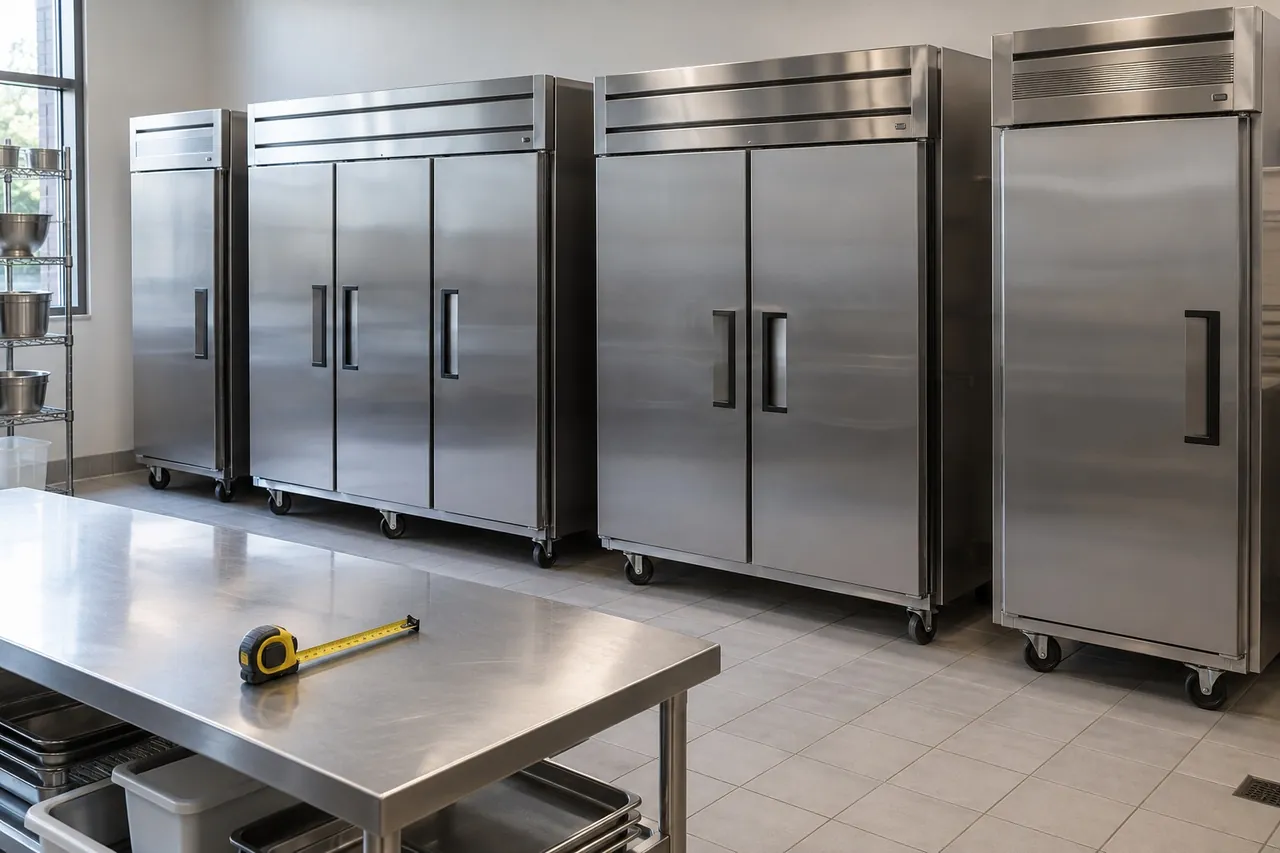
A one-door reach-in is about 27–29 in (690–740 mm) wide with 19–25 cu ft (540–700 L); a two-door is about 52–55 in (1,320–1,400 mm) wide with 43–49 cu ft (1,220–1,390 L); and a three-door is about 77–83 in (1,960–2,110 mm) wide with 69–74 cu ft (1,950–2,100 L). All are roughly 78–84 in (1,980–2,130 mm) tall and 30–35 in (760–890 mm) deep.
| Format | Width | Capacity | Typical compressor | Shelves (standard) | Suits |
|---|---|---|---|---|---|
| 1-door reach-in (US style) | 27–29 in (690–740 mm) | 19–25 cu ft (540–700 L) | about ⅕–⅓ HP | 3 | Cafés, bars, small kitchens |
| 2-door reach-in (US style) | 52–55 in (1,320–1,400 mm) | 43–49 cu ft (1,220–1,390 L) | about ⅓–½ HP | 6 | Restaurants doing 100–250 covers a day |
| 3-door reach-in (US style) | 77–83 in (1,960–2,110 mm) | 69–74 cu ft (1,950–2,100 L) | about ½–¾ HP | 9 | High-volume kitchens, hotels, schools |
| GN 2/1 single (EU style) | about 700 mm (27.5 in) | about 600–700 L (21–25 cu ft) | about ⅓ HP | 3 GN 2/1 grids | Kitchens using gastronorm pans |
| GN 2/1 double (EU style) | about 1,400 mm (55 in) | about 1,300–1,400 L (46–49 cu ft) | about ½ HP | 6 GN 2/1 grids | Kitchens using gastronorm pans |
| 4-door kitchen upright (Asian style) | about 1,200–1,250 mm (47–49 in) | about 900–1,000 L (32–35 cu ft) | 1 or 2 compressors | 4 compartments | Asian, Middle Eastern and African kitchens |
Depth matters as much as width. Standard reach-ins are 30–35 in (760–890 mm) deep including handles, so check aisles: food-service designers generally allow at least 1,000–1,200 mm (40–48 in) clear in front of a reach-in so doors can open while someone passes. Door swing for a single full-height door is about the cabinet width; half doors halve that. Always confirm the dimensions of the unit through the narrowest doorway on the delivery route; most reach-ins pass a 32–36 in (810–915 mm) door with the doors and handles removed.
What is a 4 door fridge or industrial fridge?
A 4 door fridge in commercial use is either a four-half-door version of a two-section reach-in, or the 1.2 m (47 in) wide, four-door stainless kitchen upright common in Asian and Middle Eastern kitchens, which holds about 900–1,000 L and can often be split into fridge and freezer compartments.
Half doors cut the cold air lost per opening because only a quarter of the cabinet is exposed, which helps in kitchens where doors open 100+ times a shift. The four-door upright can be supplied all-chiller, all-freezer, or as a two-plus-two split with separate controls, a cost-effective industrial refrigerator freezer for kitchens with limited floor space. For two-compartment cabinets in the US style, see our guide to refrigerator freezer combos.
The term industrial fridge is also used loosely for large reach-ins or for walk-in coolers. Once a kitchen needs more than about three two-door reach-ins, a walk-in cold room usually costs less per litre and frees floor space.
Should you choose a solid door or glass door reach-in?
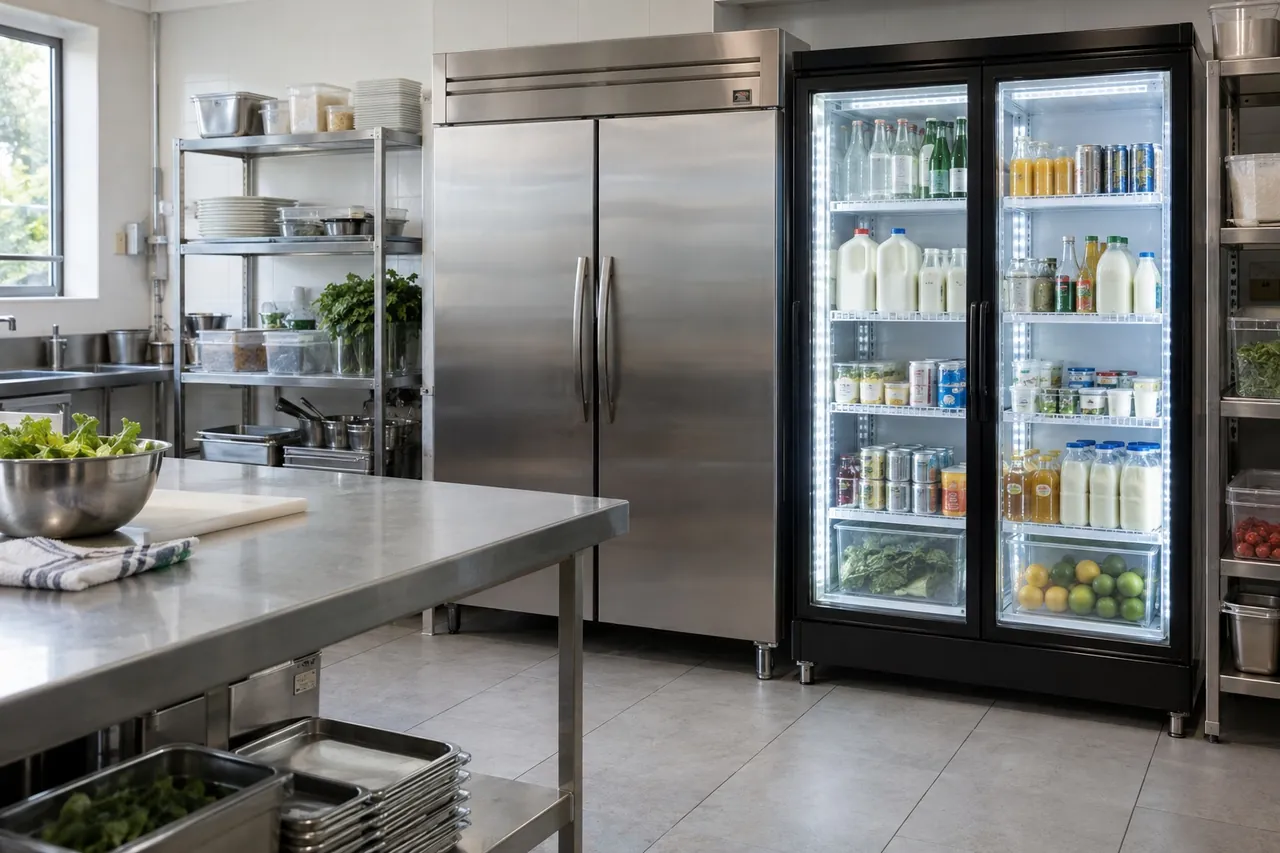
Choose solid doors for back-of-house storage, because they insulate better and use less energy, and glass doors where customers or staff need to see stock without opening the door, such as drinks, grab-and-go food and front-of-house displays.
- Solid door: foam-insulated, typically 50–75 mm (2–3 in) walls and doors, best temperature stability and lowest running cost. The standard choice for kitchens.
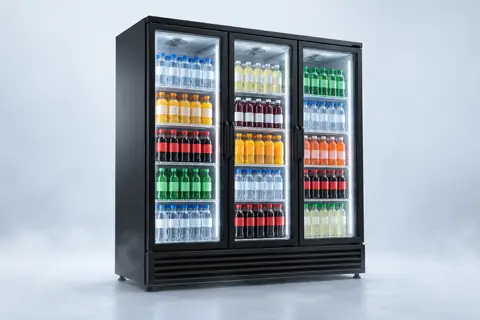
- Glass door: double or triple-glazed low-E glass, LED lighting, sells product. Uses more energy because glass insulates far less than foam. A 2 door cooler or 3 door cooler with glass doors is the standard drinks merchandiser; see the glass door display fridge buying guide.
- Half doors and pass-through: half doors reduce air loss; pass-through models with doors on both sides link a kitchen to a service area.
The same door counts apply to freezers: a two door freezer or 3 door freezer has the same footprint as the matching refrigerator but needs heated door frames, thicker insulation and a larger low-temperature compressor, and usually costs 15–30% more.
Which reach-in refrigerator specs matter most?
The specs that decide whether a reach-in will hold 5 °C (41 °F) in your kitchen are the ambient rating, refrigeration capacity and recovery time, refrigerant, cabinet construction and certification. Capacity in cubic feet matters only once those are right.
| Specification | What to look for | Why it matters |
|---|---|---|
| Ambient rating | Tested at 38–43 °C (100–110 °F) for kitchens; climate class 4 (30 °C / 55% RH) or 5 (40 °C / 40% RH) for EU-style cabinets | Household-rated units lose temperature beside hot cooklines |
| Holding range | +1 °C to +4 °C (33–40 °F) refrigerator; −18 °C to −22 °C (0 °F to −8 °F) freezer | FDA Food Code cold holding at 5 °C (41 °F) or below |
| Refrigerant | R290 (propane) or R600a in many markets; R134a or R404A only where still permitted | Regulations are phasing down high-GWP refrigerants |
| Cabinet | Stainless steel interior and exterior (often 304 for doors and food zones, 430 for sides), or coated steel | Corrosion resistance and cleanability |
| Compressor position | Top-mount keeps heat away from floor dust; bottom-mount puts top shelf at eye level and is easier to service | Affects cleaning, service access and shelf height |
| Controller | Digital display, alarm, automatic defrost, door-open alarm | HACCP temperature logging and fast fault detection |
| Electrical | 115 V 60 Hz or 220–240 V 50/60 Hz, plug type, running amps | Must match site supply; check before ordering |
| Certification | NSF/ANSI 7 and UL/ETL (US); CE (EU); SASO (Saudi Arabia) | Often required by inspectors and importers |
A stainless steel commercial refrigerator is the default for kitchens, but grades vary; 304 resists corrosion better than 430, which matters in coastal and humid sites. On refrigerant choice, see R290 vs R404A.
How much does a commercial reach-in refrigerator cost?
As an indicative guide only, new commercial reach-in refrigerators in the US commonly cost about US$2,000–5,000 for one door, US$3,000–7,000 for two doors and US$4,500–10,000 for three doors, with freezers typically 15–30% more. Prices vary widely by market, build quality, refrigerant and certification.
Buying direct from a manufacturer for import is usually cheaper per unit, but you must add freight, duty, local certification and installation, and plan for local service. Running cost is the other half of the equation: a two-door solid-door refrigerator commonly uses a few kWh a day, and an efficient model can save its price premium over its 10–15 year life. Our refrigerator power consumption guide shows how to estimate it.
Used and second-hand commercial refrigerators
A second hand commercial refrigerator can make sense if it is well under half its typical 10–15 year life, runs on a refrigerant still serviceable in your market and passes a pull-down test. Check gaskets, condenser condition, door hinges, interior corrosion and controller function, and run it empty for 24 hours with a thermometer inside. Our guide to buying used commercial refrigeration has the full checklist.
Where should a reach-in refrigerator be placed and how should it be loaded?
Place a reach-in where it gets cool, free-moving air at the compressor, at least about 50–100 mm (2–4 in) from walls unless the maker allows zero clearance, and away from fryers, ovens and dishwashers; then load it so cold air can circulate around every shelf.
A reach-in beside a charbroiler can see 40–50 °C (104–122 °F) air at the condenser, well above most ratings, and the result is warm food, constant running and early compressor failure. If it must stand on the cookline, choose a model rated for 43 °C (110 °F) and consider a heat shield or relocating the condenser intake. Practical loading rules:
- Keep 50 mm (2 in) clear of the evaporator fan and air outlets; do not stack to the roof.
- Store raw meat, poultry and fish on the lowest shelves, ready-to-eat food above.
- Use shallow, lidded containers and leave gaps between them so air reaches each one.
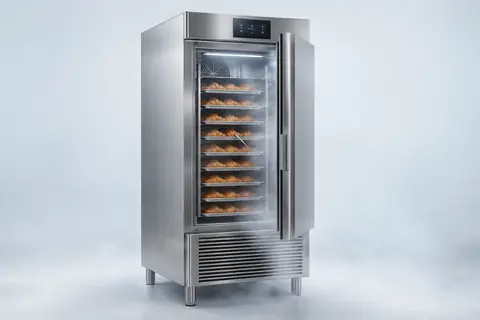
- Never load hot food; cool it first, ideally in a blast chiller, then transfer.
- Label and date containers and rotate first in, first out.
- Put a thermometer on the top shelf near the door, usually the warmest spot, and log it twice a day.
Level the cabinet so doors self-close, and use castors with brakes if staff need to pull it out for cleaning behind it.
What goes wrong with reach-in refrigerators?
Most reach in refrigerator repair calls trace back to five causes: a dirty condenser coil, worn door gaskets, a failed evaporator or condenser fan, an iced evaporator from a defrost fault, or a blocked drain line.
- Running warm: clean the condenser (monthly in greasy kitchens), check both fans run and make sure the back is not pushed against a wall.
- Water on the floor: clear the evaporator drain and check the condensate tray or heater.
- Ice on the rear coil: manual defrost, then check the defrost heater, timer or controller settings.
- Door not sealing: replace split gaskets and adjust self-closing hinges; test with a sheet of paper.
- Compressor running constantly or short-cycling: call a refrigeration technician to check refrigerant charge, controls and electrical supply.
How to choose a commercial reach-in: checklist
- Capacity: estimate chilled stock between deliveries; a common planning figure is roughly 0.5–1 cu ft (14–28 L) of reach-in space per meal served per day, adjusted for menu and delivery frequency.
- Door count and type: 1, 2, 3 or 4 doors; full or half; solid for storage, glass for display.
- Space: width, depth with handles, height under hoods and ceilings, aisle clearance and delivery route.
- Ambient rating: 38–43 °C (100–110 °F) for kitchens; climate class 5 for hot countries.
- Power and refrigerant: voltage, frequency, plug and the refrigerant allowed in your market.
- Certification and service: NSF, UL/ETL, CE or SASO as required, warranty terms and local parts supply.
Be There supplies glass door display refrigerators with one to four doors holding +2 °C to +8 °C (36–46 °F), with LED lighting, low-E glass and an R290 option, matching upright display freezers with one to four heated glass doors, and walk-in cold rooms for kitchens that have outgrown reach-ins. Send your door count, quantities, voltage and destination through the inquiry form and we will quote FOB, CIF or DDP.