Short answer
An ultra-low temperature (ULT) freezer is a laboratory freezer that holds −40 °C to −86 °C (−40 °F to −123 °F), usually set at −80 °C, using two refrigeration stages in cascade. Standard lab freezers run at −20 °C to −30 °C and lab fridges at +2 °C to +8 °C. Most vaccines need +2 °C to +8 °C; some frozen vaccines −50 °C to −15 °C.
Key takeaways
- ULT freezers hold −40 °C to −86 °C (−40 °F to −123 °F) and are normally set at −80 °C (−112 °F).
- Cascade refrigeration splits the job: a high stage cools to about −30 °C to −40 °C so a low stage can evaporate near −85 °C to −90 °C.
- Most vaccines are stored at +2 °C to +8 °C (36–46 °F), target +5 °C; some frozen vaccines at −50 °C to −15 °C.
- Vaccine units need a calibrated digital data logger with a buffered probe accurate to about ±0.5 °C (±1 °F).
- A ULT using 15 kWh a day consumes about 5,500 kWh a year; running at −70 °C instead of −80 °C can cut energy use where protocols allow.
What is an ultra-low temperature freezer?
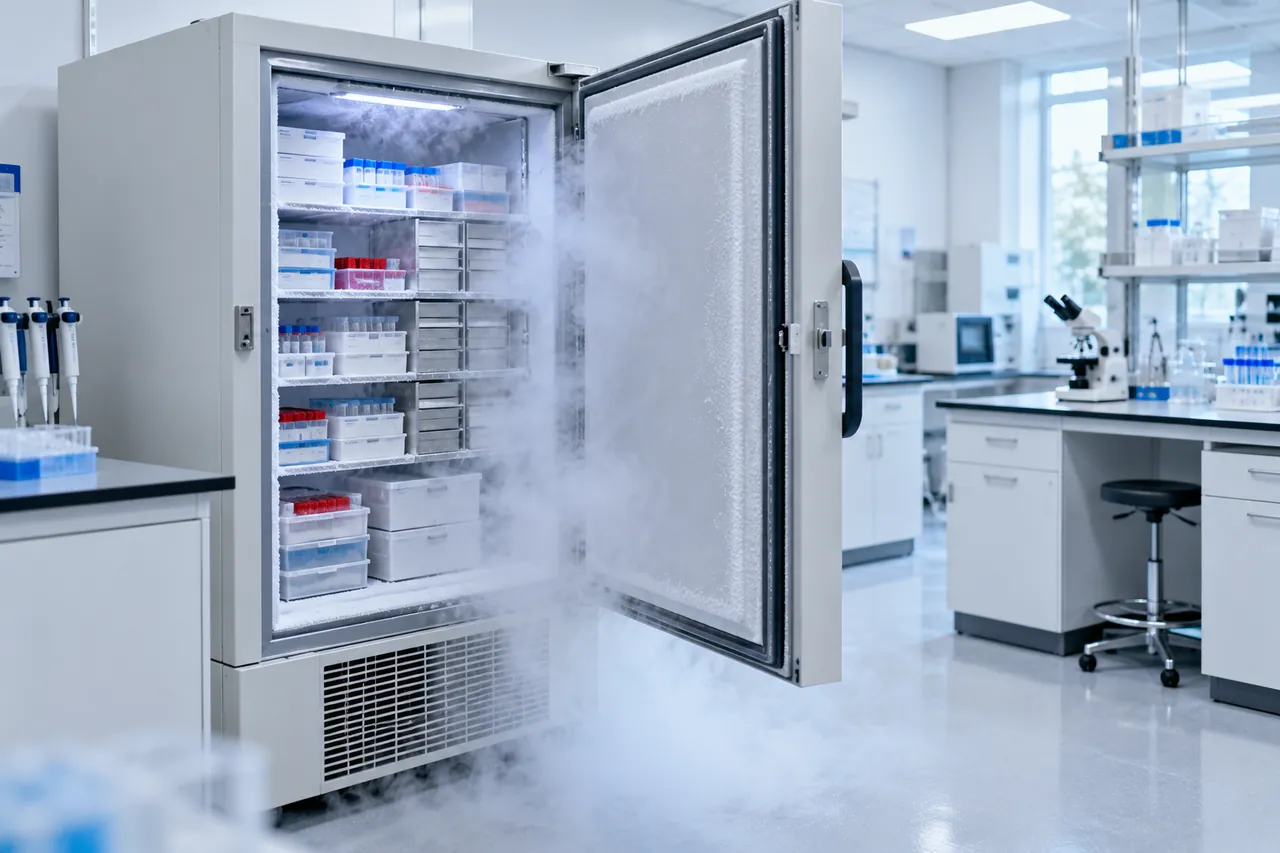
An ultra low temperature freezer (ULT freezer) is a laboratory freezer that holds samples between about −40 °C and −86 °C (−40 °F to −123 °F), and is normally run at −80 °C (−112 °F). It is used for biological samples, cell lines, enzymes, RNA and DNA, and some vaccines that must stay ultra-frozen.
A standard food freezer stops at about −18 °C to −25 °C (0 °F to −13 °F). A ULT reaches four times further below freezing by using two refrigeration circuits in cascade, thick vacuum-panel insulation and multiple inner doors. That design costs more to buy and run, and it is only justified for material that degrades at ordinary freezer temperatures. This guide explains the classes of lab freezer and lab fridge, how ULTs work, vaccine storage temperatures, monitoring requirements, and what to plan for when you buy or site one.
What types of laboratory freezers and fridges are there?
Laboratory cold storage falls into six temperature classes: lab refrigerators at +2 °C to +8 °C, −20 °C lab freezers, −30 °C freezers, −40 °C low-temperature freezers, −80 °C ultra-low freezers and cryogenic storage below −150 °C.
| Class | Temperature range | Typical contents | Refrigeration |
|---|---|---|---|
| Laboratory / pharmacy refrigerator | +2 °C to +8 °C (36–46 °F) | Vaccines, reagents, insulin, blood products (blood banks often +4 °C) | Single-stage, forced air, tight control (±1–2 °C) |
| −20 °C lab freezer | −15 °C to −25 °C (5 °F to −13 °F) | Enzymes, antibodies, some frozen vaccines, chemicals | Single-stage; manual defrost preferred for stability |
| −30 °C freezer | −20 °C to −35 °C (−4 °F to −31 °F) | Plasma, reagents needing extra margin | Single-stage, larger compressor |
| Low-temperature freezer | −40 °C (−40 °F) class | Plasma, some biologics, bridging storage | Single-stage low-temp or cascade |
| Ultra-low (ULT) freezer | −40 °C to −86 °C (−40 °F to −123 °F), set at −80 °C | Cells, tissue, RNA/DNA, proteins, ultra-frozen vaccines | Two-stage cascade or Stirling engine |
| Cryogenic storage | −150 °C to −196 °C (−238 °F to −321 °F) | Stem cells, sperm, embryos, master cell banks | Liquid nitrogen vapour or liquid phase |
Formats include upright lab freezers (the most common, about 300–850 L), chest ULTs (better cold retention, harder to organise), undercounter lab freezers of about 80–200 L, and benchtop units. For liquid nitrogen and other cryogenic freezing used in food processing, see our cryogenic freezer guide.
How does an ultra-low freezer reach −80 °C?
A ULT freezer reaches −80 °C (−112 °F) using cascade refrigeration: a high-stage circuit cools the condenser of a second, low-stage circuit, whose refrigerant can evaporate at about −90 °C (−130 °F) and cool the cabinet.
A single vapour-compression circuit cannot efficiently span the gap from a 25 °C (77 °F) room to −80 °C; the pressure ratio is too high and suitable refrigerants would need extreme pressures. So the work is split:
- The high stage, often using R290 (propane) or a similar refrigerant, rejects heat to the room and cools a cascade heat exchanger to about −30 °C to −40 °C.
- The low stage, often using R170 (ethane) or a low-temperature blend, condenses against that exchanger and evaporates in the cabinet walls at around −85 °C to −90 °C.
- Thick insulation, typically 100–130 mm (4–5 in) of foam combined with vacuum insulation panels, and two to four insulated inner doors limit heat gain and air loss when the outer door opens.
Some newer models use a free-piston Stirling engine instead of a cascade. Both approaches use natural hydrocarbon refrigerants in many current designs. For the basic cycle that both stages use, see how refrigeration works.
Typical ULT specifications
| Parameter | Typical upright ULT (approx. 700–800 L) |
|---|---|
| Temperature range | −40 °C to −86 °C (−40 °F to −123 °F) |
| Uniformity / stability | Often within about ±3–5 °C across the cabinet at −80 °C |
| Pull-down time, ambient to −80 °C | Several hours, commonly about 4–8 hours empty |
| Storage capacity | Roughly 400–600 standard 2 in (50 mm) sample boxes |
| Energy use | Roughly 8–20 kWh per day, depending on model and room |
| Ambient rating | Often +15 °C to +32 °C (59–90 °F) |
| External size | About 0.85–1 m wide × 0.9 m deep × 2 m high (34–39 × 35 × 79 in) |
| Power | Dedicated 220–240 V 50/60 Hz or 115 V 60 Hz circuit |
Figures vary by maker and model; compare data sheets at the same ambient and load conditions.
What temperature should vaccines be stored at?
Most vaccines must be stored refrigerated at +2 °C to +8 °C (36–46 °F), aiming for about +5 °C (41 °F); some live vaccines are stored frozen at −50 °C to −15 °C (−58 °F to +5 °F); and some mRNA vaccines have required ultra-cold storage of −90 °C to −60 °C (−130 °F to −76 °F). Always follow the manufacturer's package insert for each product.
| Vaccine storage category | Temperature | Examples (generic) | Equipment |
|---|---|---|---|
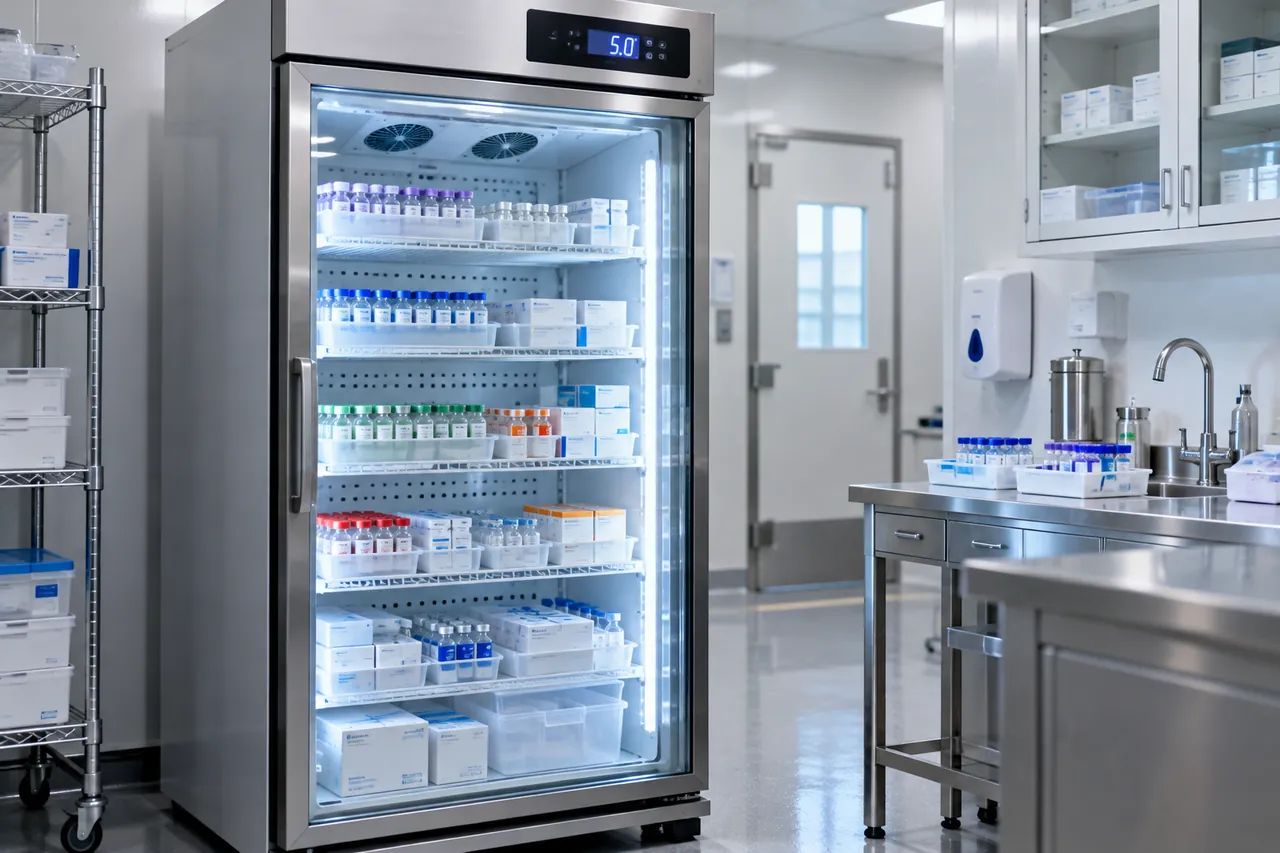
| Refrigerated | +2 °C to +8 °C (36–46 °F), target +5 °C | Most routine vaccines, including seasonal flu vaccine | Purpose-built pharmaceutical or vaccine refrigerator |
| Frozen | −50 °C to −15 °C (−58 °F to +5 °F) | Some live attenuated vaccines (e.g. certain varicella-containing vaccines) | Purpose-built pharmaceutical freezer |
| Ultra-frozen | −90 °C to −60 °C (−130 °F to −76 °F) | Some mRNA vaccine presentations | ULT freezer or thermal shipper with dry ice |
Flu vaccine storage temperature is +2 °C to +8 °C, and like most refrigerated vaccines it must never be frozen; freezing can destroy potency without any visible change. The CDC's Vaccine Storage and Handling Toolkit and WHO's Performance, Quality and Safety (PQS) programme set the reference requirements for vaccine refrigerators, freezers and monitoring devices. For the full chain from manufacturer to clinic, see our guide to pharmaceutical cold chain and vaccine storage.
What are the vaccine storage and handling requirements?
Vaccine storage requires a purpose-built or pharmaceutical-grade refrigerator or freezer, a calibrated digital data logger with a buffered probe, temperatures checked and recorded at least daily, vaccines stored in original packaging away from walls and doors, and a written plan for power failures and temperature excursions.
- Equipment: the CDC recommends purpose-built (pharmaceutical-grade) units; household combination fridge-freezers are not recommended, and dormitory-style units with a freezer compartment inside the fridge should never be used.
- Monitoring: a digital data logger with a buffered probe (for example in glycol), accuracy of about ±0.5 °C (±1 °F), a current calibration certificate and min/max display. See our temperature data logger guide.
- Placement: vaccines in the middle of the cabinet, not in doors, crisper drawers or against the evaporator; no food or drink in vaccine units.
- Records: check and record temperature at the start of each working day (min/max), keep logs for the period your health authority requires, and act on every excursion.
- Contingency: backup power or a plan to move vaccines to a qualified alternative unit or validated cool box.
So in the common exam question "which is not a vaccine storage and handling requirement?", answers such as storing vaccines in the fridge door, keeping food in the vaccine fridge or using a dormitory-style unit are the ones that are not requirements; they are practices to avoid.
How should ULT and lab freezers be monitored?
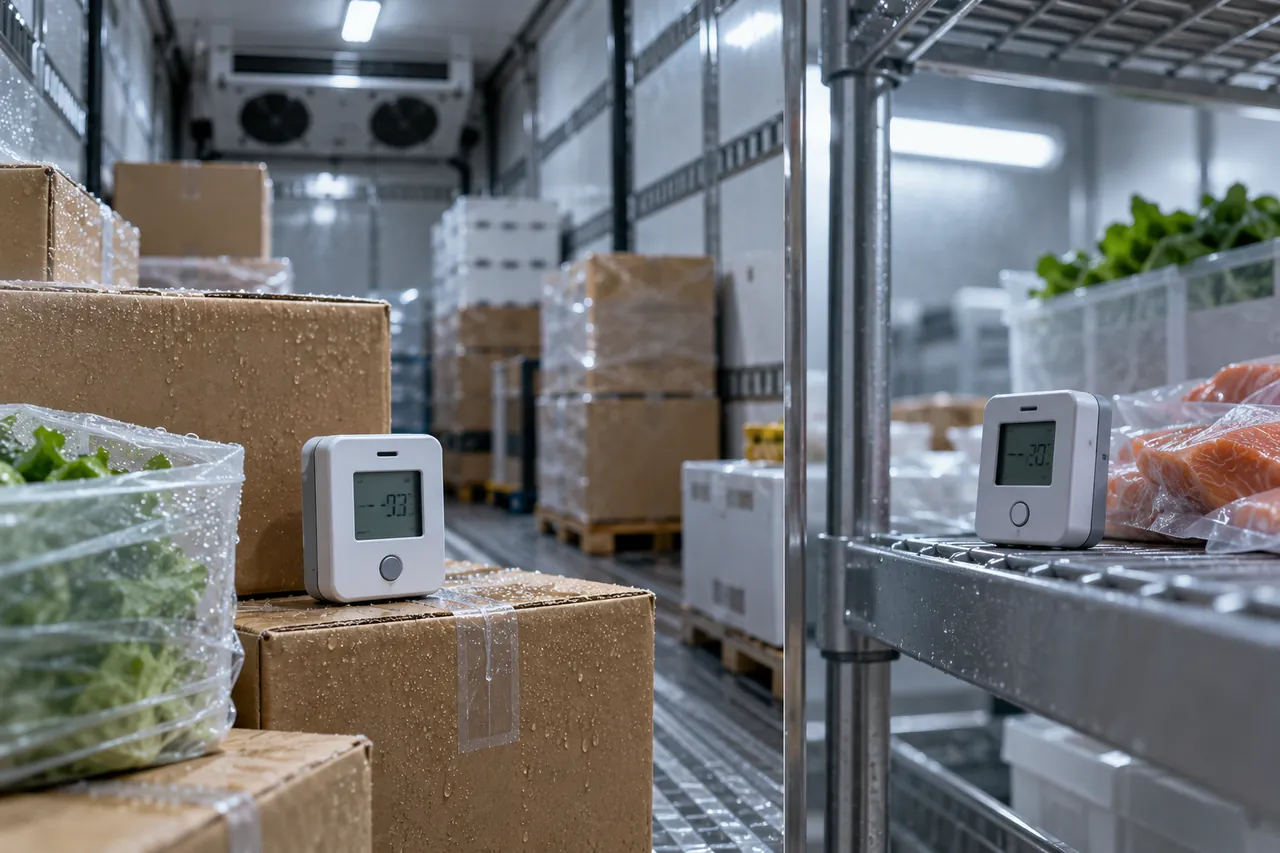
Lab and ULT freezers should be monitored continuously with an independent sensor and data logger, a local audible alarm, remote alerts by SMS, call or app, and a response plan, because a failed −80 °C freezer can warm past critical limits within hours.
Set the high alarm for a ULT at about −70 °C to −65 °C (−94 °F to −85 °F), above normal door-opening recovery but well below levels that damage samples. For −20 °C freezers, an alarm at about −15 °C (5 °F) is common; for 2–8 °C units, alarm at +8 °C and +2 °C with short delays. Our article on freezer temperature alarms explains delays and escalation.
Backup and power failure
A full, closed ULT freezer typically warms slowly at first, but the exact rate depends on model, load and room; check the manufacturer's warm-up curve. Many labs fit CO₂ or liquid nitrogen backup injection systems that hold the cabinet at about −50 °C to −70 °C during an outage, connect ULTs to emergency power, and keep at least one spare freezer running empty as a transfer unit. Large rooms of ULTs need temperature mapping and HVAC sized for their heat output; see warehouse temperature mapping for the method used under EU GDP 2013/C 343/01.
How much does an ultra-low freezer cost?
As an indicative guide only, an upright ULT freezer of about 500–800 L typically costs in the region of US$8,000–25,000, small undercounter ULTs less, and −20 °C lab freezers roughly US$1,500–6,000, depending on market, features and service contract.
Running cost is often the bigger number over a 10–15 year life. A ULT that uses 15 kWh a day consumes about 5,500 kWh a year, and almost all of that energy ends up as heat in the room, which the building's air conditioning then has to remove. Ways to cut cost and risk:
- Run at −70 °C (−94 °F) instead of −80 °C where your sample protocols allow; many institutions have adopted this and report meaningful energy savings.
- Keep an inventory so doors open briefly; use racks and boxes so whole racks can be lifted out.
- Defrost and remove ice from door seals and inner doors regularly.
- Clean condenser filters monthly and keep the room below the unit's ambient limit, ideally 18–25 °C (64–77 °F).
- Retire old units: older ULTs can use more than twice the energy of current efficient models.
How to choose a lab or ultra-low freezer: checklist
- Temperature class: +2–8 °C, −20 °C, −40 °C, −80 °C or cryogenic, set by the most demanding material stored.
- Capacity: count sample boxes or racks, then add 20–30% for growth.
- Format: upright for access, chest for stability and cold retention, undercounter for bench-side storage.
- Compliance: purpose-built units for vaccines (CDC guidance, WHO PQS where applicable); medical device or local approvals where required; flammable-storage design if solvents are kept.
- Monitoring: independent logger, remote alarm and backup system.
- Site: dedicated circuit, ventilation and room cooling for the heat output; floor loading for full units.
- Service: local engineer support, response time and spare parts for the cascade system.
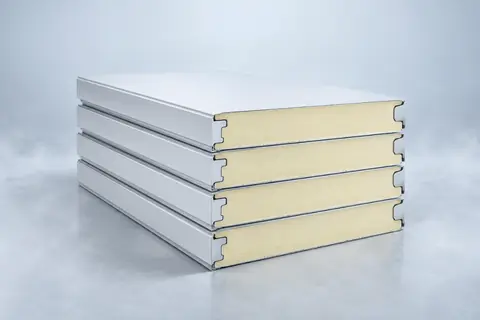
Be There does not manufacture ULT or medical-grade lab freezers, but we supply the cold storage around them: walk-in cold rooms holding 0 °C to +10 °C for 2–8 °C pharmaceutical stores and −18 °C to −25 °C freezer rooms, and PU/PIR insulation panels for pharmacy stores, clean rooms and distribution hubs. Send your room size, temperature range and site details through the inquiry form and our engineers will quote FOB, CIF or DDP.