





Short answer
A semi trailer in North America is usually 53 ft (16.15 m) long, 102 in (2.59 m) wide and 13 ft 6 in (4.11 m) high. A 53 ft dry van is about 52 ft 6 in × 100 in × 110 in inside (3,800–4,000 ft³) and holds 26 pallets; a 53 ft reefer is slightly smaller inside, about 52 ft × 99 in × 104 in.
Key takeaways
- A 53 ft trailer is 53 ft (16.15 m) long, 102 in (2.59 m) wide and usually 13 ft 6 in (4.11 m) high outside.
- Inside, a 53 ft dry van is about 52 ft 6 in × 100–101 in × 108–111 in, about 3,800–4,000 ft³ (108–113 m³), holding 26 standard pallets.
- A 53 ft reefer trailer is about 52 ft × 98–100 in × 100–108 in inside and weighs about 15,000–17,000 lb with its unit.
- A US tractor-trailer with a 53 ft trailer is about 70–80 ft (21–24 m) long overall with an 80,000 lb (36.3 t) gross limit.
- EU semi trailers have about 13.6 m loading length, 2.55 m width (2.60 m for reefers) and hold 33 euro pallets.
- Flatbeds carry freight up to about 8 ft 6 in tall, step decks up to about 10 ft and lowboys up to about 11.5–12 ft.
What is a semi trailer?
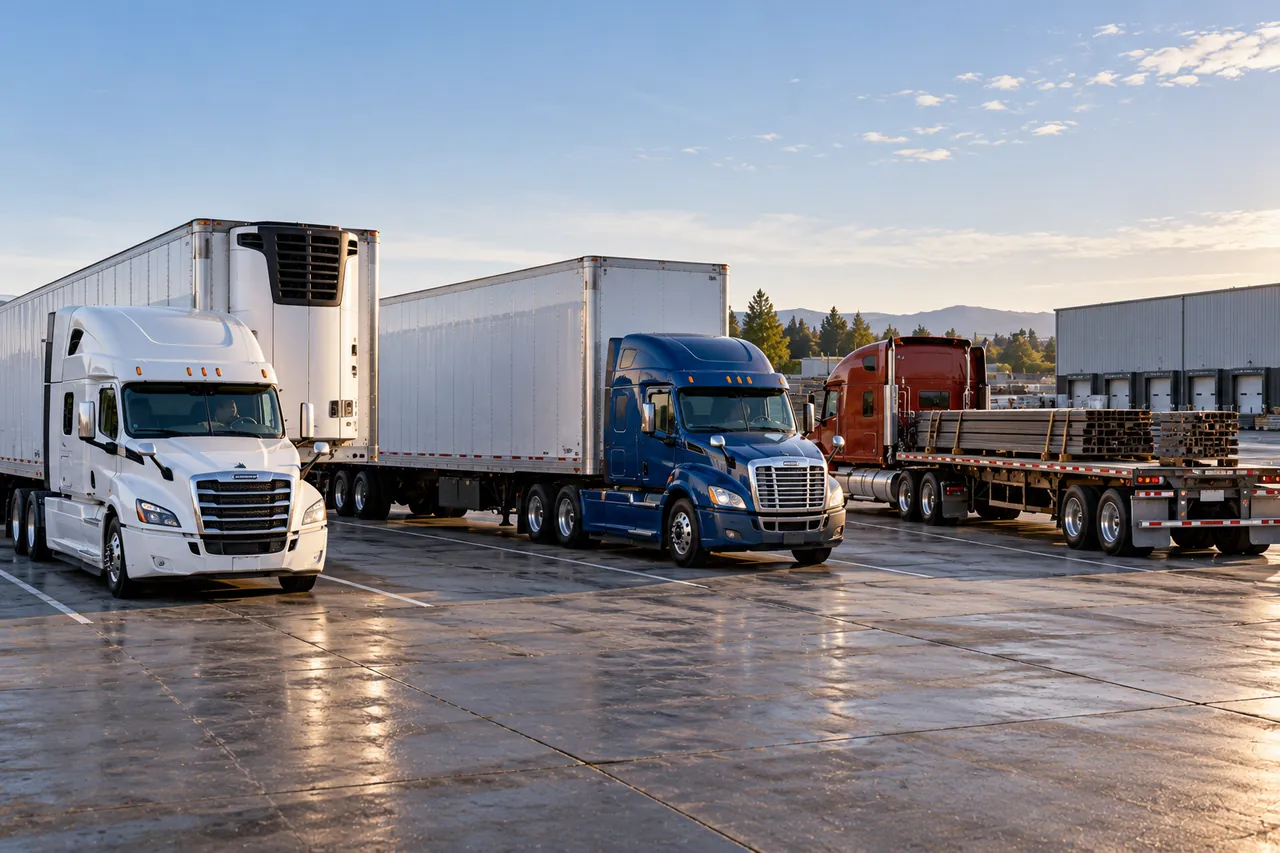
A semi trailer is a trailer with axles only at the rear: its front rests on the tractor unit through a kingpin locked into the tractor's fifth wheel, so the tractor carries part of the load. When the trailer is parked, retractable landing legs at the front hold it up. A tractor and semi trailer together are called a tractor-trailer, an articulated lorry or simply a semi.
In North America the standard is the 53 ft trailer; in Europe it is the 13.6 m (44.6 ft) trailer. Both come in many body types, from enclosed dry vans and refrigerated reefers to flatbeds and lowboys. This guide gives typical dimensions and explains the main types. For buying checks specific to refrigerated trailers and their units, see our reefer trailer guide.
What are 53 ft trailer dimensions?
A 53 ft dry van trailer is 53 ft (16.15 m) long, 102 in (2.59 m) wide and usually 13 ft 6 in (4.11 m) high outside. Inside it measures about 52 ft 6 in long, 100–101 in wide and 108–111 in high (16.0 × 2.55 × 2.77 m), giving roughly 3,800–4,000 ft³ (108–113 m³) and space for 26 standard pallets.
| 53 ft dry van (typical) | Imperial | Metric |
|---|---|---|
| External length | 53 ft | 16.15 m |
| External width | 102 in (8 ft 6 in) | 2.59 m |
| External height (common) | 13 ft 6 in | 4.11 m |
| Internal length | about 52 ft 6 in | about 16.0 m |
| Internal width | 100–101 in | 2.54–2.57 m |
| Internal height | 108–111 in | 2.74–2.82 m |
| Rear door opening (W × H) | about 98–100 × 106–110 in | about 2.49–2.54 × 2.69–2.79 m |
| Floor (deck) height | about 48–50 in | about 1.22–1.27 m |
| Volume | 3,800–4,000 ft³ | 108–113 m³ |
| Pallets, 48 × 40 in | 26 straight-loaded, up to 30 turned | About 26–30 |
| Empty weight | 13,500–15,000 lb | 6.1–6.8 t |
| Typical payload | about 43,000–45,000 lb | about 19.5–20.4 t |
The payload depends on the tractor's weight, because US federal limits cap a standard five-axle tractor-trailer at 80,000 lb (36.3 t) gross, typically split as 12,000 lb on the steer axle, 34,000 lb on the drive tandem and 34,000 lb on the trailer tandem. Internal dimensions vary by builder, wall type (thin "plate" walls give the most width) and floor. Most dry van trailer flooring is laminated hardwood, often oak, about 1⅛–1⅜ in thick, rated for forklift loads; aluminium and composite floors are lighter alternatives.
How tall is a 53 foot trailer?
A 53 ft trailer is usually 13 ft 6 in (4.11 m) tall from the road to the top of the roof, with an internal height of about 108–111 in (2.74–2.82 m) for a dry van and 100–108 in (2.54–2.74 m) for a reefer. There is no federal height limit in the US; most states set 13 ft 6 in, and some western states allow 14 ft.
- Published trailer height is not the same as clearance: a loaded trailer sits slightly lower on its suspension and an empty one higher, and fifth-wheel height on different tractors changes the figure by an inch or two.
- Low-profile or "drop frame" vans gain internal height by lowering the floor over the axles.
- Drivers must check bridge and underpass clearances on every route; a 13 ft 6 in trailer does not fit under every structure.
53 ft reefer trailer dimensions and weight
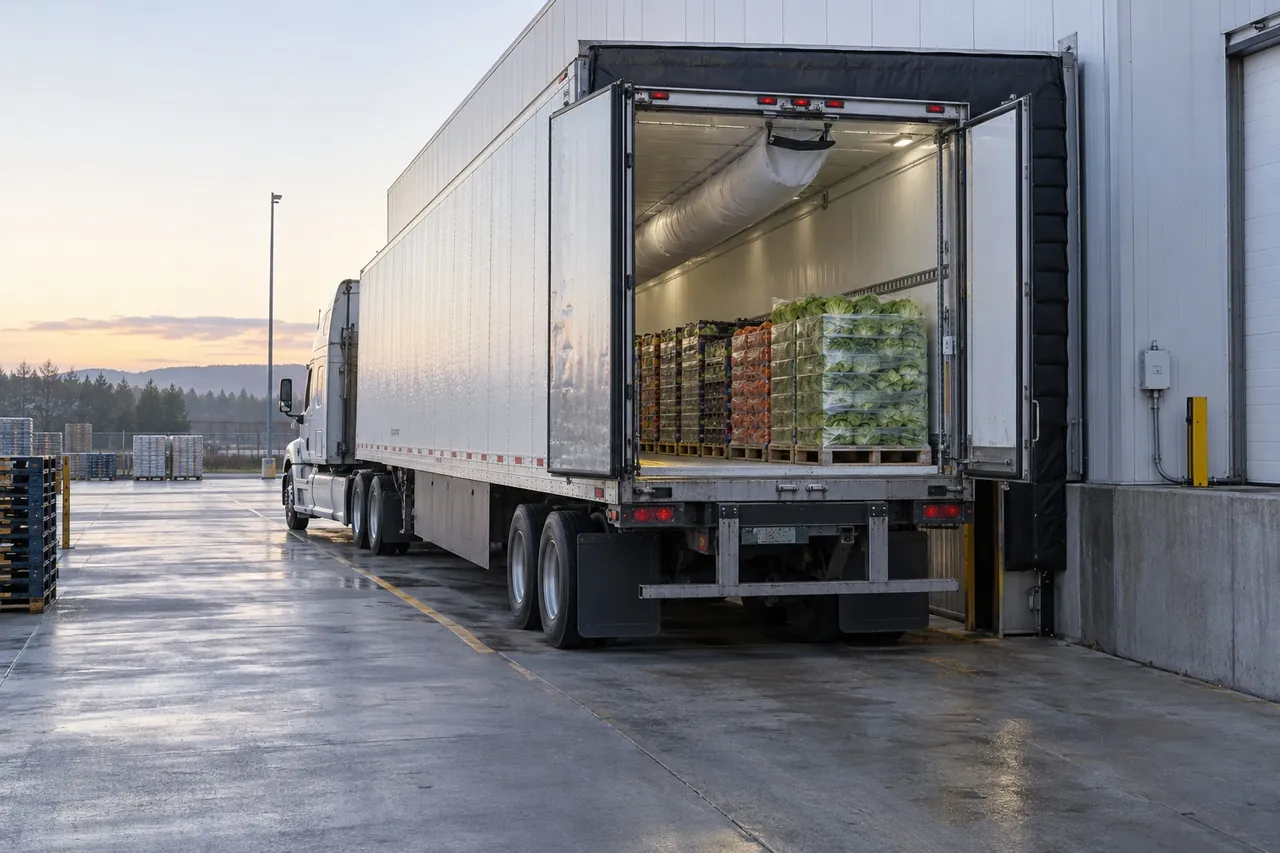
A 53 ft reefer trailer has the same external size as a dry van, 53 ft × 102 in × 13 ft 6 in, but is smaller inside: about 52 ft (15.85 m) long, 98–100 in (2.49–2.54 m) wide and 100–108 in (2.54–2.74 m) high, because of 2–4 in (50–100 mm) of foam insulation and the nose-mounted refrigeration unit. It weighs about 15,000–17,000 lb (6.8–7.7 t) with the unit and fuel.
| 53 ft trailer, typical | Dry van | Reefer trailer |
|---|---|---|
| Internal length | about 52 ft 6 in (16.0 m) | about 51 ft 6 in – 52 ft (15.7–15.85 m) |
| Internal width | 100–101 in (2.54–2.57 m) | 98–100 in (2.49–2.54 m) |
| Internal height | 108–111 in (2.74–2.82 m) | 100–108 in (2.54–2.74 m) |
| Volume | 3,800–4,000 ft³ (108–113 m³) | 3,500–3,800 ft³ (99–108 m³) |
| Empty weight | 13,500–15,000 lb (6.1–6.8 t) | 15,000–17,000 lb (6.8–7.7 t) with unit |
| Typical payload | 43,000–45,000 lb | 42,000–44,000 lb |
| Floor | Hardwood or composite | Aluminium duct floor for air flow under pallets |
| Temperature range | Ambient | About −29 °C to +30 °C (−20 °F to 86 °F) |
A 53 foot refrigerated trailer also carries a diesel tank for its refrigeration engine, typically 50 gal (190 L) or more, and often runs on shore power or an electric standby when parked. For how the nose unit works and what reefer fuel is, see how truck refrigeration units work.
Dry van vs reefer: what is the difference?
A dry van is an enclosed, uninsulated trailer for goods that do not need temperature control; a reefer is an insulated trailer with its own refrigeration unit that holds a set temperature from deep frozen to warm. Reefers cost more to buy and run, carry slightly less, and earn higher freight rates.
- Cargo: dry vans carry packaged goods, paper and electronics; reefers carry chilled and frozen food, flowers, pharmaceuticals and some chemicals. Reefers also haul dry freight on return legs.
- Walls: dry vans use thin plate or sheet-and-post walls; reefers use foamed panels that reduce internal width by 1–3 in.
- Cost: a new reefer trailer typically costs well over twice a new dry van, mainly because of the refrigeration unit, plus fuel and unit servicing.
- Driving: reefer drivers must pre-cool the trailer, check product temperatures at pickup and keep temperature records for the receiver.
The term reefer dry van is sometimes used for a reefer trailer running dry freight with the unit off. For more on the terminology, see what is a reefer.
What are the main types of semi trailers?
The main types of semi trailers are dry vans, reefers, flatbeds, step decks, lowboys, conestogas, curtain-siders, tankers, container chassis, car haulers, dump trailers and livestock trailers. The choice depends on how the cargo is loaded (rear doors, sides or crane), its height and weight, and whether it needs protection or temperature control.
| Trailer type | Typical length | Deck or interior height | Used for |
|---|---|---|---|
| Dry van | 28, 48 or 53 ft | Interior about 108–111 in | Palletised and boxed freight |
| Reefer (refrigerated) | 48 or 53 ft | Interior about 100–108 in | Chilled and frozen goods |
| Flatbed | 48 or 53 ft | Deck about 60 in; legal freight about 8 ft 6 in tall | Steel, timber, building materials |
| Step deck (drop deck) | 48 or 53 ft | Lower deck about 36–42 in; freight up to about 10 ft | Taller machinery and equipment |
| Lowboy or RGN | Well about 24–29 ft; overall 40–53 ft | Deck about 18–24 in; freight up to about 11.5–12 ft | Heavy construction machinery |
| Conestoga | 48 or 53 ft | Flatbed or step deck with rolling tarp | Flatbed cargo needing weather protection |
| Curtain-sider | 48–53 ft (13.6 m in Europe) | Interior about 2.7–3.0 m | Side loading by forklift |
| Tanker | About 40–48 ft | Not applicable | Liquids, gases, dry bulk |
| Container chassis | 20, 40, 45 or 53 ft | Frame only | Carrying ISO and domestic containers |
| Car hauler, dump, livestock | Varies | Varies | Specialised loads |
A 53 foot container is a North American domestic intermodal box, roughly 53 ft × 102 in × 9 ft 6 in outside with about 3,800 ft³ inside, carried on a 53 ft chassis and double-stack rail. It is wider than an ISO ocean container and does not go on ships. For ISO container sizes, see shipping container sizes and dimensions.
Tractor trailer dimensions: how big is a semi with a 53 foot trailer?
A semi with a 53 foot trailer is typically about 70–80 ft (21–24 m) long overall: roughly 65–72 ft with a day cab and 72–80 ft with a sleeper cab. It is 102 in (2.59 m) wide, excluding mirrors, and about 13 ft 6 in (4.11 m) tall, with a legal gross weight in the US of 80,000 lb (36.3 t) without a permit.
- Length of a semi truck trailer: US federal rules require states to allow trailers of at least 48 ft on the National Network; 53 ft is permitted in all states, often with kingpin-to-rear-axle limits.
- Kingpin setting: some states limit the distance from the kingpin to the rear axle, for example 40 ft in California, so 53 ft trailers have sliding tandems that move the axles forward.
- Spread axles: some trailers use a spread-axle setup, with the two rear axles about 10 ft (3 m) apart, which some states rate higher than a closed tandem.
- Turning: a 53 ft trailer needs a wide swing; check yard, dock and street access before choosing it for urban delivery.
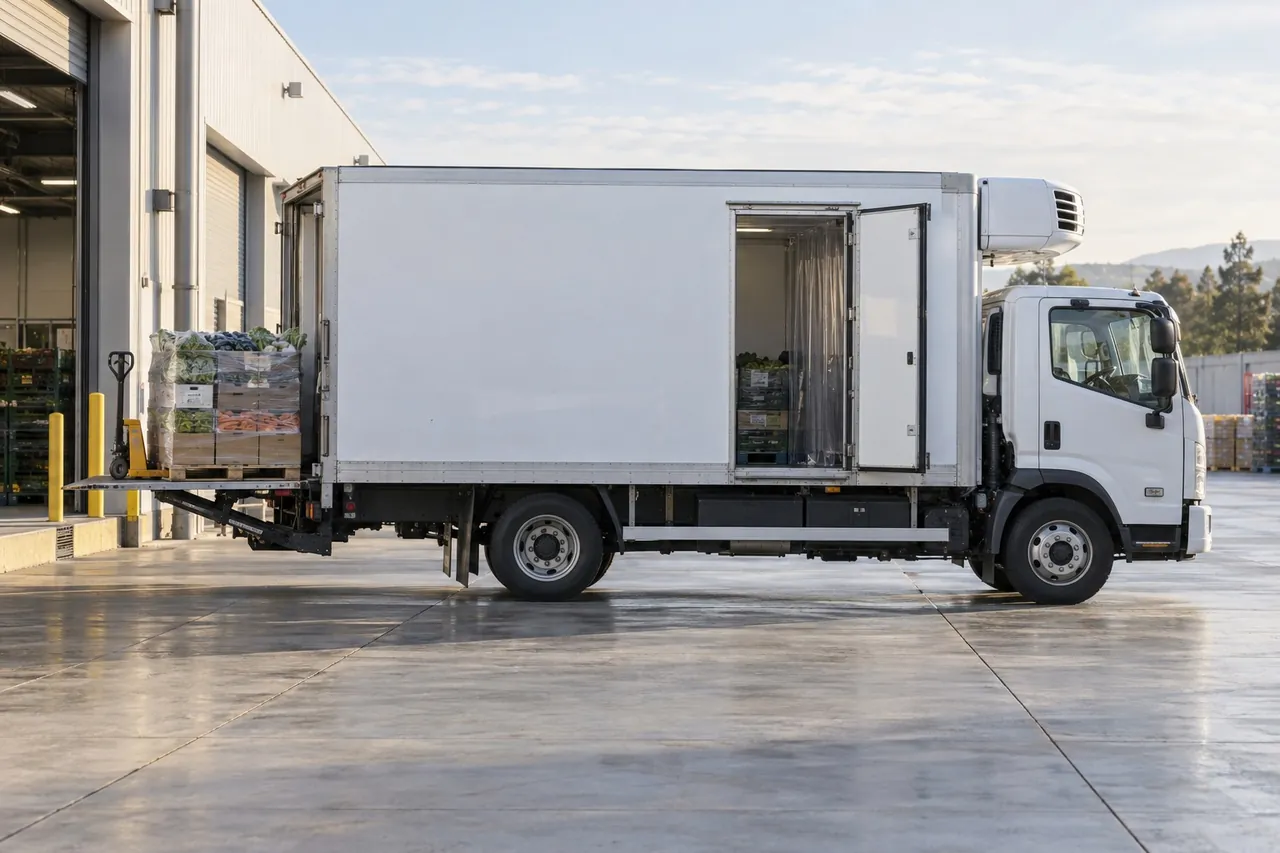
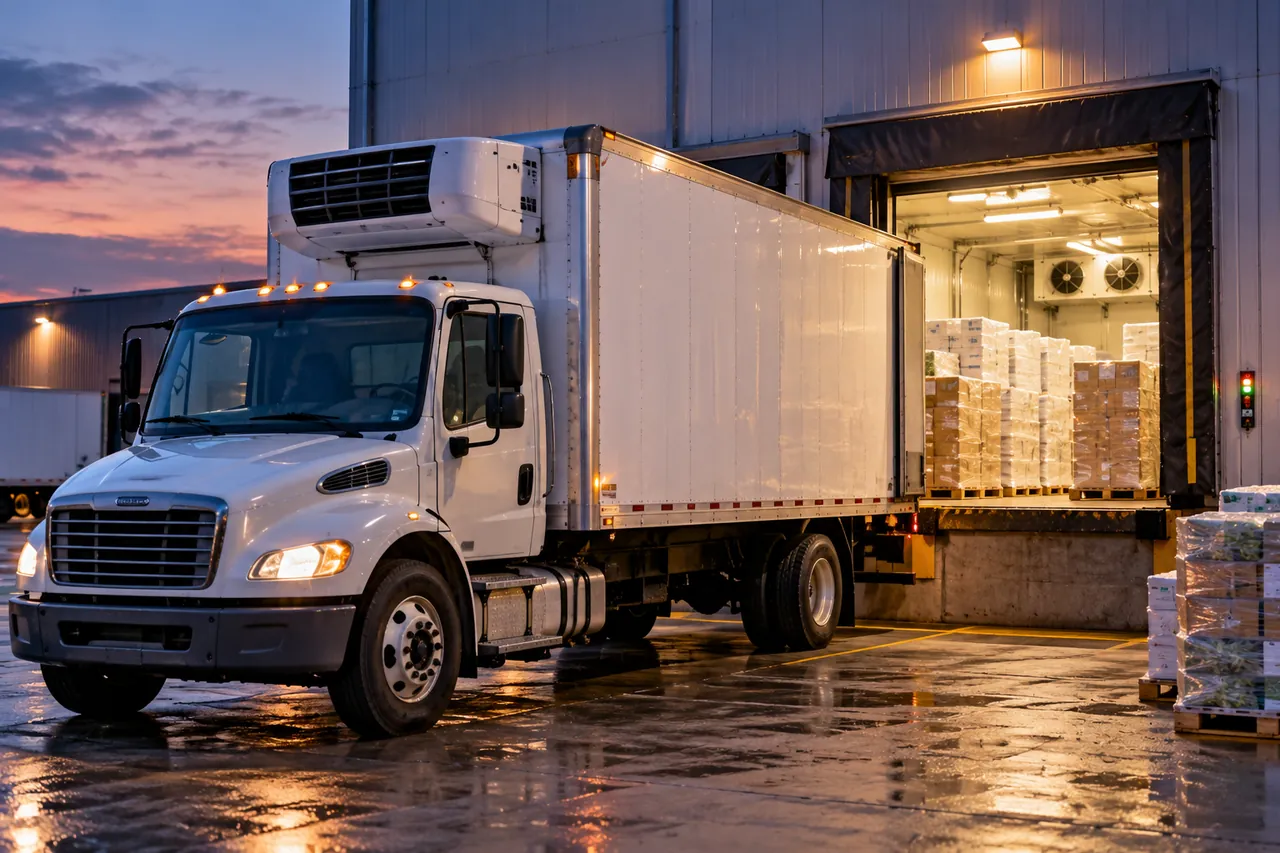
Where a 53 ft trailer is too large, a straight truck with a 16–26 ft box often does the job; see our refrigerated box truck guide.
Standard trailer dimensions outside North America
In the EU, a standard semi trailer has a loading length of about 13.6 m (44.6 ft), a maximum width of 2.55 m (8 ft 4 in), or 2.60 m for refrigerated bodies with thick insulated walls under Directive 96/53/EC, and a typical maximum height of 4.0 m (13 ft 1 in). The whole articulated vehicle is limited to 16.5 m (54 ft) and usually 40 t gross, or 44 t in some countries and for intermodal transport.
| Typical figures | US 53 ft dry van | EU 13.6 m curtain-sider | EU 13.6 m reefer |
|---|---|---|---|
| Internal length | about 16.0 m (52 ft 6 in) | about 13.6 m | about 13.3–13.4 m |
| Internal width | about 2.55 m | about 2.48 m | about 2.46–2.50 m |
| Internal height | about 2.75–2.80 m | about 2.7–3.0 m | about 2.6–2.7 m |
| Pallets | 26 US pallets | 33 euro pallets | 33 euro pallets |
| Volume | 108–113 m³ | about 90–100 m³ | about 86–90 m³ |
Australia, China, the Middle East and Latin America have their own length and weight rules, often with 12–14.6 m trailers. Always check the local regulations before specifying a trailer body.
Checklist: choosing a trailer type and size
- Cargo temperature: ambient goods in a dry van or curtain-sider; chilled or frozen goods in a reefer.
- Pallets per load: 26 US pallets in a 53 ft van, 33 euro pallets in a 13.6 m trailer, 10–12 in a 26 ft box truck.
- Weight versus volume: dense freight hits 80,000 lb gross before the van is full; light freight fills the van first.
- Height of cargo: over about 8 ft 6 in on a flatbed, use a step deck; over about 10 ft, use a lowboy or RGN.
- Route limits: kingpin settings, height clearances, city access and dock heights.
- Driver comfort: on long reefer runs, a cab fridge such as a 12V compressor fridge is a common refrigerator for tractor trailer cabs.
Be There does not build or sell semi trailers, and our refrigeration units are not 53 ft trailer nose units. We supply truck refrigeration units for vans and straight trucks with 4–45 m³ insulated boxes, holding −20 °C to +15 °C, in engine-driven, independent diesel and fully electric versions, plus PU and PIR insulation panels for cold rooms and insulated buildings. Size a unit for your box with the truck refrigeration calculator, then send your box size, temperature and vehicle details through the inquiry form for an FOB, CIF or DDP quote.