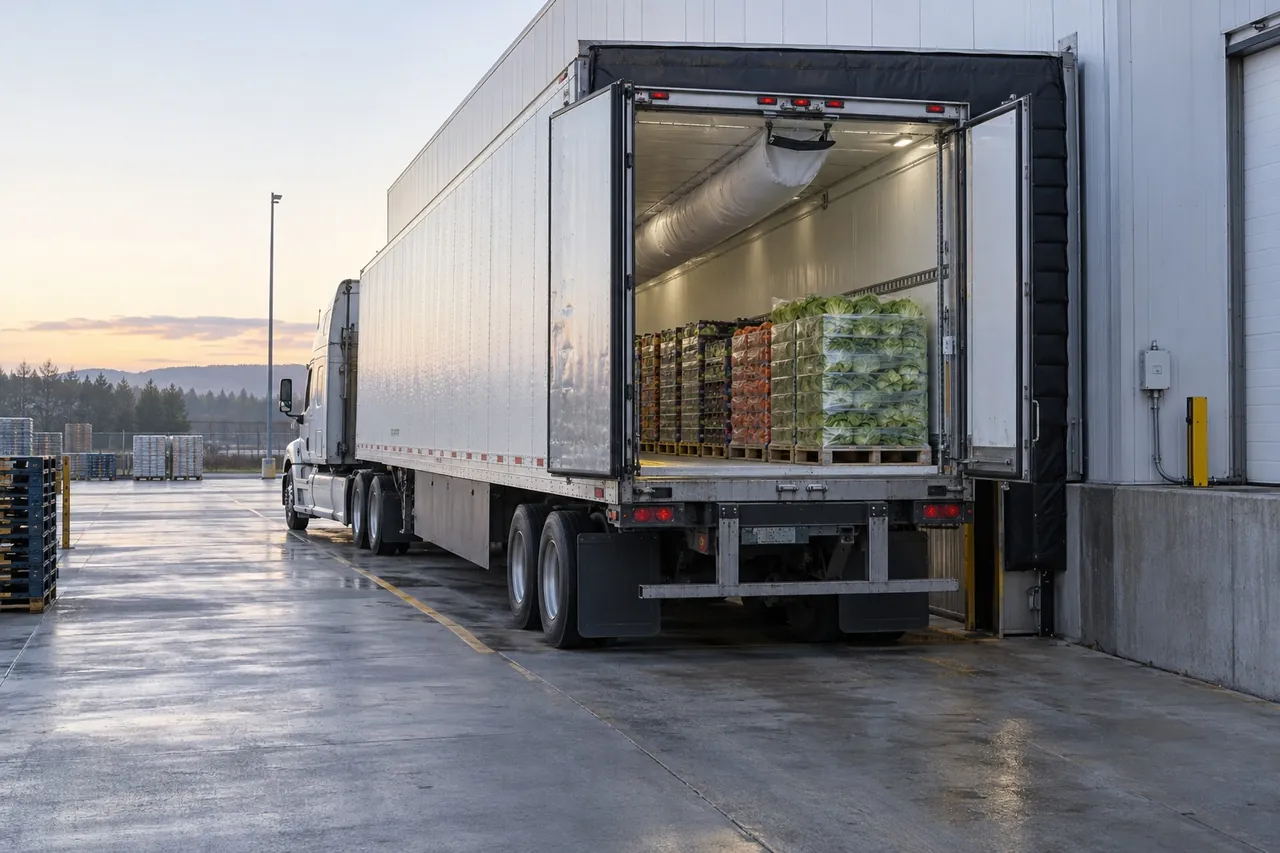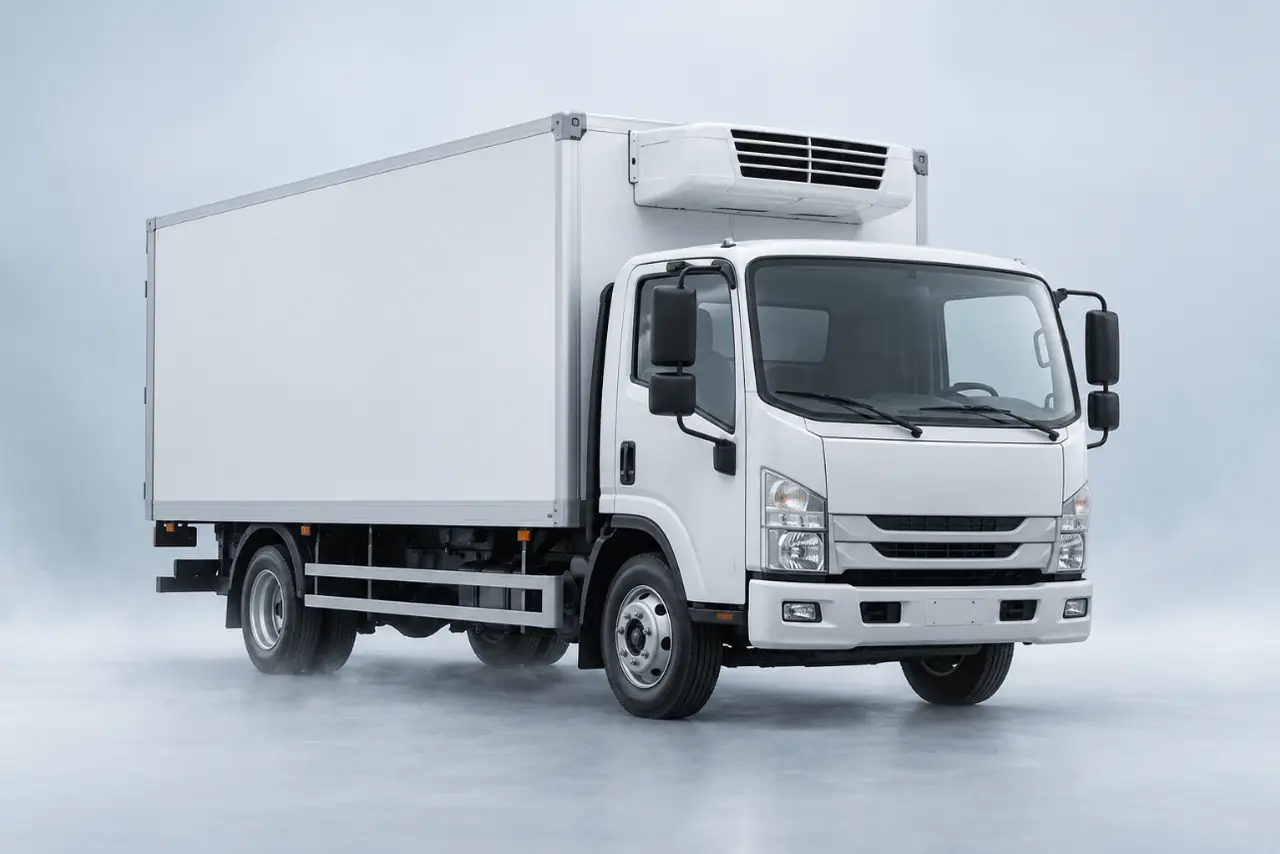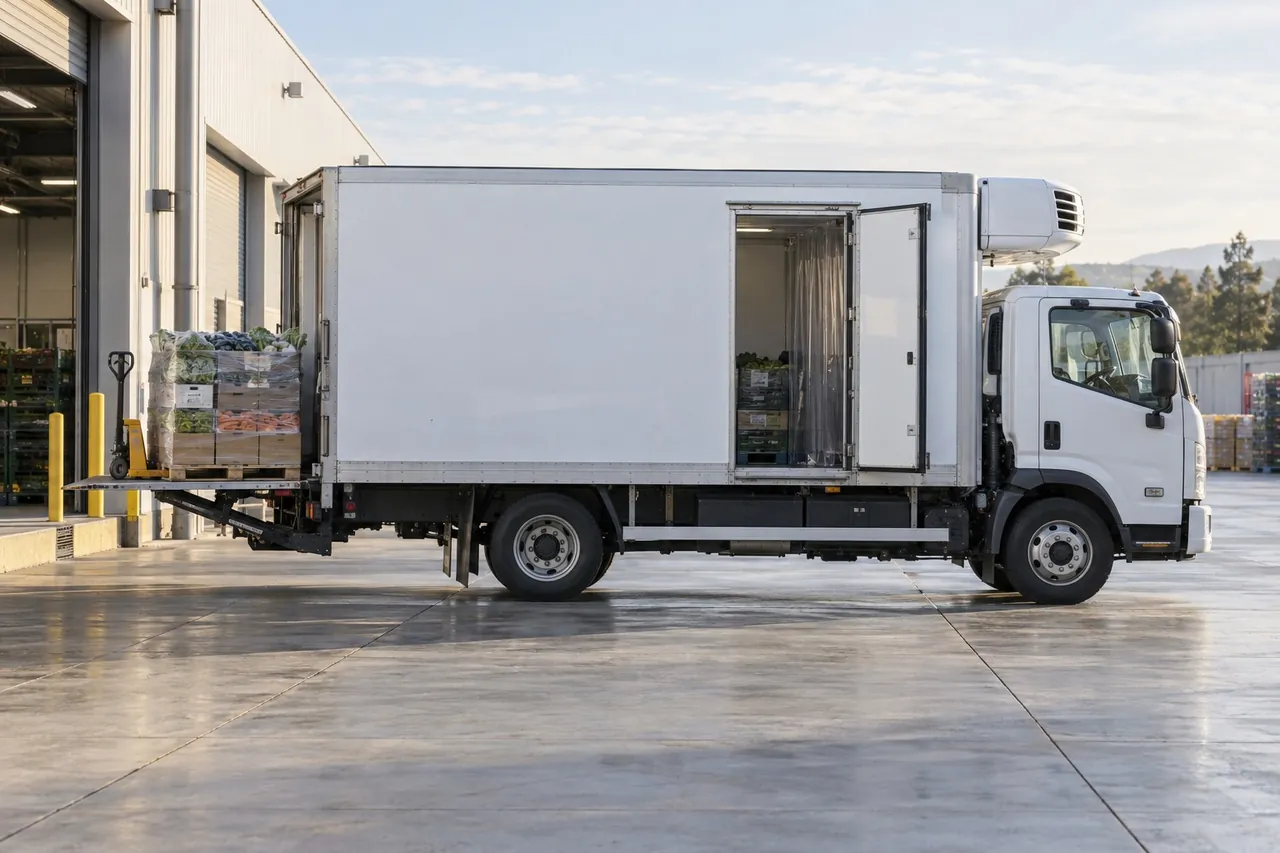
Short answer
A reefer truck is a straight truck with an insulated box body and its own refrigeration unit, holding cargo at about −20 °C to +15 °C (−4 °F to 59 °F). Box lengths run from 10 ft to 26 ft, giving about 10–43 m³ (350–1,500 cu ft) and 2–12 standard pallets. A 26 ft reefer box truck under 26,001 lb GVWR needs no CDL in the US.
Key takeaways
- A 16 ft refrigerated box truck holds about 8 pallets and 23 m³ (800 cu ft); a 26 ft truck holds about 12 pallets and 43 m³ (1,500 cu ft).
- Reefer truck bodies use about 75–100 mm (3–4 in) of PU foam for frozen loads and 50–75 mm (2–3 in) for chilled.
- Small trucks often use engine-driven units; 16–26 ft trucks usually use self-powered diesel or electric units so cooling continues with the engine off.
- Typical US prices in 2026 run about $110,000–$200,000 new and $45,000–$120,000 used, depending on size and unit.
- Door openings often add as much heat as the walls on multi-drop routes, so size the unit on your real delivery pattern.
What is a reefer truck?
A reefer truck is a rigid (straight) truck with an insulated cargo body and a refrigeration unit that keeps the load at a set temperature. "Reefer" is short for refrigerated. In the US you will hear refrigerated truck, refrigerated box truck or straight truck reefer; in the UK and much of the Commonwealth the same vehicle is a reefer lorry, refrigerated lorry or freezer lorry.
Unlike a reefer trailer, the box is mounted permanently on the truck chassis, so one driver and one vehicle do the whole job. That makes reefer trucks the standard choice for city and regional distribution: food service delivery, grocery top-ups, bakery and dairy rounds, meat and seafood wholesalers, ice cream and frozen food distributors, florists and pharmaceutical couriers.
A refrigerated truck has three parts you choose separately:
- Chassis – the truck itself, defined by gross vehicle weight rating (GVWR), wheelbase and cab.
- Refrigerated truck body – the insulated reefer box with doors, floor and fittings.
- Reefer unit – the refrigeration system and controller, mounted on the front of the box or under the body.
A freezer truck is simply a reefer truck with thicker insulation and a unit sized to hold −18 °C to −20 °C (0 °F to −4 °F). Many units can also heat, which protects produce and drinks from freezing in winter.
How big is a reefer truck? Sizes from 10 to 26 ft
Box trucks are sold by nominal body length. Inside, a reefer box loses a few inches to insulation, so it is narrower and shorter than a dry box of the same length. Typical interior figures:
| Body length | Typical interior volume | Standard pallets (48 × 40 in) | Typical use |
|---|---|---|---|
| 10 ft truck | About 10 m³ (350 cu ft) | 2–3 | Bakery, florist, catering |
| 12 foot truck | About 15 m³ (520 cu ft) | 4 | Restaurant supply, pharmacy |
| 14 ft / 15 foot truck | About 18 m³ (640 cu ft) | 6 | Butchers, dairy rounds |
| 16 ft truck | About 23 m³ (800 cu ft) | 8 | Food service, grocery |
| 18 foot truck | About 27 m³ (950 cu ft) | 8–9 | Regional multi-drop |
| 20–22 ft truck | About 33–36 m³ (1,150–1,270 cu ft) | 10–11 | Wholesale, seafood |
| 24 ft truck | About 39 m³ (1,380 cu ft) | 12 | Distribution centres |
| 26 ft truck | About 43 m³ (1,500 cu ft) | 12 | Largest non-CDL box truck |
Interior width is usually about 2.0–2.4 m (79–94 in) and interior height about 1.8–2.3 m (71–90 in), depending on body builder and chassis. Bodies longer than 26 ft, such as 30 ft box trucks, usually need a heavier chassis and a commercial licence; beyond that, operators move to a 53 ft reefer semi trailer, covered in our reefer trailer guide.
Small refrigerated truck or 26 ft truck: choosing the right size
Bigger is not automatically better. A half-empty reefer box costs fuel and refrigeration capacity on every trip, and long trucks are harder to park at city restaurants and shops. Choose size on four numbers:
- Peak load – pallets, roll cages or cartons on the busiest day, plus about 10–20% growth.
- Payload – a 26 ft box truck rated at 26,000 lb GVWR typically carries roughly 7,000–10,000 lb (3.2–4.5 t) once the reefer body and unit are fitted. Dense loads such as meat, drinks and ice often run out of weight before space.
- Licence – in the US, trucks up to 26,000 lb GVWR can usually be driven without a commercial driver's licence, which is why non-CDL reefer box trucks at 24–26 ft are so popular. Rules differ elsewhere; in the UK and EU, vehicles over 3.5 t need a C1 or C licence.
- Access – loading docks, rear lanes, height limits and urban low-emission zones.
A small refrigerated truck of 10–14 ft often replaces two vans on a multi-drop route. A 16ft truck is the most versatile size for food service. Choose a 24 ft truck or 26 ft truck when you move whole pallets between depots or supply supermarkets. If your daily volume is under about 10 m³, look at a converted van instead; see our refrigerated van conversion guide.
Refrigerated truck body options: insulation, doors and tail lifts
The reefer truck body matters as much as the unit. A poorly insulated or leaking box forces the unit to run harder, wastes fuel and causes hot spots.
- Insulation – PU or PIR foam sandwich panels with GRP or aluminium skins. Typical thickness is 50–75 mm (2–3 in) for chilled and 75–100 mm (3–4 in) for frozen bodies. Under ATP rules, frozen classes need a heavily insulated body with K ≤ 0.40 W/(m²·K).
- Rear doors – hinged swing doors seal best; roll-up doors are faster at docks but leak more air.
- Side door – a box truck with side door speeds multi-drop deliveries and cuts the time rear doors stand open.
- Tail lift – a box truck with tail lift (liftgate) lets one person deliver pallets and roll cages without a dock. Tuck-under lifts keep the rear clear; column lifts carry heavier loads. Add the weight to your payload calculation.
- Floor – non-slip aluminium or GRP, coved corners and drains for wash-down; meat rails for hanging carcasses.
- Multi-temp – a movable insulated bulkhead and second evaporator create chilled and frozen compartments in one refrigerated box.
- Strip curtains and air chute – curtains cut air exchange at each opening; on longer bodies a ceiling air chute spreads air to the rear.
Be There supplies PU and PIR insulated sandwich panels as well as units, which helps body builders source a matched insulation and refrigeration package.
How do refrigerated trucks work? Reefer unit types
A reefer unit is a compact vapour-compression system: a compressor drives refrigerant through a condenser outside the box, where heat is released, and an evaporator inside, where heat is absorbed from the cargo. Fans blow cold air from the evaporator over the load and draw warm air back. The main difference between units is how the compressor is powered:
| Unit type | Compressor power | Typical truck size | Pros and cons |
|---|---|---|---|
| Engine-driven (direct drive) | Belt from truck engine | Vans to about 16 ft | Lowest cost and weight; stops when engine stops unless electric standby is fitted |
| Independent diesel (self-powered) | Small diesel engine on the unit | 14–26 ft | Cools with the truck engine off; more weight, noise and servicing |
| Electric | Battery, alternator or e-axle, plus shore power | Vans to 26 ft | Quiet, zero exhaust at the unit; needs a charging plan |
Most units also offer electric standby, so the box can be pre-cooled overnight at the depot on mains power. Be There truck refrigeration units cover boxes of 4–45 m³, which spans everything from a small van to a 26 ft truck, in engine-driven, independent diesel and fully electric versions holding −20 °C to +15 °C (−4 °F to 59 °F).
How to size the reefer unit for your truck
Required cooling capacity is roughly wall heat plus door-opening heat plus a safety margin. Wall heat is the body's K-value × surface area × the difference between outside and box temperature; transport standards such as ATP apply a 1.75× factor to it. Door-opening heat depends on how many drops you make and how long doors stay open.
As a reference, a 15 m³ (530 cu ft) frozen box with K = 0.40 W/(m²·K) at −20 °C (−4 °F), in 30 °C (86 °F) ambient with about 10 drops a day, needs about 3 kW of cooling at −20 °C, equivalent to a unit rated around 5 kW at 0 °C. A 26 ft frozen body with three times the volume and a busy route needs roughly double that.
Points that push you to a larger unit:
- Many drops per day or long door-open times.
- Hot climates; check the unit's capacity at 40–43 °C (104–110 °F) ambient, not just 30 °C.
- Loading product that is not fully pre-cooled.
- Older insulation, which loses performance as it ages.
Use our free truck refrigeration calculator to estimate capacity from box dimensions, insulation, set point and door openings, then compare against unit ratings at the same box temperature.
Truck fridge, semi truck fridge or reefer unit?
Searches for a truck fridge, semi truck fridge, mini fridge for truck or refrigerator for semi truck are usually about something much smaller: a 12 V or 24 V compressor fridge or cooler of about 15–50 L (0.5–1.8 cu ft) in the cab, for the driver's food and drinks. These are personal appliances. They draw a few amps from the truck battery and cannot cool a cargo body.
A cargo truck refrigerator is the reefer unit and insulated box described above, rated in kilowatts or BTU per hour rather than litres. If you are buying for a fleet, budget for both: a reliable cab fridge improves driver comfort on long shifts, while the reefer unit protects the load.
Mobile kitchens are another separate category. A lunch truck, canteen truck or catering truck carries under-counter fridges, freezers and sometimes ice cream equipment for food it prepares and sells on the spot, rather than a refrigerated cargo box. Equipment for those vehicles is covered in our food truck refrigeration guide.
Shipping containers are different again: a reefer shipping container has an integral electric refrigeration unit and runs on ship, port or genset power, not on a truck engine.
Buying a refrigerated truck for sale: prices and checks
Typical US price ranges in 2026, before taxes and fees:
- 16–20 ft reefer box truck – about $110,000–$170,000 new, $45,000–$100,000 used.
- 24–26 ft reefer box truck – about $140,000–$200,000 new, $60,000–$120,000 used.
- Reefer unit alone – roughly $15,000–$35,000 for a straight-truck unit, more for multi-temp.
When you look at reefer trucks for sale or a refrigerated box truck for sale, check:
- Pull-down test – empty box from ambient to set point; time it and watch for short cycling.
- Unit hours and service records, including electric standby hours and refrigerant leak checks.
- Body condition – cracked skins, delamination, water in the foam, damaged floor or door seals.
- Certification – ATP certificate and expiry where it applies.
- Liftgate, side door and chassis – service history, tyres, brakes and GVWR versus your loads.
A tired unit on a sound body can often be replaced for much less than a new truck. Ask a reefer mechanic to inspect before you buy; our reefer maintenance guide lists what they should check. To buy refrigerated truck equipment direct, send your body dimensions, insulation, set point and drops per day through the quotation form and we will size and quote a matched reefer unit with install kit.