Short answer
Reefer container cold storage means using a refrigerated shipping container on site as a cold room. It holds −30 °C to +30 °C (−22 °F to 86 °F), needs a 380–460 V three-phase supply, and typically uses about 50–120 kWh per day. It suits pre-cooled product and seasonal peaks; for daily picking, a panel-lined container cold room or walk-in often works better.
Key takeaways
- A reefer container holds −30 °C to +30 °C (−22 °F to 86 °F) and needs a 380–460 V three-phase supply on a 32 A IEC 60309 plug.
- Indicative running energy for a 40 ft high-cube reefer used as static storage is about 50–120 kWh per day, highest for frozen goods in hot climates.
- Reefer containers are designed to hold temperature, not to cool warm product, so load only pre-cooled goods below the red load line.
- A 20 ft dry container lined with 100 mm panels gives a container cold room of about 26–27 m³ (950 ft³) and can run on single-phase power.
- Leave at least 1 m (3 ft) of free air at the machinery end and set the box level on all four corner castings.
- Beyond about two 40 ft containers or frequent daily access, a panel walk-in cold room usually costs less to run per cubic metre.
Can a reefer container be used as cold storage?
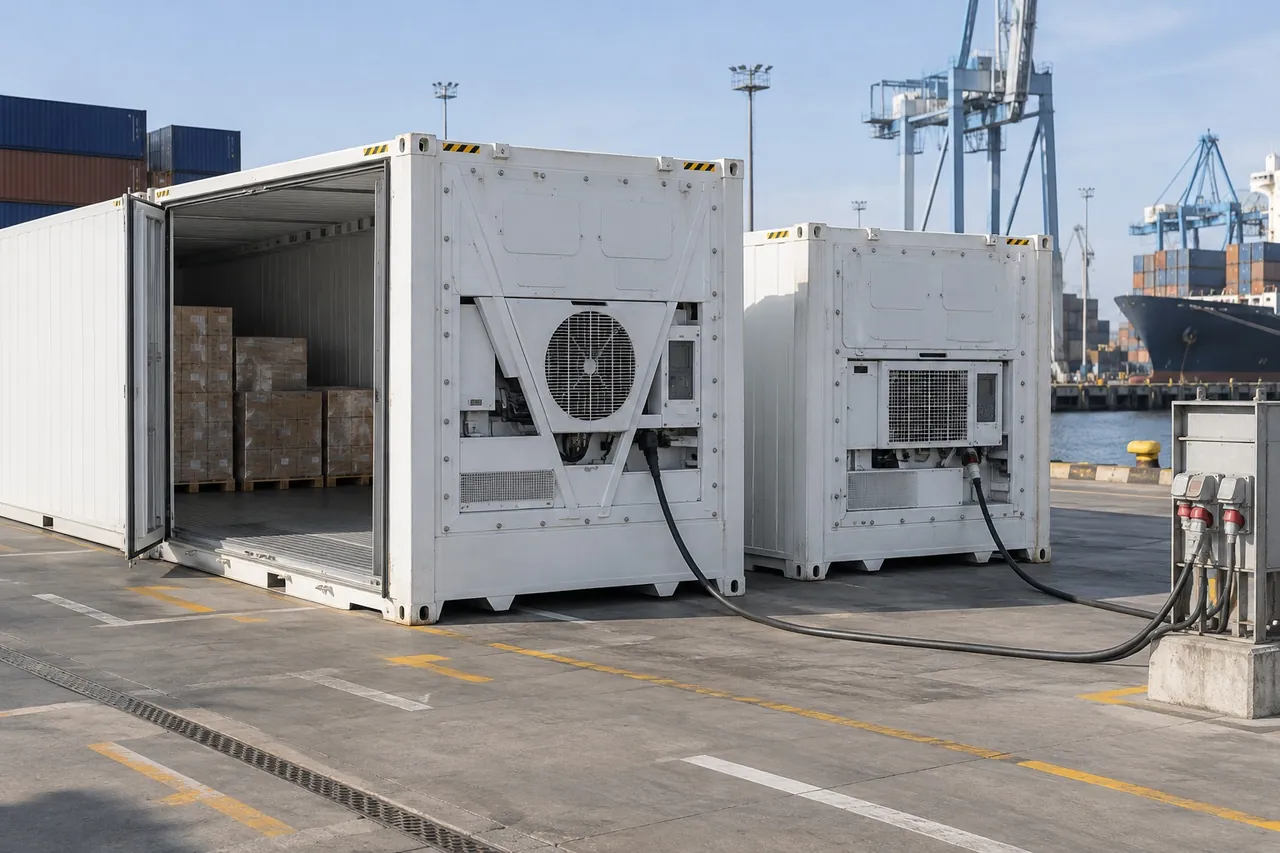
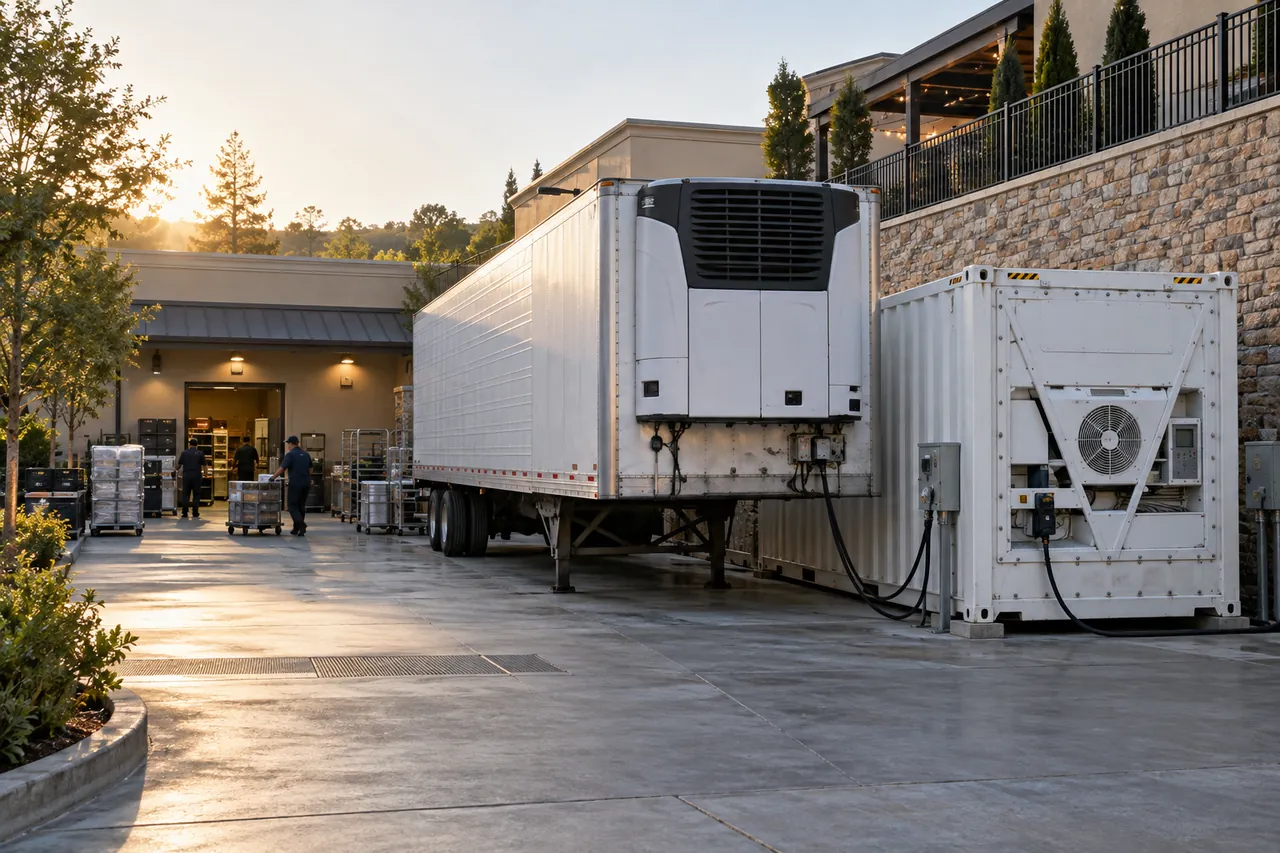
Yes. A reefer container parked on site and plugged into three-phase power is one of the quickest ways to add cold storage: it arrives ready to run, holds anywhere from −30 °C to +30 °C (−22 °F to 86 °F), and can be moved when you no longer need it. Reefer cold storage is widely used by farms at harvest, food processors during peaks, restaurants during refits, events and remote sites.
It is not the right answer for every case. A reefer container is designed to hold product that was already cold when loaded, through a 2.29 m (7.5 ft) wide steel box with one door at the end. If you need to cool warm product, walk in and out all day, store more than a couple of containers' worth, or run on single-phase power, a purpose-built cold room or a container cold room built from insulated panels is often better. This guide explains how to set one up and when the alternatives win. For internal dimensions and capacities, see our separate guide to reefer container sizes.
What types of cold storage containers are there?
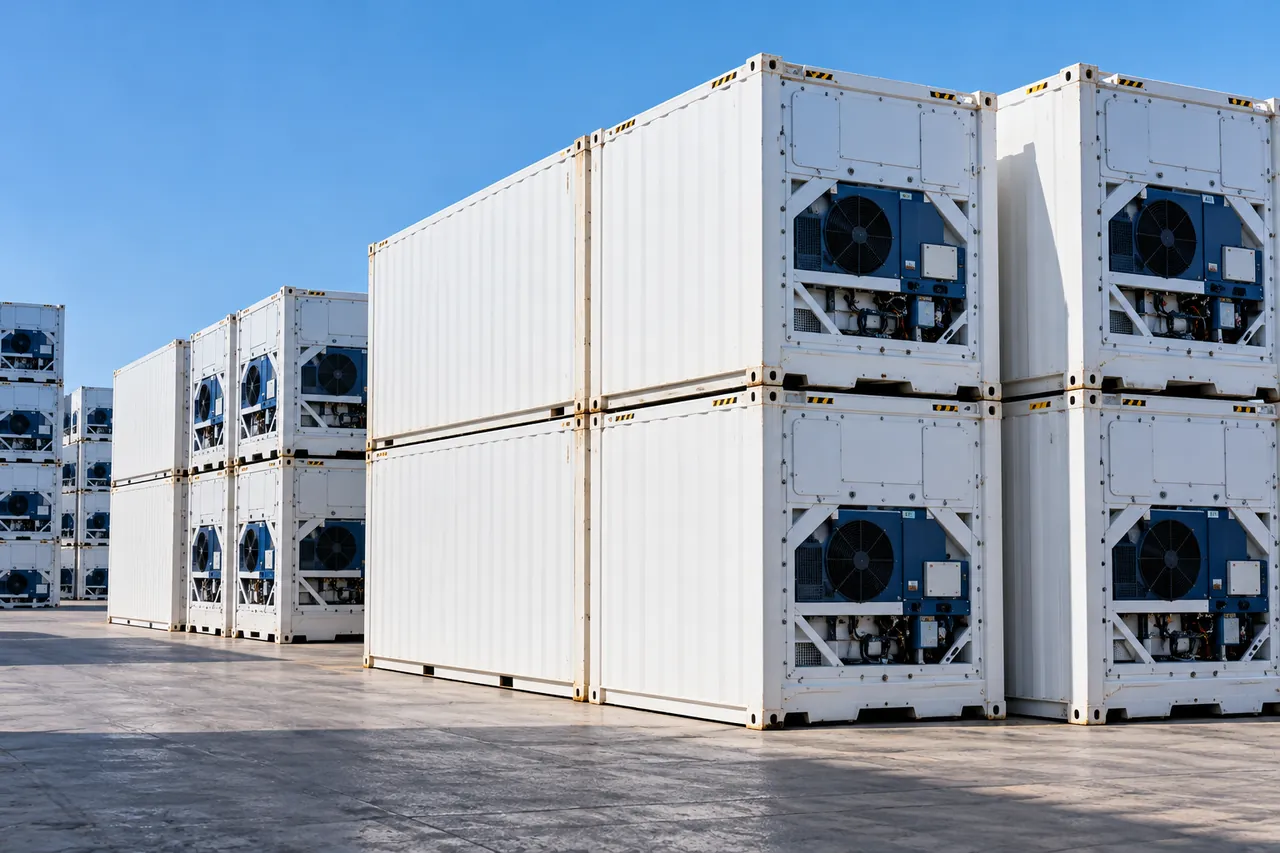
Cold storage containers come in three main forms: ex-shipping reefer containers with an integral refrigeration unit, insulated containers or dry containers converted into cold rooms with panels and a separate refrigeration unit, and purpose-built portable cold rooms on skids. They look similar from outside but behave very differently on site.
| Type | Insulation | Refrigeration | Power | Typical temperature | Best for |
|---|---|---|---|---|---|
| Shipping reefer container (20 ft or 40 ft HC) | Factory PU foam, about 100–120 mm walls | Integral unit at one end, bottom-air delivery through T-floor | 380–460 V three-phase, 50/60 Hz | −30 °C to +30 °C | Fast deployment, pre-cooled product, frozen storage |
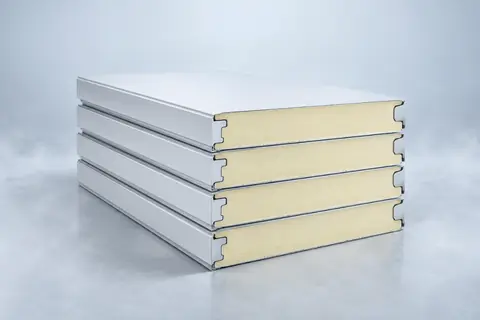
| Container cold room (dry container lined with panels) | 75–150 mm PU or PIR panels inside the steel shell | Monoblock or split system through the wall | Single- or three-phase, chosen to suit site | Chilled or frozen to the design | Shops, farms and sites that want shelving, a side door or single-phase power |
| Insulated container without machinery (reefer box) | Factory PU foam | None; a wall-mounted unit can be added | To suit the added unit | Depends on added unit | Budget projects with a dead or removed reefer unit |
| Portable or skid-mounted cold room | 100–150 mm panels on a steel base frame | Monoblock or split | Single- or three-phase | Chilled, frozen or dual-zone | Semi-permanent rooms that can be lifted and relocated |
A shipping container cooler built from a dry box can be laid out with shelving, two compartments at different temperatures, or a personnel door in the side wall, which an ex-shipping reefer cannot easily offer. The trade-off is that you must design the insulation, vapour sealing and refrigeration rather than buying them proven.
How do you set up a reefer container for on-site storage?
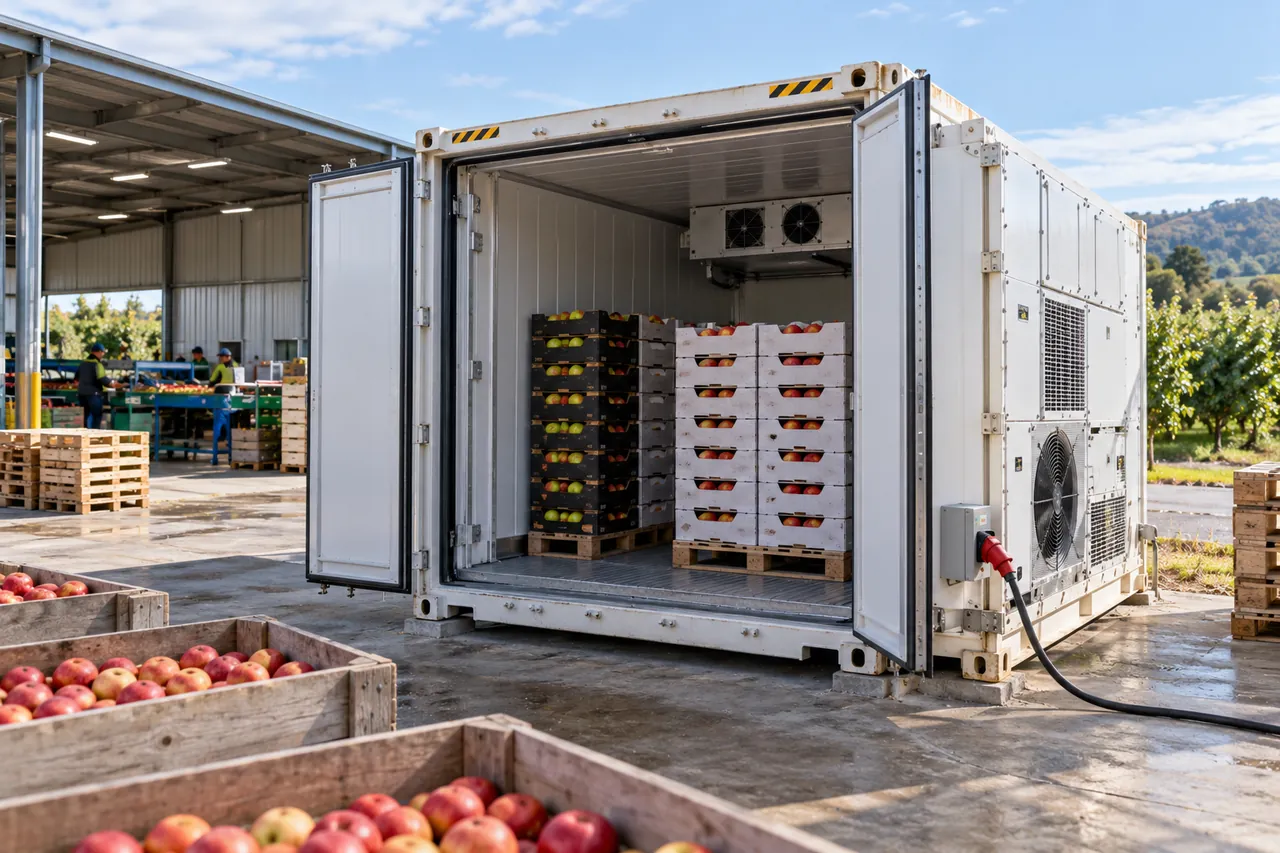
To set up reefer storage, place the container level on firm hardstanding or supports under all four corner castings, leave at least 1 m (3 ft) of free air at the machinery end, connect it to a correctly protected three-phase supply with the standard reefer plug, pre-cool the empty box, then load pre-cooled product without blocking the airflow.
- Choose the site. Firm, level and drained ground or concrete, with access for the delivery truck or crane. Shade the machinery end from afternoon sun if possible.
- Level and support. Set the container on the four corner castings (concrete pads or sleepers) with a slight fall towards the doors so defrost water and wash water drain out.
- Arrange power. A licensed electrician should provide a 380–460 V three-phase, 50 or 60 Hz supply on a 32 A IEC 60309 socket with earth and residual-current protection. Do not run the reefer from a long extension that drops voltage on start-up.
- Set the controller. Enter the set point, check the fresh-air vent is closed for frozen goods (or set as required for produce), and run a pre-trip inspection (PTI) if the unit offers one.
- Pre-cool. Run the empty container down to set point with the doors closed before any product goes in.
- Load correctly. Load only product that is already at storage temperature; keep below the red load line, leave the T-floor channels clear, and keep a gap at the door end so return air reaches the unit.
- Monitor. Use the reefer's own data logger, add a remote alarm, and check the temperature record daily.
- Access. Add a ramp or loading dock plate, a strip curtain inside the doors, and a lock.
If grid power is not available, a diesel generator set (genset) of the kind used for reefers on road chassis can run a container, but fuel and service then become daily tasks. For short-term emergency hire and trailers, see emergency and temporary cold storage.
How much power does a reefer container use?
A reefer container used as static cold storage typically draws about 2–5 kW on average once at temperature, roughly 50–120 kWh per day, with peaks of 10–15 kVA during pull-down and defrost. Frozen storage in a hot climate sits at the top of that range; chilled storage in mild weather at the bottom. These are indicative figures; check the data plate and your own meter.
| Use (40 ft high-cube reefer) | Set point | Ambient | Indicative average draw | Indicative energy per day |
|---|---|---|---|---|
| Chilled produce or drinks | +2 °C to +5 °C (36–41 °F) | 20–25 °C | 2–3 kW | 50–70 kWh |
| Chilled, hot site | +2 °C to +5 °C | 35–40 °C | 3–4 kW | 70–95 kWh |
| Frozen food | −18 °C to −20 °C (0 °F to −4 °F) | 20–25 °C | 3–4 kW | 70–100 kWh |
| Frozen, hot site | −20 °C to −25 °C | 35–40 °C | 4–5 kW or more | 95–120+ kWh |
Three things raise consumption more than anything else: door openings, warm product, and a dirty condenser or damaged door seals. A reefer opened every few minutes for picking can use 30–50% more energy than one opened twice a day. Ex-shipping units are often 10–15 years old, so a worn compressor and degraded foam can add more again. A shipping container refrigeration unit retrofitted with a modern inverter monoblock, or a panel-built room with a correctly sized condensing unit, can be cheaper to run where the box is used as a working store rather than a hold-only store.
Reefer container vs container cold room vs panel walk-in
Choose a reefer container for speed and mobility with pre-cooled product, a container cold room when you want a container footprint but a working cold room inside, and a panel walk-in when the room will stay put and be used heavily every day. The deciding factors are access, power, how much warm product you load and how long you need it.
| Factor | Reefer container | Container cold room | Panel walk-in cold room |
|---|---|---|---|
| Lead time to working storage | Days (delivery and plug in) | Weeks (lining, refrigeration fit-out) | Weeks (panels, floor, installation) |
| Internal width | About 2.29 m (7.5 ft) | About 2.0–2.2 m after lining | Any size, e.g. 3–10 m wide |
| Doors | Full-width end doors only | End doors and/or side personnel door | Hinged or sliding, anywhere |
| Power | Three-phase required | Single- or three-phase | Single- or three-phase |
| Pull-down of warm product | Limited; built to hold temperature | Sized as designed | Sized as designed, can include blast cooling |
| Mobility | Excellent; standard ISO handling | Good; standard ISO handling | Can be dismantled and rebuilt |
| Expansion | Add more containers | Add more containers | Add panels to extend |
| Floor | Aluminium T-floor raised above ground level; needs a ramp | Lined floor inside steel box | At grade, flush with pallet trucks |
Once a site needs more than about two 40 ft containers of space, or staff go in and out all day, a panel cold room usually wins on running cost, workflow and floor area per dollar. Our walk-in cooler cost guide gives typical installed prices to compare against container purchase or hire, and reefer container price: new, used and rental covers the other side of the comparison.
How to build a container cold room from a dry container
A container cold room is built by lining a dry ISO container with insulated sandwich panels on all six faces, sealing the vapour barrier, then fitting a refrigeration unit through an end or side wall. Use 75–100 mm (3–4 in) panels for chilled rooms and 120–150 mm (5–6 in) for freezers, as for any cold room.
- Pick a sound container: dry, wind and water tight, with a straight floor and working doors.
- Lay an insulated floor: XPS board or floor panels with a wearing surface, or floor panels with an aluminium or plywood finish.
- Fit wall and ceiling panels inside the steel shell, leaving no air gap where condensation can collect against cold steel.
- Choose access: keep the original doors with an insulated inner door, or cut a side opening and fit a hinged cold room door.
- Install refrigeration: a monoblock through the wall for small boxes, or a split system with the condensing unit mounted on the end wall or roof.
- Add lighting, a controller with alarm, shelving or racking, and a drain for defrost water.
A 20 ft dry container lined with 100 mm panels gives an internal room of about 5.7 × 2.15 × 2.2 m, roughly 26–27 m³ (about 950 ft³). That suits a farm shop, butcher or restaurant group that wants a movable room. For panel selection, see cold room panel thickness.
Cold storage containers for rent or for sale?
Rent cold storage containers when the need lasts weeks or a single season; buy when you will use the box for more than roughly 12–24 months, depending on local rental rates. Seasonal users such as packhouses, fisheries, event caterers and food banks often rent from suppliers who handle delivery, power hook-up and breakdown service.
- Renting: no capital outlay, service included, easy to scale for cold storage containers for seasonal demand. Delivery and collection charges can be a large part of a short hire.
- Buying used: low purchase price, but check the machinery runs, holds set point after a PTI, the refrigerant is still serviceable in your market and the floor and gaskets are sound.
- Buying new or one-trip: highest price, full machinery life and warranty, best energy performance.
- Building a container cold room: you control layout, power supply and refrigeration selection, and can use new panels and a new unit in a second-hand dry box.
Whichever route you take, the cold storage step must fit the rest of your cold chain; see cold chain logistics explained for temperature ranges and handover points.
Checklist: is a reefer container right for your site?
- Is the product already at storage temperature when it arrives? If not, plan separate pre-cooling or choose a room with pull-down capacity.
- Do you have a 380–460 V three-phase supply with a 32 A socket, or are you prepared to run a genset?
- How often will the doors open? Frequent picking favours a cold room with a strip curtain and side door.
- How long will you need the space? Weeks favour renting; years favour buying or building.
- Is 2.29 m internal width enough for your pallets and pallet truck? A 40 ft high-cube fits about 20 standard pallets in two rows.
- Do you have firm, level ground, a ramp or dock, and 1 m of clear air at the machinery end?
- Will you need more space next year? Several containers cost more to run than one larger cold room.
Be There does not sell shipping or reefer containers. We supply what you need to turn a container footprint into a working cold store, or to build a larger room instead: PU and PIR insulation panels from 50 to 200 mm cut to fit inside 20 ft and 40 ft dry containers, complete walk-in cold room kits with doors, condensing units, evaporators and controllers for chilled or frozen storage, and refrigeration selected for single- or three-phase power. Send your container size or room size, temperature, product and power supply through the inquiry form and we will quote FOB, CIF or DDP.