Short answer
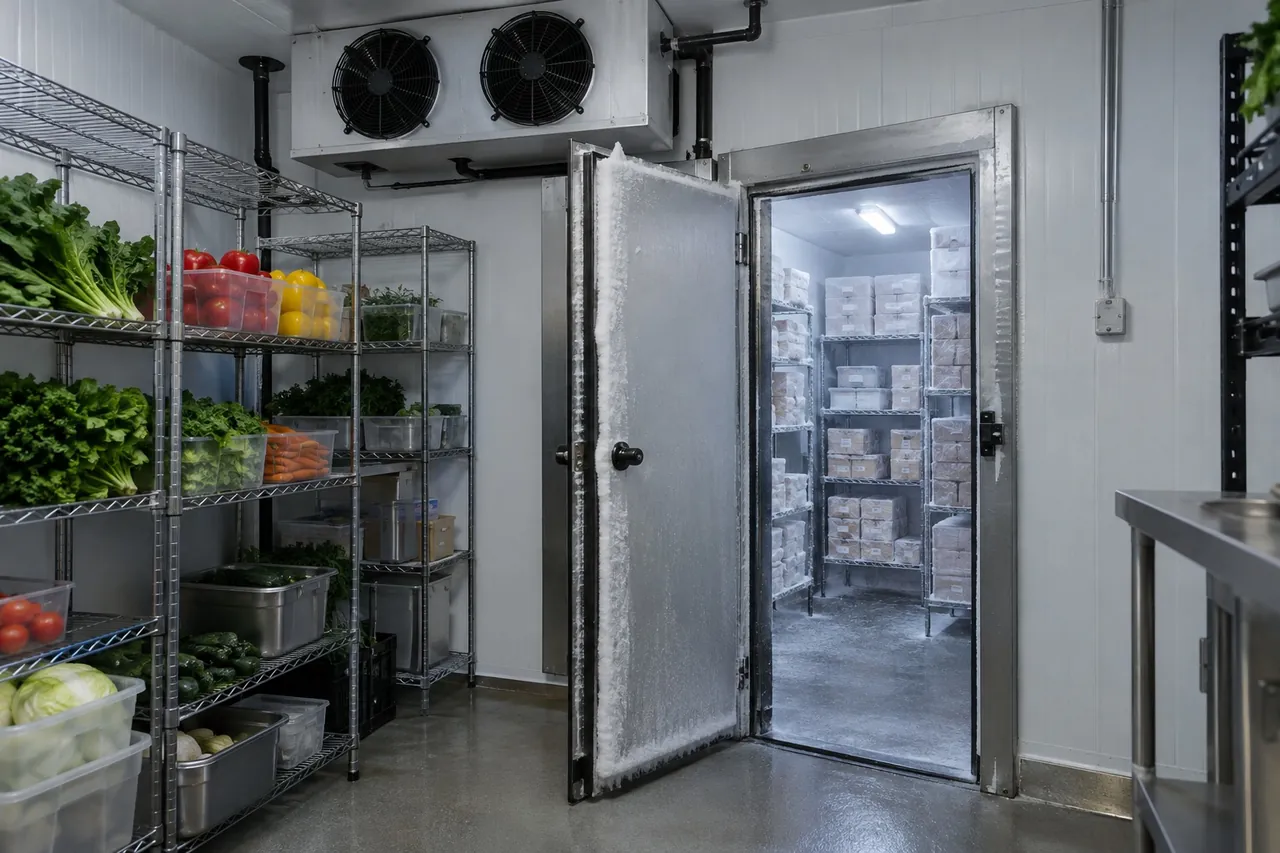
In the US in 2026, walk-in cooler cost typically runs about $8,000–$16,000 installed for a small 6×8 ft (1.8 × 2.4 m) box and $12,000–$25,000 for an 8×10 ft (2.4 × 3.0 m) box. A walk-in freezer of the same size usually costs 20–40% more because it needs thicker panels, an insulated floor and a low-temperature condensing unit.
Key takeaways
- A typical 8×10 ft walk-in cooler costs about $12,000–$25,000 installed in the US, depending on spec, site and labour rates.
- A walk-in freezer usually costs 20–40% more than a cooler of the same footprint because of 100–150 mm panels, floor insulation and low-temperature refrigeration.
- The refrigeration system is often 25–40% of the equipment price; a replacement walk-in cooler compressor typically costs $1,000–$6,500 fitted.
- Running a small walk-in cooler typically uses about 10–25 kWh per day, roughly $500–$1,400 a year at $0.15 per kWh.
- Buying a factory-direct cold room kit can cut equipment cost, but freight, duty, local installation and electrics must be added to compare fairly.
How much does a walk-in cooler cost?
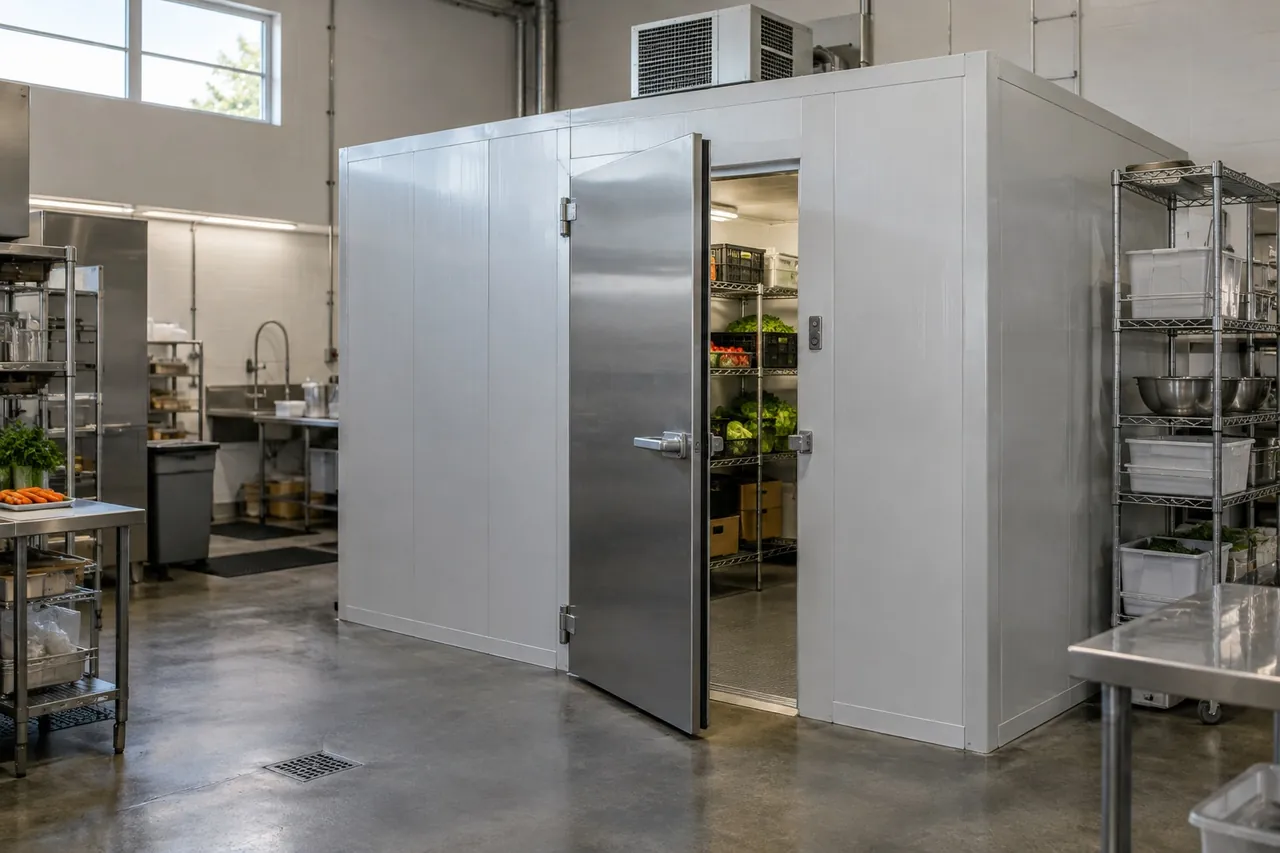
Walk-in cooler cost depends mainly on size, temperature and how much installation work the site needs. In the US market in 2026, a small prefabricated walk-in cooler typically costs about $8,000–$16,000 installed, and the common 8×10 ft restaurant box about $12,000–$25,000 installed.
Those figures assume a modular panel box, a standard hinged door, a matched condensing unit and evaporator, a digital controller and professional installation. Custom sizes, outdoor boxes, remote refrigeration, glass doors and electrical upgrades push the price up. The table gives typical installed ranges; treat them as budgeting numbers, not quotes.
| Size (ft / m) | Floor area | Walk-in cooler, installed | Walk-in freezer, installed |
|---|---|---|---|
| 6×6 / 1.8 × 1.8 | 36 ft² (3.3 m²) | $7,000–$14,000 | $9,000–$18,000 |
| 6×8 / 1.8 × 2.4 | 48 ft² (4.5 m²) | $8,000–$16,000 | $10,000–$21,000 |
| 8×10 / 2.4 × 3.0 | 80 ft² (7.4 m²) | $12,000–$25,000 | $15,000–$32,000 |
| 10×12 / 3.0 × 3.6 | 120 ft² (11 m²) | $15,000–$30,000 | $19,000–$40,000 |
| 12×20 / 3.6 × 6.0 | 240 ft² (22 m²) | $25,000–$50,000+ | $32,000–$65,000+ |
The average cost of a walk-in cooler per square foot falls as the box gets bigger, because the door, controller and much of the labour stay the same while only panel area grows. Small boxes often work out at $150–$300 per ft² of floor; large cold rooms can be well under half of that.
How much does a walk-in freezer cost?
A walk-in freezer typically costs 20–40% more than a walk-in cooler of the same footprint. A cooler holds about 0 °C to +5 °C (32–41 °F); a freezer holds −18 °C to −25 °C (0 °F to −13 °F), so the temperature difference across the walls is roughly twice as large. That changes almost every line of the quote:
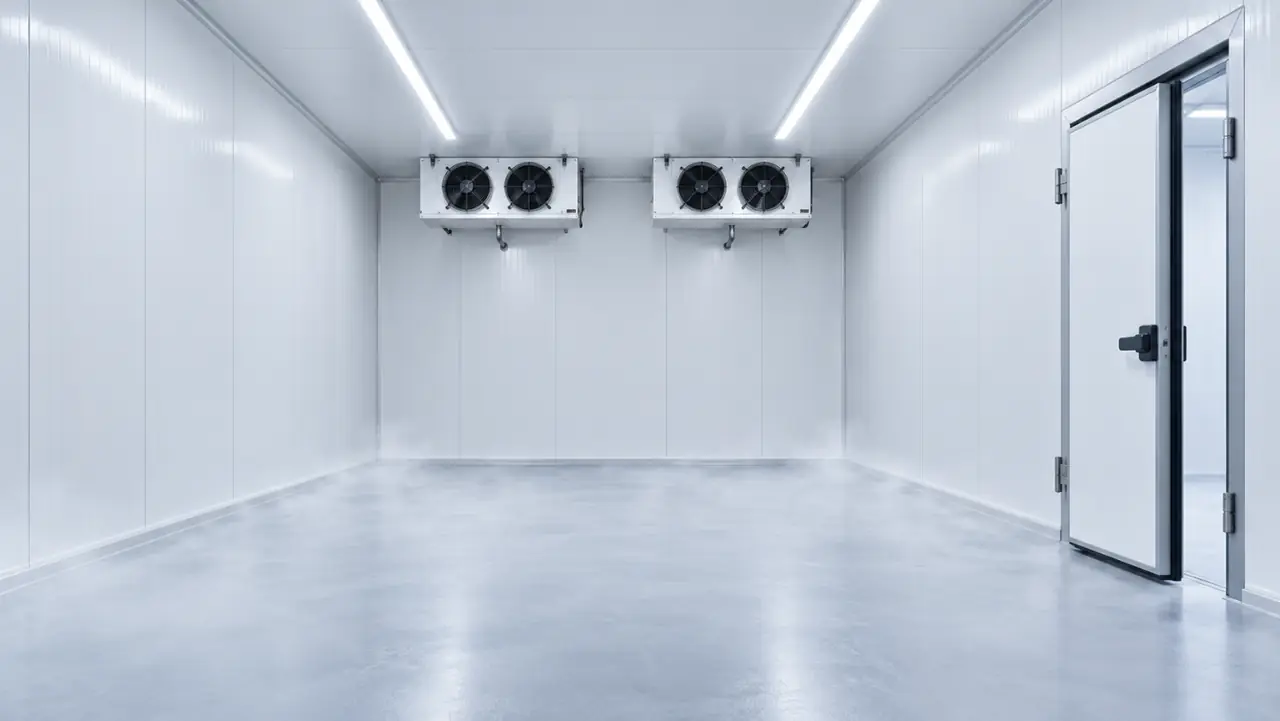
- Panels: 100–150 mm (4–6 in) PU or PIR instead of 75–100 mm (3–4 in). See our cold room panel thickness guide.
- Floor: an insulated floor is mandatory, and on a ground slab larger freezer rooms also need heave protection.
- Door: a heated frame and a pressure-relief port to stop the door freezing shut.
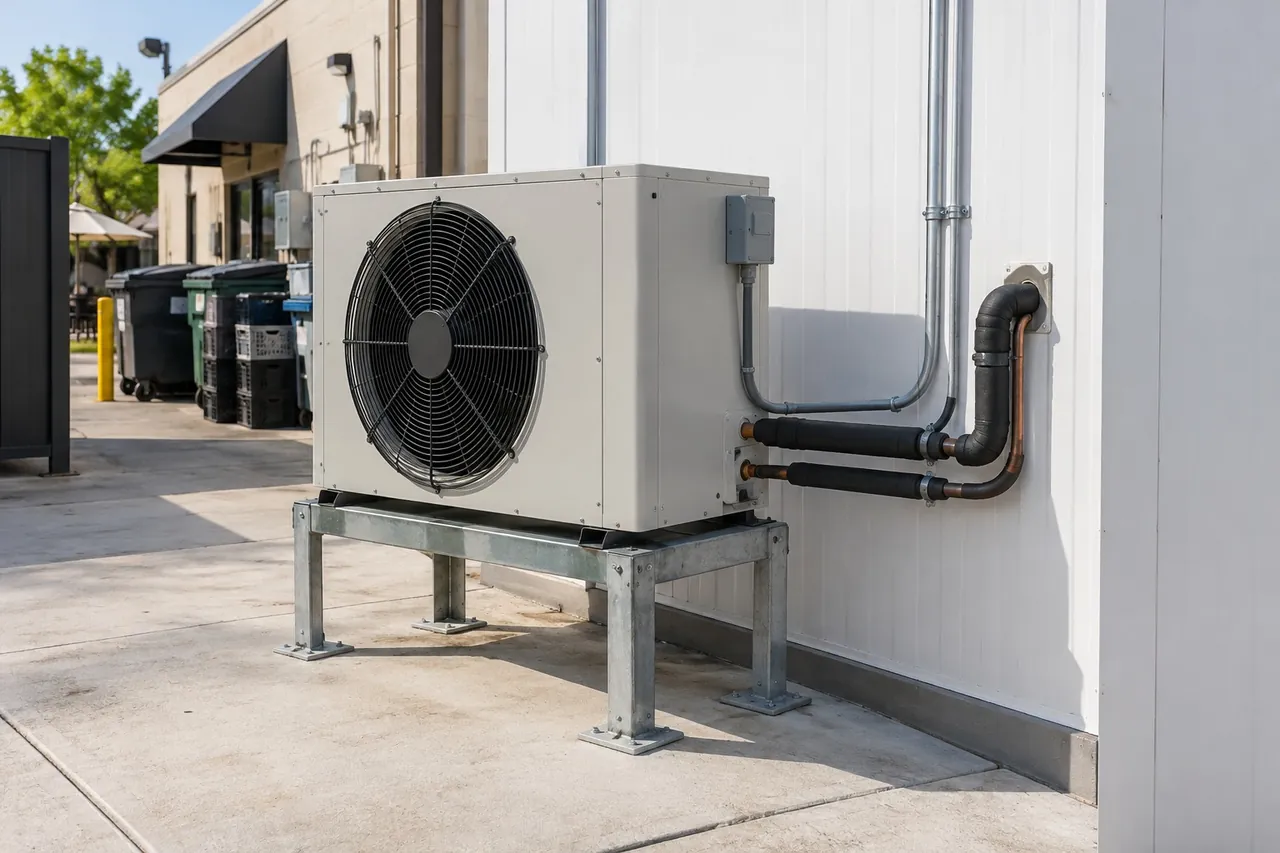
- Refrigeration: a low-temperature condensing unit, larger in horsepower for the same box, plus an evaporator with electric defrost heaters.
- Electrics: defrost heaters and door heaters often mean a larger supply or three-phase power.
Commercial walk-in freezer cost is also driven by use. A freezer that receives warm product every day, or a door opened every few minutes, needs more refrigeration capacity than a pure storage room. If you also need fast freezing of cooked food, a separate blast freezer is usually cheaper than oversizing the room. For a fuller comparison of the two room types, read walk-in cooler vs walk-in freezer.
What makes up the price of a walk-in fridge?
When you compare a cooler price, walk-in fridge price or walk-in refrigerator price from different suppliers, break each quote into the same lines. The shares below are typical for a small to mid-size prefabricated box; they shift with site conditions.
| Cost item | Typical share of total | What changes it |
|---|---|---|
| Insulated panels (walls, ceiling) | 25–35% | Thickness, PU vs PIR core, facing (painted steel, stainless, aluminium) |
| Floor (panels or insulated slab) | 5–10% | Floorless on existing slab vs floor panels vs new insulated slab |
| Door(s) | 5–15% | Hinged vs sliding, size, heated frame, glass doors, strip curtain |
| Refrigeration system | 25–40% | Capacity, low vs medium temperature, monoblock vs split, refrigerant |
| Controls, lighting, accessories | 3–8% | Digital controller, alarms, remote monitoring, shelving |
| Installation, electrics, permits | 15–35% | Labour rates, access, distance to condenser, power supply upgrades |
A Be There walk-in cold room kit bundles the first five lines: PU or PIR panels from 75 to 200 mm, an insulated hinged or sliding door, a matched condensing unit and evaporator, a digital controller, lighting and fixings. Installation, electrics and local permits are then priced by your local contractor, which makes it easier to see what you are paying for.
Walk-in cooler compressor, condensing unit and evaporator coil prices
Parts prices matter both for new projects and for repairs on an existing box. Typical US ranges in 2026 are below; prices vary widely with capacity, refrigerant and brand of components.
| Component | Typical equipment price | Typical fitted / replacement cost |
|---|---|---|
| Cooler condensing unit, 1–2 HP | $1,500–$4,500 | $2,500–$6,500 |
| Low-temp freezer condensing unit, 2–4 HP | $2,500–$7,000 | $4,000–$10,000 |
| Evaporator coil (unit cooler) | $500–$2,500 | $1,000–$3,500 |
| Compressor only (1–3 HP) | $600–$3,000 | $1,000–$6,500 |
Walk-in cooler compressor replacement cost
A like-for-like walk-in cooler compressor replacement typically costs about $1,000–$6,500, with many small systems around $2,500–$4,000. The total includes the compressor, a new filter drier, refrigerant recovery and recharge, vacuum and leak testing, and 4–12 hours of technician labour. Walk-in freezer compressor price sits at the upper end because low-temperature compressors are larger for the same box.
If the compressor failed young, find out why before replacing it: a dirty condenser, low charge, iced evaporator or failed defrost will kill the new one too. On an older system using a phased-down refrigerant, replacing the whole condensing unit is often better value than replacing the compressor alone. Our guide to walk-in cooler refrigeration systems explains each component.
How much does a walk-in fridge for home cost?
A residential walk-in refrigerator uses the same panels and refrigeration as a commercial one, so the cost is similar for the same size. A small 5×6 ft to 6×8 ft walk-in fridge for home typically costs about $8,000–$20,000 installed. Luxury builds with full-height glass fronts, stainless interiors, wood cladding and quiet remote condensers often go well beyond $25,000.
Points that change residential walk-in refrigerator cost:
- Noise and heat: a self-contained unit on the roof of the box puts compressor noise and heat into the room. A remote condensing unit outside costs more to install but is quieter.
- Glass doors: wine and display rooms need heated or low-E double or triple glazing to avoid condensation.
- Power: most small home walk-ins run on a single-phase supply, but check that a dedicated circuit is available.
- Use: a hunter's game room or a home brewery is effectively a commercial cooler and should be specified like one.
If you need less than about 1,000 L (35 ft³) of cold storage, two reach-in fridges are usually cheaper than a walk-in. Above that, a small modular cold room starts to win on capacity per dollar and is easier to organise.
What does a walk-in cooler cost to run?
Purchase price is only part of the cost of ownership. A small, well-insulated walk-in cooler of 6×8 to 8×10 ft typically uses about 10–25 kWh of electricity per day. At $0.15 per kWh that is about $1.50–$3.75 a day, or roughly $500–$1,400 a year. A walk-in freezer of the same size often uses 1.5–2.5 times as much.
What raises running cost:
- Thin panels or damaged door gaskets that let heat and moist air in.
- A door left open, or no strip curtain on a busy door.
- A condensing unit placed in a hot kitchen or on a sunny roof without airflow.
- Dirty condenser coils, which can raise energy use noticeably within months.
- Loading large amounts of warm product rather than pre-chilling it.
Spending more on thicker panels, an efficient condensing unit and a good door seal usually pays back within a few years at commercial electricity prices. Size the refrigeration correctly rather than generously: an oversized unit short-cycles, controls humidity poorly and costs more to buy. Use our cold room refrigeration load calculator to estimate the load from your dimensions, temperature and daily product intake.
How to lower walk-in cooler and freezer prices without cutting corners
The safest savings come from specification and sourcing, not from thinner insulation or undersized refrigeration.
- Choose a standard modular size. Panel widths of 950 or 1150 mm mean sizes that fit the module waste less material and labour.
- Use the existing slab for a cooler. A floorless cooler on a sound, level concrete floor avoids floor panels; freezers still need an insulated floor.
- Match the panel to the temperature. 75–100 mm for chillers, 120–150 mm for freezers. Thicker than needed costs money; thinner costs more in power.
- Buy the box and refrigeration as one kit. A matched condensing unit and evaporator avoids mismatched capacity and finger-pointing between suppliers.
- Consider factory-direct supply. Importing a complete walk-in cooler and freezer kit can reduce equipment cost, especially for several rooms or a full container.
When comparing an imported kit with a local installed price, add sea freight, insurance, import duty and taxes, port and inland delivery, local installation, electrical work and permits. Confirm voltage and frequency, refrigerant accepted in your market and any certification your inspector requires. Our checklist on importing refrigeration equipment from China covers each point. Be There quotes each order FOB, CIF or DDP, so you can choose how much of the logistics you handle yourself.
Checklist: what to send for an accurate walk-in cooler quote
Most walk-in cooler and walk-in freezer quotes differ because the suppliers assumed different things. Send every supplier the same information:
- Internal or external dimensions (length × width × height) and whether a floor is needed.
- Room temperature: chiller 0 °C to +10 °C, freezer −18 °C to −25 °C, or blast room down to −35 °C.
- Product, daily intake in kg or lb, and the temperature it arrives at.
- Door type, clear opening size and how often it opens per hour.
- Indoor or outdoor installation, and the hottest ambient temperature where the condenser will stand.
- Power supply: voltage, phase and frequency (for example 220 V/1/60 Hz or 380–415 V/3/50 Hz).
- Refrigerant preference or restrictions, and any certification required locally.
- Delivery terms you want: FOB, CIF or DDP, and the destination port or address.
With these details, a supplier can price the panels, door and refrigeration properly and you can compare quotes line by line. To get a quotation for a complete cold room kit, send the list through our inquiry form; Be There replies within one working day.