Short answer
A 20 ft reefer container measures about 5.44 × 2.29 × 2.26 m inside (28 m³, 990 ft³) and carries about 27 t. A 40 ft high-cube reefer is about 11.58 × 2.29 × 2.55 m inside (67 m³, 2,370 ft³) with about 29 t payload. Both typically hold −30 °C to +30 °C (−22 °F to 86 °F).
Key takeaways
- A 20 ft reefer container has about 28 m³ (990 ft³) of internal volume and about 27 t of payload.
- A 40 ft high-cube reefer has about 67 m³ (2,370 ft³) and fits about 23 Euro or 20 standard pallets.
- Reefer units hold −30 °C to +30 °C on 380–460 V three-phase power; super-freezers reach −60 °C.
- Reefers maintain temperature but do not pull down warm cargo, so pre-cool goods before loading.
- For permanent storage, a panel cold room of the same volume is often similar in cost and far more flexible.
What is a reefer container?
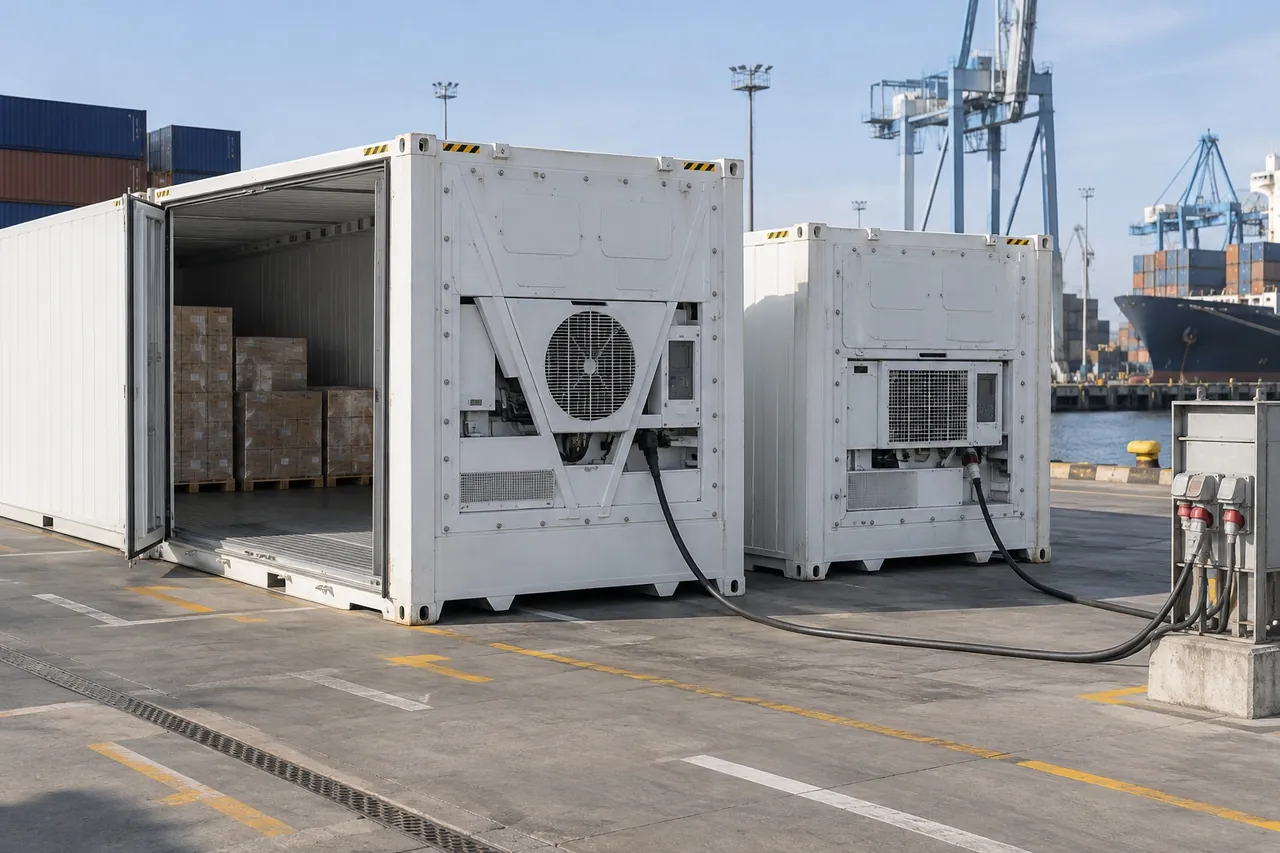
A reefer container is an ISO shipping container with insulated walls and a built-in electric refrigeration unit that holds cargo at a set temperature, typically anywhere from −30 °C to +30 °C (−22 °F to 86 °F). Reefer refrigerated containers come in two main lengths, 20 ft and 40 ft, and carry chilled and frozen goods by ship, rail and truck.
The refrigeration unit sits in the front wall and runs on three-phase power from the ship, a terminal plug or a diesel generator set. It blows cold air down into a T-shaped grooved floor, up through the cargo and back to the unit at the top. Because the air must flow under and around the load, how you stack reefer cargo matters as much as the set point.
Typical reefer cargo includes:
- Frozen: meat, poultry, fish, seafood, frozen vegetables and ice cream at −18 °C to −25 °C.
- Chilled: fresh meat, dairy, fruit and vegetables at −1 °C to +13 °C, depending on product.
- Controlled ambient: pharmaceuticals, chemicals, chocolate, wine and flowers.
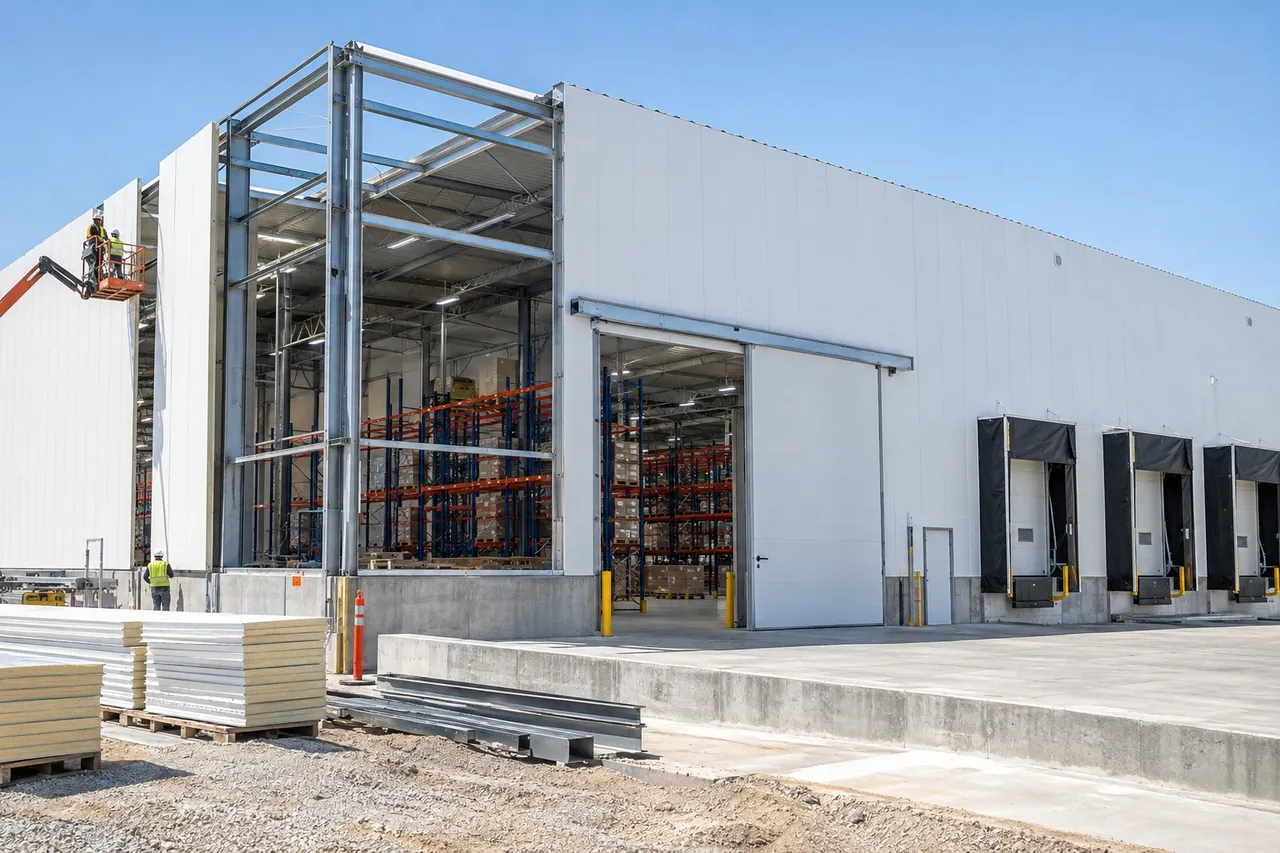
On land, refrigerated containers are also used as static cold stores at farms, ports, events and building sites. For permanent storage, an insulated panel cold room is often the better long-term option – Be There supplies walk-in cold room kits sized to any footprint, including room-in-a-container builds.
Reefer container dimensions: 20 ft vs 40 ft
Reefer container dimensions are fixed outside by ISO standards; inside they are smaller than dry containers because of the insulation and unit. Values vary by manufacturer, so confirm on the data plate.
| Specification | 20 ft reefer | 40 ft standard reefer | 40 ft high-cube reefer |
|---|---|---|---|
| External L × W × H | 6.06 × 2.44 × 2.59 m (20 ft × 8 ft × 8 ft 6 in) | 12.19 × 2.44 × 2.59 m (40 ft × 8 ft × 8 ft 6 in) | 12.19 × 2.44 × 2.90 m (40 ft × 8 ft × 9 ft 6 in) |
| Internal length | about 5.44 m (17 ft 10 in) | about 11.58 m (38 ft) | about 11.58 m (38 ft) |
| Internal width | about 2.29 m (7 ft 6 in) | about 2.29 m (7 ft 6 in) | about 2.29 m (7 ft 6 in) |
| Internal height | about 2.26 m (7 ft 5 in) | about 2.25 m (7 ft 5 in) | about 2.55 m (8 ft 4 in) |
| Internal volume | about 28 m³ (990 ft³) | about 60 m³ (2,100 ft³) | about 67 m³ (2,370 ft³) |
| Tare weight | about 3,000 kg (6,600 lb) | about 4,500 kg (9,900 lb) | about 4,700 kg (10,400 lb) |
| Max payload | about 27,000 kg (59,500 lb) | about 27,000–28,000 kg (59,500–61,700 lb) | about 29,000 kg (64,000 lb) |
The 40 ft high-cube reefer is by far the most common type in today's fleets – the extra 30 cm (1 ft) adds volume at little extra cost. The 20ft reefer container suits dense cargo such as frozen meat or fish, where payload runs out before space, and importers who cannot fill a 40 ft.
You cannot load to the ceiling: cargo must stay below the red load line, about 10–12 cm (4–5 in) below the top, to leave a return air path.
Reefer container specifications: temperature, power and airflow
Beyond size, check these reefer container specifications – they describe the container refrigeration unit as much as the box – before you book, buy or rent:
| Feature | Typical value | Why it matters |
|---|---|---|
| Temperature range | −30 °C to +30 °C (−22 °F to 86 °F); super-freezers to −60 °C (−76 °F) | Ice cream and sashimi tuna need deeper set points |
| Power supply | 380–460 V, three-phase, 50/60 Hz | Static use needs a matching three-phase supply or generator |
| Fresh-air vent | Adjustable, about 0–250 m³/h | Removes CO2 and ethylene from fruit and vegetables |
| Humidity control | Dehumidification option, roughly 60–95% RH | Bulbs, flowers and some produce need drier air |
| Floor | Aluminium T-bar floor | Delivers air under the cargo |
| Data logging | Built-in controller log, often with remote monitoring | Proves the cold chain to buyers and authorities |
A key point for buyers: a reefer unit is designed to maintain temperature, not to pull a warm load down. Cargo must be pre-cooled to its carriage temperature before loading. Frozen cargo loaded at −10 °C into a −20 °C container may arrive warmer than required, and fresh fruit loaded warm will ripen and lose weight on the voyage.
For static use, ask about running power. Draw varies with set point, ambient temperature and door openings, so budget for the maximum current shown on the data plate, not the average. If you will open the door many times a day, a panel cold room with a door strip curtain and a properly sized condensing unit will hold temperature better.
Types of reefer container
There are several types of reefer container, and the name on a booking often hides the differences:
- Integral reefer – the standard type, with the refrigeration unit built into the front wall. Nearly all modern refrigerated containers are integral.
- Controlled atmosphere (CA) reefer – adjusts oxygen and CO2 levels as well as temperature to slow ripening of bananas, avocados, berries and other produce on long voyages.
- Super-freezer – reaches −60 °C (−76 °F) or colder for sashimi-grade tuna and some medical or lab cargo.
- Porthole (insulated) container – an older design with no unit of its own, cooled by a ship or terminal air system through ports in the door end. Rare today.
- Insulated container without refrigeration – useful as an outer shell for a container cold room, with a separate condensing unit fitted.
Lengths come as 20 ft, 40 ft standard and 40 ft high-cube. A few 45 ft high-cube reefers exist for specific trades, and some regional fleets use 10 ft units for local storage.
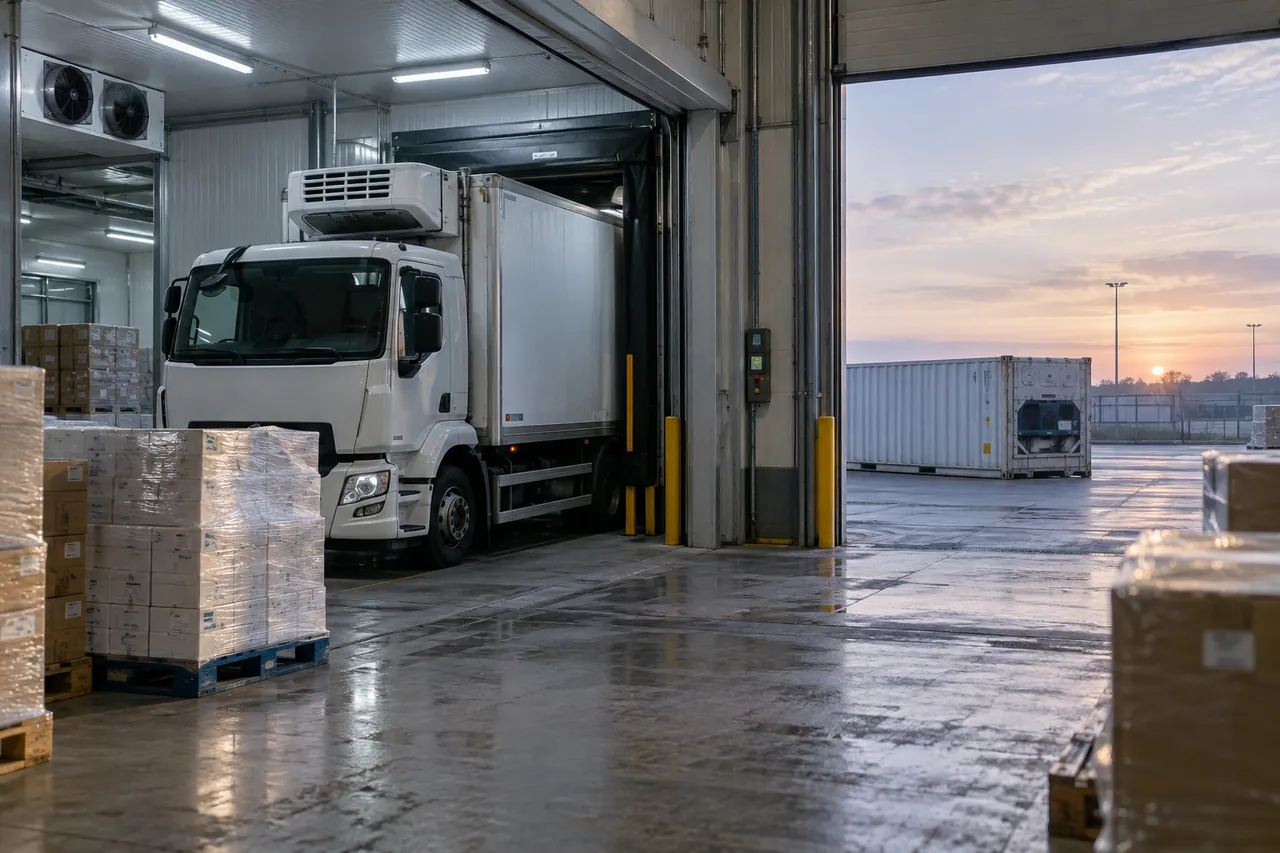
On the road, reefer containers move on chassis with a clip-on or underslung generator set. For distribution within a city, cargo is usually transferred into reefer trucks or vans fitted with truck refrigeration units, which handle many door openings better.
How to load reefer cargo correctly
Most temperature claims on reefer cargo are caused by loading, not unit failure. Follow these rules:
- Pre-cool the cargo to carriage temperature in a cold store before stuffing. Do not pre-cool the container itself with the doors open at a warm dock – warm, humid air condenses inside.
- Set the right temperature and fresh-air vent setting for the product, as written on the booking and the container controller.
- Keep air paths open: do not cover the T-floor beyond the end of the cargo; fill gaps at the door end with an air-tight board or leave the floor open as the shipping line specifies.
- Stay below the load line and keep a gap between the cargo and the rear doors.
- Use ventilated cartons and pallets for fresh produce so air can pass through; use tight, block stows for frozen cargo, where air only needs to flow around the outside.
- Load fast from a chilled dock and close the doors as soon as possible.
- Add an independent data logger inside the load as proof of the temperature history.
Frozen cargo is usually carried at −18 °C to −25 °C (0 °F to −13 °F). Chilled meat travels close to −1 °C (30 °F), while bananas need about +13 °C to +14 °C (55–57 °F) – a reminder that ‘colder’ is not always safer.
Our cold chain logistics guide covers temperature ranges and monitoring across the whole chain.
Refrigerated storage containers vs panel cold rooms
Refrigerated storage containers – often sold as container freezers, shipping container coolers or portable cold storage containers – are popular because they arrive ready to plug in. But they are not the only way to get portable or fast cold storage. Compare the options:
| Option | Strengths | Limitations |
|---|---|---|
| Used reefer container | Ready to run, movable, lockable, weatherproof | Fixed size, three-phase power, internal width only 2.29 m, ageing units |
| Insulated container + condensing unit | Standard power options, reliable separate unit | Still a narrow box with one end door |
| Panel walk-in cold room kit | Any size, any door position, 75–200 mm panels, easy to extend | Needs a level floor, shelter or roof for outdoor use, assembly |
| Panel room built inside a container | Movable, choose insulation and refrigeration | More labour than a used reefer |
A container suits temporary storage, sites without a building, or goods that must move with you. A panel cold room suits anything permanent: it can be wider than 2.29 m, have side doors and shelving, run on single-phase power when small, and use a quieter condensing unit placed where its heat does no harm.
Be There walk-in cooler and freezer kits use cam-lock PU/PIR panels, so they can be dismantled and moved later – a practical portable walk-in cooler for businesses that might relocate.
Reefer container for sale: price, rental and inspection
Refrigerated container prices depend on size, age, unit condition and location, and move with global shipping markets. As a typical 2026 guide in the US market:
- New 20 ft and 40 ft high-cube reefers: commonly listed at roughly US$25,000–45,000.
- Used reefers: much cheaper, with the price driven mainly by the year of manufacture and the condition of the refrigeration unit. Ex-fleet units are often 10–15 years old.
- Rental: about US$800–1,500 per four weeks for standard 20 ft and 40 ft units, more for blast and super-freezer units, plus delivery.
Before you buy a refrigerated container, check:
- A pre-trip inspection (PTI) report less than a few months old.
- Pull-down test: the unit reaches your set point within the time the seller states.
- Refrigerant type and whether it is still serviceable in your country.
- Door seals, floor T-bars and inner lining free from damage; no wet or swollen insulation.
- Power plug and voltage that match your site.
- Controller data download working.
Freight and duty can be significant if the container is not already near you. For a fixed site, compare the landed cost of a used reefer with a new panel cold room of the same volume – the room is often similar in price and far more flexible.
Reefer cargo vans and portable refrigeration for smaller loads
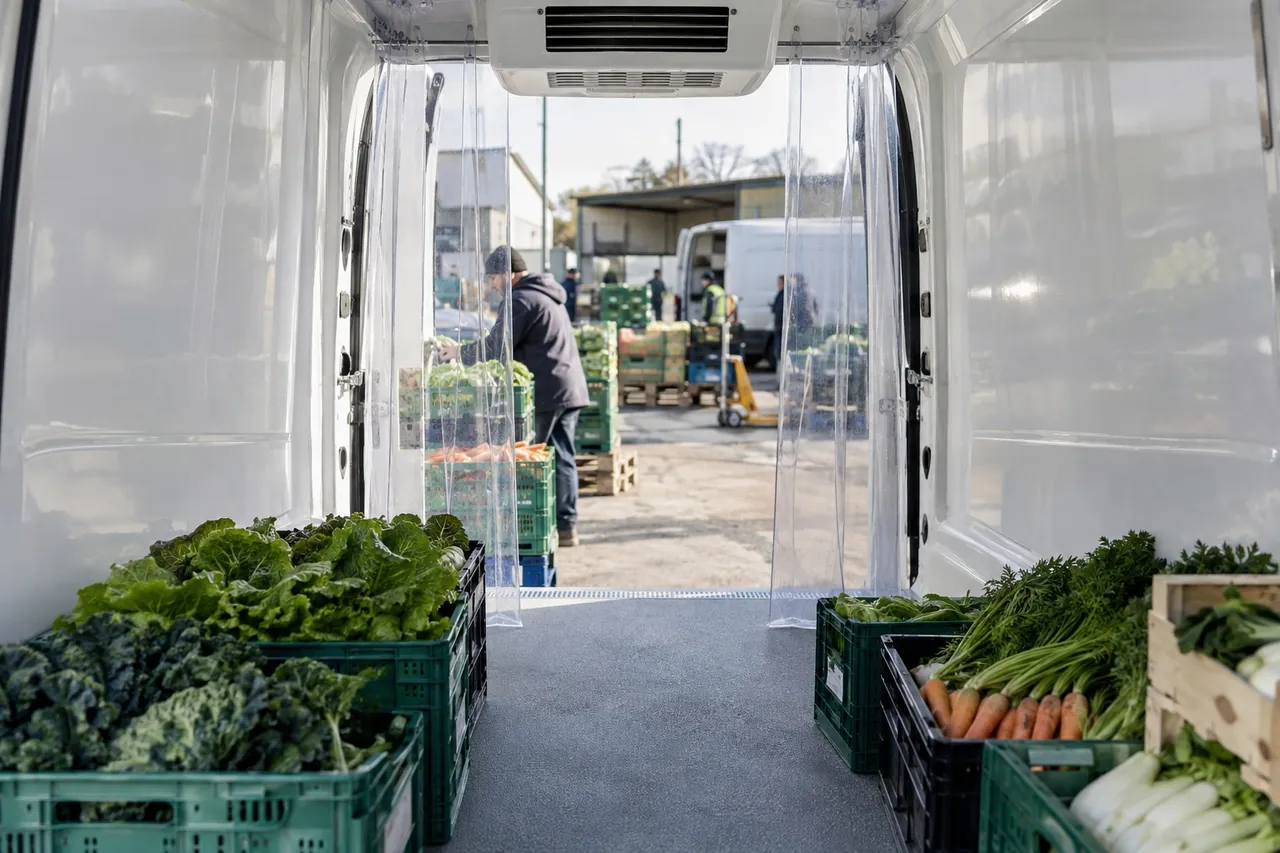
If you search for a reefer cargo van for sale, you are looking for a different product: a van with an insulated box and a transport refrigeration unit, not a shipping container. Vans carry 4–15 m³ (140–530 ft³) for local deliveries of food, flowers and medicines, with many door openings a day.
- Refrigerated vans and trucks use engine-driven, independent diesel or electric units. Be There supplies truck and van refrigeration units for 4–45 m³ boxes holding −20 °C to +15 °C (−4 °F to 59 °F).
- Converting your own van: insulate the box, fit a matched unit and seal the doors – see our refrigerated van conversion guide.
- Portable cold box: insulated boxes with ice packs, phase-change plates or a small compressor, good for last-mile deliveries or samples.
Portable refrigeration storage choices therefore run from a cool box, to a van, to a container, to a permanent cold room. Pick the smallest option that holds your peak volume at the right temperature with an acceptable number of door openings.
How to choose: 20 ft reefer, 40 ft reefer or a cold room?
- Shipping dense frozen cargo, under about 25 t: a 20 ft reefer container is often the most economical.
- Shipping light or bulky cargo: a 40ft reefer high-cube gives about 67 m³, while a standard-height 40 ft refrigerated container gives about 60 m³ and the lowest cost per pallet.
- Short-term storage on site: rent a reefer and check the power supply first.
- Long-term storage on site: price a panel cold room of the same volume; you gain width, doors where you want them and easier power.
- Local deliveries: a reefer van or truck, not a container.
Tell us your volume, temperature and site power, and we will propose a cold room kit or a truck unit. Request a quotation – we quote FOB, CIF or DDP and reply within one working day.