




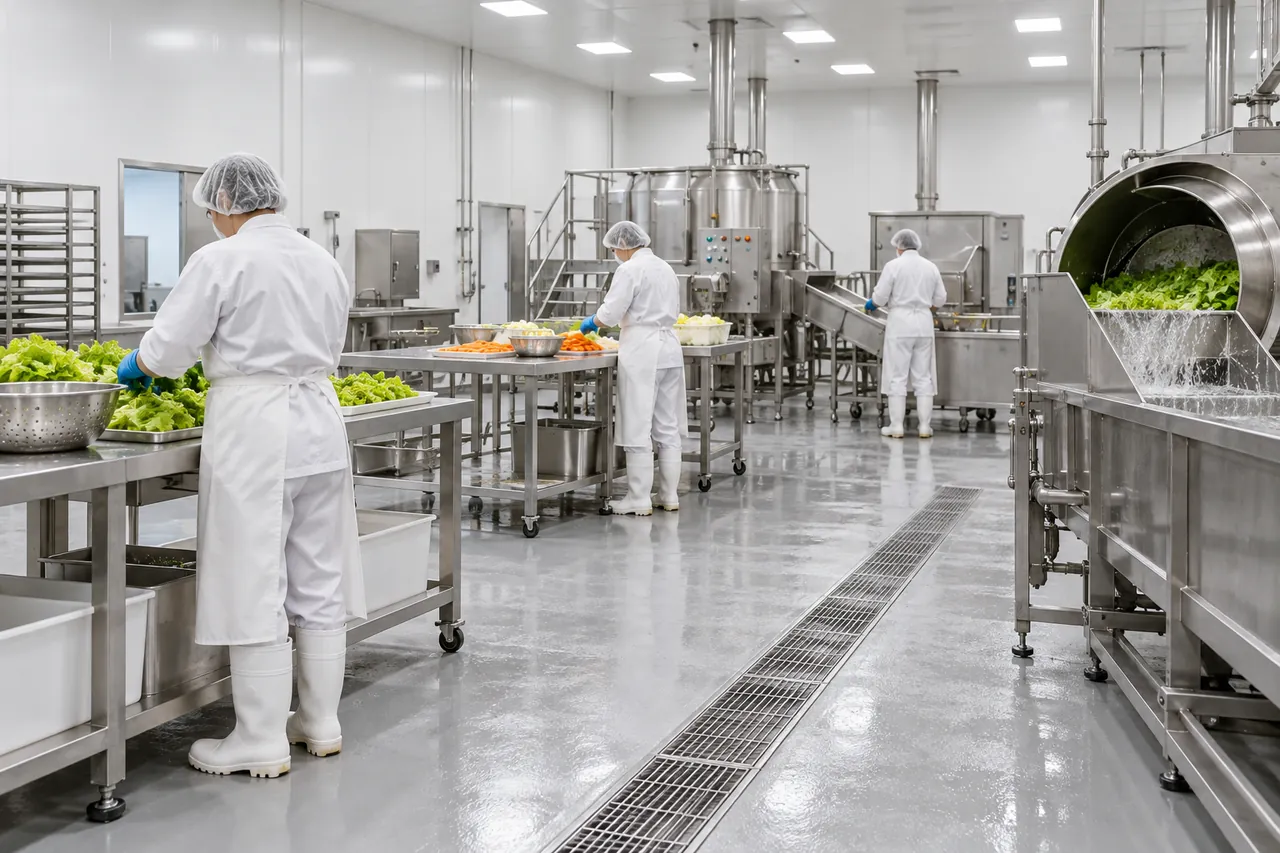
Short answer
FRP panels are 2.3 mm (0.09 in) fibreglass-reinforced plastic sheets glued over a wall, PVC wall panels are hollow 8–10 mm planks or solid 2.5–10 mm hygienic sheets, and stainless sheet is 0.8–1.5 mm. All three are coverings without insulation. For cold rooms and chilled food plants, 75–150 mm PU/PIR sandwich panels with food-safe faces form the wall and insulation in one.
Key takeaways
- FRP panels are typically 2.3 mm (0.09 in) thick in 1.22 × 2.44 m or 1.22 × 3.05 m (4 × 8 or 4 × 10 ft) sheets.
- PVC softens at about 60 °C (140 °F), so keep it away from fryers and ovens, where 304 stainless is used.
- Use 316 stainless in fish, brine and chloride-heavy washdown areas; 304 suits most kitchens.
- The FDA Food Code and EU Regulation 852/2004 both require food-area walls to be smooth, non-absorbent and washable.
- PU/PIR sandwich panels 75–100 mm thick suit chillers and 120–150 mm suit −18 °C to −25 °C freezers.
- Cove wall-floor junctions with a 25–50 mm (1–2 in) radius and seal every joint with food-grade silicone.
What are hygienic wall panels?
Hygienic wall panels are smooth, non-absorbent, washable wall linings used wherever food is prepared or stored, or where walls are hosed down: commercial kitchens, food processing plants, cold rooms, washrooms and laboratories. The main options are FRP panels (fibreglass-reinforced plastic sheet), PVC wall panels, stainless steel sheet, and insulated sandwich panels with food-safe coated steel or stainless faces.
The rule they all serve is the same. The FDA Food Code requires floors, walls and ceilings in food areas to be smooth, durable, easily cleanable and non-absorbent, and EU Regulation (EC) No 852/2004 requires wall surfaces to be impervious, non-absorbent, washable and non-toxic. Painted plasterboard and bare block fail those tests; the materials below pass them in different ways, at different costs and with different weak points.
The important split is between wall coverings (FRP, PVC and stainless sheets glued or fixed over an existing wall) and wall systems (insulated sandwich panels that are the wall). If you are lining an existing kitchen, a covering is enough. If you are building a cold room, a processing hall or a new partition, a panel system usually costs less overall.
What are FRP wall panels?
FRP wall panels are thin sheets of polyester resin reinforced with glass fibres, typically 2.3 mm (0.09 in) thick and sold in 1.22 × 2.44 m or 1.22 × 3.05 m (4 × 8 ft or 4 × 10 ft) sheets, usually with a pebbled surface. They are glued to plasterboard, plywood or block with FRP adhesive and joined with plastic H-mouldings and corner trims.
FRP is the classic low-cost commercial kitchen wall panel in North America: cheap, tough enough for mop buckets and trolleys, and accepted by most food inspectors for walls in kitchens, back-of-house corridors, washrooms and dish areas. Fiberglass wall panels and FRP wall covering are the same product under other names.
FRP limits
- Joints: plastic mouldings leave gaps where moisture and dirt collect; they are the first thing auditors look at.
- Fire: standard FRP is typically Class C under ASTM E84; fire-rated Class A grades exist and are often required in commercial buildings. Check local code.
- Substrate: FRP is only as good as the wall behind it; plasterboard that gets wet behind the sheet will rot and grow mould.
- No insulation: FRP adds no thermal value, so it cannot make a cold room.
- Pebbled texture: hides scratches but is slightly harder to wipe clean than a smooth face. Food grade FRP and smooth FRP are available for stricter areas.
PVC wall panels: hollow cladding vs solid hygienic sheet
PVC wall panels come in two very different forms: hollow, interlocking extruded planks about 8–10 mm thick and 250–400 mm wide, sold mainly for bathrooms and showers, and solid PVC hygienic sheet about 2.5–10 mm thick, bonded to the wall with heat-welded or capped joints for kitchens and food plants.
Hollow PVC panels for bathrooms
PVC wall panels for bathrooms are the hollow interlocking type. They are light, fully waterproof, quick to fit with adhesive or clips, and need no grout, which is why waterproof PVC wall panels for bathroom and shower refits are popular. Most are 2.4–2.7 m (8–9 ft) long. They suit washrooms, changing rooms and staff showers. For heavy food production they are less suitable: the thin face dents, and the tongue-and-groove joints can trap moisture.
Solid PVC hygienic cladding
Solid PVC sheet is the European standard for food grade wall covering in kitchens, butcheries and hospitals. Sheets of about 1.22 × 2.44–3.05 m are bonded fully to the substrate, and joints are either hot-air welded with a PVC rod or sealed with a capping strip and food-safe sealant, giving a near-seamless surface. Coved skirtings in the same material close the wall-floor joint.
PVC limits
- Heat: PVC softens at about 60 °C (140 °F), so keep it away from fryers, ovens and steam outlets, where stainless steel belongs.
- Cold: PVC becomes more brittle below about 0 °C (32 °F), so check the supplier's rating before using thin PVC inside freezers.
- Expansion: PVC expands roughly five times as much as steel per degree, so long runs need the specified expansion gaps.
- Fire and smoke: PVC is self-extinguishing but gives off dense smoke; check fire classification for escape routes.
Stainless steel wall panels
Stainless steel wall panels are sheets of 304 or 316 stainless, usually 0.8–1.5 mm thick, fixed behind cooking lines, sinks and dishwashers and in wet processing areas where heat, grease and chemicals rule out plastics. They are the most durable and hygienic covering and also the most expensive, typically several times the cost of FRP per m².
- 304 stainless suits most kitchens and dry food areas.
- 316 stainless resists chlorides and salt; use it in fish processing, brine areas and where chlorinated cleaners are used daily.
- Bond sheets to a flat, rigid substrate (cement board or plywood) so they do not drum, and seal joints with food-grade silicone or use welded seams in critical zones.
- A brushed (No. 4) finish hides scratches; mirror finish shows every mark.
FRP vs PVC vs stainless vs insulated sandwich panels
FRP is the cheapest covering, solid PVC is the most hygienic plastic, stainless is the toughest, and an insulated sandwich panel is the only option that is both the wall and the insulation.
| Factor | FRP sheet | Hollow PVC panel | Solid PVC hygienic sheet | Stainless steel sheet | PU/PIR sandwich panel |
|---|---|---|---|---|---|
| Typical thickness | 2.3 mm (0.09 in) | 8–10 mm | 2.5–10 mm | 0.8–1.5 mm | 50–200 mm |
| Needs a substrate wall | Yes | Yes (or battens) | Yes | Yes | No, self-supporting |
| Joints | Plastic mouldings | Interlocking | Welded or capped | Sealed or welded | Cam-lock or tongue-and-groove, sealed |
| Max surface temperature, approx. | About 70–80 °C | About 60 °C | About 60 °C | Very high | About 70–80 °C (coated steel) |
| Impact resistance | Good | Low | Good | Very good | Good (steel dents) |
| Insulation | None | None | None | None | About R-24 to R-26 at 100 mm |
| Relative cost per m² (indicative) | Low | Low | Medium | High | Medium, but replaces the wall |
| Best use | Kitchen and back-of-house linings | Bathrooms, showers, washrooms | Food prep, butcheries, hospitals | Cooking lines, wet processing | Cold rooms, processing halls, new partitions |
Costs depend on market, grade and installation; treat the column as a relative guide only. Temperatures are typical service limits for the face material; always use the supplier's figures.
Insulated sandwich panels as hygienic walls
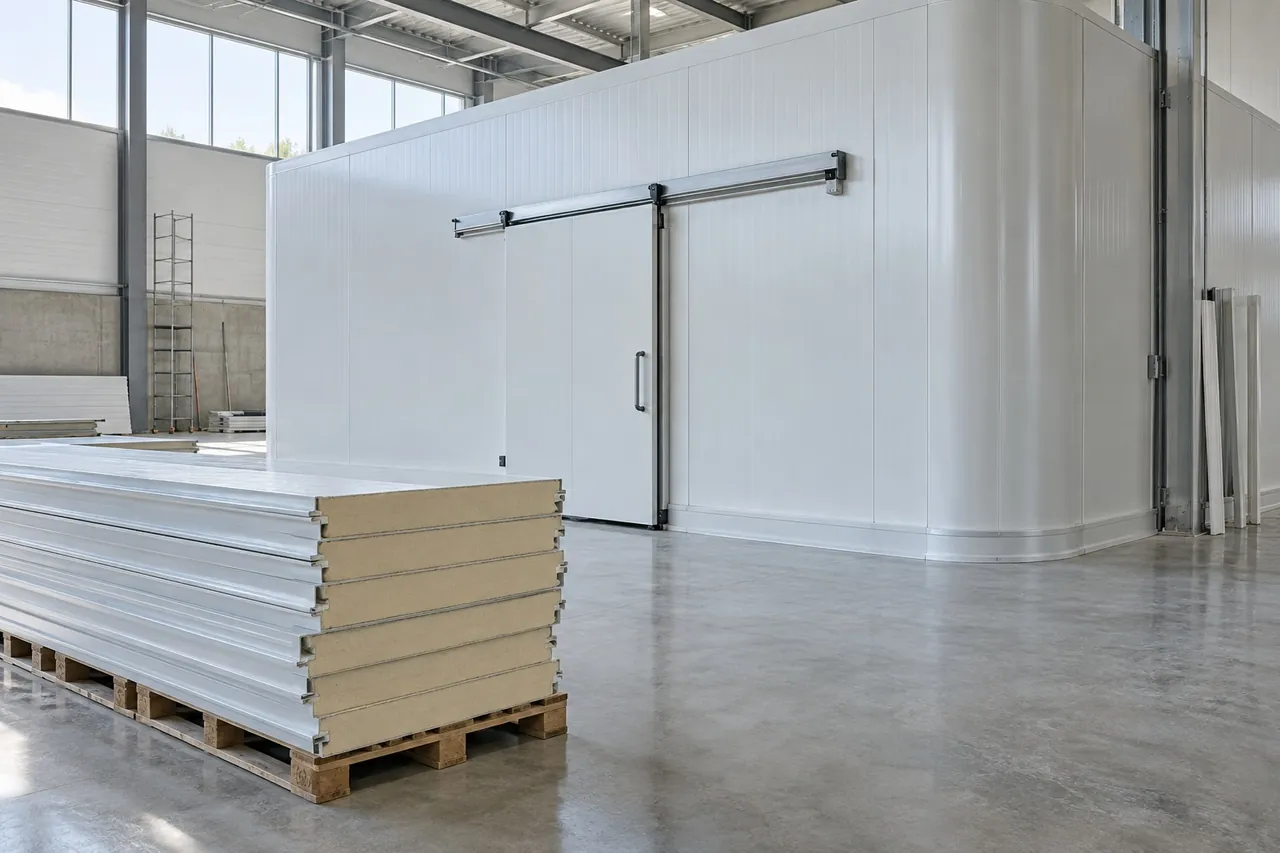
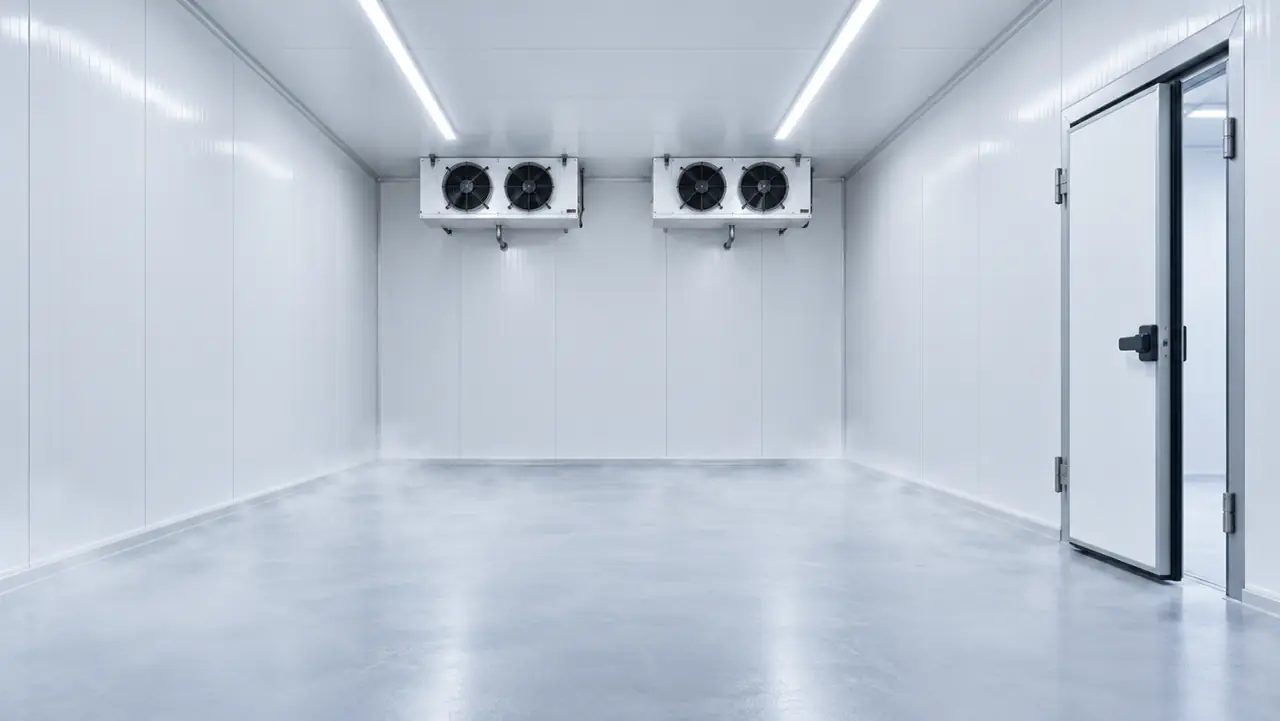
Insulated sandwich panels for food plants have a PU or PIR foam core between two steel skins with a food-safe coating, PVC film laminate or stainless face, so a single panel gives a smooth, washable wall and insulation. They are standard for cold rooms, chilled processing halls, meat and dairy plants and packing houses.
- Facings: food-safe polyester or PVDF coated steel for general use; PVC film-laminated steel for aggressive cleaning; 304 stainless for wet and high-hygiene zones.
- Joints: tight cam-lock or tongue-and-groove joints sealed with food-grade silicone on the inside face, so there are far fewer joints than with 1.22 m sheets.
- Corners: coved internal corners and wall-floor coving remove the 90° angles where dirt collects.
- Insulation: 75–100 mm (3–4 in) for chillers and processing rooms, 120–150 mm (5–6 in) for freezers; see our cold room panel thickness guide.
- No hidden substrate: nothing behind the face can rot or grow mould, unlike FRP or PVC glued to plasterboard.
Panels also make up the room itself: a walk-in or processing room can be built in days from floor, wall and ceiling panels. Our walk-in cold room build guide shows the sequence, and for controlled environments the cleanroom panels guide covers flush-jointed systems. The insulated wall panels guide gives general wall-system detail.
Which wall panel should you use in each room?
Match the wall material to temperature, heat sources, cleaning regime and whether the room needs insulation.
| Area | Conditions | Recommended wall |
|---|---|---|
| Restaurant kitchen, general walls | Warm, splashes, daily cleaning | FRP or solid PVC over cement board; stainless behind cooking line |
| Cooking line, fryers, ovens | Heat, grease | Stainless steel 304 |
| Dishwash and pot wash | Hot water, steam, chemicals | Stainless steel, or solid PVC away from steam outlets |
| Staff showers and washrooms | Water, humidity | Hollow PVC panels, FRP or tiles |
| Walk-in cooler 0 °C to +5 °C | Cold, humid | PU/PIR sandwich panels 75–100 mm |
| Walk-in freezer −18 °C to −25 °C | Frozen | PU/PIR sandwich panels 120–150 mm, insulated floor |
| Meat, fish or dairy processing hall | Chilled, wet, high-pressure cleaning | Sandwich panels with PVC film or stainless faces, coved corners |
| Dry goods store, packing area | Ambient | Coated-steel sandwich panels or FRP |
For an overview of the cold equipment a kitchen needs alongside its walls, see our restaurant refrigeration equipment list; for chilled stores of meat and produce, produce and meat coolers covers temperatures and humidity.
Installation details that decide hygiene
A hygienic wall fails at its joints, edges and penetrations long before the panel face wears out, so the details below matter more than the material choice.
- Seal every joint with food-grade, mould-resistant silicone or welded seams; no open mouldings in wet zones.
- Cove the wall-floor junction with a radius of about 25–50 mm (1–2 in) so floors can be squeegeed clean.
- Seal all penetrations for pipes, cables and switches with sleeves and sealant on both faces.
- Protect lower walls with stainless kick plates or bump rails where trolleys and pallet trucks run.
- Keep substrates dry: fix FRP and PVC only to moisture-resistant boards, never to standard plasterboard in wet areas.
- Check cleaning chemicals against the face material; strong chlorinated or caustic cleaners attack some coatings and plastics.
How to choose hygienic wall panels: checklist
Choose by asking, in order: does the room need insulation, how hot does the wall get, how is it cleaned, and is it new construction or a lining?
- Insulation needed (cold room, chilled processing): PU/PIR sandwich panels with food-safe faces.
- Lining an existing kitchen wall: FRP for budget, solid PVC for higher hygiene, stainless near heat.
- Showers and washrooms: hollow PVC panels or FRP.
- High-pressure washdown: stainless or PVC-film-laminated sandwich panels with sealed joints and coving.
- Fire rules: confirm the fire classification of FRP, PVC and panel cores for your building.
- Inspection: ask your local food authority what it accepts before you order.
Be There does not sell FRP sheets, PVC cladding or loose stainless wall sheets. We supply PU and PIR insulated sandwich panels with food-safe coated steel, stainless or aluminium faces, 50–200 mm thick, for cold rooms, processing rooms and hygienic partitions, and complete walk-in cooler and freezer kits with coving, trims and sealant. Send your room layout, temperatures and cleaning regime through the inquiry form and we will quote FOB, CIF or DDP.