
Short answer
Cold storage doors are insulated, sealed doors for chillers, freezers and refrigerated warehouses. Busy openings use high speed roll up doors that open at about 1–2.5 m/s and close within seconds; freezers also use 100–150 mm insulated sliding doors with heated frames. A fully open 2.4 × 3 m door to a −25 °C freezer can admit around 400 kW of heat.
Key takeaways
- A fully open, unprotected 2.4 × 3 m (8 × 10 ft) doorway between a 30 °C dock and a −25 °C freezer admits heat on the order of 400 kW.
- High speed roll up doors open at about 1–2.5 m/s and close within seconds, cutting open time per pass several times.
- Insulated sliding cold store doors use 100–150 mm (4–6 in) PU panels, with heated frames on freezers.
- Freezer strip curtains should use low-temperature PVC strips 200–300 mm wide, 2–3 mm thick, overlapping 30–50%.
- A chilled dock at +2 °C to +10 °C (36–50 °F) reduces frost and fog at freezer doors.
- Standard storage containers with roll up doors are uninsulated; cold storage needs a reefer container or an insulated panel room.
What are cold storage doors?
Cold storage doors are the insulated, sealed openings that let people, pallets and forklifts move in and out of chillers, freezers and refrigerated warehouses while keeping warm, humid air out. The main types for warehouse-scale openings are insulated sliding doors, high speed roll up doors, insulated sectional dock doors, and secondary protection such as strip curtains, air curtains and anterooms.
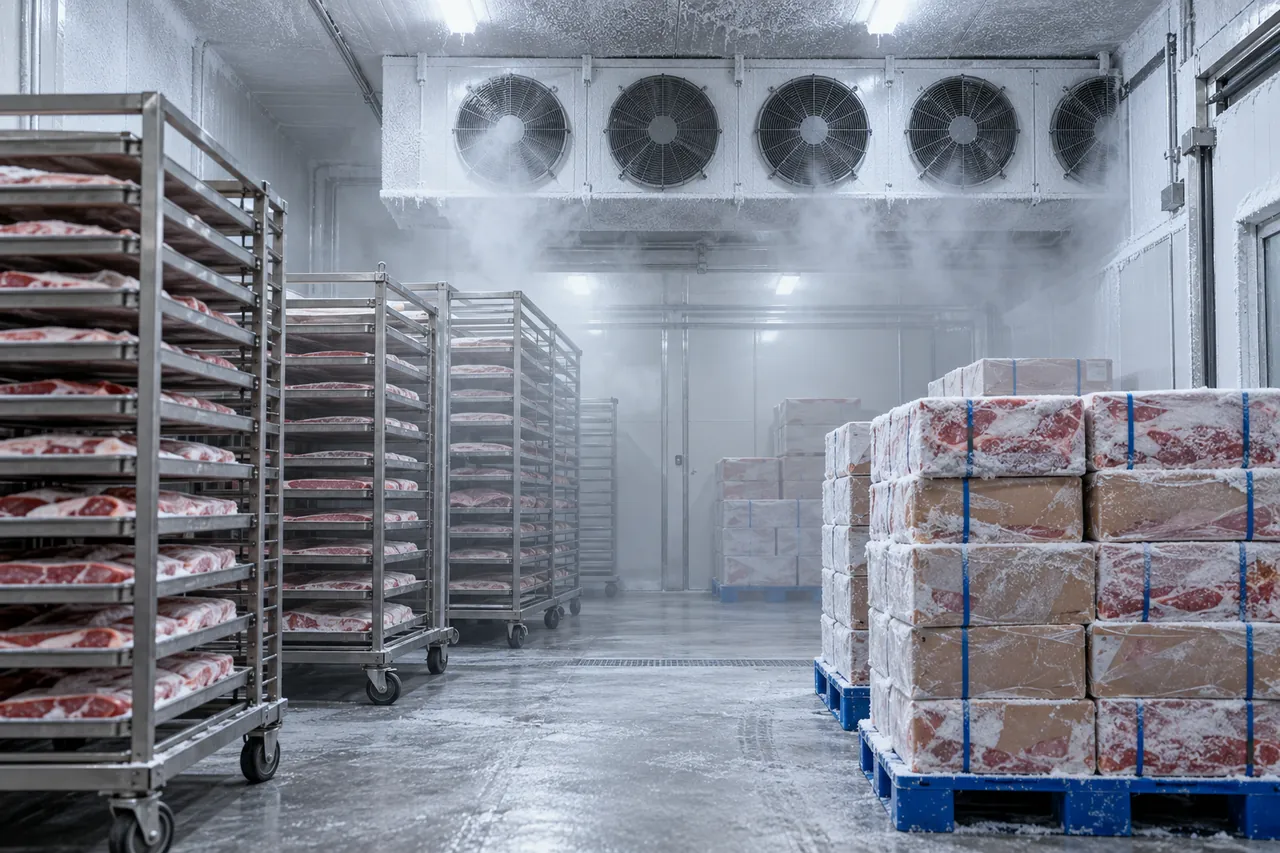
The door is usually the largest single source of uncontrolled heat and moisture entering a cold store. Every time it opens, dense cold air pours out along the floor and warm air flows in at the top, carrying moisture that ends up as frost on evaporators, ice on floors and fog at the doorway. Choosing the right door, and how it is protected and operated, has a direct effect on refrigeration capacity, defrost frequency, floor safety and energy bills. Small walk-in coolers have their own guide: see walk-in cooler doors for hinged, glass and small sliding doors. This guide covers the larger doors used in distribution centres, food plants and cold stores.
How much heat enters through an open cold store door?
A lot. Using the ASHRAE doorway infiltration method (the Gosney–Olama equation), a fully open 2.4 × 3 m (8 × 10 ft) doorway between a 30 °C (86 °F), humid dock and a −25 °C (−13 °F) freezer lets in heat on the order of 400 kW while it stands open with no protection. Most of that is moisture and air that the refrigeration must later remove.
That figure only applies while the door is fully open, but it shows why open time matters more than almost anything else. If such a door is open a total of one hour a day, it adds roughly the same energy as a 15–20 kW refrigeration load running all day. The flow rate rises with door height (roughly with the square root of height) and with the temperature difference, so tall freezer doors to warm docks are the worst case.
| Measure | What it changes | Typical effect |
|---|---|---|
| Faster opening and closing | Time the opening is fully or partly open per passage | A high-speed door open 5–10 s per pass versus 20–40 s for a standard powered door cuts infiltration per pass several times |
| Strip curtain | Blocks most airflow when traffic is not passing | Large reduction when strips are complete and overlapping; poor when strips are torn or tied back |
| Air curtain | Downward air jet across the opening | Moderate to large reduction when correctly set; falls with wind, pressure imbalance and traffic blocking the jet |
| Chilled dock or anteroom | Reduces temperature and humidity difference at the freezer door | Freezer door sees a +2 °C to +10 °C space instead of a 30 °C dock; less frost and fog |
| Dock seals and shelters | Seals the trailer to the building | Stops outdoor air entering during loading |
To size refrigeration with door loads included, use the cold room refrigeration load calculator, and for warehouse layouts see cold storage warehouse construction.
What are high speed doors and when should you use them?
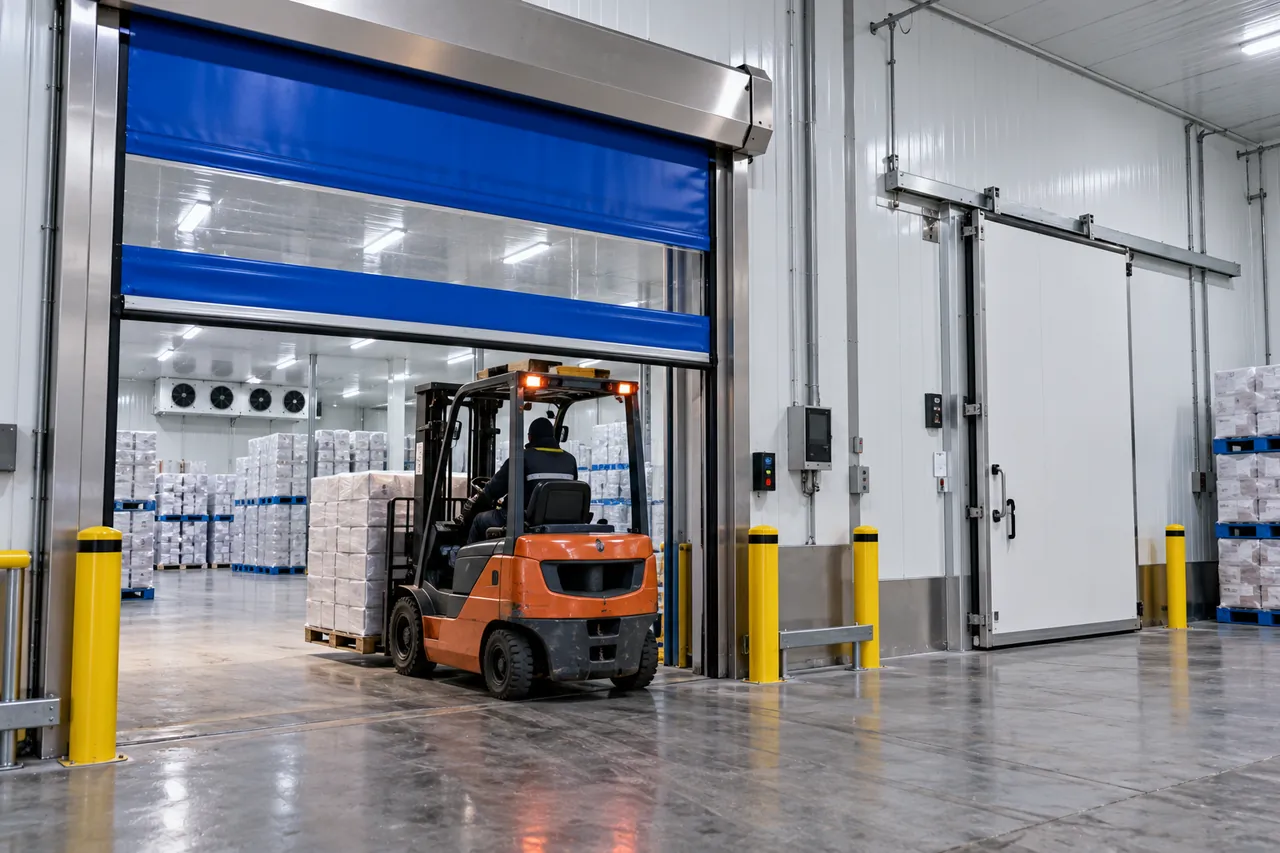
High speed doors, also called rapid roll doors, are fabric or flexible-panel doors that roll up into a head drum at about 1–2.5 m/s (3–8 ft/s) and close again automatically within seconds, triggered by radar, induction loops or pull cords. They are used wherever forklifts pass many times an hour, because they minimise open time without slowing traffic.
Types of high speed roll up doors
- Single-skin PVC fabric doors: for chillers, internal openings between temperature zones, and dock-to-chill-room openings. They seal against draughts but add little insulation.
- Insulated freezer high-speed doors: an insulated curtain or a spiral of insulated slats, with heated side guides, heated bottom edge and sometimes warm-air de-icing so the door does not freeze in its tracks at −20 °C to −30 °C.
- Self-repairing (breakaway) doors: the curtain pops out of its guides if a forklift hits it and re-inserts on the next cycle, avoiding downtime.
- Spiral high-speed doors: rigid slats coil into a spiral without touching, giving higher wind resistance and security for external openings.
Speed brings safety requirements. In Europe, industrial doors fall under EN 13241, with safety-related requirements including force limits and safety edges; light curtains or photocells across the opening stop and reverse the door when anything is in its path. Ask for the door's rated cycles per day, opening and closing speed, wind class, motor duty and the safety devices included.
When are insulated sliding cold store doors the better choice?
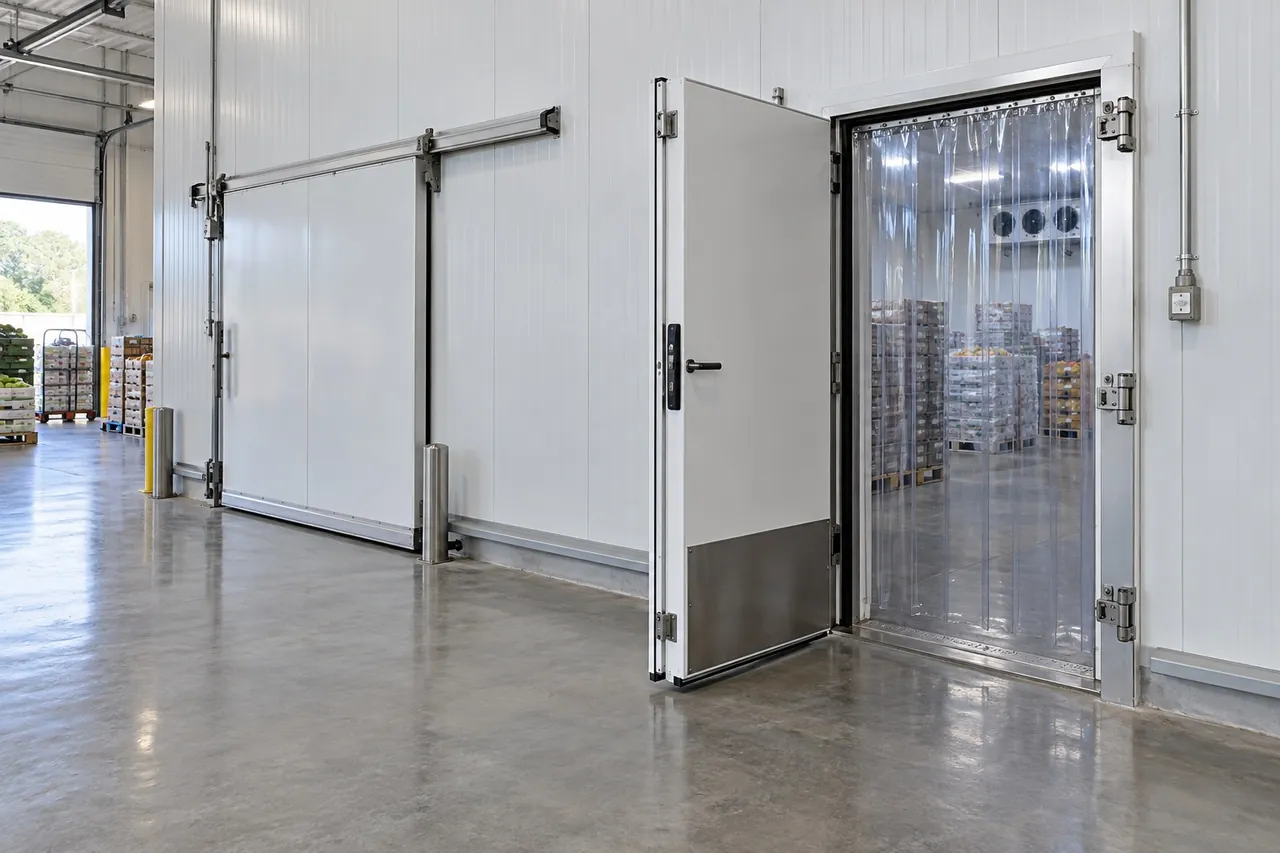
Insulated sliding doors are the best choice when the door must hold the full insulation value of the wall, especially on freezers, and when openings are used tens of times a day rather than continuously. A typical sliding cold store door has a 100–150 mm (4–6 in) PU panel, a perimeter gasket that presses against the frame as the door closes, and, on freezers, a heated frame.
- Sizes for pallet traffic typically run from about 1.5 × 2 m to 3 × 4 m (5 × 6.5 ft to 10 × 13 ft), and larger on request.
- Manual doors suit occasional pallet-truck use; powered doors with pull cords, radar or loop detectors suit forklift traffic.
- Freezer versions use frame heaters to stop the gasket freezing to the frame and, often, a heated threshold.
- All personnel-accessible cold store doors need a release that opens the door from inside, and an emergency light and alarm button inside the room.
The best practice in busy freezers is to fit both: an insulated sliding door that is closed overnight and at weekends, and a high-speed door in the same opening that handles traffic during working hours. Panel thickness for the door should match the wall; see cold room panel thickness.
Which cold storage door type fits which opening?
Match the door to temperature, traffic frequency and opening size. The table summarises typical ranges for the main types.
| Door type | Insulation | Opening speed | Typical size range | Best for |
|---|---|---|---|---|
| Hinged insulated door | 75–150 mm PU | Manual | 0.8–1.2 m wide | Personnel and trolley doors, walk-ins |
| Insulated sliding door, manual or powered | 100–150 mm PU; heated frame on freezers | Powered about 0.3–0.5 m/s | 1.5–4 m wide, 2–5 m high | Main doors of chillers and freezers, overnight closure |
| High-speed fabric roll-up door | None to light | About 1–2.5 m/s | Up to about 5 × 5 m | Chill-zone and internal openings with heavy forklift traffic |
| Insulated high-speed freezer door | Insulated curtain or slats; heated guides | About 1–2 m/s | Up to about 4 × 5 m | Busy freezer openings, −20 °C to −30 °C |
| Insulated sectional overhead dock door | 40–80 mm PU panels | About 0.2–0.3 m/s | About 2.4–3.0 m wide, 2.7–3.2 m high | Loading docks with dock levellers and shelters |
| Strip curtain | None | Passive | Any | Secondary protection behind any door |
| Air curtain | None | Passive | Doorways to about 4 m high | Secondary protection where strips obstruct traffic |
Speeds and sizes are typical; individual products vary. For blast freezer rooms with very cold air, see blast freezer room design, where door heaters and anterooms are essential.
How should loading dock doors for cold storage be set up?
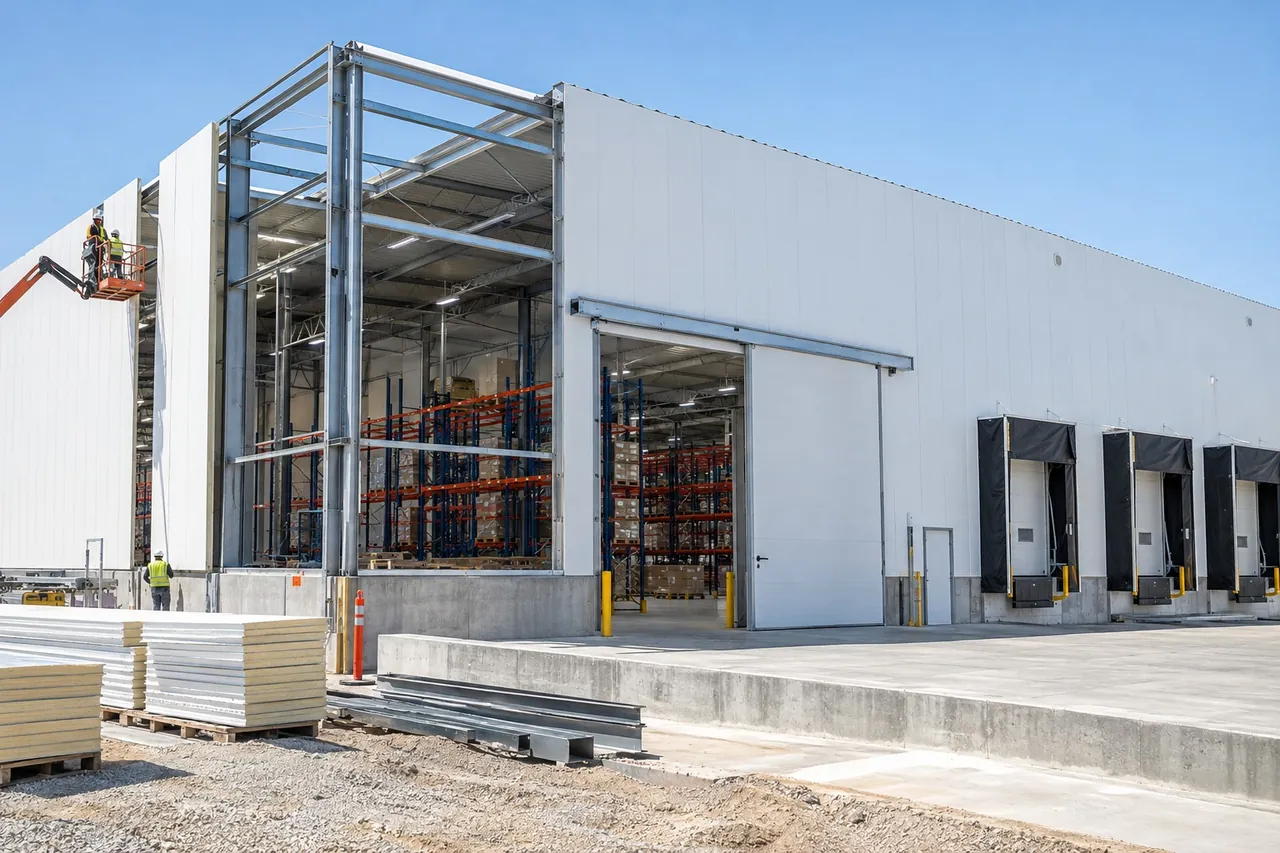
A cold storage loading dock should be enclosed and kept chilled, with insulated sectional doors, dock levellers and inflatable or foam dock seals so trucks load directly from the building into the trailer without outdoor air entering. The dock then acts as a buffer between the outdoors and the cold rooms.
- Keep the dock at about +2 °C to +10 °C (36–50 °F) with low humidity so chilled product stays in temperature and the freezer doors see a small temperature difference.
- Fit insulated sectional doors with perimeter seals; keep them closed when no trailer is docked.
- Use dock seals or shelters sized to the trailer fleet so the gap around the trailer is closed.
- Install insulated dock levellers or leveller pits with seals; an uninsulated pit leaks air and condensate.
- Place high-speed doors between the dock and each cold room, with strip curtains or an air curtain as secondary protection.
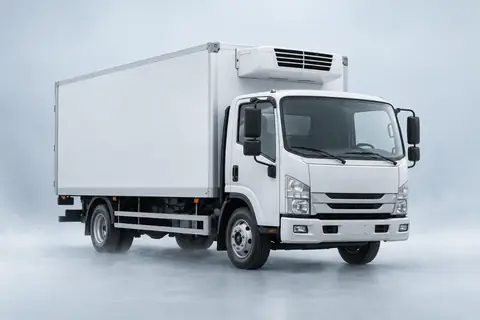
- Pre-cool trailers before loading, and keep reefer units off with the doors open to avoid icing the unit's coil.
Do air curtains and strip curtains work on cold rooms?
Yes, both work when correctly installed and maintained. A strip curtain gives the most reliable reduction in infiltration for the least cost; an air curtain keeps the opening clear for traffic but needs careful set-up and loses effectiveness with wind or pressure imbalance.
Strip curtains
- Use PVC strips about 200–300 mm (8–12 in) wide and 2–3 mm thick, overlapping by 30–50% of their width.
- Use low-temperature ("polar") PVC for freezers so strips stay flexible down to about −40 °C; standard PVC turns stiff and cracks.
- Replace torn, missing or yellowed strips; a curtain with gaps or strips tied back is barely better than none.
Air curtains
A cold store air curtain blows a jet of air downward across the doorway, separating the two air masses. Correct jet velocity, angle and width over the full opening are essential, and the door should not see strong wind or building pressure differences. In supermarkets, "air curtain" more often means the cold air jet that keeps doorless display cases cold; a commercial air curtain refrigerator or multideck uses the same principle on a smaller scale, as explained in the open air cooler guide.
Can a shipping container with a roll up door be used as cold storage?
A standard shipping container with roll up door is a dry storage unit: it is a steel box with no insulation, and the roll-up door has no thermal seal, so it cannot hold chilled or frozen temperatures. For cold storage, use a reefer container with its built-in refrigeration and insulated swing doors, or build an insulated panel cold room inside a building or container.
- Storage containers with roll-up doors, sometimes called conex boxes with roll-up doors (conex is a genericised term for a steel shipping container), are popular for site storage and self-storage because roll-up doors save swing space.
- A roll up door insulation blanket or foil-faced kit can reduce heat gain through a garage or container roll-up door in hot weather, but adds only modest R-value and does not seal air leaks, so it is not suitable for food cold storage.
- A reefer container holds about −30 °C to +30 °C (−22 °F to 86 °F) and is the practical portable option; see reefer containers as cold storage.
What hardware should a commercial freezer door have?
A commercial freezer door needs a heated frame and threshold, a full perimeter gasket, self-closing hinges or a closing sliding track, a lockable handle with an inside safety release, a heated pressure relief port on the room, and kick plates or impact protection where forklifts work.
- Commercial freezer door handle: lever or pull handle with a cam latch that draws the door tight against the gasket, a padlock hasp, and an inside push-release so nobody can be trapped.
- Gasket: magnetic or compression gasket, inspected weekly and replaced when torn or flattened.
- Heaters: frame and threshold heaters on all freezer doors; check they work at the start of each cold season.
- Protection: stainless kick plates, bump guards and floor-mounted bollards on both sides of busy openings.
- Viewing window and lighting: a heated window reduces collisions at busy doors.
How to choose cold storage doors: checklist
- List each opening: temperature on both sides, traffic type (people, pallet trucks, forklifts) and passes per hour.
- Above roughly 10–20 forklift passes an hour, fit a high-speed door; on freezers, choose an insulated, heated high-speed model.
- Add an insulated sliding door for overnight closure on freezers and main chiller openings.
- Enclose and chill the loading dock; specify insulated sectional doors, sealed levellers and dock seals.
- Add strip curtains or air curtains as secondary protection, and plan for maintaining them.
- Confirm heaters, inside release, safety sensors and compliance with standards such as EN 13241 where applicable.
- Include door infiltration in the refrigeration load and defrost design.
Be There supplies complete walk-in coolers, freezers and cold rooms with hinged or sliding insulated doors, heated frames for freezers, matched refrigeration and controllers, and PU/PIR cold room panels of 50–200 mm for larger stores. Send your room sizes, temperatures, door openings and traffic through the inquiry form and we will quote FOB, CIF or DDP, including the door options that suit your layout.