
Short answer
A snow flake ice making machine freezes sweetened milk, juice, tea or coffee onto a refrigerated drum at well below −20 °C (−4 °F) and shaves it into soft ribbons for bingsu and snow ice desserts. Commercial units make about 120–240 kg (265–530 lb) per day, roughly 5–10 kg per hour or 14–28 large bowls, on 220 V single-phase power.
Key takeaways
- Snow ice is frozen flavoured mix, not plain water ice, so the flavour is inside every flake and the texture is soft and creamy.
- Commercial snow flake ice machines make about 120–240 kg (265–530 lb) per 24 hours, or roughly 5–10 kg (11–22 lb) per hour.
- A café bowl of bingsu uses about 250–400 g of snow ice, so one 240 kg/day machine serves roughly 28 large bowls an hour.
- A milk snow mix typically starts at 100–150 g sugar or 150–250 g condensed milk per litre of milk; too little sugar gives hard, icy flakes.
- Keep dairy mix at 5 °C (41 °F) or below and clean and sanitise the drum, reservoir and blade every day the machine is used.
- Size for your busiest hour plus 20%; two smaller machines give backup and let you run two flavours at once.
What is a snow flake ice making machine?
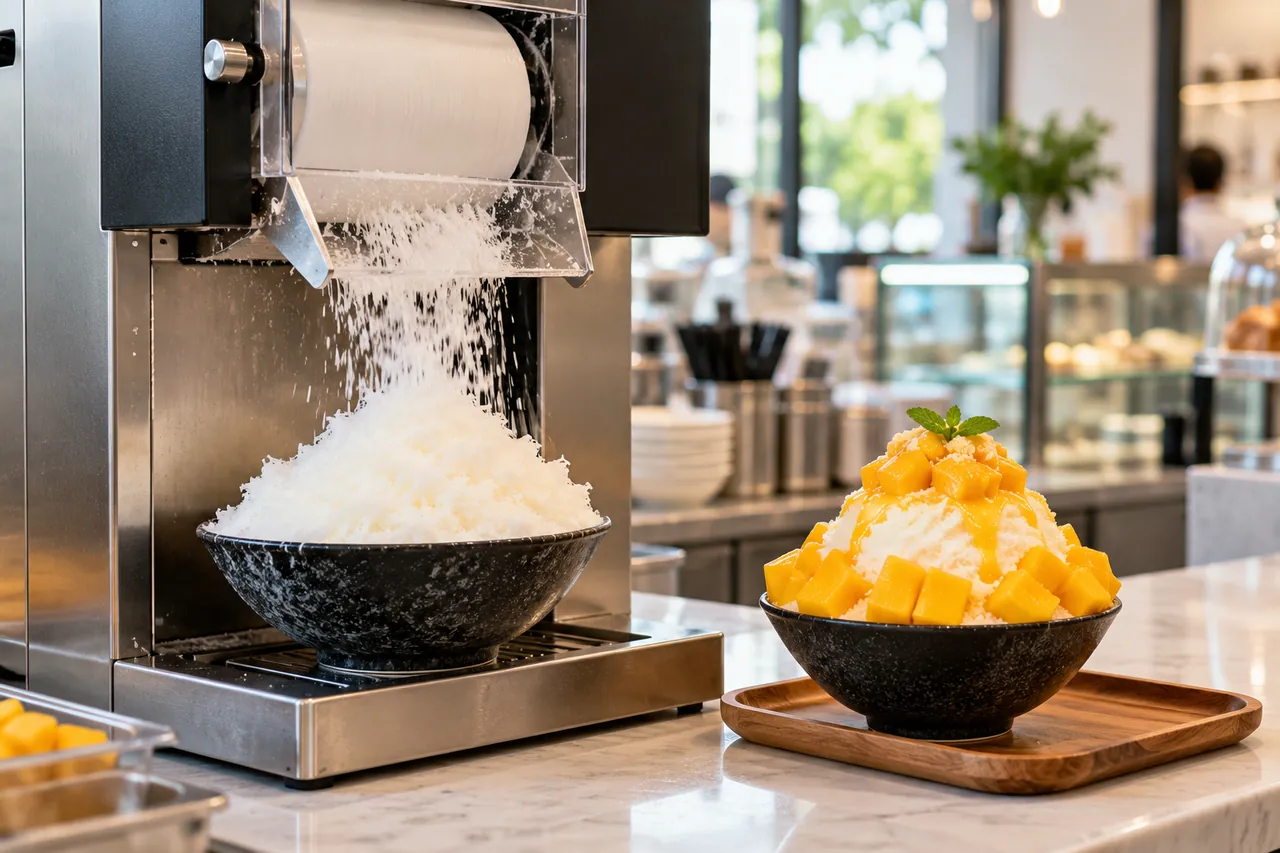
A snow flake ice making machine is a refrigerated dessert machine that freezes a flavoured liquid, usually sweetened milk, juice, tea or coffee, onto a very cold metal drum or plate and shaves it off in thin, soft ribbons that pile up like fresh snow. It makes the base for Korean bingsu, Taiwanese snow ice (xue hua bing) and similar desserts, on demand, one bowl at a time.
The key difference from an ordinary ice machine is the input. A cube or flake ice machine freezes plain water and makes hard ice for drinks or food display. A snow flake ice machine freezes a mix that already contains sugar, milk solids and flavour, so the result is creamy and melts on the tongue rather than crunching. That is why the trade also calls it a snow ice cream machine or a snow flake ice maker, and why it sits in the dessert section of a shop rather than behind the bar.
Commercial units are compact, counter-standing machines. Be There's snow ice (bingsu) machines, for example, make about 120–240 kg (265–530 lb) of snow ice per day on 220 V single-phase power, which covers a dessert café, a bubble tea shop adding a bingsu menu, or a busy kiosk.
How is snow ice different from shaved ice and bingsu?
Snow ice is frozen flavoured mix shaved into fine ribbons; shaved ice is plain water ice shaved from a block and flavoured afterwards with syrup; bingsu is the Korean dessert that can be built on either base. Modern café-style bingsu almost always uses milk snow ice, which is what a snow flake ice machine makes.
Buyers often compare these machines side by side, so here is how the common frozen-dessert ice textures line up. If you want plain shaved ice, snow cones or crushed ice, see our guide to crushed ice and shaved ice machines; for the full range of ice shapes see types of ice machines.
| Product | What is frozen | Machine | Texture | Flavour added |
|---|---|---|---|---|
| Snow ice / milk snow (bingsu base) | Sweetened milk, juice, tea or coffee mix | Snow flake ice making machine (refrigerated drum or plate) | Thin, soft, layered ribbons; creamy | Before freezing, in the mix |
| Hawaiian-style shave ice | Plain water block | Block ice shaver with blade | Fine, fluffy, absorbs syrup | After shaving, syrup poured on |
| Snow cone | Plain water cubes | Cube ice crusher | Coarse, crunchy granules | After crushing, syrup |
| Japanese kakigori | Clear water block | Hand-crank or electric block shaver | Very fine, airy shavings | After shaving, syrup and toppings |
| Italian ice | Fruit and sugar mix, stirred | Batch freezer | Smooth, scoopable, dense | In the mix |
The practical point for a business is that snow ice carries its flavour inside every flake, so a bowl tastes the same from top to bottom instead of leaving a pool of syrup at the bottom. It also means the mix recipe, not just the machine, controls quality.
How does a snow flake ice machine work?
A snow flake ice machine works by running a refrigeration circuit through a stainless steel drum or plate so that liquid mix touching its surface freezes in a thin film, which a blade then scrapes off as ribbons. The thinner the film and the colder the surface, the finer and softer the snow.
Inside the cabinet is a standard vapour-compression system: a hermetic compressor, an air-cooled or water-cooled condenser, an expansion device and the drum as the evaporator. A typical serving cycle looks like this:
- Pull-down. The machine is switched on 10–20 minutes before service so the drum reaches its working temperature, typically well below −20 °C (−4 °F).
- Mix feed. Chilled mix flows from a reservoir or is pumped onto the drum surface, where it freezes in a layer a fraction of a millimetre thick.
- Shaving. As the drum rotates, a fixed blade lifts the frozen film off in continuous ribbons that fall into the bowl held under the outlet.
- Control. The operator starts and stops output with a button or foot switch; speed and mix flow settings set how thick and dense the snow is.
- Rinse and defrost. At the end of service the drum is warmed, flushed with warm water and sanitised.
Because the snow is made on demand, there is nothing to hold in a freezer between orders. Snow ice does not store well anyway: once made, the ribbons fuse into a dense lump within minutes in a freezer, which is why shops shave each bowl to order.
Air-cooled or water-cooled?
Most snow ice machines are air-cooled and need 100–150 mm (4–6 in) of clear space at the vents. In a hot, enclosed kiosk above about 32 °C (90 °F), output falls and a water-cooled version keeps it stable at the cost of extra water use. The same trade-off applies to all ice equipment; see air-cooled vs water-cooled ice machines.
What can you put in a snow ice machine?
You can run almost any pourable, sweetened liquid through a snow ice machine as long as it has enough sugar and solids to freeze into soft ribbons rather than hard ice: milk mixes, fruit purée blends, matcha, black tea, coffee, chocolate and yoghurt-based mixes are all common. Plain water or unsweetened juice produces hard, crunchy flakes.
Sugar and solids lower the freezing point and break up the ice structure. Too little and the snow is icy and sharp; too much and the film will not release cleanly from the drum, giving wet, sticky snow. The table gives typical starting points that operators then tune to taste and to their machine.
| Mix base | Typical starting recipe (per 1 L of liquid) | Notes |
|---|---|---|
| Classic milk snow | Whole milk plus 100–150 g sugar or 150–250 g sweetened condensed milk | The standard bingsu base; ready-made milk snow powders are also sold |
| Fruit snow | 50–70% fruit purée or juice, rest milk or water, 80–140 g sugar | Acidic fruit can curdle milk; blend fruit into water-based mix or add last |
| Matcha or tea snow | Milk base plus 10–20 g matcha or strong brewed tea | Dissolve powder fully and strain to avoid clogging the feed |
| Coffee snow | Milk base plus 1–2 shots of espresso per 500 ml | Pairs with chocolate or caramel toppings |
| Dairy-free | Oat, soy or coconut drink plus 100–150 g sugar | Fat and protein content change texture; test small batches |
Food safety matters because a milk mix is a time and temperature control for safety (TCS) food. Use pasteurised milk, keep prepared mix at 5 °C (41 °F) or below in a refrigerator, and if the machine's reservoir is not refrigerated, pour in only what you will use in the next hour or two. The temperature danger zone guide explains the limits health inspectors apply under the FDA Food Code and similar rules.
How much snow ice does a snow flake ice maker produce?
A commercial snow ice machine typically produces 120–240 kg (265–530 lb) of snow ice in 24 hours, which works out to roughly 5–10 kg (11–22 lb) per hour of continuous running. Because shops serve in peaks, the hourly figure, not the daily figure, decides whether one machine is enough.
A café-size bowl of bingsu uses roughly 250–400 g (9–14 oz) of snow ice before toppings; a single-serve cup about 150–200 g. That gives the following realistic serving rates.
| Rated output per 24 h | Approx. output per hour | Large bowls per hour (350 g) | Small cups per hour (180 g) | Suits |
|---|---|---|---|---|
| 120 kg (265 lb) | 5 kg (11 lb) | about 14 | about 28 | Bubble tea shop or café adding a dessert line |
| 180 kg (400 lb) | 7.5 kg (16.5 lb) | about 21 | about 42 | Dedicated dessert café with 20–40 seats |
| 240 kg (530 lb) | 10 kg (22 lb) | about 28 | about 55 | Busy café, mall kiosk, food court |
Worked example: a dessert café expects 60 large bowls between 2 pm and 4 pm on a weekend. That is 30 bowls an hour, or about 10.5 kg (23 lb) of snow per hour. A 240 kg/day machine is at its limit; two 120–180 kg machines give the same output with a backup if one goes down for cleaning or service. As a rule of thumb, size for your busiest hour plus 20%, and plan a second machine once peak demand exceeds about 25 large bowls an hour.
Output ratings are stated at moderate room and mix temperatures. Warm mix, a hot room above about 32 °C (90 °F) or blocked condenser vents can cut real output by 15–25%, the same derating that applies to ice machines in our ice machine sizing guide.
How much does a snow ice cream machine cost?
A commercial snow ice cream machine price typically falls somewhere between about US$1,500 and US$6,000 ex-works for single-drum units of 120–240 kg per day, with locally distributed or premium-finish machines costing more. These are indicative ranges only; capacity, condenser type, voltage, certification and freight change the landed price.
When comparing quotes, look at the total cost of serving a bowl rather than the machine alone:
- Mix cost. Milk, sugar and flavour for 300 g of snow usually cost far less than the toppings (fruit, red bean, cheesecake cubes, cereal), which are where most of the food cost sits.
- Electricity. Most 120–240 kg/day units draw roughly 1–2.5 kW while running; check the nameplate and plan a dedicated circuit.
- Water. Only for cleaning on air-cooled units; water-cooled models also use condenser water continuously.
- Spares. Blades, seals and the feed pump are wear parts; ask for a spare blade and seal kit with the order.
- Certification. Markets such as the US and EU expect electrical safety and food-equipment marks (for example UL/ETL and NSF in North America, CE in Europe), which can affect which model you can legally sell or use.
If you are importing, get the voltage, refrigerant, certification and Incoterms written on the proforma invoice before you pay a deposit.
What does a snow ice machine need for installation and cleaning?
A snow ice machine needs a level, sturdy counter, a dedicated 220–240 V single-phase socket (or a step-up transformer in 110–120 V markets if the model is 220 V only), clear air flow around the condenser, and easy access to a sink for daily cleaning. Water-cooled models also need a water supply and drain.
Placement checklist
- Allow 100–150 mm (4–6 in) behind and beside the vents; never box the machine into a cupboard.
- Keep it away from fryers, ovens and direct sun, which raise condensing temperature and cut output.
- Put the mix refrigerator within arm's reach so mix is not left standing at room temperature.
- Plan the toppings rail next to the outlet; a refrigerated prep table with pans of fruit and sauces keeps assembly fast and cold.
Daily cleaning routine
- Switch off refrigeration and let the drum warm to room temperature.
- Drain remaining mix and discard it.
- Flush the reservoir, feed line and drum with warm water until it runs clear.
- Wash removable parts and the blade guard with food-safe detergent.
- Sanitise all food-contact surfaces with an approved sanitiser at the label concentration and air dry.
- Wipe the cabinet and clean the condenser filter weekly, or daily in greasy kitchens.
Milk residue is the main hygiene risk. Treat the machine like any dairy equipment: clean every day it is used, and log it the same way you log ice machine cleaning.
What are common snow ice machine problems?
Most snow ice machine problems come from the mix, air flow or a worn blade rather than from the refrigeration system. Check those first before calling a technician.
| Symptom | Likely cause | Fix |
|---|---|---|
| Hard, crunchy flakes | Too little sugar or solids; mix too thin | Raise sugar or condensed milk; use whole milk |
| Wet, sticky snow that will not form ribbons | Too much sugar; mix too warm; drum not fully pulled down | Reduce sugar; chill mix to 2–5 °C; allow full pre-cooling |
| Output falls in the afternoon | Hot room or blocked condenser filter | Clean filter, improve ventilation, consider water-cooled model |
| Snow comes off in chunks | Dull or misaligned blade | Adjust or replace blade per manual |
| Mix leaking at the drum | Worn seal or over-filled reservoir | Replace seal kit; fill to the marked level |
| Drum never gets cold enough | Refrigerant leak or compressor fault | Call a refrigeration technician |
How to choose a snow flake ice making machine
Choose a snow flake ice making machine by peak bowls per hour first, then power supply, cooling type, cleaning access and support. Use this checklist before you order:
- Peak demand: estimate your busiest hour in bowls, multiply by 0.35 kg (or your portion), add 20%, and compare with the machine's hourly output (daily rating ÷ 24).
- Number of machines: two smaller machines beat one large one if you cannot afford downtime or want two flavours running at once.
- Power: confirm voltage, frequency and plug type for your country; most units are 220–240 V, 50 or 60 Hz.
- Cooling: air-cooled for normal shops; water-cooled for hot, enclosed kiosks.
- Hygiene: stainless food-contact parts, tool-free removal of the reservoir and blade guard, and a clear cleaning procedure.
- Mix handling: refrigerated reservoir or a plan to keep mix at 5 °C (41 °F) or below.
- Certification and spares: the marks your market requires, plus spare blades and seals.
Snow ice usually sits inside a wider dessert menu, so plan it with the rest of the line-up; our ice cream shop equipment list and Italian ice and shaved ice business guide cover the other machines and freezers.
Be There supplies commercial snow ice and bingsu machines making about 120–240 kg of snow ice per day on 220 V single-phase power, alongside soft serve, batch freezer and popsicle machines, display freezers and glass door fridges for the mix and toppings. Tell us your expected bowls per hour, power supply and destination through the inquiry form and we will recommend a model and quote FOB, CIF or DDP.