
Ice machines are rated in kilograms per 24 hours, but the number on the label is measured in comfortable test conditions. Size the machine from your real demand and your real kitchen, and it will keep up on the busiest day of summer.
Step 1: estimate daily demand
| Business | Rule of thumb | Example |
|---|---|---|
| Restaurant | 1–1.5 kg per seat | 80 seats → 80–120 kg |
| Bar / lounge | 1.5–2 kg per seat | 60 seats → 90–120 kg |
| Hotel (guest floors) | about 2.5 kg per room | 120 rooms → 300 kg |
| Fast food | about 0.25 kg per drink served | 600 drinks → 150 kg |
| Seafood display | about 10 kg per metre of counter, changed daily | 6 m counter → 60 kg |
Add 20% for peaks, events and growth.
Step 2: correct for your climate
Manufacturers usually publish output at about 21 °C air and 10 °C water. In a 32 °C kitchen with 21 °C inlet water, many air-cooled machines produce 20–30% less. If the machine will stand in a hot back room, divide your demand by 0.75 before choosing a model.
Step 3: match storage to your peak
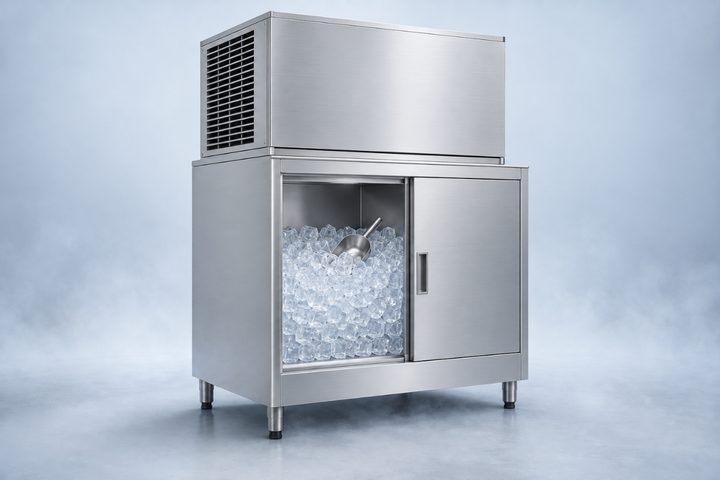
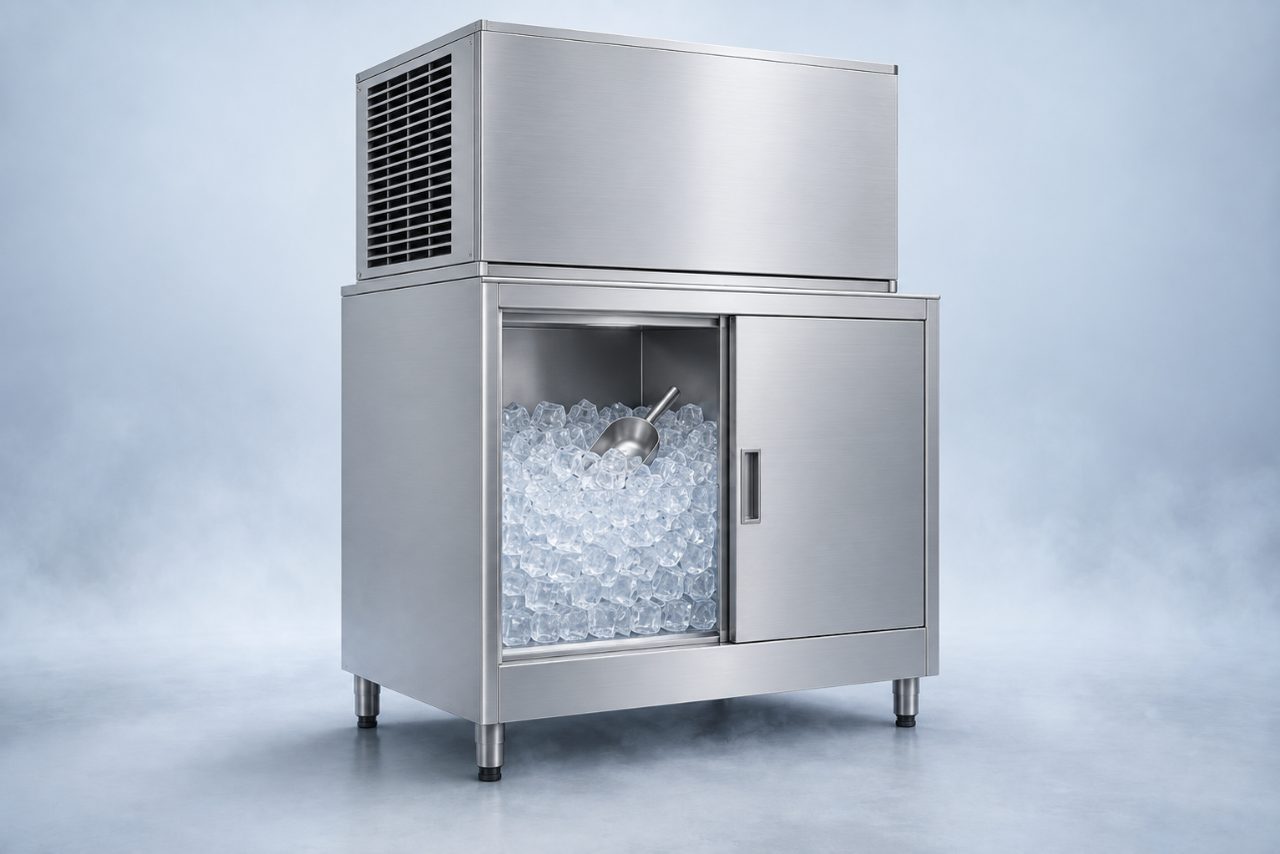
The machine makes ice continuously; the bin covers the rush. A good bin holds at least half of the daily demand, so ice made overnight is ready for lunch service. Modular heads sit on separate bins, which lets you choose bin size freely.
Step 4: choose the ice shape
| Ice type | Character | Best for |
|---|---|---|
| Cube (22 or 29 mm) | Hard, clear, slow melting | Bars, restaurants, hotels |
| Bullet / hollow | Fast to make, cools drinks quickly | Fast food, cafés |
| Crescent | Stacks well in cups, dispenses smoothly | Beverage dispensers |
| Nugget | Soft, chewable, absorbs flavour | Healthcare, smoothies, fast food |
| Flake (1.5–2.2 mm) | Moulds around product, no sharp edges | Seafood display, supermarkets, labs |
| Snow ice (bingsu) | Frozen milk or juice shaved into fluffy flakes | Dessert shops |
| Ball (45–60 mm) | Very slow melting, premium look | Cocktail and whisky bars |
Step 5: air or water cooling
Air-cooled machines are simpler to install and cheaper to run where water is expensive, but they push heat into the room and need 15–20 cm of clearance around the vents. Water-cooled machines keep output stable in hot, cramped rooms but use extra water. Large machines can use a remote condenser on the roof.
Installation checklist
- Fit a water filter. It gives clearer ice and less scale on the evaporator.
- Provide a floor drain within reach of the bin drain.
- Check the voltage: 110–115 V/60 Hz or 220–240 V/50 Hz, and whether the model needs three phase.
- Plan descaling every 6 months, more often with hard water.